A company can add locations faster than it can develop a shared understanding of how work should be done. Each new branch adapts the process to local conditions. Some adaptations are necessary. Others reflect habit, incomplete training, or a workaround that nobody revisits.
Eventually, central teams cannot tell whether a different result reflects a genuine business difference or a different interpretation of the process. Training becomes location-specific, reporting becomes difficult to compare, and technology changes require negotiations with every branch.
Standardization addresses this coordination problem. Its purpose is to make shared obligations, decisions, evidence, and interfaces dependable as the business grows. It should preserve justified local variation while making that variation explicit. For operations leaders, the important choice is which elements must be common and which may differ under defined conditions.
Standardize the contract between activities first
Identical task sequences are not always necessary. Two warehouses may use different equipment and layouts while producing the same reliable dispatch evidence. Two service teams may organize their day differently while meeting the same customer commitment.
Begin with the interfaces between activities: what must be true when work arrives, what outcome must be produced, what evidence accompanies it, and who resolves an exception. These shared boundaries let teams coordinate even when their internal methods differ.
Then identify decisions whose meaning must remain consistent. “Ready to dispatch,” “approved supplier,” or “complete installation” should not mean materially different things across sites if downstream teams rely on the same status.
ISO’s guidance on the process approach in ISO 9001:2015 describes interrelated activities and checks that deliver intended results, with planning and controls appropriate to context. This supports treating processes as an integrated system rather than insisting on identical local activity for its own sake. ISO, The process approach.
Distinguish three kinds of variation
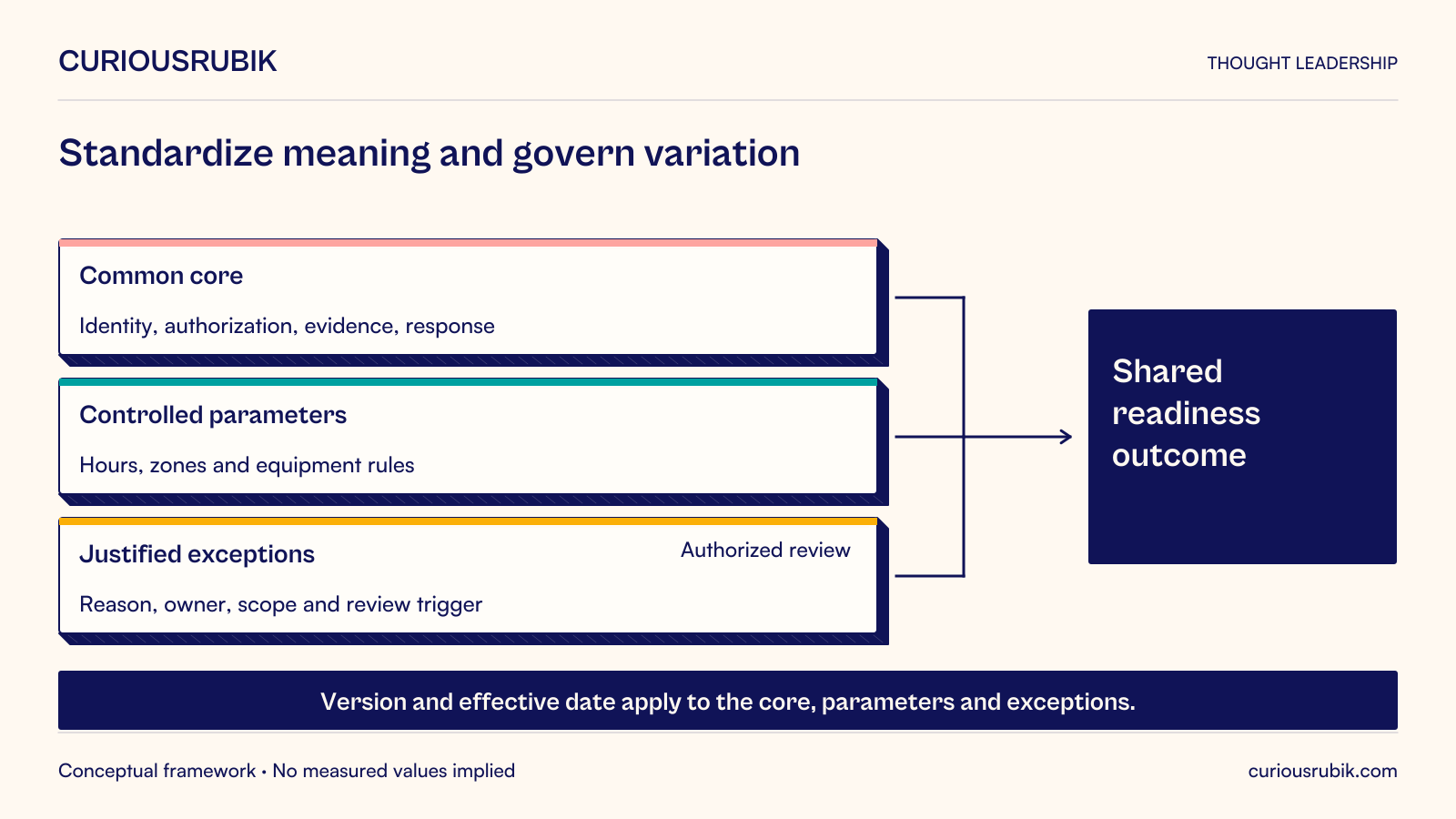
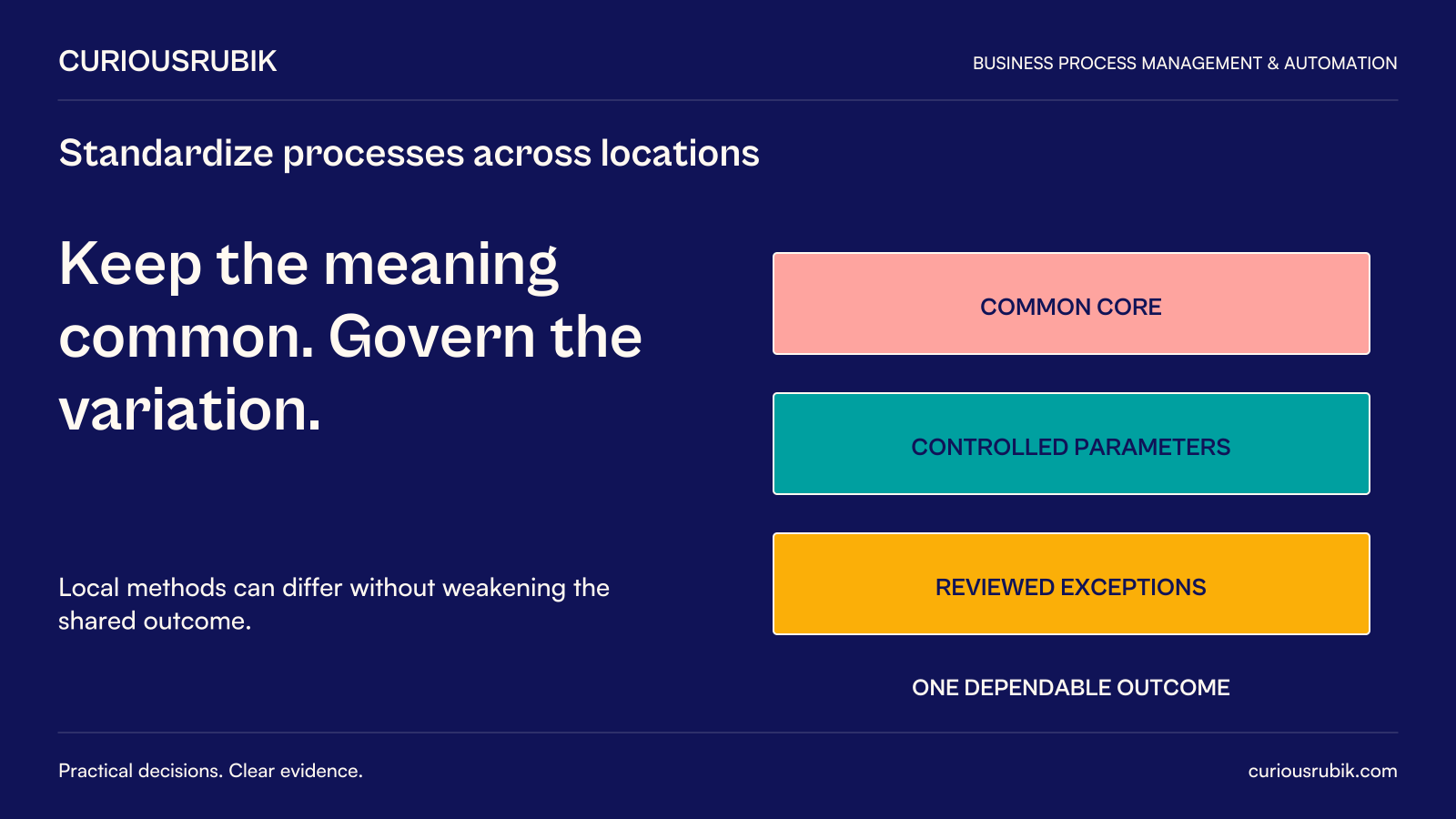
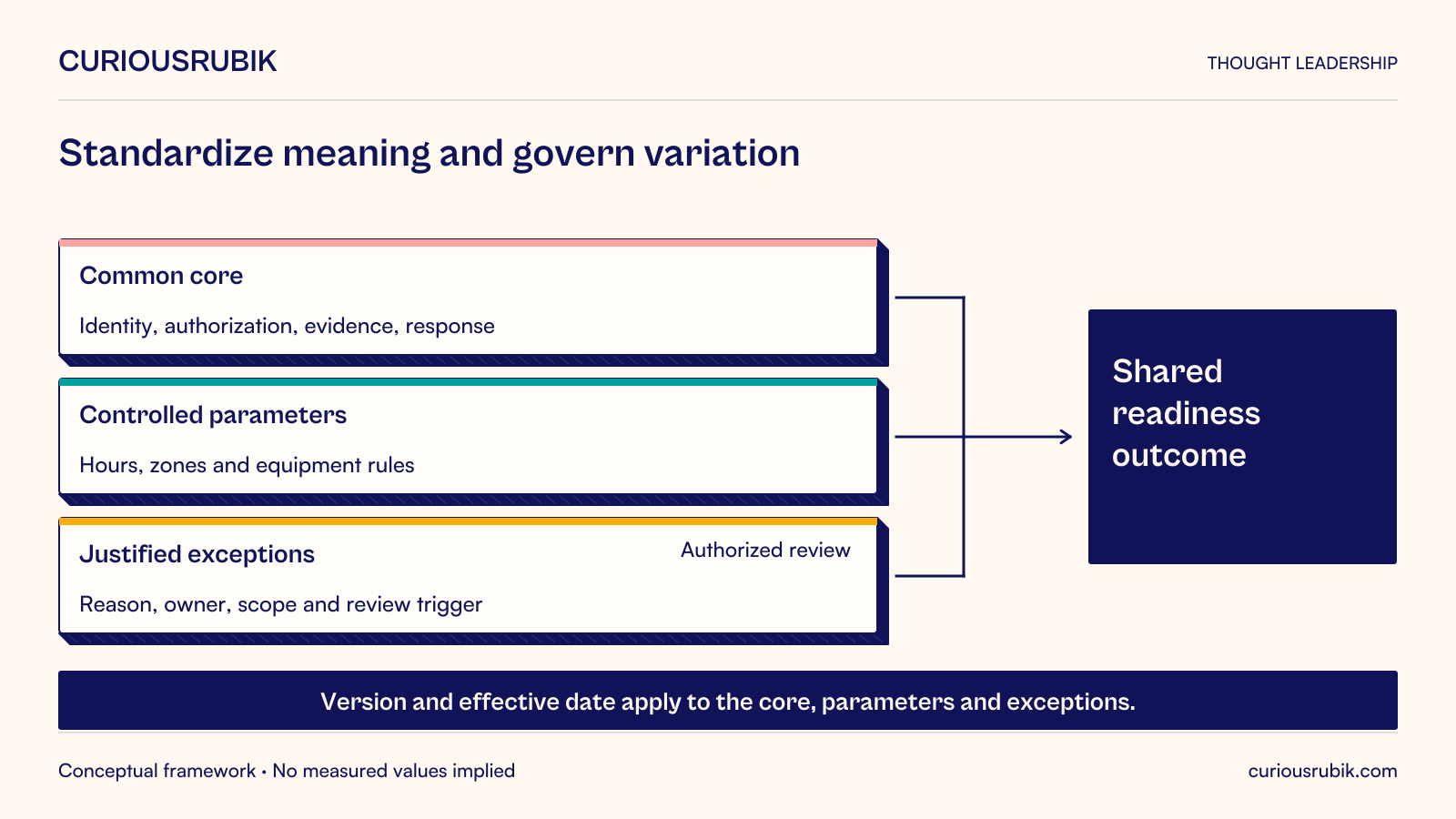
A useful working heuristic separates a common core, controlled parameters, and justified exceptions. It is an author-proposed design method, not an ISO classification.
The common core contains definitions and obligations that should remain consistent. Examples include transaction identity, required authorization, evidence of completion, and the response to a failed control.
Controlled parameters represent known differences within the shared design. A branch may have different operating hours, delivery zones, or approved capacity limits. The values can vary while their meaning, owner, and update process remain common.
Justified exceptions cover cases that cannot be represented responsibly by the current core or parameters. They need a reason, authorized owner, scope, and review trigger. An exception should not silently become a new local standard simply because it is used repeatedly.
This classification gives variation a place without allowing unlimited divergence. It also prevents every local preference from being described as a strategic requirement.
An equipment-rental business defines readiness across branches
Consider a hypothetical equipment-rental company with several branches. Each branch has a different procedure for releasing equipment to a customer. One uses a paper checklist, another records inspection in a maintenance system, and a third relies on a supervisor’s verbal confirmation.
The central team initially proposes one identical checklist and approval sequence. Branch managers object because equipment types, operating hours, and delivery arrangements differ. The debate becomes a choice between total uniformity and local autonomy.
The redesign starts with a shared readiness definition. Before equipment is released, its identity, reservation, required inspection evidence, known restrictions, and authorized release status must be established. The precise inspection requirements remain with qualified operational and safety owners; the process design does not invent them.
Equipment-specific checks become controlled variants within the common record. Delivery cutoffs and local contact details are parameters. A case involving unavailable evidence follows a defined hold-and-resolution route rather than a branch manager improvising a new status.
The branch with a maintenance system can supply approved evidence through integration. The branch using paper needs a controlled way to capture and reference the same essential facts. The company may later standardize the tools, but it can first establish a reliable operational boundary.
The pilot tests an ordinary rental, a substituted unit, a late return affecting the next reservation, and an inspection record that cannot be retrieved. Central dispatch must interpret readiness consistently across branches without needing to know each branch’s internal routine.
The test also checks local burden. If the common record requires information a branch cannot obtain at the required time, the team must repair the design or the dependency. Requiring a field does not make the evidence exist. This hypothetical example illustrates controlled variation; it claims no measured reduction in incidents or operating cost.
Build the standard from evidence and purpose
Do not choose a “best” branch merely because its manager is influential or its documentation is most polished. Compare actual outcomes and the conditions under which they were achieved.
Observe several variants. Identify which differences affect quality, time, cost, customer experience, or control. Ask what would happen if each difference were removed. Some may have no useful purpose; others may protect an obligation that is not obvious to a central team.
Draft the common process with the people who perform and receive the work. Include the definitions, decision rules, necessary evidence, and exception route. Keep detailed local instructions where they genuinely differ, linked to the common structure.
Use a recognized modeling notation where it improves precision. BPMN provides a standard notation for business processes, but a correctly drawn diagram does not establish that the process is commercially sound or operationally feasible. Validate the work with the people who must perform it. OMG, BPMN 2.0.2.
Give deviations a governance path
A standard without a deviation route encourages hidden workarounds. A deviation route without boundaries turns the standard into a suggestion.
Require a request to explain the need, affected cases, risk, expected benefit, and why existing parameters are insufficient. Assign an owner who can evaluate the cross-process consequences. A local change may affect billing, reporting, customer communication, or support beyond the requesting team.
Set review triggers that match the reason for the exception. A temporary supplier issue may end when normal service resumes. A new equipment category may require incorporation into the standard after the design is tested. A permanent local regulatory requirement may justify a maintained variant, subject to specialist review.
Record which standard version applies. Without version control, a site can appear noncompliant when it is following an older approved process. Make effective dates and transition arrangements clear, especially when training and system configuration cannot change simultaneously.
Standardization changes training and support economics
A shared process can reduce the number of concepts a new employee must learn and make it easier for one team to cover another. Those benefits depend on the standard being understandable and reflected in the tools.
Train people on decisions and exceptions, not only the normal sequence. A person who knows which button to press but cannot recognize missing evidence may complete the workflow incorrectly with confidence.
Create scenario-based checks for role readiness. In the rental example, a release coordinator should know what to do when a substituted unit has different inspection evidence or when the system is unavailable. The response should be consistent enough that support can help without first rediscovering local policy.
Support teams need a searchable account of approved variants. If every unusual case requires a phone call to the local expert, the organization has documented variation without making it operationally manageable.
Use common measures without erasing context
Standard definitions make performance comparisons more useful, but comparisons still need context. A branch handling complex equipment or remote deliveries may have different cycle times for legitimate reasons.
Measure compliance with the shared outcome and evidence separately from local speed. Track rejected downstream work, missing evidence, repeated deviations, and cases requiring interpretation. Segment results by relevant work type rather than ranking unlike operations in one league table.
Watch for proxy behavior. If the target is a completed checklist, employees may complete it without ensuring readiness. If the target is fewer exceptions, they may relabel unusual cases as normal. Sample outcomes and investigate unexpected changes.
The standard should make improvement easier. When one branch discovers a better method, evaluate whether it should become a common practice, a controlled variant, or a local option. Standardization that prevents learning eventually protects obsolete work.
Avoid premature standardization
A new business model may still be exploring what works. Freezing a detailed process too early can impose assumptions before the organization has evidence.
In that situation, standardize the minimum necessary boundaries: customer commitments, safety and control obligations, identifiers, measurement, and escalation. Allow experimentation inside those boundaries, with clear ownership and a way to compare results.
Acquisitions require similar judgment. Forcing a newly acquired business into the existing template can destroy useful capabilities if its economics or obligations differ materially. Conversely, accepting every inherited practice indefinitely prevents integration. Use evidence to identify which differences earn their ongoing cost.
Small organizations should avoid excessive documentation. A short, clear process with a few controlled parameters may be enough. The design should fit the cost of inconsistency and the complexity of the work.
What leaders should approve
Before approving a standardization program, ask for a precise definition of the common core, the permitted parameters, and the route for justified exceptions. Require evidence that the proposed design works across representative locations and work types.
Ask technology partners how the system will represent variants, versions, effective dates, and exceptions. A configuration that requires custom code for every local value can make a sensible operating standard expensive to maintain.
Scaling depends on being able to trust work produced outside one’s immediate team. Standardization earns its value when that trust rests on shared meaning and reliable evidence, while legitimate differences remain visible and governed. Uniformity is useful only to the extent that it supports that result.