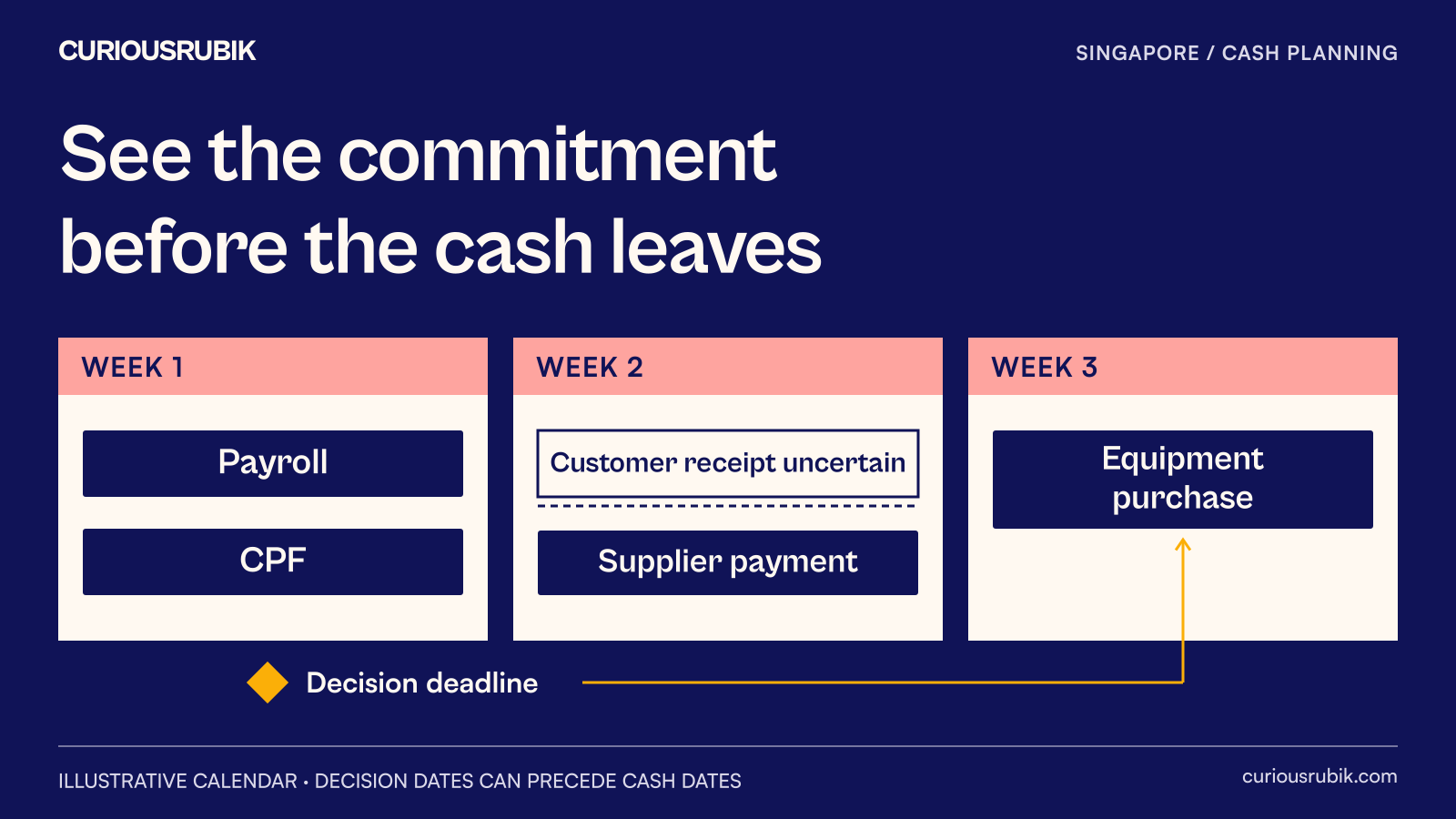
A forecast can show a comfortable closing balance while hiding the decision that will make next week's balance uncomfortable. The missing information is often the date on which a purchase, contract or delivery commitment becomes difficult to change.
For a Singapore owner, a useful weekly forecast needs both a cash date and a decision date. The first shows when money is expected to move. The second shows how long management has to act, with whom, and within what constraints. A thirteen-week view is a practical planning choice, not a guarantee that every liquidity risk will be visible.
Put an owner behind every important assumption
Imagine a hypothetical business expecting S$50,000 from a customer in week two. The invoice is due, so the forecast includes the receipt. Sales is aware of a delivery dispute but has not told finance. Meanwhile, payroll, CPF and supplier commitments have already entered the same week's schedule.
The problem is not that finance needs a more elaborate formula. The forecast lacks an owner who is accountable for the receipt assumption and evidence that it remains realistic.
A useful receipt record distinguishes a contractual due date from an expected collection date. Add the latest customer confirmation, dispute status, amount considered at risk and the person responsible for the next action. Avoid converting “we normally get paid on time” into a confirmed receipt.
For outflows, separate obligations already incurred from purchases management is still considering. An approved purchase request may remain cancellable; a confirmed order may not. Operations should state the contractual or practical constraint rather than letting finance infer it from an approval label.
Build the worksheet around commitments
Use thirteen weekly columns, but keep the supporting records detailed enough to explain each material movement. The core fields are:
- Item, counterparty and company entity
- Receipt or payment amount and currency
- Contractual due date and expected cash date
- Evidence date and source owner
- Receipt confidence, with a plain explanation
- Commitment status and any cancellation or change conditions
- Latest date for a management decision
- Proposed action, approver and resulting cash effect
A confidence field works best when its meaning is explicit. “Customer confirmed” should point to a recent confirmation for an identified invoice. “Disputed” should show the unresolved issue. Do not use percentage probabilities simply to make uncertain receipts appear precise.
Give each week's forecast a version date and retain the preceding version. Changes become much easier to discuss when the meeting can see that a receipt moved two weeks or an unplanned payment appeared. Replacing last week's forecast removes the evidence needed to learn from the change.
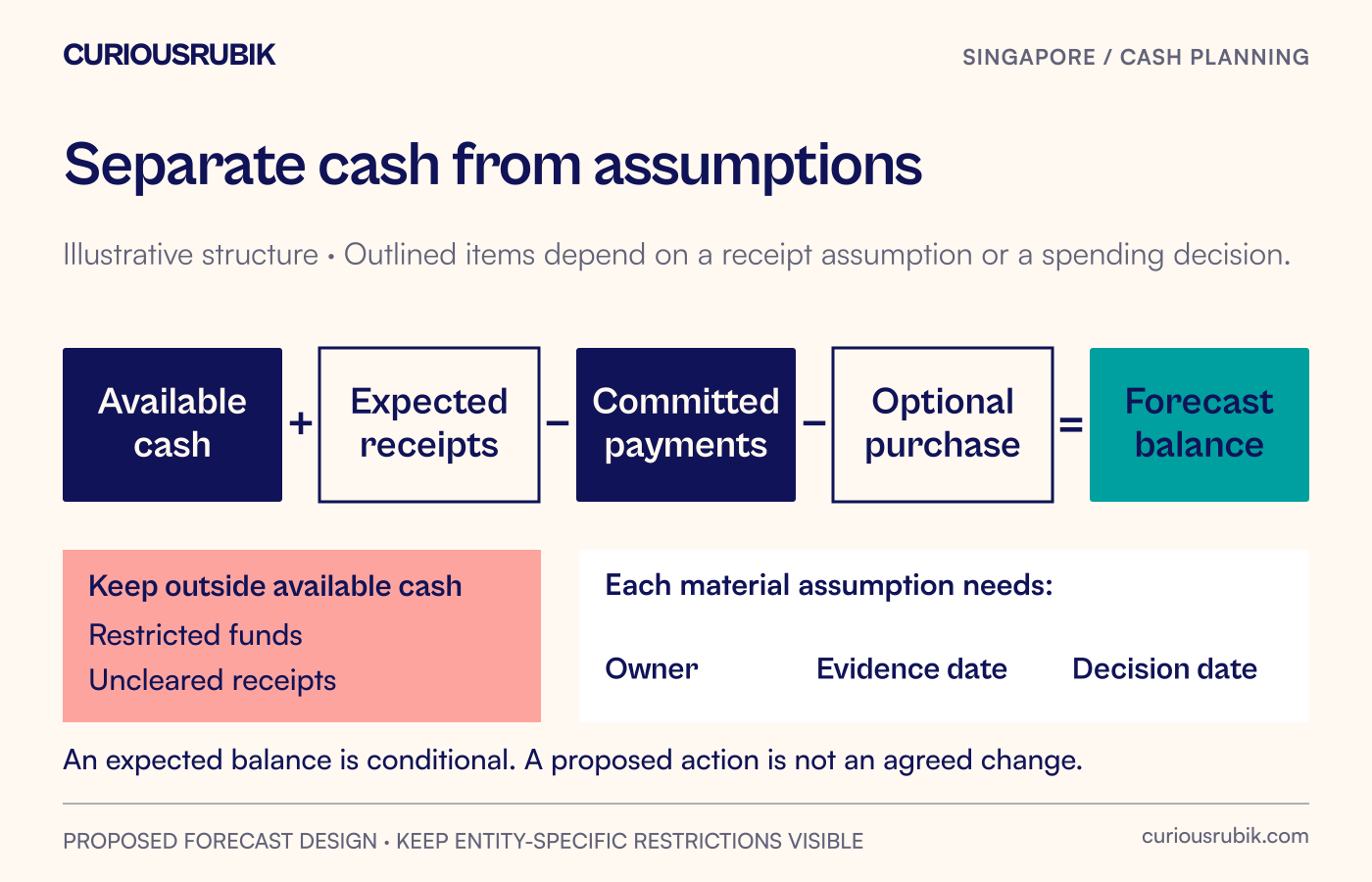
Start the cash bridge with funds actually available for the entity's use. Show restricted balances, uncleared receipts and proposed financing separately rather than quietly treating them as available cash. Where the business has several entities, an apparent group surplus does not establish that funds can freely move to the entity with the obligation.
Read the diagram text
CURIOUSRUBIK SINGAPORE / CASH PLANNING Separate cash from assumptions Illustrative structure · Outlined items depend on a receipt assumption or a spending decision. Available cash + Expected receipts − Committed payments − Optional purchase = Forecast balance Keep outside available cash Restricted funds Uncleared receipts Each material assumption needs: Owner Evidence date Decision date An expected balance is conditional. A proposed action is not an agreed change. PROPOSED FORECAST DESIGN · KEEP ENTITY-SPECIFIC RESTRICTIONS VISIBLE curiousrubik.com
Use a delayed receipt to test the forecast
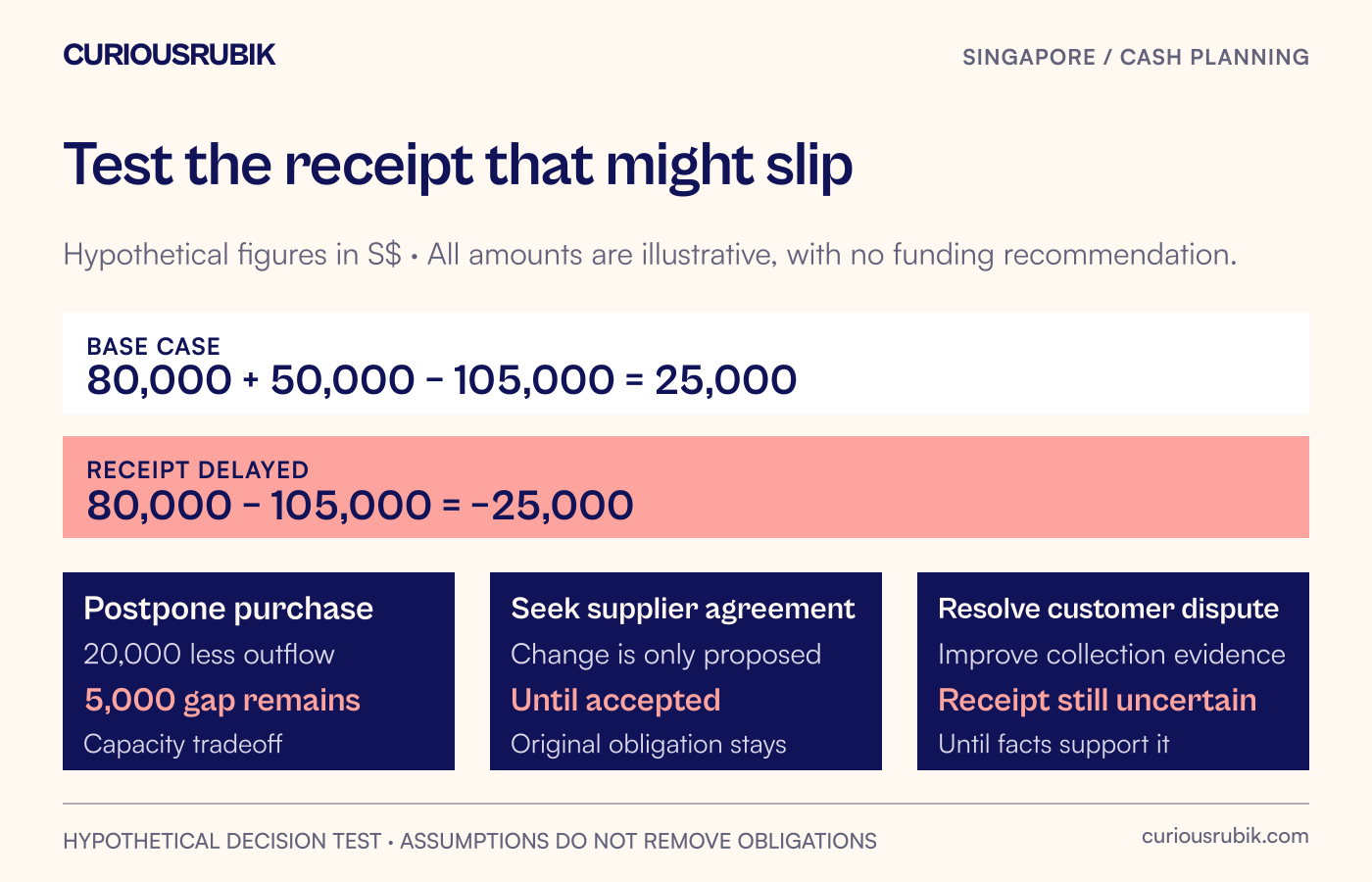
Suppose the hypothetical business starts week two with S$80,000 of available cash. It expects the S$50,000 customer receipt and has S$105,000 of scheduled outflows. The base case ends at S$25,000. If that receipt does not arrive, the same week ends at negative S$25,000 before any management action.
These are illustrative planning figures. The arithmetic is simple; the operating question is whether the team discovers the exposure while choices remain available.
One option might be to postpone an uncommitted S$20,000 equipment purchase. That improves the delayed-receipt case, but still leaves a S$5,000 shortfall. It may also delay capacity needed for a customer order. Record both effects rather than presenting the cash benefit alone.
A second option could be to seek a revised payment arrangement with a supplier. This remains a proposal until the authorised parties agree. The forecast should retain the original obligation and separately show the proposed outcome. Moving the payment date in a cell does not change the agreement.
A third route is to resolve the customer's dispute promptly and obtain a credible collection update. It may be the best commercial action, but it does not justify marking the receipt certain before the dispute is resolved. Keep the downside case visible while the work continues.
If none of the available actions closes the gap, management needs an early escalation with qualified finance advice. A forecast should expose that result. It should not force the balance positive by assuming additional receipts, delayed statutory payments or funding that has not been secured.
Read the diagram text
CURIOUSRUBIK SINGAPORE / CASH PLANNING Test the receipt that might slip Hypothetical figures in S$ · All amounts are illustrative, with no funding recommendation. BASE CASE 80,000 + 50,000 − 105,000 = 25,000 RECEIPT DELAYED 80,000 − 105,000 = −25,000 Postpone purchase 20,000 less outflow 5,000 gap remains Capacity tradeoff Seek supplier agreement Change is only proposed Until accepted Original obligation stays Resolve customer dispute Improve collection evidence Receipt still uncertain Until facts support it HYPOTHETICAL DECISION TEST · ASSUMPTIONS DO NOT REMOVE OBLIGATIONS curiousrubik.com
Give Singapore obligations their correct dates
Payroll and statutory obligations should come from maintained calendars and current facts. They should not be used as balancing items when another assumption deteriorates.
For employees covered by the Employment Act, MOM states that salary must generally be paid at least monthly and within seven days after the salary period; overtime has a fourteen-day timeframe. Final-pay situations need separate handling. CPF Board identifies the last day of the calendar month as the contribution due date. Its later enforcement window should not be relabelled as that due date.
Build practical preparation and payment lead times around the applicable obligations. The internal date for completing payroll checks or arranging payment may be earlier than a legal deadline. Show both where useful, with an owner responsible for changes in employee circumstances or the payment calendar.
Keep tax filing events separate from cash-payment events. For example, an ECI filing obligation is not itself a single universal payment date. Finance should use the company's actual assessment and approved payment arrangements, alongside relevant filing requirements, when building the cash schedule. Check entity-specific conditions rather than copying dates from another company's forecast.
Make the weekly meeting a decision meeting
A short meeting can work if participants prepare the changed assumptions beforehand. Finance brings the bridge from the previous forecast. Sales owners bring updates on material receipts. Operations identifies purchases about to become binding. Management decides the actions that fall within its authority.
Work through the earliest decision deadlines first. A moderate outflow that becomes non-cancellable tomorrow may deserve attention before a larger payment that can still be negotiated next month. The forecast's value lies partly in changing the order of the conversation.
For each action, record who must do what and by when. If the finance lead is asked to “manage cash”, responsibility remains vague. “Operations director to confirm whether the equipment order can be postponed before acceptance on Thursday” is an actionable instruction with a testable result.
Close the loop at the next meeting. An unanswered action should remain visible with its original deadline and consequence. Do not allow the forecast refresh to wipe away the missed decision.
Automate the refresh without rewriting the facts
Automation can bring in due invoices, approved payroll totals and purchase commitments, then highlight changes. It can flag a receipt that has slipped repeatedly or a major outflow with no owner. Those are useful preparation tasks.
Retain human approval for changing a material receipt assumption, moving a contractual payment or deciding how to respond to a shortfall. Show the source timestamp for every imported category. If an input fails, carry a visible warning and the last verified value rather than presenting an incomplete forecast as current.
Also prevent double counting. An equipment order may move from the commitment list to accounts payable when the invoice arrives. The record should change status, not become two outflows. Similarly, a customer receipt in the bank should resolve the expected collection rather than being added again alongside it.
Learn from the week that actually happened
After each week, compare forecast with actual cash movement by cause: timing difference, missing item, incorrect amount or an assumption that proved unrealistic. A timing error on a large customer receipt tells a different story from a payroll amount error.
Track unplanned outflows, repeated receipt slippage and the proportion of shortfalls escalated before the relevant decisions became binding. Use these measures to improve ownership and evidence, rather than punishing people for reporting uncertainty honestly.
For the next weekly review, add just one field to each material outflow: “What is the last date we can change this, and on whose authority?” The answer often makes an existing forecast more useful before any new automation is introduced.