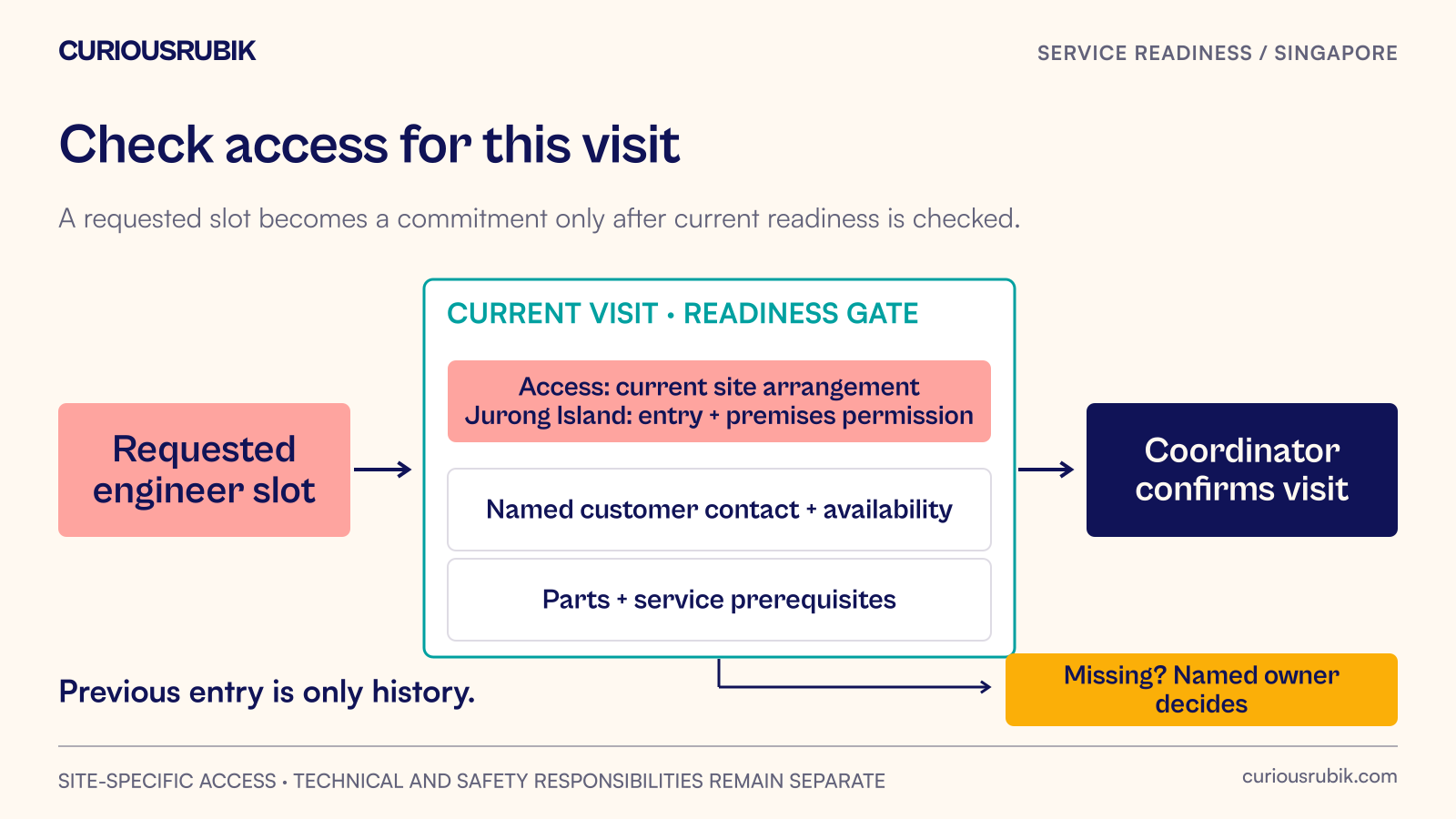
The engineer visited the customer several months ago, so the coordinator books another call-out. On the morning of the visit, nobody has checked whether the access arrangement is still active. The customer expects the work, the engineer has the right skills, and the trip can still fail at the entrance.
A useful service schedule distinguishes a requested slot from a visit that is ready to dispatch. The coordinator needs current confirmation of the prerequisites, an owner for anything missing and a latest decision point before a tentative slot becomes a firm commitment.
Jurong Island makes the current-status question concrete
JTC limits entry to Jurong Island to staff and visitors with a valid Jurong Island Pass obtained through sponsorship. Its guidance also explains inactivity-based deactivation: more than 30 days without recorded entry for foreigners using FIN or passport numbers, and more than 90 days for Singaporeans and permanent residents. A sponsor handles the reactivation request before the next entry.
These are site-specific requirements, not a general rule for every Singapore workplace. Their operating lesson is that a past visit does not establish current access. Even a pass with an apparently future expiry date may require a current-status check.
JTC also says not to use screenshots of a digital pass or dynamic QR code for clearance. The scheduling process should therefore record a necessary status confirmation, its source and check time, rather than collect screenshots or security tokens as convenient booking evidence.
Permission to enter Jurong Island does not itself establish permission to enter a particular customer's premises. JTC states that access to any premises requires authorisation or permission. Confirm that separate site arrangement as well.
For other sites, establish the actual access arrangements with the responsible customer or site contact. Do not copy Jurong Island's rules into a universal service template.
Work backwards from the moment the booking becomes costly to change
The relevant decision point may be when the customer confirms downtime, when a specialist is assigned, when parts leave the store or when the engineer departs. Identify it for the service in question.
A coordinator can hold a tentative slot while information is being obtained. The customer communication should make that status clear. “Requested for Tuesday, subject to current access confirmation” is a different commitment from “the engineer will attend Tuesday”. Use the wording your commercial policy permits and avoid promises the service team has not accepted.
Set an internal readiness review early enough to resolve missing prerequisites. Its timing is an operating choice based on the site and service, not a universal legal deadline. If the condition cannot be confirmed in time, escalate to the person who can agree the next feasible step with the customer.
Do not use an arbitrary countdown to turn an unresolved status green. A request that has received no reply is still unconfirmed, even when the diary slot is approaching.
Three bookings can need three different decisions
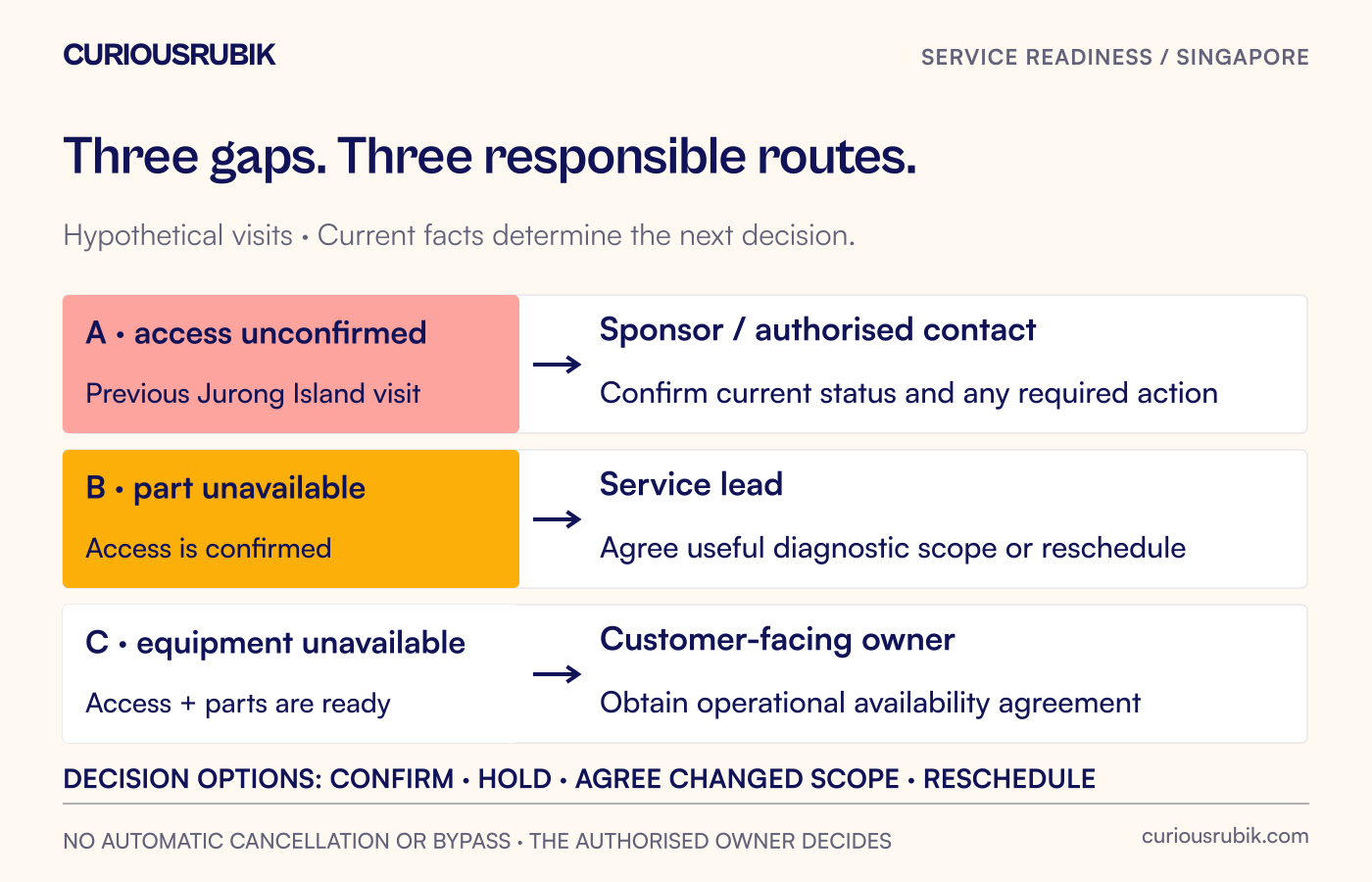
Consider three hypothetical service visits.
Visit A: the engineer attended Jurong Island previously, but current access is unconfirmed. The service coordinator asks the appropriate sponsor or authorised contact to confirm the status and any necessary action. The old visit record remains useful history, but the booking does not pass the access gate on that basis alone.
Visit B: access is confirmed, but the replacement part is not available. The service lead decides whether a diagnostic visit has a useful, agreed purpose without the part. If so, the scope and customer expectation are changed through the authorised process. If not, the coordinator seeks a feasible replacement slot. Access readiness cannot compensate for an unready service scope.
Visit C: access and parts are ready, but the customer cannot confirm that the equipment will be available. The account owner obtains the required operational agreement. A calendar invitation accepted by a receptionist may not establish that the person responsible for the equipment has agreed to the work.
The correct outcome is not always “cancel”. It might be confirm, hold provisionally, revise the scope with agreement or reschedule. The responsible person must make that decision from the evidence. The scheduling system should not infer it from whichever field was updated last.
Read the diagram text
CURIOUSRUBIK SERVICE READINESS / SINGAPORE Three gaps. Three responsible routes. Hypothetical visits · Current facts determine the next decision. A · access unconfirmed Previous Jurong Island visit Sponsor / authorised contact Confirm current status and any required action B · part unavailable Access is confirmed Service lead Agree useful diagnostic scope or reschedule C · equipment unavailable Access + parts are ready Customer-facing owner Obtain operational availability agreement DECISION OPTIONS: CONFIRM · HOLD · AGREE CHANGED SCOPE · RESCHEDULE NO AUTOMATIC CANCELLATION OR BYPASS · THE AUTHORISED OWNER DECIDES curiousrubik.com
Keep the readiness card small enough to maintain
The coordinator's card can focus on the information needed to release the visit:
| Item | What the coordinator needs | Who resolves a gap |
|---|---|---|
| Site and service scope | Correct location and agreed purpose | Account owner and service lead |
| Current access | Appropriate status confirmation for the assigned person | Sponsor or authorised site contact |
| Customer readiness | Named operational contact and agreed availability | Customer-facing owner |
| Parts and prerequisites | Confirmed resources and necessary preparation | Service lead and stores owner |
| Decision point | Latest readiness review and current booking status | Service coordinator |
Use a reference to controlled evidence where necessary. Keep identity documents, biometrics and access credentials out of the general scheduling queue. The people administering an official access application may need information the wider dispatch team does not.
A confirmed status should show when it was checked and which visit or person it covers. Confirmation for one engineer is not transferable to a substitute. Confirmation for one site is not proof of access to another facility in the same customer group.
A personnel change should reopen the relevant checks
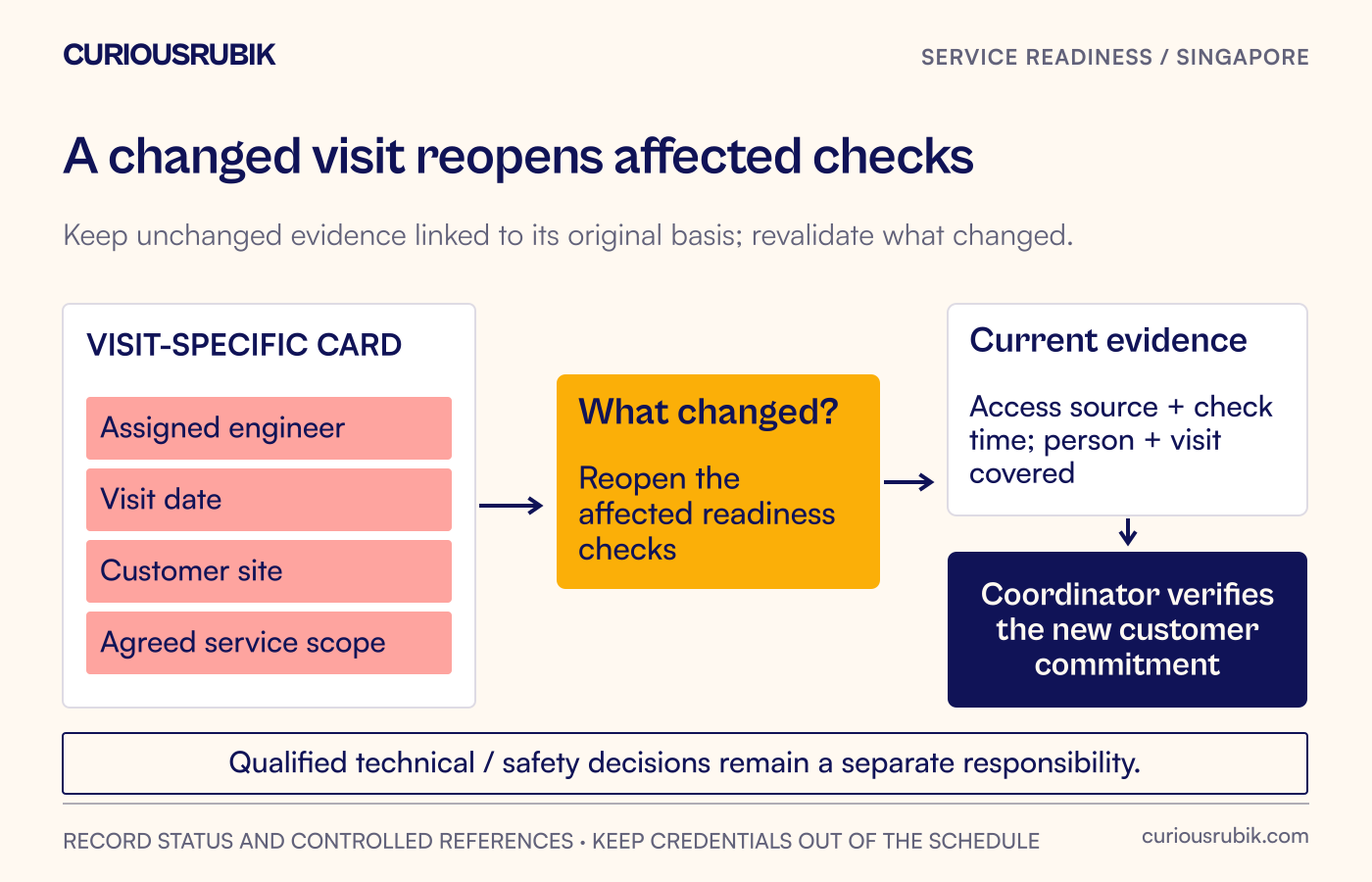
An engineer becomes unavailable and a colleague takes the visit. Skills may be equivalent, but access and site induction conditions may differ. The coordinator should reopen the affected readiness checks rather than preserve every green status from the original assignment.
The same applies to a changed date, location or scope. Decide which evidence remains valid and which needs reconfirmation. A date move might affect the customer's shutdown window or the availability of an escort. A scope change might require different technical preparation.
The change record should identify what changed, who confirmed it and whether the customer commitment was updated. Otherwise, the internal schedule and the customer's expectation can diverge while both appear current.
Read the diagram text
CURIOUSRUBIK SERVICE READINESS / SINGAPORE A changed visit reopens affected checks Keep unchanged evidence linked to its original basis; revalidate what changed. VISIT-SPECIFIC CARD Assigned engineer Visit date Customer site Agreed service scope What changed? Reopen the affected readiness checks Current evidence Access source + check time; person + visit covered Coordinator verifies the new customer commitment Qualified technical / safety decisions remain a separate responsibility. RECORD STATUS AND CONTROLLED REFERENCES · KEEP CREDENTIALS OUT OF THE SCHEDULE curiousrubik.com
Access permission does not certify that the work is safe
A valid entry arrangement and a complete scheduling card do not establish technical or safety readiness for the work. The qualified service and site owners must retain their separate responsibilities for the task, applicable permits, competence and safe working arrangements.
The coordinator should know when those owners have to decide, without pretending to replace their judgment. If a safety prerequisite is unresolved, urgency from the customer does not turn it into a scheduling exception that an administrator can waive.
Similarly, an access rejection or uncertainty should follow the official sponsor or site route. Do not propose borrowing another person's pass, reusing a clearance image or finding a way around the entrance control. A reliable schedule respects the condition it depends on.
Automate the reminders around current evidence
Automation can request confirmation, flag ageing status information and prevent a tentative booking from being described as confirmed before the agreed checks are complete. It can alert the coordinator when a relevant assignment or date changes.
The evidence still needs to mean what the workflow says it means. An email sent to the sponsor is not a sponsor confirmation. A submitted access request is not approval. A successful previous visit is not a current status result.
Review visits that were rescheduled late or failed before work could begin. Separate access problems from parts, customer readiness and technical issues. This helps the business choose the right repair instead of adding the same broad “confirm everything” reminder to every booking.
For the next repeat visit, ask one question before promising the slot: what current fact shows that this engineer can enter this site and perform the agreed visit on that date? If the answer is only “they went last time”, the coordinator still has a useful check to make.