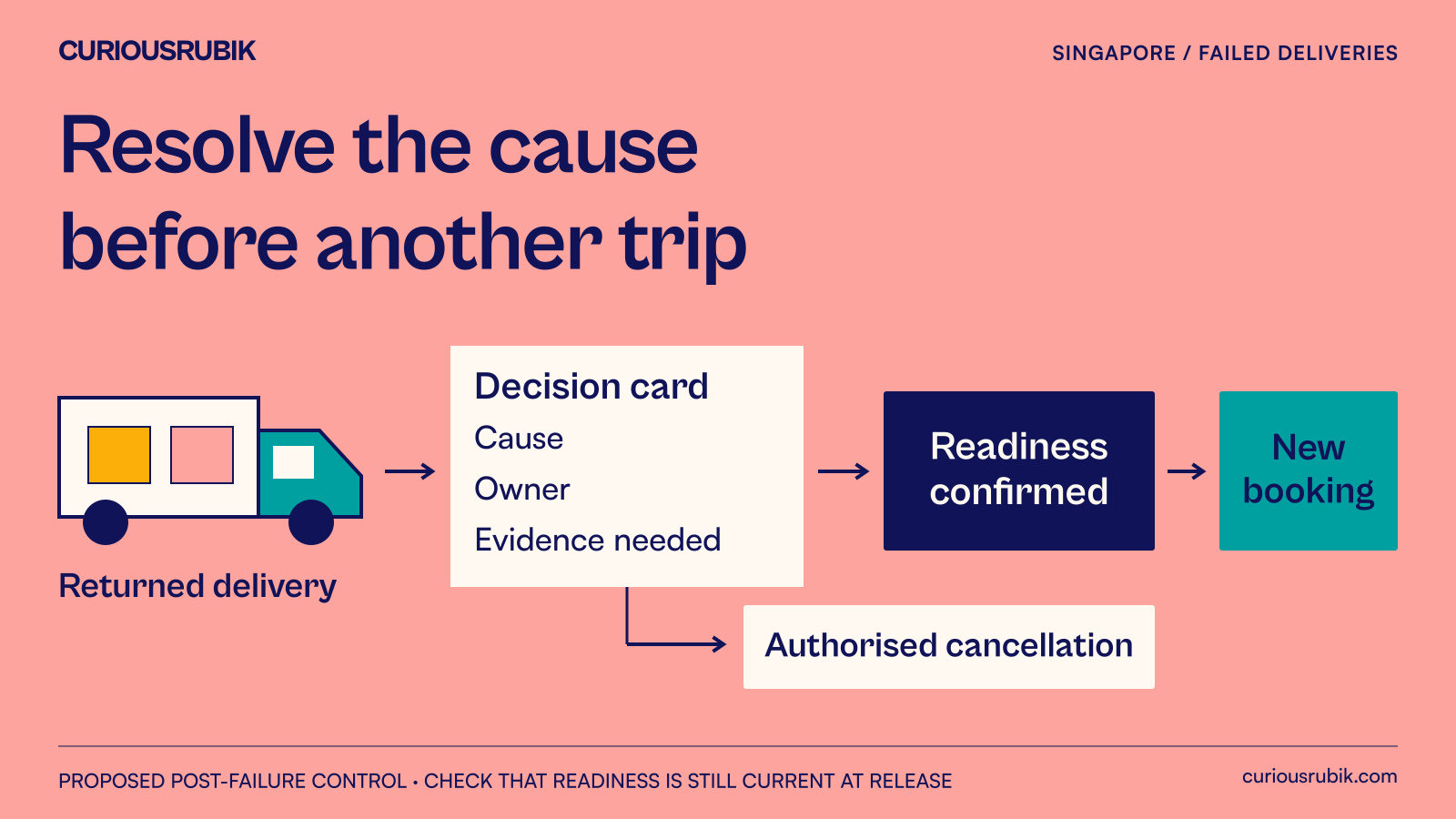
A driver returns with goods after reaching the correct building. The receiving desk was closed, the customer contact was unavailable and the delivery reference did not match the site's booking. The order is moved to tomorrow's route without any of those conditions changing.
A second attempt may reproduce the first failure. Before choosing another slot, the delivery coordinator needs a specific cause, an owner who can resolve it and evidence that the next attempt is ready. The account owner handles customer-dependent changes and any commercial agreement.
This is a post-failure control for goods deliveries. Its starting point is the evidence from an unsuccessful attempt, including where the goods are now and what must change before they move again.
Reconstruct the first attempt while the facts are available
Use a short debrief with the driver or delivery partner. Record the order and delivery reference, actual destination, attempt time, goods carried, specific reason the handover failed and the current custody of the goods.
“Customer unavailable” may conceal several different facts. Nobody answered a call. A named receiver was absent. The business was closed. A security desk refused entry. The customer refused the goods. These explanations lead to different actions, so retain the observed facts rather than selecting the nearest convenient label.
Ask whether any goods were accepted. A partially completed delivery needs line-level quantities and proof of the accepted portion. Otherwise a retry can send the full order again or leave the stock record showing goods in two places.
Keep evidence proportionate. A timestamped attempt record and relevant receiving instruction may be sufficient. Avoid collecting personal identity documents, security passes or unrelated photographs to prove that a delivery failed. The purpose is to resolve the operational issue, not build an indiscriminate evidence file.
Identify the fact a second attempt would need
In a hypothetical Singapore delivery, the address lookup correctly identifies the building and postal code. The receiving unit uses a different loading entrance and only accepts booked deliveries. A valid address therefore answers only part of the readiness question.
Singapore Land Authority's address-search information can establish road, building, postal and location details. The operational inference is narrower: that information does not establish which receiving unit expects the goods, whether a loading bay is available or whether the order is accepted. Those facts need the relevant customer or site confirmation.
The next action in this case is for the account owner to obtain the receiving instruction and accepted appointment, then pass it to the coordinator. Rechecking the postal code alone does not resolve the failure. Calling the same unanswered number repeatedly may be equally unproductive if the contact was wrong.
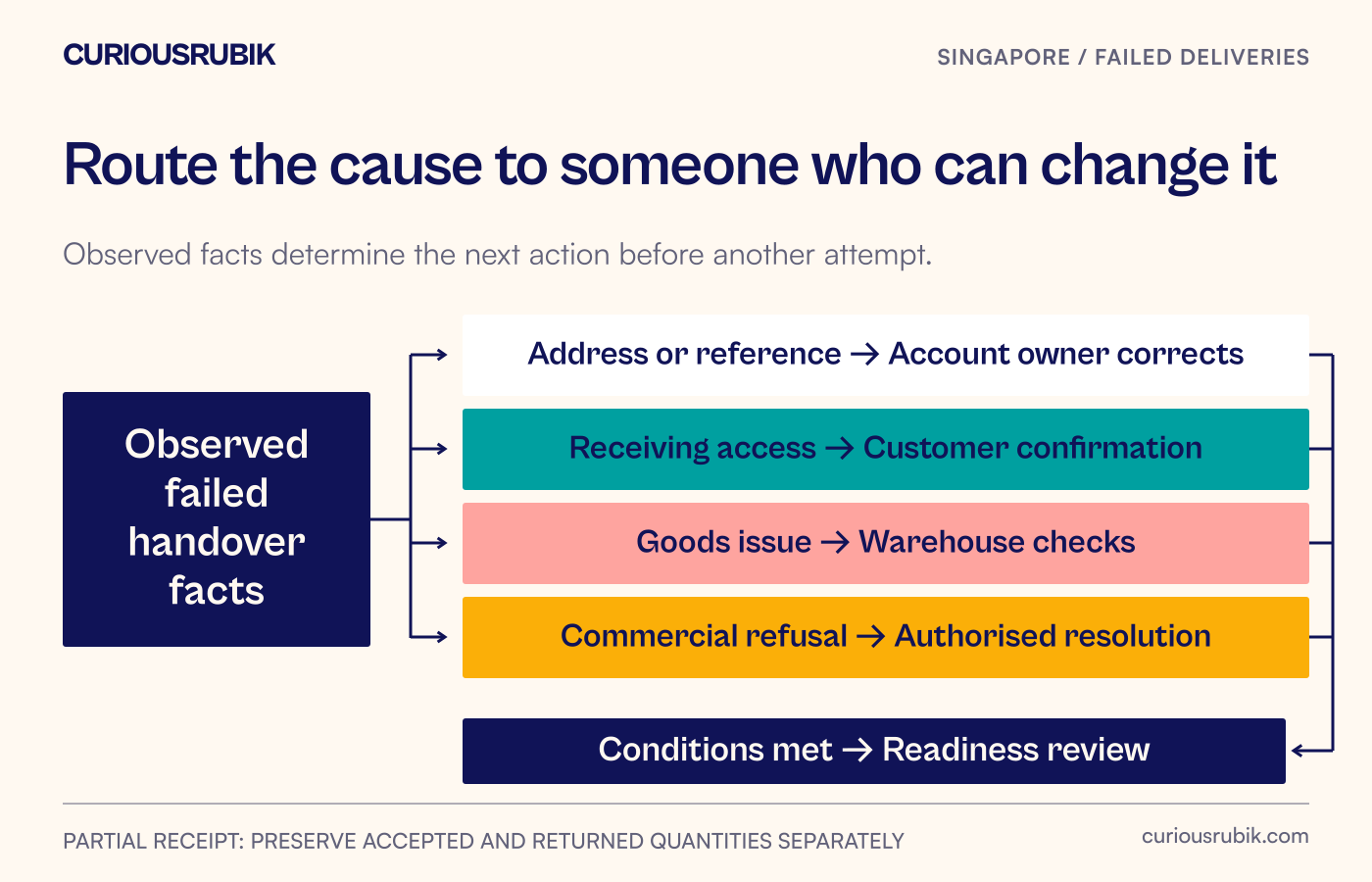
A different case may involve a missing purchase-order reference. The account owner confirms the correct reference and the customer's receiving requirements. Another may involve the wrong goods, which requires warehouse correction before the customer is asked to accept another attempt.
Read the diagram text
CURIOUSRUBIK SINGAPORE / FAILED DELIVERIES Route the cause to someone who can change it Observed facts determine the next action before another attempt. Observed failed handover facts Address or reference → Account owner corrects Receiving access → Customer confirmation Goods issue → Warehouse checks Commercial refusal → Authorised resolution Conditions met → Readiness review PARTIAL RECEIPT: PRESERVE ACCEPTED AND RETURNED QUANTITIES SEPARATELY curiousrubik.com
Put the returned goods back under control
The delivery coordinator needs confirmation of where the goods are after the failed handover. They may be back in the warehouse, at a carrier depot or still on a vehicle. A delivery failure status should not automatically make them available for another order.
Record quantity, condition and any handling constraints. If the goods require temperature control, inspection or another specialist condition check, follow the applicable operational requirements before reuse or redelivery. Do not infer suitability from the fact that the packages remain sealed.
For a partial delivery, connect the returned portion to the original order and accepted portion. If a replacement is prepared, preserve the relationship so the original goods are not later released as an additional fulfilment. The warehouse lead owns physical readiness, while the coordinator owns the revised movement plan.
The commercial owner also needs to know whether the customer still wants the order. A refusal based on disputed goods or terms is different from an unsuccessful appointment. Rescheduling without resolving that disagreement can create another unwanted trip.
Review one decision card before booking the retry
A failed-delivery decision card can contain six concise entries:
- What happened and what evidence supports it
- Which goods were accepted, returned or remain elsewhere
- The specific condition that must change
- The person responsible for changing or confirming it
- The authorised commercial outcome, including any unresolved charge question
- The proof needed before a new delivery is released
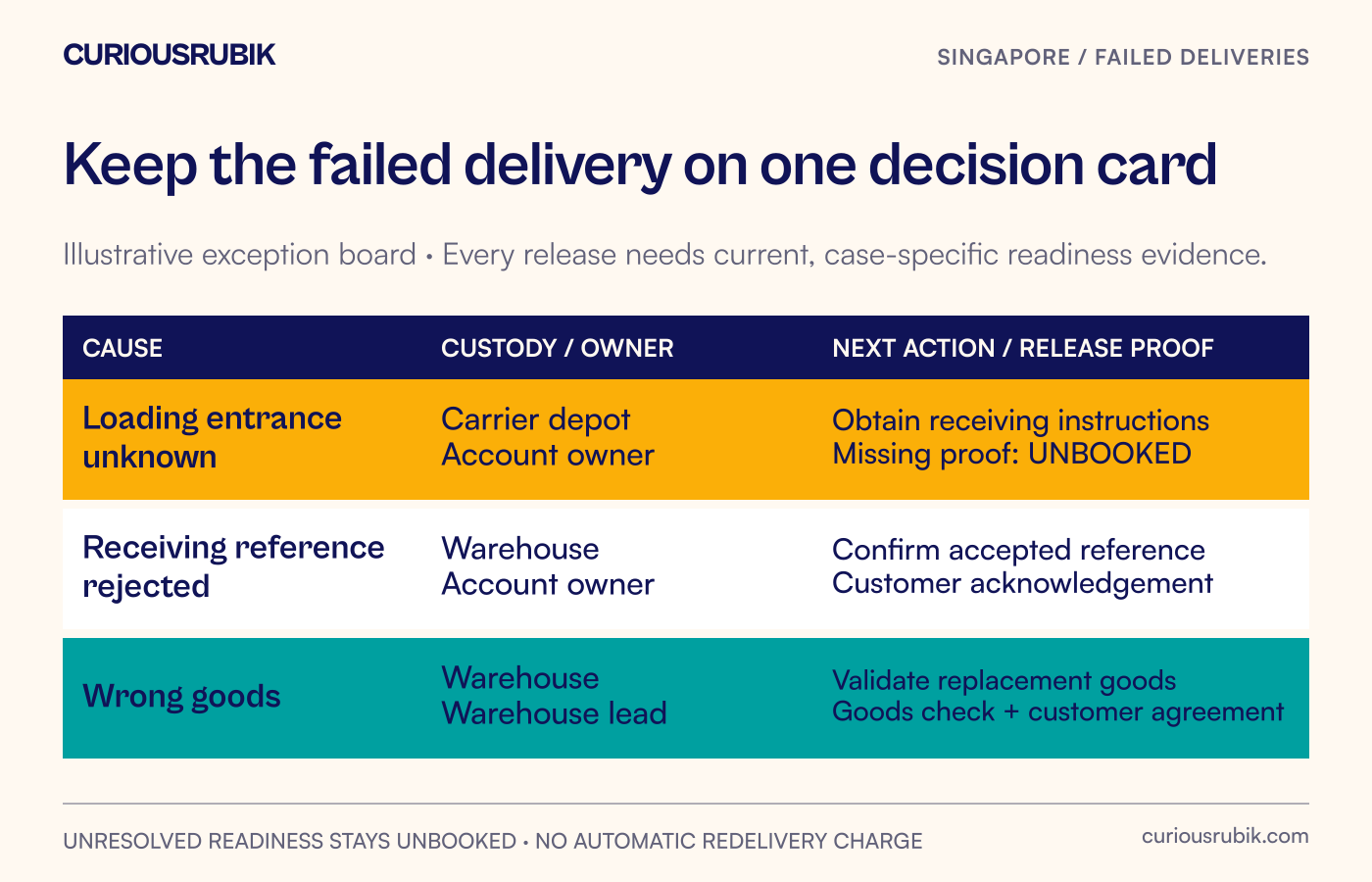
For the loading-entrance example, the readiness evidence could be a confirmed receiving window, corrected entrance instruction and verified operational contact. For a goods error, it could be checked replacement stock and customer agreement. For a cancelled order, it could be the authorised cancellation and disposition of the returned goods.
These are recommended control choices, not universal legal requirements. Contract terms, customer arrangements and product constraints determine the necessary review. Do not automatically impose a redelivery fee because the route shows two attempts. Any charge needs the appropriate commercial basis and authority.
Read the diagram text
CURIOUSRUBIK SINGAPORE / FAILED DELIVERIES Keep the failed delivery on one decision card Illustrative exception board · Every release needs current, case-specific readiness evidence. CAUSE CUSTODY / OWNER NEXT ACTION / RELEASE PROOF Loading entrance unknown Carrier depot Account owner Obtain receiving instructions Missing proof: UNBOOKED Receiving reference rejected Warehouse Account owner Confirm accepted reference Customer acknowledgement Wrong goods Warehouse Warehouse lead Validate replacement goods Goods check + customer agreement UNRESOLVED READINESS STAYS UNBOOKED · NO AUTOMATIC REDELIVERY CHARGE curiousrubik.com
Give rescheduling an evidence gate
Once the required condition is confirmed, the coordinator selects a feasible slot and ensures the instruction reaches the driver or delivery partner. Preserve the original failure alongside the revised plan. A clean new booking should not hide why the previous attempt failed.
Check that readiness is still current at release. A customer confirmation made before an unexpected site closure may no longer apply. If a material condition changes, reopen the relevant check rather than rely on yesterday's completed card.
For cross-border deliveries, a changed destination, timing or disposition may have trade-document consequences. Route those changes to the responsible specialist. A domestic rescheduling process should not silently amend declarations or assume that returned goods can cross a border under the same documents.
If the customer has not confirmed the missing fact, show the case as awaiting that decision. The coordinator can plan capacity provisionally, but should not represent an unconfirmed appointment as ready simply to complete the route schedule.
Notice when repeated failure is a process problem
Automation can attach the first-attempt evidence to the case, route the required task and prevent release while the relevant readiness condition is unresolved. It can identify recurring failures at the same receiving site or repeated missing references from the same order source.
The pattern should lead to a practical correction. If several drivers repeatedly use the wrong entrance, update the approved receiving instruction and verify its use. If the same customer rejects unbooked deliveries, change the order handoff. If goods repeatedly return damaged, investigate handling rather than adding more customer reminders.
Measure second-attempt failures by cause, time to a confirmed next action and trips made with unresolved readiness. Distinguish unavoidable changes from preventable repetition. Avoid claiming every avoided booking as a saved trip without evidence that the vehicle would otherwise have travelled.
At the next daily review, choose one delivery that has already failed twice. Ask what changed between the attempts and who confirmed it. If the only difference was the date, redesign that decision before adding another slot.