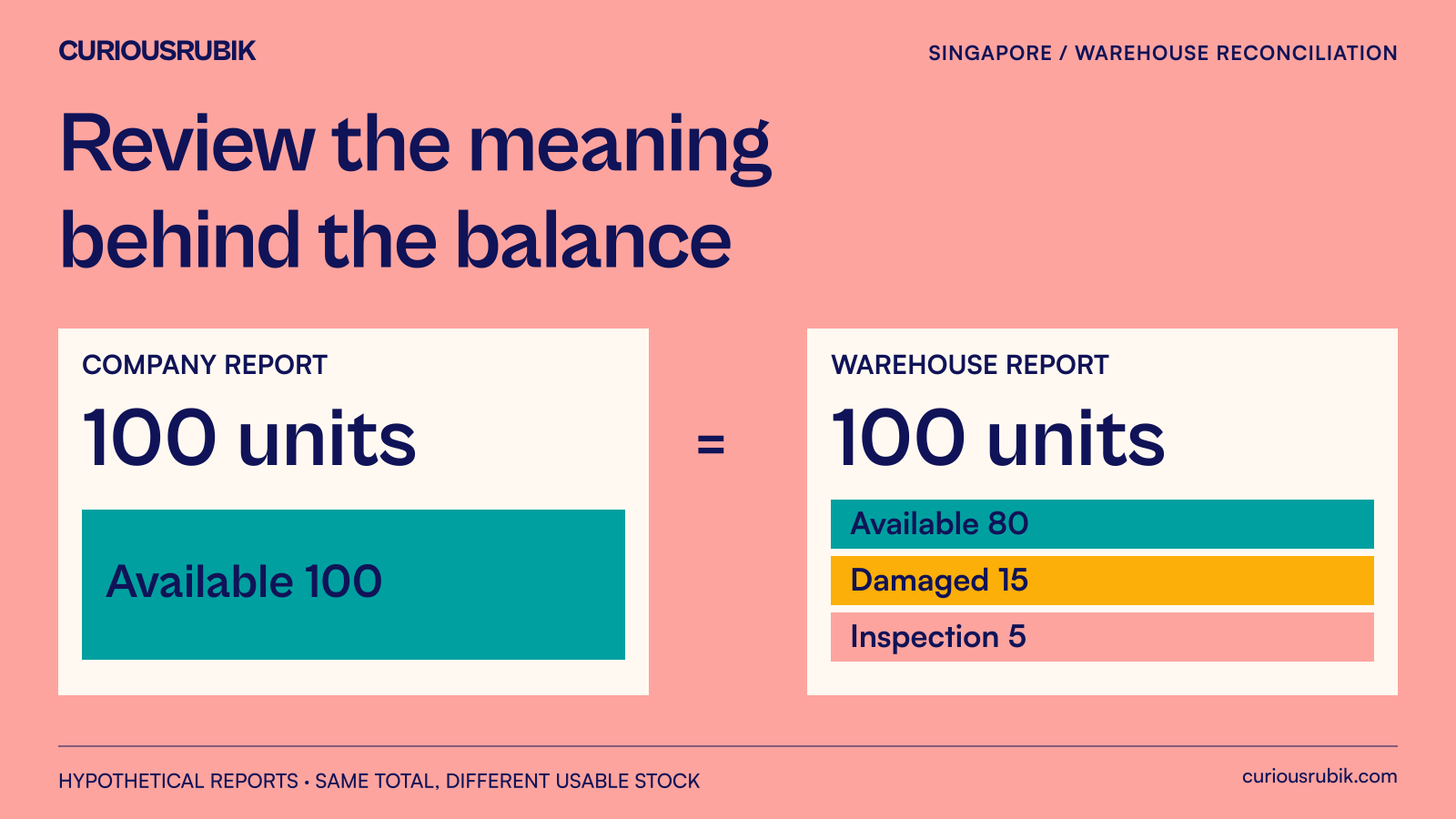
Two stock reports each show one hundred units. The company's report treats all one hundred as available. The warehouse report shows eighty available, fifteen damaged and five awaiting inspection. A comparison of totals will pass, while the sales team may promise stock that cannot be released.
This hypothetical discrepancy illustrates the real purpose of an external-stock reconciliation: establish whether the records describe the same goods, owner, condition and point in time. Matching a grand total is only the beginning.
Assign an inventory controller to own the reconciliation, a warehouse liaison to obtain movement evidence and an authorised reviewer to decide adjustments. A recurring comparison without those roles can produce a fresh list of old differences every month.
First annotation: whose stock is included
Read the warehouse report's scope before checking quantities. Does it contain only goods owned by the business, goods in its custody on behalf of others, or everything stored under a customer account? Are consignment, loan and returned items included?
Physical location does not by itself establish ownership. The inventory controller needs the relevant commercial terms and transaction evidence, with finance reviewing accounting consequences. A warehouse's account label may reflect billing arrangements rather than legal ownership.
The confirmation template should identify the company, warehouse, reporting period, included locations and ownership basis. Where the warehouse cannot report ownership directly, record that limitation and agree the supplementary evidence required. Do not silently translate an unknown owner category into company-owned stock.
This is a recurring operating control. It should work whether the parties exchange a structured file or a signed statement, without becoming a technology-integration project before the report's meaning is understood.
Second annotation: the same item in the same unit
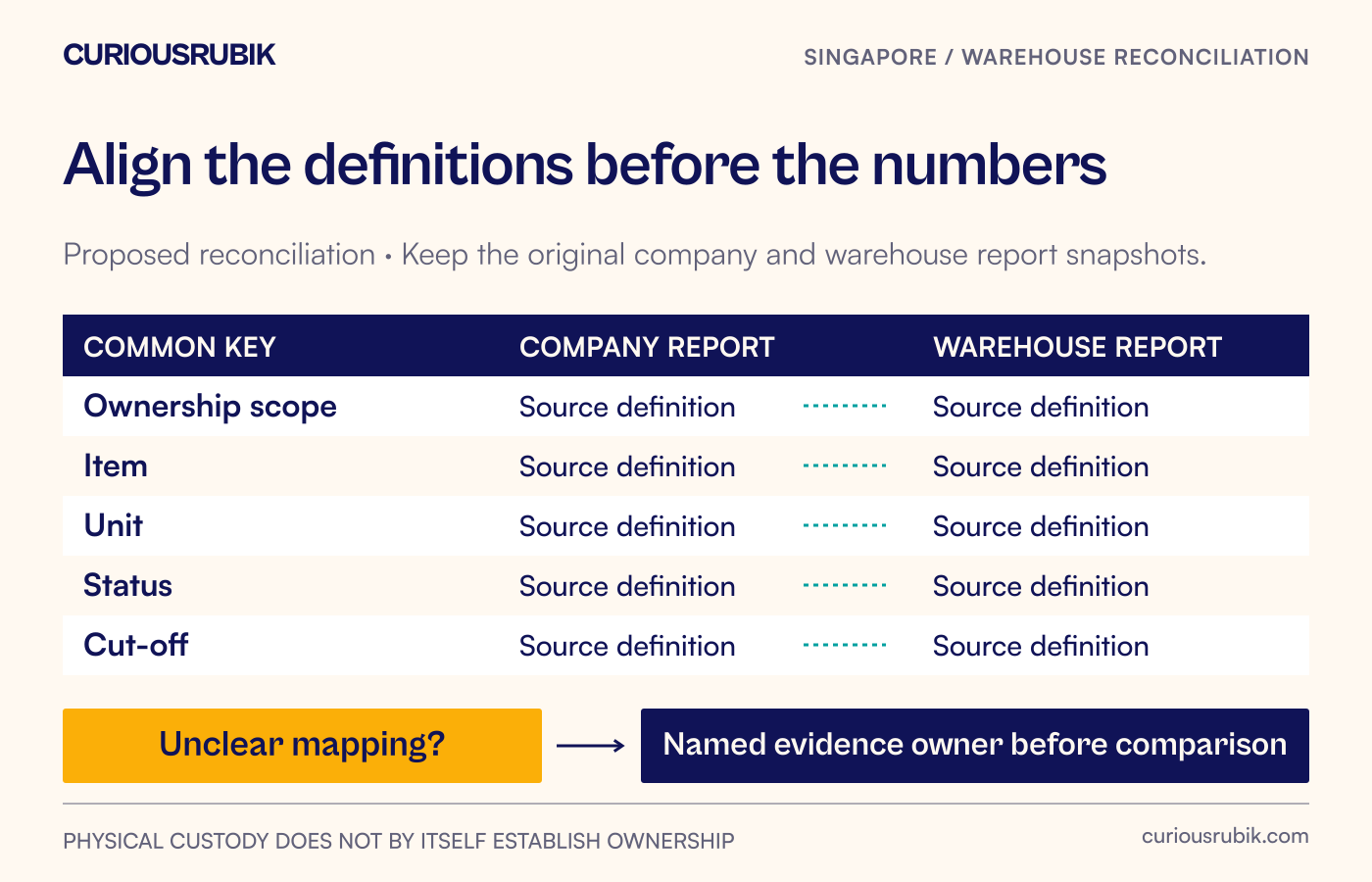
A warehouse may use its own product code, pack unit or batch reference. The company's record may use an individual-unit quantity. Agree the mapping and preserve both identifiers so a discrepancy can be traced back to the source.
Review packaging changes and mixed units explicitly. One hundred cartons and one hundred individual units are not comparable balances. If the approved relationship is uncertain, assign an item-data investigation rather than treating the resulting difference as missing stock.
For goods where batch, serial number, expiry or other attributes matter, select the necessary comparison level. A product-level total can hide a wrong batch or a unit held for a customer-specific purpose. The appropriate detail depends on how the stock is used and controlled.
Ask the warehouse liaison to confirm whether the report includes all physical zones. Stock on a loading bay, in returns processing or held for inspection can be omitted from an “available” extract even though it remains within the warehouse's custody.
Third annotation: the moment each report describes
Agree a cut-off with a clear date and time. Record whether movement dates reflect physical receipt or dispatch, document posting, or another event. Use a consistent time basis where regional operations make timestamps ambiguous.
Suppose the company's report records a dispatch instruction at 5 pm while the warehouse dispatches the goods the next morning. A same-day difference may reflect an event-definition mismatch rather than loss. The right response is to identify the goods and movement, then apply the agreed cut-off and accounting policy.
Late entries need to remain visible. Keep the original report snapshot and note the subsequent transaction that explains the difference. Replacing yesterday's file with an updated version can make the totals agree while removing the evidence of why the initial comparison failed.
Read the diagram text
CURIOUSRUBIK SINGAPORE / WAREHOUSE RECONCILIATION Align the definitions before the numbers Proposed reconciliation · Keep the original company and warehouse report snapshots. COMMON KEY COMPANY REPORT WAREHOUSE REPORT Ownership scope Source definition Source definition Item Source definition Source definition Unit Source definition Source definition Status Source definition Source definition Cut-off Source definition Source definition Unclear mapping? Named evidence owner before comparison PHYSICAL CUSTODY DOES NOT BY ITSELF ESTABLISH OWNERSHIP curiousrubik.com
Fourth annotation: what the status allows
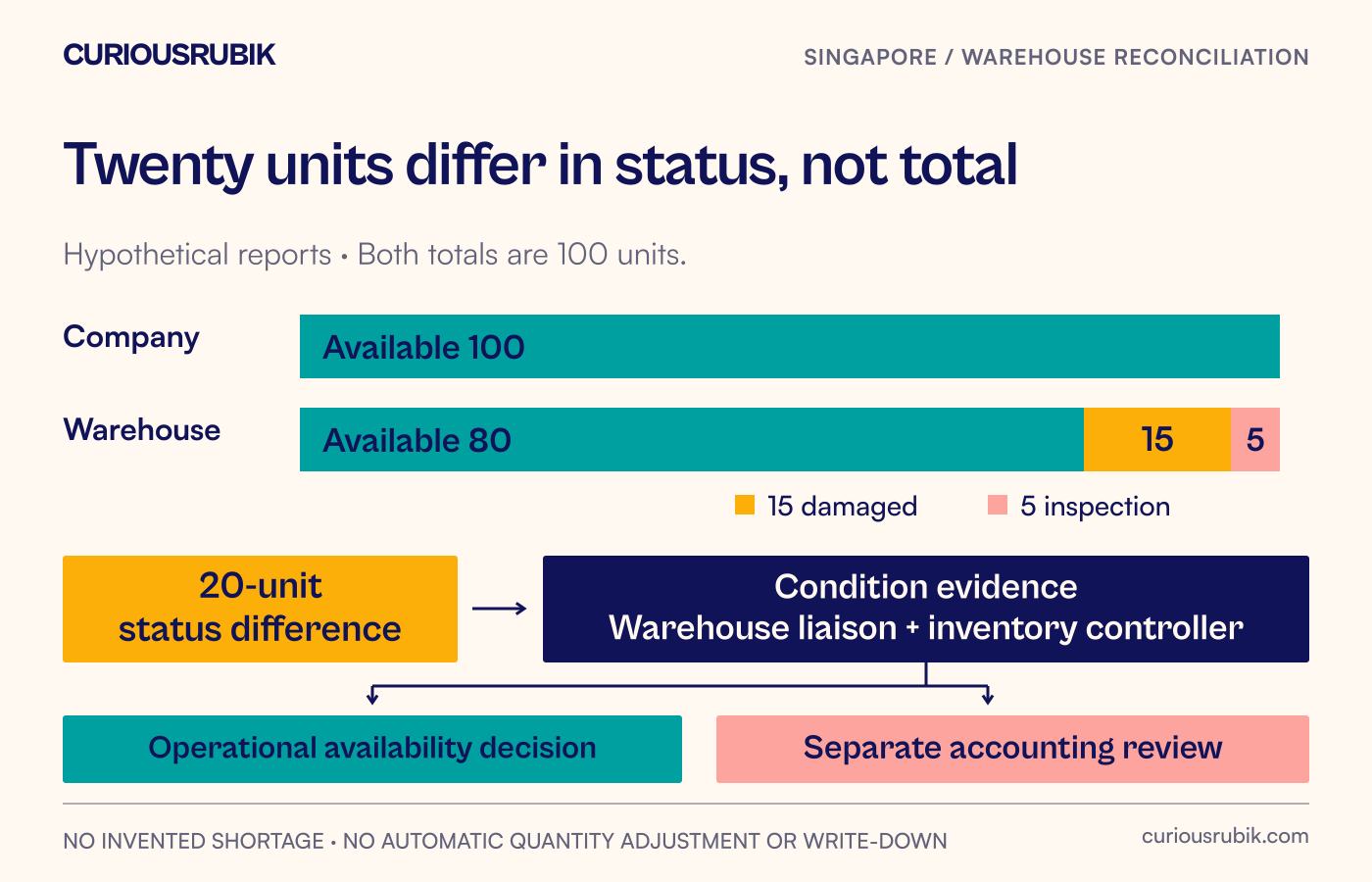
Return to the one-hundred-unit example. The warehouse's eighty available, fifteen damaged and five awaiting inspection still total one hundred. The company needs to review the status of the twenty units before treating them as ordinary available stock.
The warehouse liaison obtains the relevant damage and inspection evidence. Operations determines what can be released or needs further handling. Finance assesses whether the condition has valuation consequences under the applicable framework. Changing availability is not automatically the same as writing down inventory.
An instruction to hold stock should have a reason and owner. If the company says the hold was lifted but the warehouse still blocks release, reconcile the authorised instruction and acknowledgement. The correct quantity in the wrong status can cause a service failure just as surely as a missing quantity.
A cross-status difference should not disappear when the totals net to zero. Keep it as a distinct category with its operational consequence. That allows management to prioritise stock needed for an imminent order rather than work the queue strictly by count size.
Read the diagram text
CURIOUSRUBIK SINGAPORE / WAREHOUSE RECONCILIATION Twenty units differ in status, not total Hypothetical reports · Both totals are 100 units. Company Available 100 Warehouse Available 80 15 5 15 damaged 5 inspection 20-unit status difference Condition evidence Warehouse liaison + inventory controller Operational availability decision Separate accounting review NO INVENTED SHORTAGE · NO AUTOMATIC QUANTITY ADJUSTMENT OR WRITE-DOWN curiousrubik.com
Write a resolution that another person can follow
A discrepancy log should contain the item or movement, quantity and unit, source reports, initial reason, investigation owner, requested evidence and due date. At resolution, add the finding, approved action, person deciding and reference to the resulting record.
Use meaningful reasons: timing, mapping, missing movement, condition, ownership or unresolved physical quantity. “Reconciled” is an outcome label, not an explanation. “Dispatch recorded by company one day before physical release; cut-off corrected under approved policy” gives the next reviewer something to verify.
Do not force agreement through a balancing adjustment. If a quantity is genuinely unaccounted for, the authorised people must investigate and decide the appropriate treatment. If a report is wrong, correct its source or mapping so the same discrepancy does not recur.
For material or persistent exceptions, establish an escalation route involving the warehouse and the business's responsible manager. The inventory controller owns progress, but should not be expected to approve every commercial claim, write-off or accounting entry merely to clear the log.
Keep evidence responsibility inside the business
Using a third-party warehouse does not make the business's own transaction evidence unnecessary. Singapore Customs requires the relevant trader and declaring agent to retain trade records. A warehouse quantity file cannot substitute for the applicable invoices, permits and movement documents.
ACRA's director guidance also addresses appropriate controls and accurate records. The reconciliation design here is a recommended operating response, not a certification of financial reporting or Customs compliance. Specialist reviewers still need to assess the entity's facts and obligations.
Automation can perform the repeat comparison once the definitions are approved. It can group differences by reason, surface an unchanged exception and highlight a report received after the agreed cut-off. It should preserve the source snapshot and comparison version so the result is reproducible.
Make the review visible in the monthly routine
Measure unresolved differences by age and consequence, repeated cut-off errors and adjustments lacking adequate support. Separate confirmed quantity differences from status and timing issues. Otherwise a large timing difference can dominate the report while a smaller loss remains unexplained.
The reviewer should confirm what was compared, which exceptions remain and whether any require action before stock is promised or financial reporting is completed. A signed reconciliation with open items can be honest and useful if those items have owners and decisions. A zero-difference report achieved through unsupported edits cannot offer the same assurance.
At the next review, choose one matching total and ask what it contains. Check ownership, unit, condition and cut-off. If the two parties mean different things by the same number, fix the confirmation template before automating another comparison.