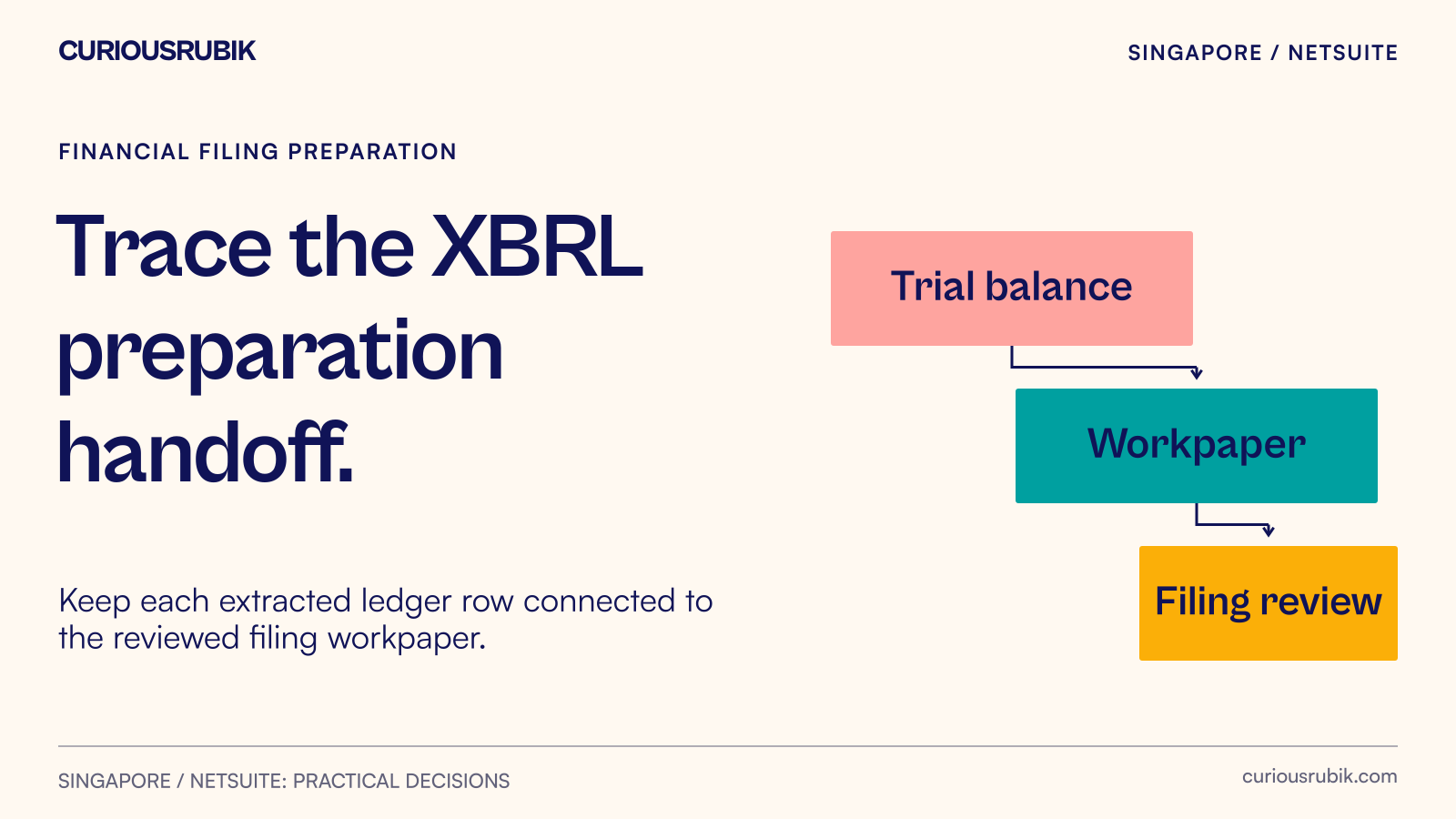
Make the handoff traceable from ledger accounts to the reviewed filing workpaper.
A NetSuite trial balance becomes useful for ACRA XBRL preparation when the filing team can trace every mapped amount back to an approved accounting source. Preserve the extraction scope, explain presentation changes, obtain approval for adjustments and hand over a reproducible workpaper. Exporting a balanced file is only the first part of that job.
The company's reporting and filing owners must first confirm its applicable obligations and current ACRA requirements. This guide explains the evidence handoff after that determination. It does not identify a native NetSuite filing connector or decide the correct taxonomy for a particular company.
Agree what the extract represents
Start the workpaper with the legal entity, reporting period, accounting book, presentation currency and version of the approved financial statements. Record whether the required information is entity-only or consolidated. The source population must match the filing team's approved scope.
Oracle documents subsidiary contexts and currency translation in OneWorld consolidated reporting. That capability makes the report context important; it does not make a group report automatically appropriate for a Singapore entity's filing. A consolidated number can be accurate for its original purpose and still be the wrong starting point for the current workpaper.
Save the report parameters, generation time, source account identifiers and unmodified extract. If the ledger changes during preparation, create a new numbered extract and show the change. Replacing the file behind an existing workpaper prevents the reviewer from knowing which balances were actually approved.
The financial-report export reconciliation guide covers fidelity between a report and its exported file. The next stage needs additional controls over presentation mapping and filing review.
Follow one balance through a worked example
The following example uses fictional account numbers and amounts in SGD. Its presentation decisions are assumed approved by the fictional company's accounting reviewer. They do not prescribe taxonomy tags or accounting classifications for another business.
At the agreed reporting date, the extract contains account 1100, trade receivables, with a debit balance of SGD 420,000. Account 1190, receivables allowance, has a credit balance of SGD 20,000. The workpaper presents the reviewed net receivables amount as SGD 400,000.
The mapping record therefore keeps both source rows. It records their signs and a calculation of 420,000 less 20,000. Deleting the allowance row because the reviewer only wants one presentation number would remove important lineage.
Now assume that account 2100, trade payables, contains SGD 165,000, of which a documented SGD 15,000 balance belongs in a separately presented related-party line under the reviewer's approved financial-statement presentation. Workpaper adjustment P-01 reduces the trade-payables presentation to SGD 150,000 and increases the separate presentation line by SGD 15,000. Total liabilities are unchanged.
P-01 is explicitly a presentation reclassification in this illustration. It is not automatically a journal to post back to NetSuite. If the accountant determines that the source ledger itself needs correction, that requires an independently approved posting and a refreshed extraction.
Finally, an unmatched SGD 4,000 account appears in the extract after a new account was added late in the close. The workpaper marks it “unmapped, review required.” It does not hide the amount in an “other” line merely to make the file look complete.
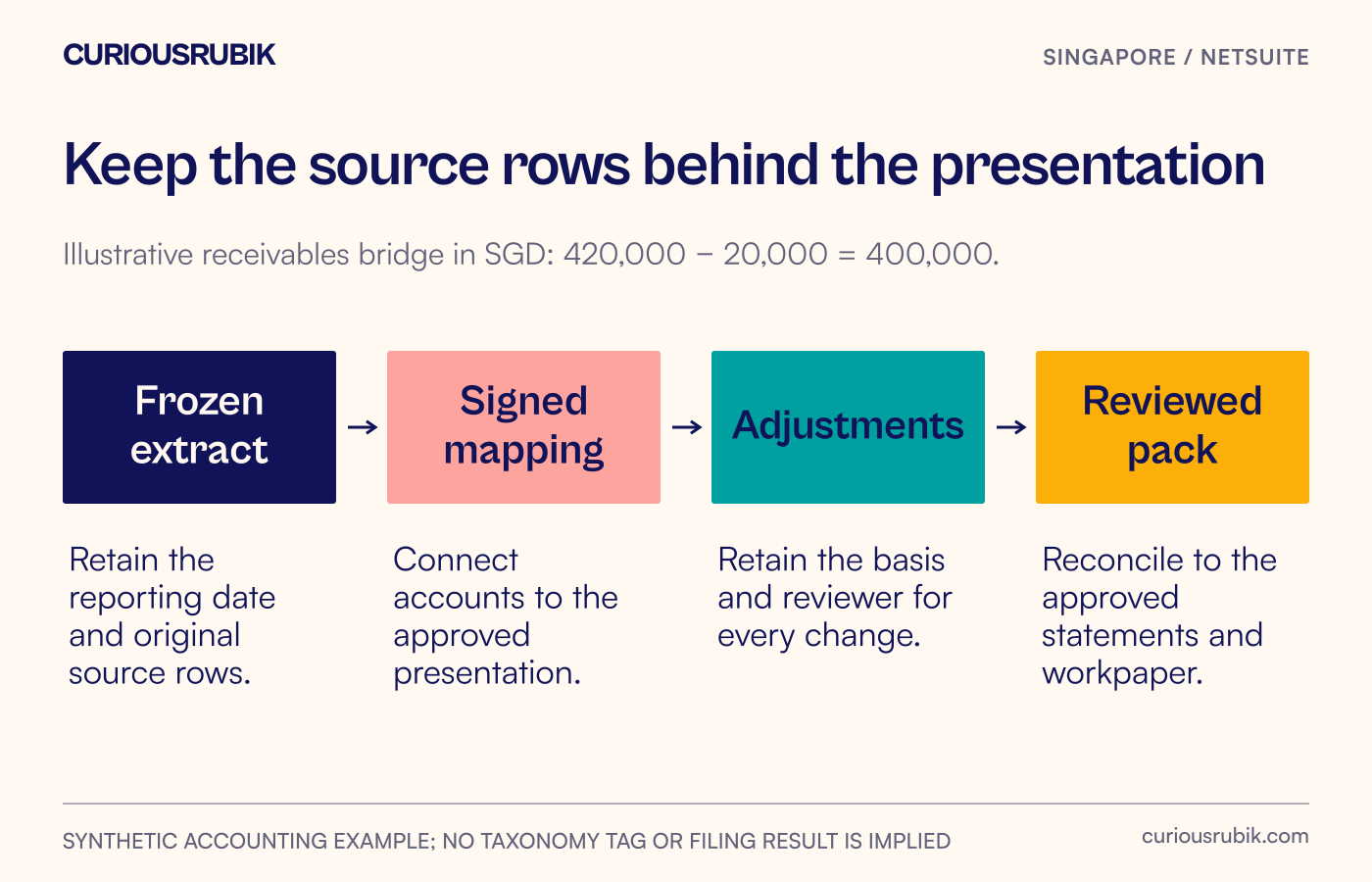
Build a mapping that a replacement preparer can understand
Each mapping row should identify the source account, its description, signed amount, intended financial-statement line, proposed taxonomy destination where applicable and the reviewer responsible for that choice. Keep the mapping version with the workpaper.
Record why a many-to-one or one-to-many mapping is appropriate. Net receivables combine two accounts in the worked example. The payable reclassification splits one account using an approved supporting schedule. These relationships need different completeness checks.
For a many-to-one mapping, prove that every intended source row is included exactly once. For a split, prove that the components sum back to the original source amount. For P-01, SGD 150,000 plus SGD 15,000 must reconcile to SGD 165,000.
Include comparative periods in the design. A mapping changed for the current period may also affect how a comparative balance is presented. The filing reviewer should decide whether and how that change is reflected, with a clear explanation kept beside the workpaper.
Use current filing materials without assuming applicability
ACRA's current BizFinx guidance points preparers to revised 2026 materials, while older guides remain available. Select the materials and tool version appropriate to the company's actual filing. The existence of a familiar older workbook is not evidence that it remains the correct preparation route.
The filing reviewer owns the applicable taxonomy and presentation decisions. The finance owner supplies the approved statements and supporting schedules. The NetSuite owner supplies a reproducible extract and explains source-system changes. A partner-built export or custom mapping tool can support that handoff, but its presence does not establish a native filing feature or transfer the company's review responsibilities.
A trial balance also cannot supply every narrative disclosure or classification fact. Maintain a separate list of required information that comes from approved financial statements, legal records or other reviewed schedules. Assign each missing item to an owner rather than manufacturing it from an account description.
Treat validation messages as questions to resolve
Preserve the validation output together with the exact file version tested. A message may arise from a sign, a missing field, an inconsistent comparative or a presentation mapping. Investigate the source before changing an amount solely to remove the message.
Even when a file satisfies a tool's validation rules, the underlying classification and disclosures still need human review. A technically accepted structure can contain the wrong entity, stale balances or an unsupported mapping.
For the fictional pack, the receivables calculation is ready for review, P-01 needs its signed presentation schedule, and the SGD 4,000 account blocks mapping completion. The preparer can report those statuses precisely without calling the entire pack “done.”
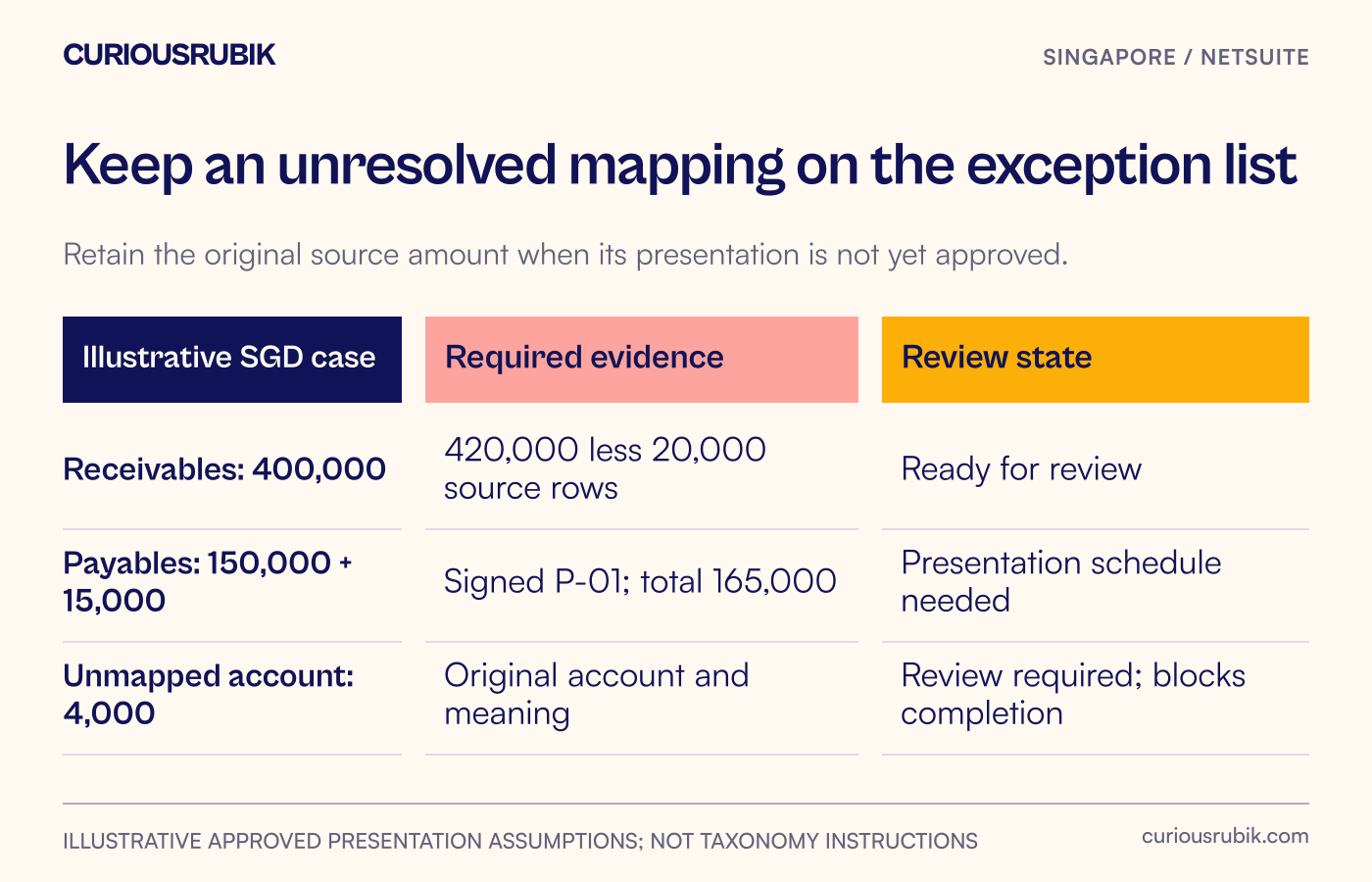
Close the handoff before filing authority is used
Require a final bridge from the frozen trial balance to the approved statements and the prepared filing workpaper. Attach mapping changes, presentation adjustments, validation results and the exception resolutions. Record the reviewer and the version approved for the next step.
Keep preparation, approval and submission statuses separate. This article's handoff ends with a reviewed preparation pack; only the authorized filing process establishes whether a filing was submitted or accepted. Retain that later evidence against the approved version.
The practical next step is to choose one material balance and one awkward exception from the real close. If the team can trace both through extraction, mapping and review without relying on the original preparer's memory, it has a useful foundation for the rest of the XBRL preparation work.