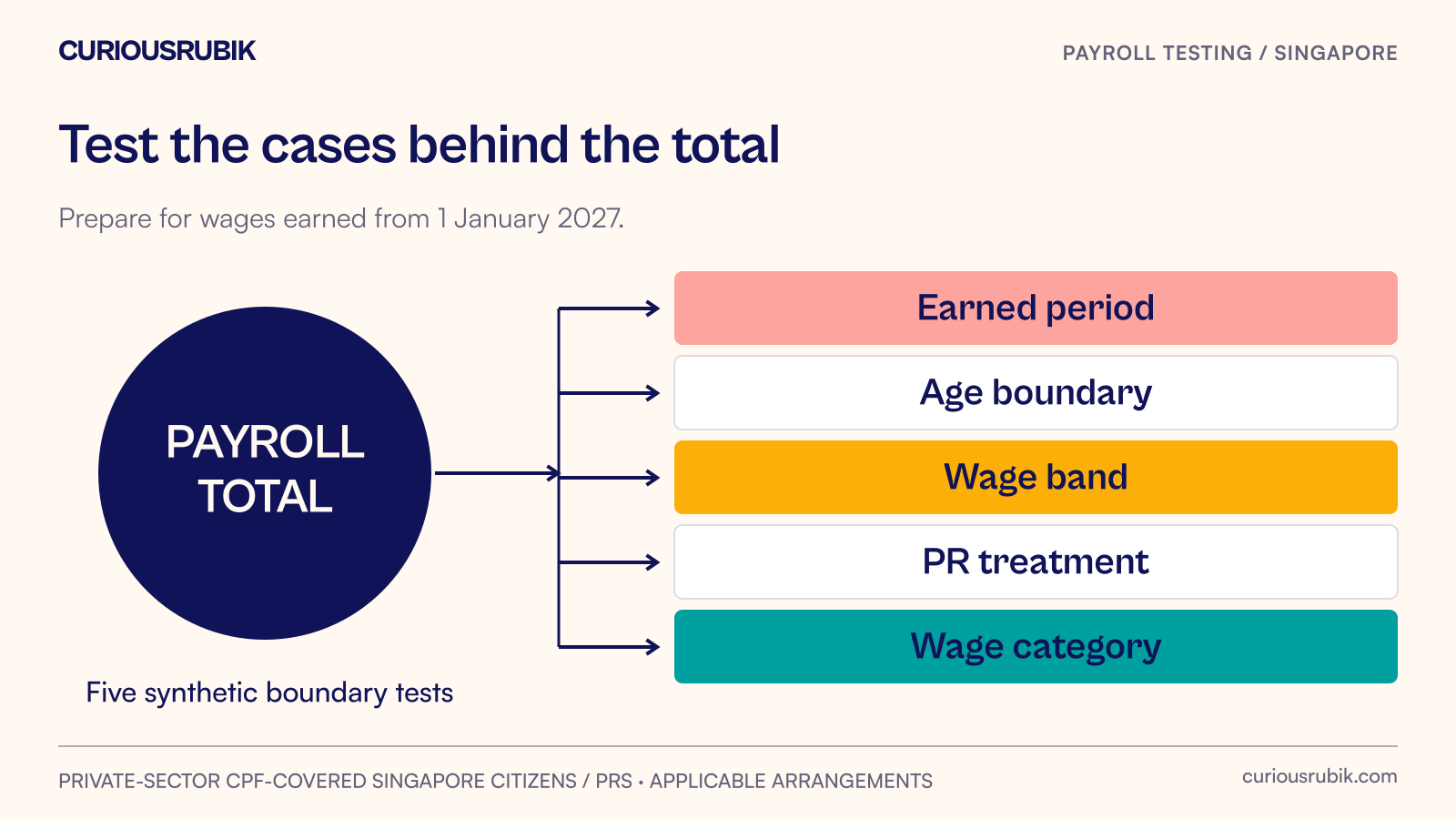
A payroll test that produces the expected total for one full-month employee proves very little about a rule change. It may never exercise the earned-period boundary, an age transition, a lower wage band or a permanent-resident rate arrangement.
For the 2027 CPF contribution change, build the test around those differences. The payroll lead should be able to explain which rule version each case uses, which employee facts drive it and who independently checked the expected result. A matching overall total is the end of the review, not its starting point.
Define the change narrowly enough to test it
This preparation method concerns private-sector payroll for CPF-covered Singapore citizens and permanent residents under their applicable contribution arrangements. CPF Board's announced contribution-rate increase applies to wages earned from 1 January 2027 for employees aged above 55 to 65. The headline table addresses monthly wages above S$750; the announcement also addresses phased-in rates for wages above S$500 to S$750 and states that first- and second-year permanent-resident graduated rates are unchanged.
The detailed contribution tables distinguish employee categories and wage bands. The payroll specialist should use the applicable table and employee facts, including any approved rate arrangement, rather than apply a headline rate to everyone in the age range.
Freeze a test specification stating the change being introduced, its effective basis and the relevant official source version. Keep unrelated payroll-policy changes out of the same exercise where possible. If several changes are unavoidable, identify their expected effects separately so a difference can be explained.
This is a preparation method, not a substitute for the current CPF tables, wage ceilings or qualified payroll review. Avoid using a calendar reminder as the authority for a calculation.
Case one examines the earned period
Create two otherwise identical synthetic cases with different earned periods on either side of the change. Record the earned period and payment date separately. The expected outcome should come from a reviewed interpretation of the applicable rules.
Then add a late correction to an earlier period processed after the transition. Ask the payroll specialist how that correction should be classified and handled. A routine that selects rules solely from the current processing date may produce a plausible number using the wrong basis.
The test record needs the original period, correction reason, amount category, expected rule version and reviewer. Do not treat every payment made in January as though every part was earned in January. Equally, do not assume that a payment described as arrears can be assigned to an earlier period without supporting facts.
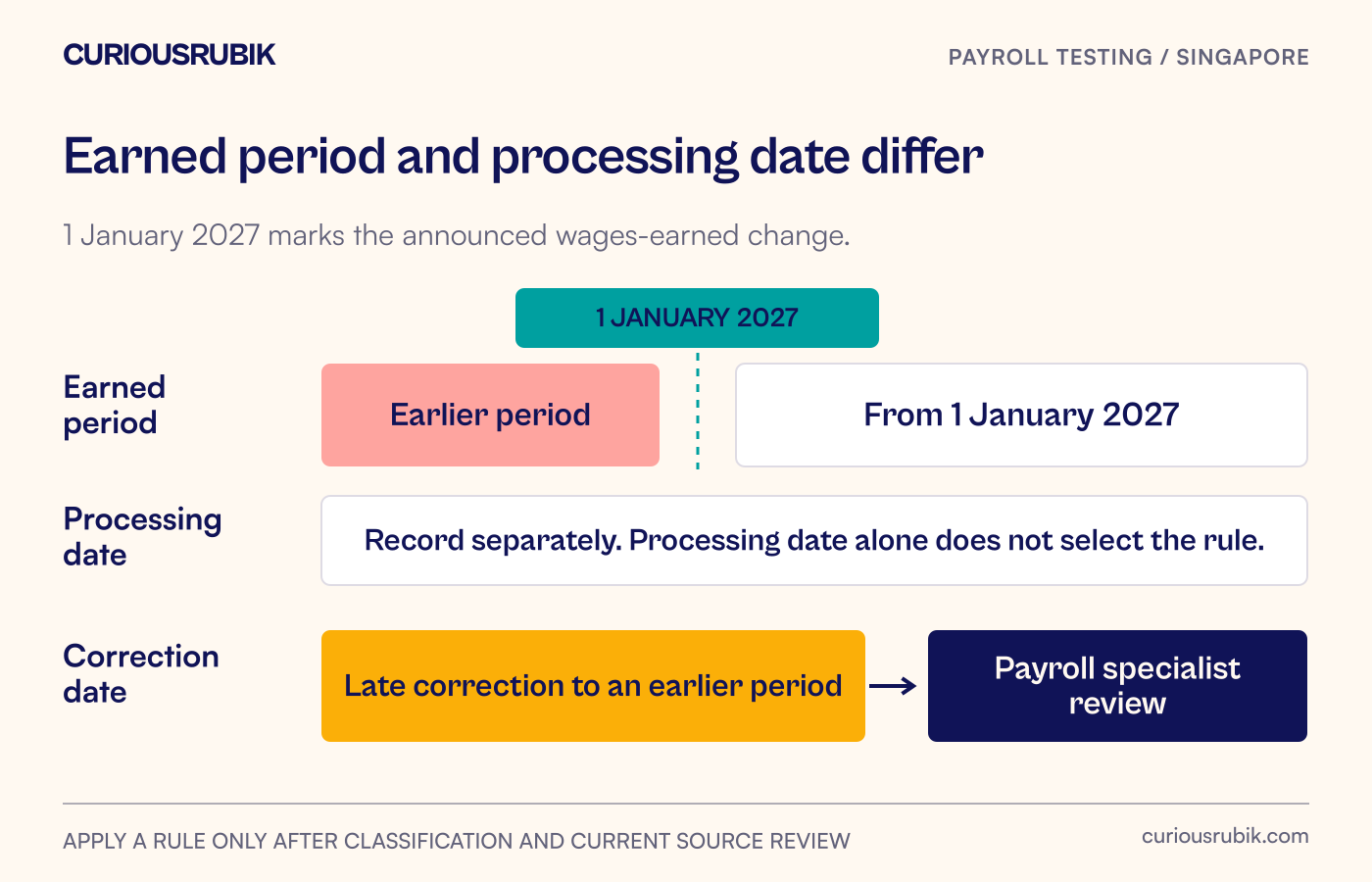
Read the diagram text
CURIOUSRUBIK PAYROLL TESTING / SINGAPORE Earned period and processing date differ 1 January 2027 marks the announced wages-earned change. 1 JANUARY 2027 Earned period Earlier period From 1 January 2027 Processing date Record separately. Processing date alone does not select the rule. Correction date Late correction to an earlier period Payroll specialist review APPLY A RULE ONLY AFTER CLASSIFICATION AND CURRENT SOURCE REVIEW curiousrubik.com
Case two examines an age transition
Use synthetic employees near the relevant age boundaries, with an authoritative date-of-birth source represented by test data. The specialist should establish the correct rate category and effective treatment for each relevant month using current guidance.
The important test is the transition. Run the period before, the relevant change period and the period after. Check that the result changes when it should and remains unchanged when it should. A correct result for someone comfortably inside an age band will not reveal an off-by-one-month error.
HR owns the underlying employee facts. Payroll owns their interpretation for contribution purposes. If a corrected birth date arrives during testing, preserve the previous and corrected test inputs so the difference remains explainable. Do not allow a manual override to hide an unresolved source-data question.
Case three challenges the headline wage example
Add cases in the lower wage bands and at relevant boundaries identified in the official tables. Include a partial-month employee whose total wages differ from their normal full-month salary.
For each case, the reviewer specifies the applicable formula or table basis and the expected employer and employee portions. The test should check each portion, not only their sum. Two opposite errors can cancel in an aggregate contribution total while still affecting the employee and employer incorrectly.
Use neighbouring values where useful to test boundary behaviour. These are synthetic inputs chosen for coverage, not recommended wage amounts. Record the rounding approach and check it against the relevant instructions. A small repeated difference can indicate a systematic problem rather than harmless noise.
Case four tests permanent-resident treatment
Include the categories that actually exist in the employer's population, such as first-year, second-year and later-year permanent residents. Check any approved contribution-rate arrangement rather than assuming the label “PR” identifies one calculation.
The announcement's unchanged graduated rates are an important negative test: the new release should leave a genuinely unaffected case unchanged. If all cases move simply because they fall within a selected age range, the test has found a rule-selection problem.
HR validates the relevant status facts and dates. Payroll confirms the applicable category and evidence. Restrict access to live personal information; synthetic test profiles can exercise the rule without copying an entire employee record into a broadly shared test file.
Case five separates ordinary and additional wages
A test pack containing only basic salary can miss the interaction with other wage components. Include the wage categories, ceilings and adjustments relevant to the actual payroll, with their treatment approved by the specialist.
The purpose is not to invent every possible payroll scenario. It is to make sure each calculation route used by the employer has been exercised. A component called “allowance” or “bonus” should have a documented classification; the label alone should not become the rule.
For a complex case, calculate the expected result independently of the routine being tested. Reusing the same formula in two places and obtaining the same answer is weaker evidence than a separately reviewed calculation grounded in the official requirements.
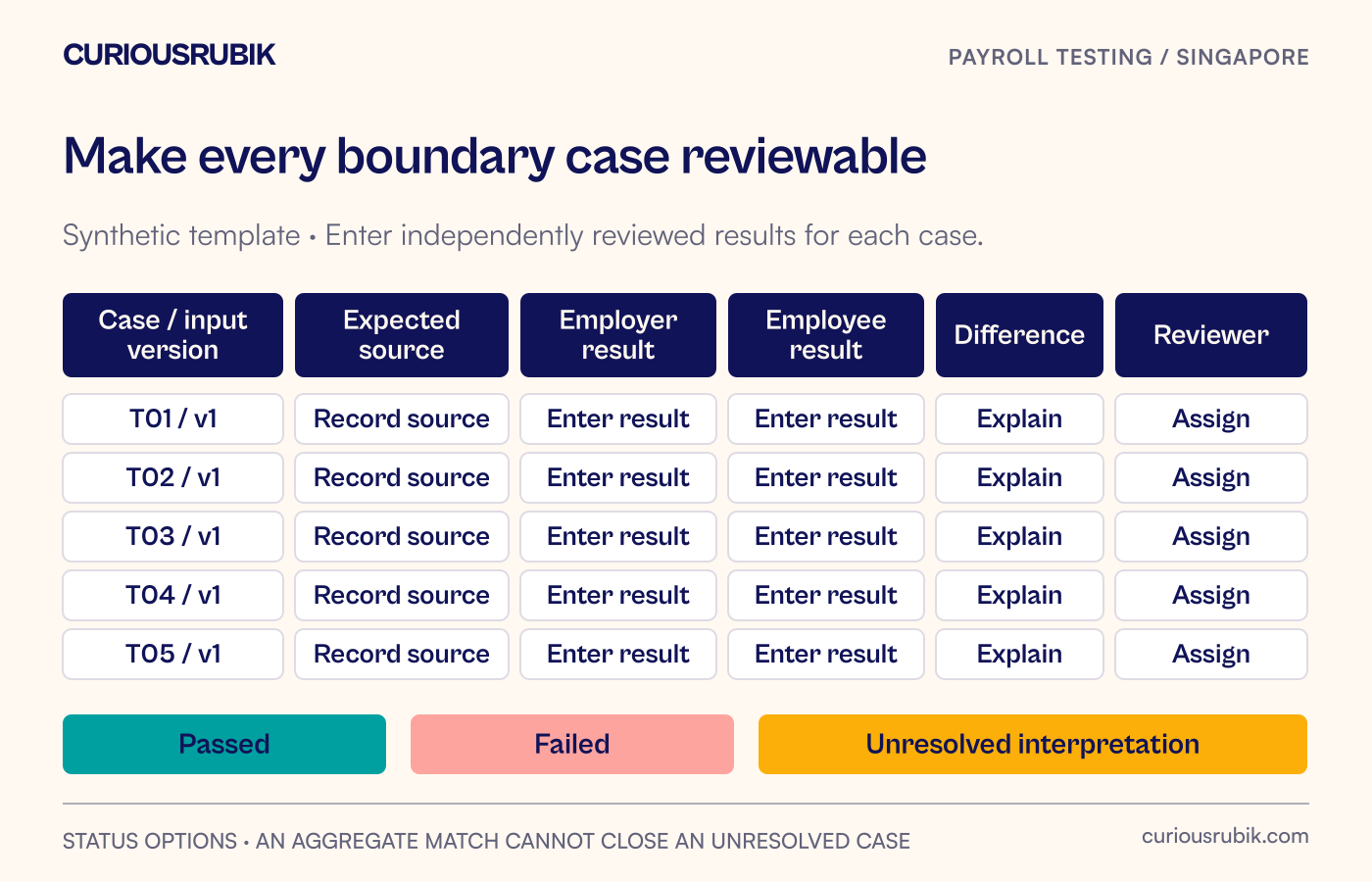
Read the diagram text
CURIOUSRUBIK PAYROLL TESTING / SINGAPORE Make every boundary case reviewable Synthetic template · Enter independently reviewed results for each case. Case / input version Expected source Employer result Employee result Difference Reviewer T01 / v1 Record source Enter result Enter result Explain Assign T02 / v1 Record source Enter result Enter result Explain Assign T03 / v1 Record source Enter result Enter result Explain Assign T04 / v1 Record source Enter result Enter result Explain Assign T05 / v1 Record source Enter result Enter result Explain Assign Passed Failed Unresolved interpretation STATUS OPTIONS · AN AGGREGATE MATCH CANNOT CLOSE AN UNRESOLVED CASE curiousrubik.com
Turn the cases into a release decision
For every case, preserve the input version, expected result, actual result, difference and conclusion. Use explicit outcomes: passed, failed, or unresolved interpretation. A case awaiting guidance has not passed merely because the routine completed without an error.
Group differences by cause. Incorrect employee facts need an HR correction. A wrong rule version needs a calculation change. A misunderstood wage component needs specialist interpretation. The payroll lead coordinates the list and confirms that a correction is retested against the affected cases and relevant previously passed cases.
Automation can prepare these comparisons and highlight changed outputs. It should not approve its own expected results. Keep a reviewer who can inspect the source, understand the calculation and challenge a proposed resolution.
Before the first affected live run, reconcile the tested configuration with the version actually in use. Check the payslip outputs, employee deductions and employer liabilities as well as the submission totals. MOM's itemised-payslip requirements for covered employees make intelligible component-level output part of the operational handoff.
Keep a practical recovery route
Agree who decides what happens if a material discrepancy remains near payroll completion. The team needs a controlled alternative calculation and review route, with lawful payment obligations maintained. “Wait until next month” is not an adequate default response to an unresolved payroll error.
Monitor the first affected run for differences from the approved test expectations. Investigate unexpected changes before treating the release as established. Keep the original evidence and correction trail so the team can explain any adjustment to the appropriate recipients.
A useful sign-off is therefore specific: the relevant population and calculation routes were tested, unresolved questions were settled by the right people, and the live version matches the reviewed one. That is stronger evidence than a screenshot showing a green total.