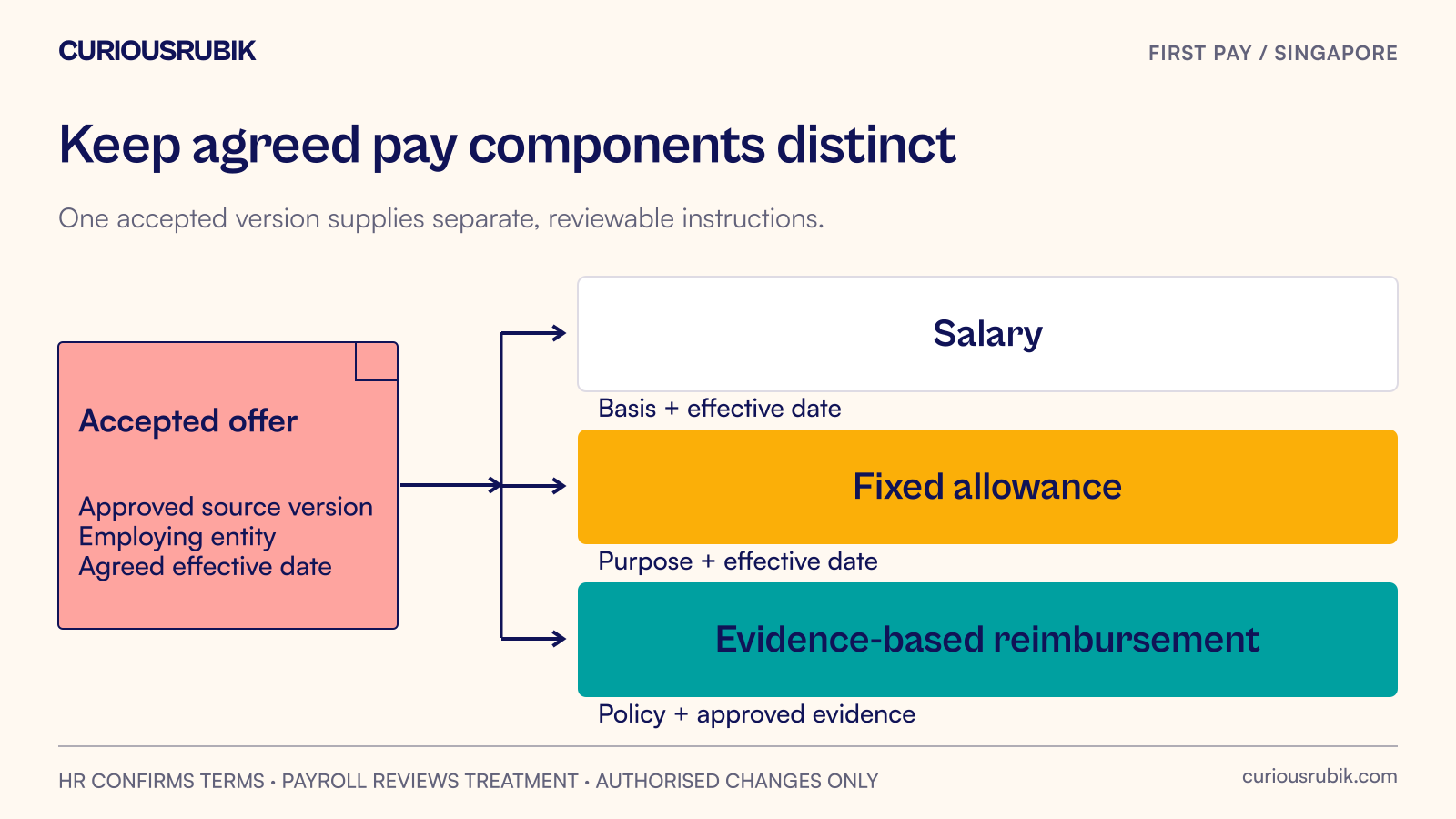
The offer promises basic salary, a fixed allowance and reimbursement of approved work expenses. Payroll receives a message saying “monthly package S$4,500”. The number is easy to enter, but the distinctions that determine how the employee is paid have disappeared.
A good handoff preserves the accepted terms as separate instructions. HR confirms the agreement and effective dates. Payroll reviews each component's treatment. The authorised approver resolves changes. The first pay run should be traceable back to that shared, approved version.
Before the handoff the total looks complete
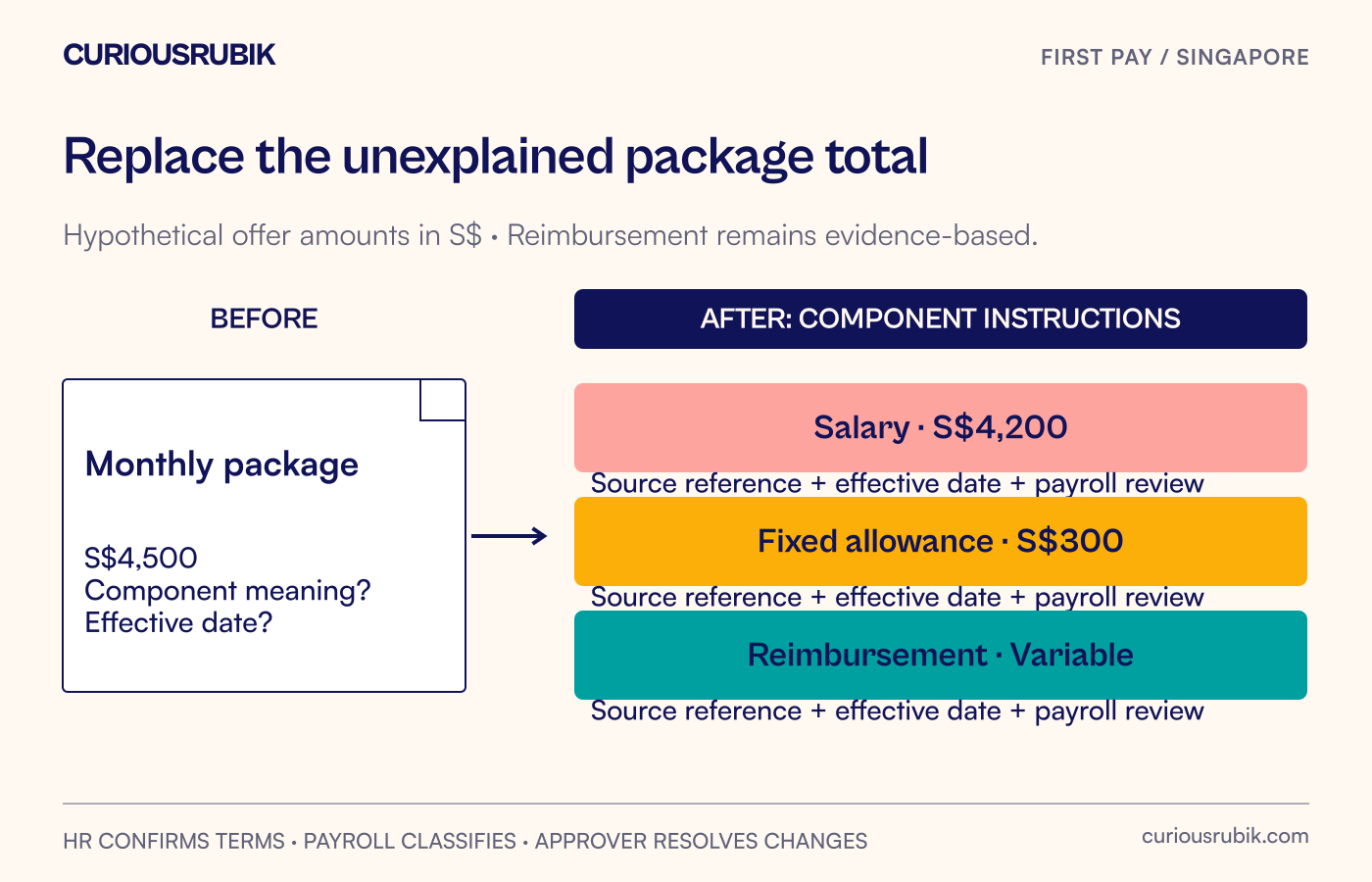
Consider a hypothetical offer with S$4,200 monthly basic salary, a S$300 fixed allowance and reimbursement of eligible work expenses against approved evidence. The S$4,500 fixed monthly total does not include an automatic S$300 expense reimbursement or any assumed amount of future claims.
If payroll receives only the total, it may lose the distinction between basic salary and the allowance. If someone adds a reimbursement budget to the total, it may turn a conditional claim into a recurring payment. If the employee starts partway through the month, an unexplained full-month amount also leaves the effective-date question unresolved.
These are hypothetical commercial terms, not recommended pay levels or statutory calculations. Their value is in exposing what a simple total cannot communicate. Payroll needs the approved components and their basis before it can apply the appropriate rules.
In Singapore, MOM's key-employment-terms guidance identifies separate pay-related items, and its itemised-payslip requirements apply to covered employees. Written KETs are required for Employment Act-covered employees entering a contract of service on or after 1 April 2016 for 14 days or more. This is the contract length, not the number of days worked. Employers must issue them within 14 days after employment starts. The handoff should respect those requirements without assuming that every accepted offer automatically satisfies them.
After the handoff each component answers a different question
The revised instruction has one row for each component. For the hypothetical basic salary, it records the monthly basis, amount, start date and accepted source. For the fixed allowance, it records the amount, purpose, frequency and any relevant conditions. For reimbursement, it records the approved policy and evidence route rather than inventing a recurring amount.
Add the employee reference, employing legal entity, salary period and source version to the instruction. Include the treatment decisions payroll needs, with the reviewer and basis. A field left unresolved should have an owner and a date; it should not be filled with a convenient default merely to allow the first run to proceed.
The distinction between a fixed allowance and reimbursement is especially worth preserving. CPF treatment depends on the nature of the payment and applicable conditions. The label in an offer is not, by itself, a reliable classification. Payroll should check the substance and relevant guidance, including what a reimbursement compensates and how it is supported.
Do not ask the recruiter or line manager to settle that classification without the necessary expertise. Their role is to explain the agreed benefit and its purpose. The payroll specialist owns the contribution and payroll treatment.
Read the diagram text
CURIOUSRUBIK FIRST PAY / SINGAPORE Replace the unexplained package total Hypothetical offer amounts in S$ · Reimbursement remains evidence-based. BEFORE Monthly package S$4,500 Component meaning? Effective date? AFTER: COMPONENT INSTRUCTIONS Salary · S$4,200 Source reference + effective date + payroll review Fixed allowance · S$300 Source reference + effective date + payroll review Reimbursement · Variable Source reference + effective date + payroll review HR CONFIRMS TERMS · PAYROLL CLASSIFIES · APPROVER RESOLVES CHANGES curiousrubik.com
Reconcile the instruction back to the accepted agreement
The reviewer should be able to read in both directions: from the offer to every required payroll instruction, and from every payroll instruction back to an approved term or policy.
For each component, check the amount or calculation basis, frequency, effective period, conditions and destination in the payroll output. Confirm that a one-time payment has not become recurring and that a conditional amount has not become guaranteed through a data-entry shortcut.
A useful reconciliation record asks:
- Which accepted document or amendment supports this component?
- Is the component fixed, variable, conditional or reimbursement-based?
- When does it start, stop or change?
- What further evidence is required before payment?
- Who approved the payroll and contribution treatment?
- How will the employee see it in the relevant pay records?
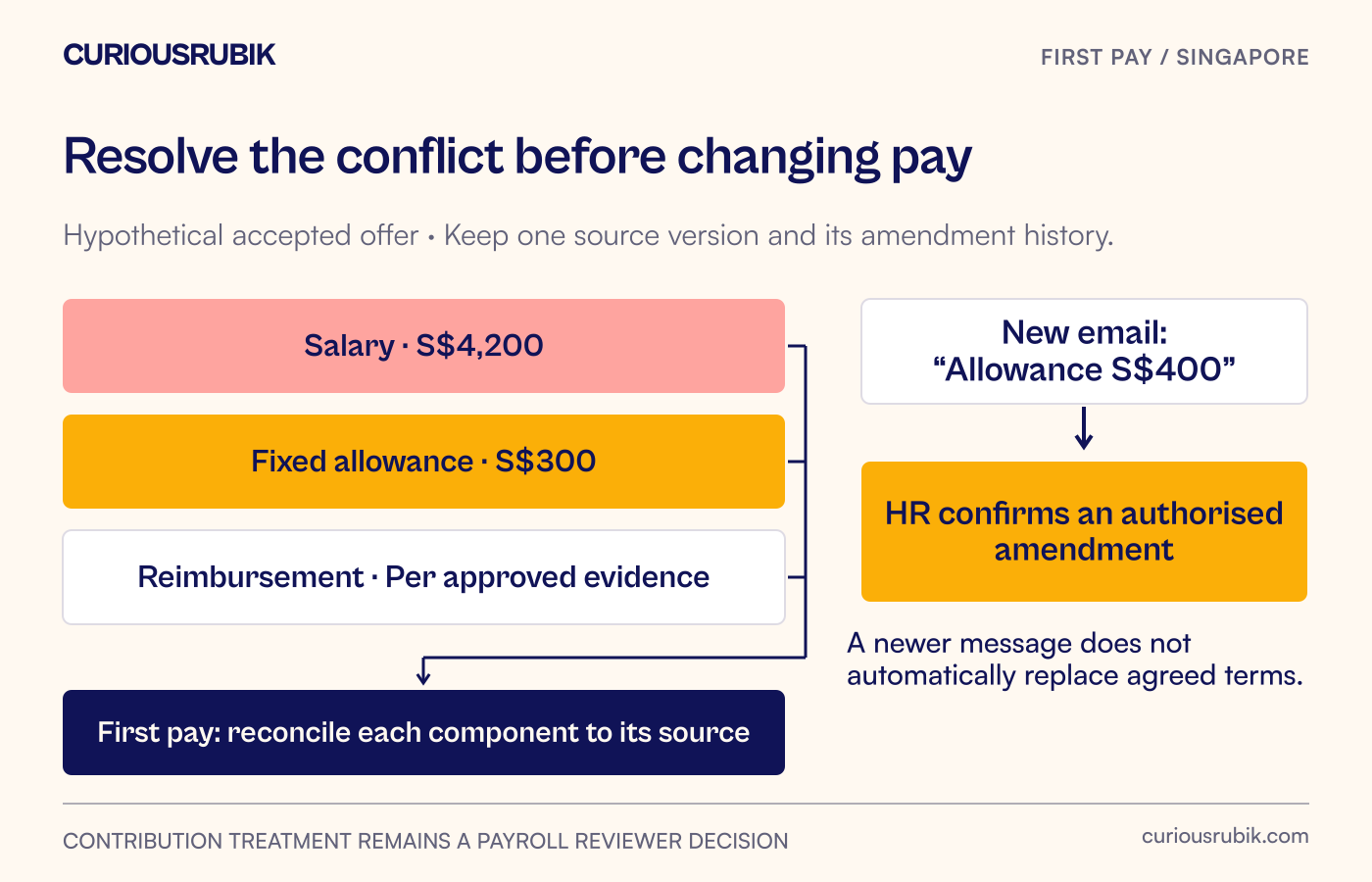
Now introduce a conflicting email. The manager says the allowance should be S$400, while the accepted offer says S$300. Payroll should not choose the newest message automatically. HR establishes whether a change was properly agreed and authorised, then supplies the controlled amendment. The original version remains in the history.
If the start date changes, confirm which instructions are affected. The payroll lead assesses any partial-period calculation using the applicable rules and terms. A revised date should not silently change unrelated benefits or erase an earlier calculation that now needs correction.
Read the diagram text
CURIOUSRUBIK FIRST PAY / SINGAPORE Resolve the conflict before changing pay Hypothetical accepted offer · Keep one source version and its amendment history. Salary · S$4,200 Fixed allowance · S$300 Reimbursement · Per approved evidence New email: “Allowance S$400” HR confirms an authorised amendment A newer message does not automatically replace agreed terms. First pay: reconcile each component to its source CONTRIBUTION TREATMENT REMAINS A PAYROLL REVIEWER DECISION curiousrubik.com
The first pay review should follow the components
Before release, compare the first payroll result with the approved instruction. Check the components individually, including the effective period, deductions, contribution treatment and net result. A matching fixed gross total can hide an allowance placed in the wrong component or a reimbursement incorrectly included.
MOM's payslip guidance specifies applicable items rather than requiring irrelevant ones. Use the employee's actual situation to check that the output is intelligible and complete. The employee should be able to understand the payment without seeing confidential internal review notes.
Give unusual cases a named resolution owner. A one-time joining payment, variable incentive or cross-border arrangement may need additional review. The workflow should identify that need early rather than compressing every case into the same monthly-total field.
If a material question remains close to payday, payroll and HR must coordinate a lawful, authorised resolution. Missing internal information is not a reason to invent an amount or leave a due payment unmanaged. Record the decision and any required correction or communication.
Keep one source without making it impossible to change
A controlled instruction is a current approved version with a history, not a document that can never be amended. Changes should state the affected component, effective date, authority and reason. Payroll confirms that the accepted change reached the relevant calculation and output.
Automation can populate a draft from approved terms, compare document versions and flag inconsistent amounts or missing dates. It should preserve the source beside each proposed field. An extracted number near the phrase “total package” may include items that do not belong in basic salary.
Treat uncertain extraction and conflicting terms as review items. Do not let a generated summary replace the accepted agreement. Limit access to compensation and personal information, and use synthetic profiles for testing the handoff wherever possible.
A small first-pay audit can show whether the design works. Select several recent starters with different component patterns. Ask a reviewer to explain each payment from the accepted terms without consulting the original recruiter. Record unexplained components, late clarifications and corrections after the first run.
The best handoff is one that lets payroll ask its necessary questions once, while HR still has the agreement in front of it. Before the next starter is loaded, replace the unexplained total with component-level instructions and obtain the missing treatment decisions. That removes ambiguity before it becomes an employee's pay problem.