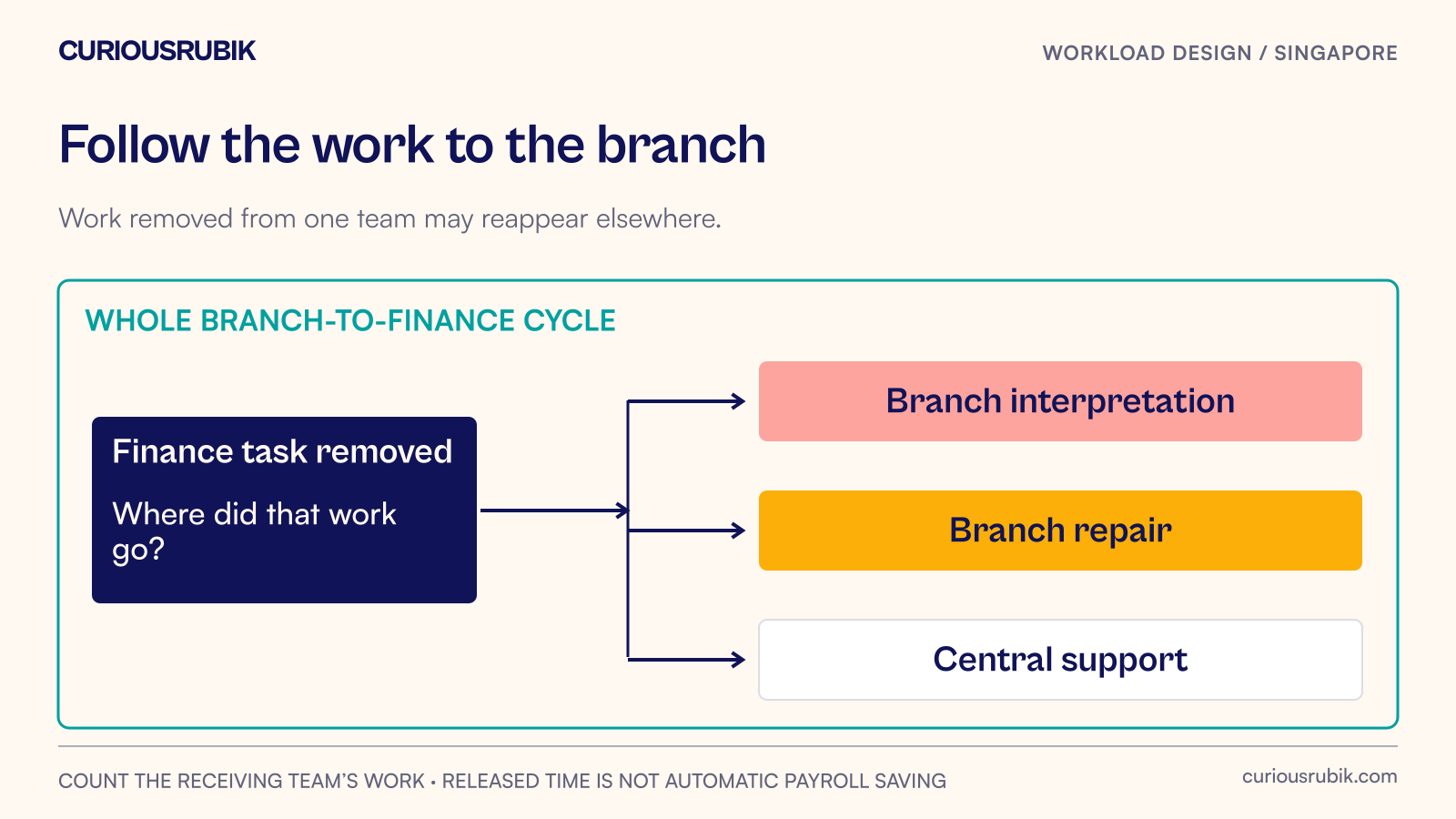
Finance has removed a daily rekeying task. Outlet managers now spend longer correcting submissions after closing, while the help desk answers questions about fields that did not exist before. The central team's saving is real, but it may be only one part of the result.
Before calling the change a productivity gain, follow a complete branch-to-finance cycle. Count work where it now happens, including interruptions and unresolved cases. A redesign can deliberately move a task closer to the person who knows the answer, but that decision should be visible and supported by a workable job design.
Begin at closing time, not at the finance dashboard
Observe an outlet through the point at which its daily submission becomes usable by finance. A successful upload may be only the middle of that sequence. The manager may still be asked to identify a variance, replace evidence or explain a category after the initial submission.
Record active work separately from elapsed waiting. Ten minutes spent investigating a discrepancy is different from two hours waiting for a reply. Both matter, but adding them together would produce a misleading workload number.
Also note when the work occurs. A five-minute task during a quiet administrative period is different from five minutes repeatedly interrupting customer service. Do not invent an exact monetary cost for every interruption. Record its occurrence and practical effect, then decide what evidence is needed.
Use the observation to understand the process, not to rank individual employees. Explain the purpose, keep the diary proportionate and involve the people who perform the work. A manager concealing extra work to avoid looking slow will make the improvement harder to assess.
A before-and-after result can reverse when the boundary changes
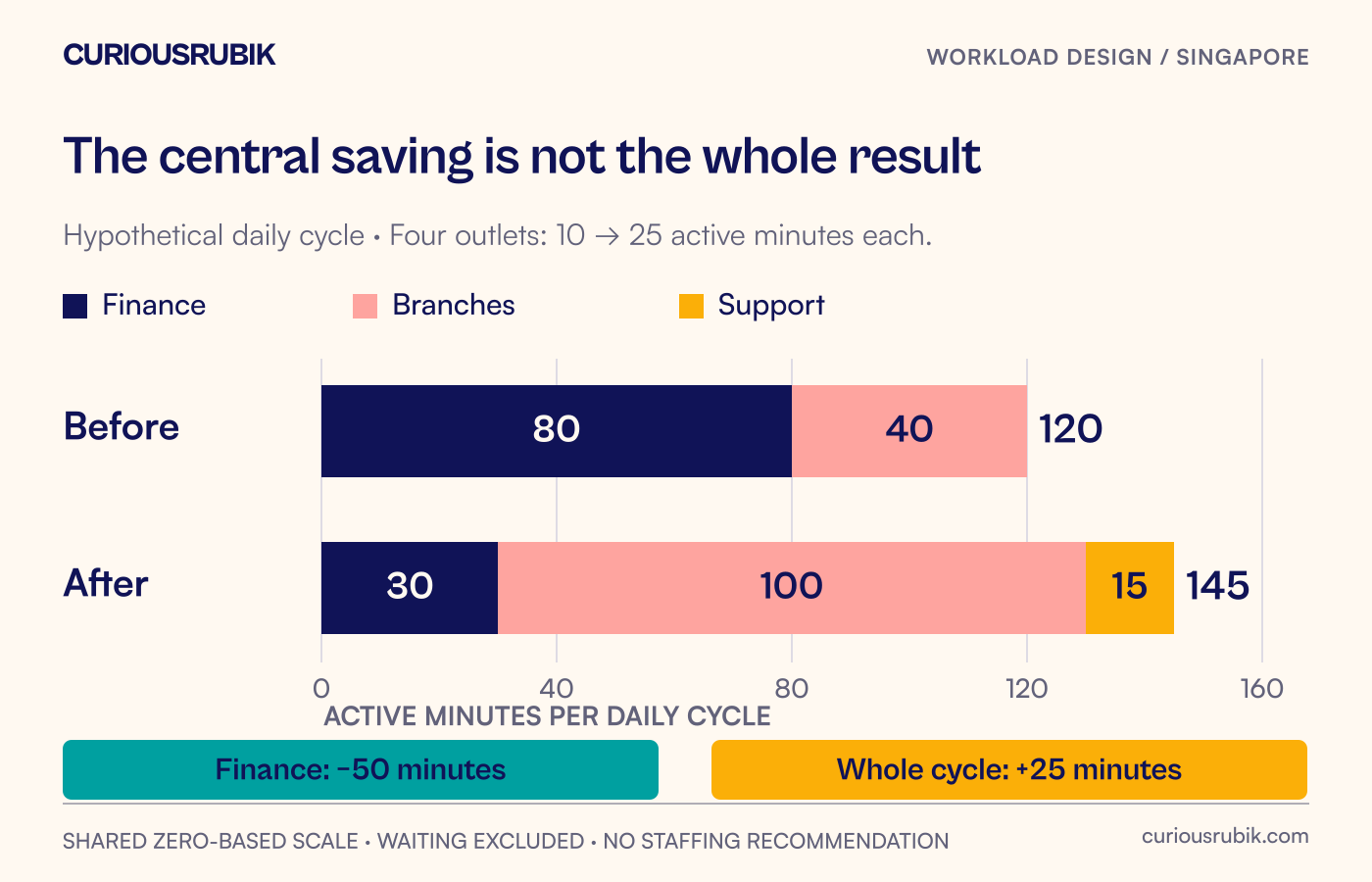
Consider a hypothetical four-outlet business. Before a change, finance spends 80 minutes per daily cycle preparing and checking the combined submissions. Each outlet spends 10 minutes, giving 40 branch minutes. The modelled total is 120 minutes.
After the change, finance spends 30 minutes. Each outlet spends 25 minutes because it must classify exceptions and repair rejected submissions, giving 100 branch minutes. A central support owner spends another 15 minutes on recurring questions. The modelled total is now 145 minutes.
Finance alone has saved 50 minutes. Across the stated boundary, active effort has increased by 25 minutes. These invented figures are not a benchmark or evidence that automation usually fails. They show why the measurement boundary can change the conclusion.
The next question is whether the added branch work serves a useful purpose. Perhaps source-level classification improves accuracy enough to justify some effort. Perhaps the branch is being asked to supply a finance code it cannot reasonably know. The same total can conceal two very different design decisions.
Read the diagram text
CURIOUSRUBIK WORKLOAD DESIGN / SINGAPORE The central saving is not the whole result Hypothetical daily cycle · Four outlets: 10 → 25 active minutes each. Finance Branches Support 0 40 80 120 160 Before 80 40 120 After 30 100 15 145 ACTIVE MINUTES PER DAILY CYCLE Finance: −50 minutes Whole cycle: +25 minutes SHARED ZERO-BASED SCALE · WAITING EXCLUDED · NO STAFFING RECOMMENDATION curiousrubik.com
Put the new work into four practical categories
A short diary can distinguish the work needed to complete the business outcome:
| Category | What to record | What the pattern may suggest |
|---|---|---|
| Source capture | Facts entered where they become known | Keep here if the source person can provide them reliably |
| Interpretation | Choosing a category or explaining a variance | Check whether the branch has the knowledge and authority |
| Repair | Resubmission, duplicate entry or evidence replacement | Investigate validation and handoff design |
| Interruption and follow-up | Questions, waiting, repeated contacts | Improve timing, ownership or the completeness of the query |
Include ordinary successful days and difficult ones. A trial observed only while the project team is on site may hide the support effort needed later. Likewise, a diary from one unusually busy outlet should not be extrapolated to every branch without comparison.
Follow cases that cross days. If an unresolved submission leaves today's finance queue and returns tomorrow, its work has not vanished. Link the case across the cycle so the same task is not counted as two completed outcomes or omitted entirely.
Ask who should know the answer
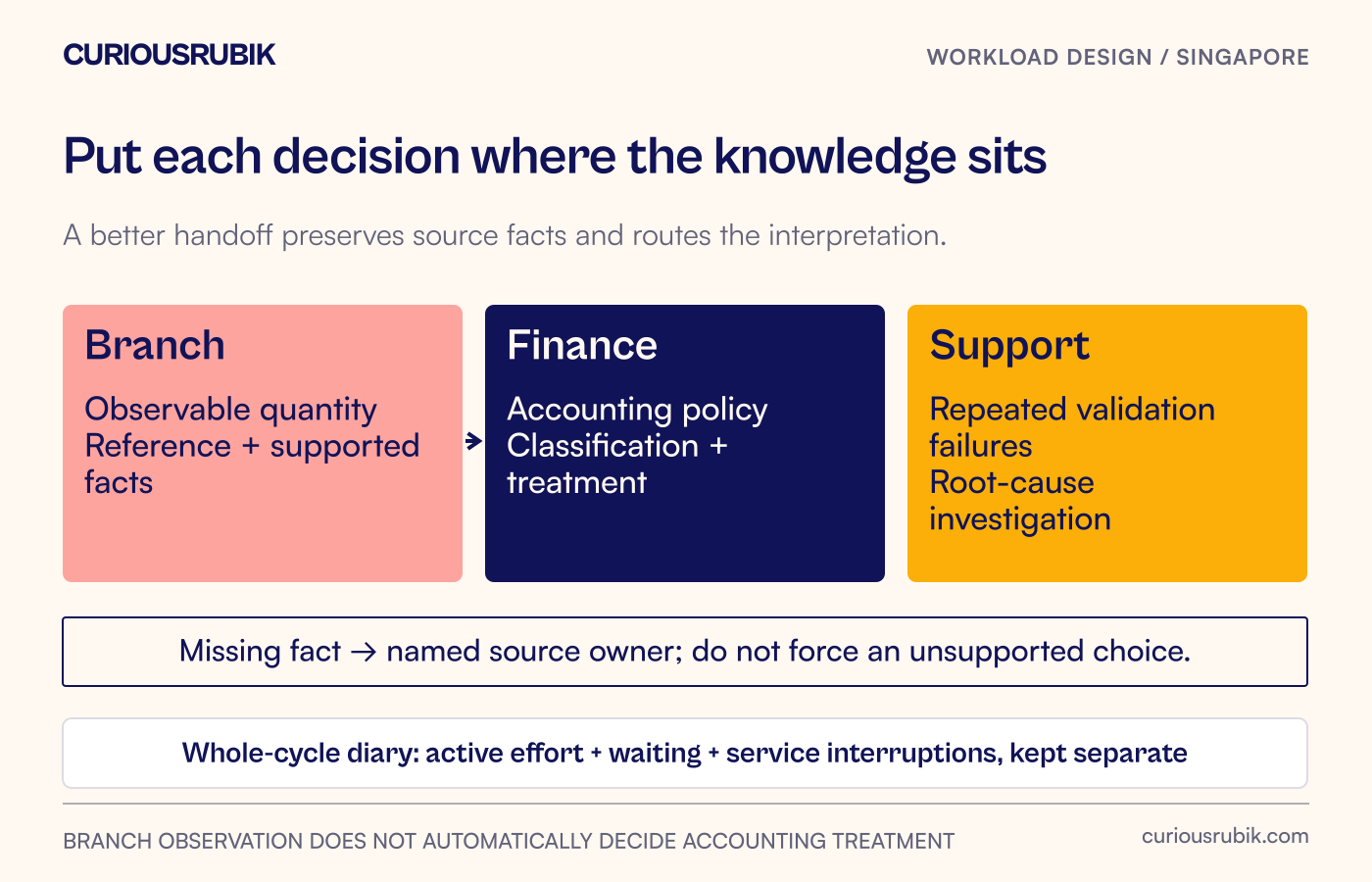
For every new branch field, ask who can establish the underlying fact. An outlet may know which goods arrived and whether the physical count differs from the expected count. Finance may own the accounting classification and policy treatment. Asking the outlet to invent the latter does not improve source capture.
A useful redesign preserves the branch's observation and routes interpretation to the appropriate owner. Instead of “select the correct adjustment code”, the branch might record the observed quantity, relevant reference and reason it can substantiate. The finance owner then applies the approved treatment.
Some tasks should remain local. A manager may be best placed to explain a cash difference or identify the employee who received a delivery. Moving every question back to head office could recreate the original delay. The aim is to place work where evidence and authority meet, then give that person enough time and support.
Enterprise Singapore's F&B Process Optimisation Programme is a useful local reminder of that broader scope: its process-redesign coverage includes outlet layout, technology adoption, menu engineering and job redesign. This does not make every branch project eligible for support. It illustrates why a technology change should be assessed alongside the work people are expected to do.
Repair one burden transfer before widening the rollout
Return to the hypothetical four-outlet case. Suppose the diary shows that most extra branch time concerns three unfamiliar classification choices. The project team should examine whether those choices can be determined from existing approved information or handled by finance, rather than adding more explanatory text to a difficult form.
Try the revised handoff in a limited, representative setting. Preserve the branch's source facts, give interpretation a named owner and make the return query specific enough to answer once. The receiving team confirms that the new record is usable.
Keep a route for genuine exceptions. If the branch cannot establish a fact, it should report that limitation with an owner for resolution. Forcing a choice merely to close the day encourages inaccurate records and hides the need for investigation.
Read the diagram text
CURIOUSRUBIK WORKLOAD DESIGN / SINGAPORE Put each decision where the knowledge sits A better handoff preserves source facts and routes the interpretation. Branch Observable quantity Reference + supported facts Finance Accounting policy Classification + treatment Support Repeated validation failures Root-cause investigation Missing fact → named source owner; do not force an unsupported choice. Whole-cycle diary: active effort + waiting + service interruptions, kept separate BRANCH OBSERVATION DOES NOT AUTOMATICALLY DECIDE ACCOUNTING TREATMENT curiousrubik.com
Compare jobs as well as minutes
A change can reduce total effort while making a critical role less workable. If small tasks are scattered across peak service periods, the branch may struggle even when the daily total looks modest. Review when the work must happen, what can be batched and what competes for the same person's attention.
Consider training, cover and ongoing maintenance. A process that works only for the most experienced outlet manager needs a plan for new starters and absences. Do not count the project team's temporary assistance as free operating capacity.
Released time is not automatically payroll savings. It may improve service, reduce backlog or make growth manageable. Any claim of reduced expenditure needs an actual spending change and a responsible owner. Avoid turning a small distributed time saving into a headcount promise.
Employment obligations and safe staffing still apply. An internal submission deadline should not encourage hidden work outside recorded arrangements or override the appropriate payroll and employment review.
Report the distribution of the result
Present central effort, branch effort, support effort and service or control outcomes together. Explain where the work moved and why. If the business deliberately accepts more branch work for a better result, state that decision and the resources it requires.
Keep a small sample of unresolved and corrected cases in the review. They reveal whether a faster average was achieved by rejecting difficult submissions or leaving them to frontline staff after the measured period ended.
The next useful question for an automation sponsor is therefore very concrete: “Who is doing something now that they did not do before?” Ask it at the outlet, follow the answer through to finance and include that work in the decision about what to change next.