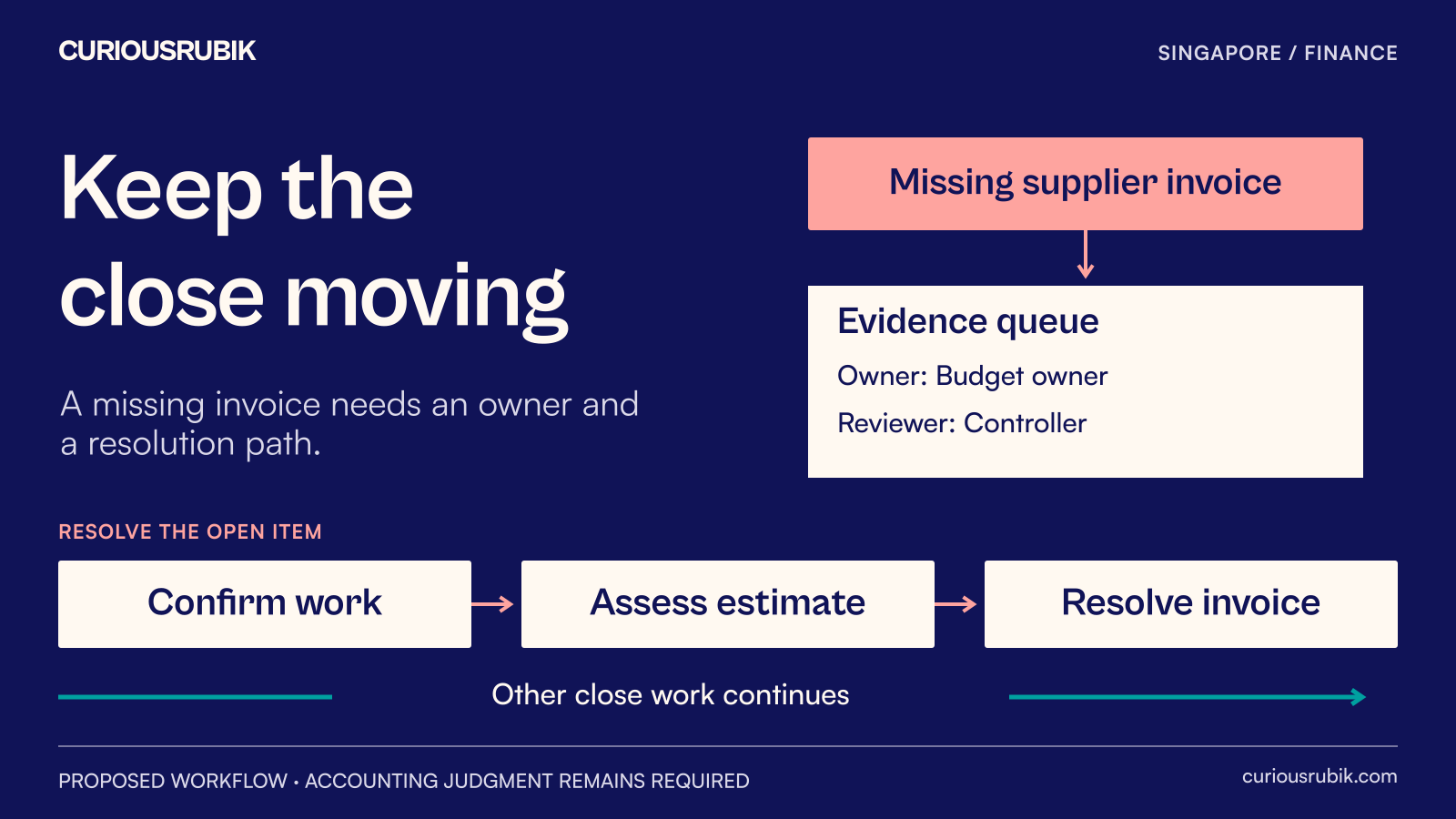
The invoice is missing, but the work may already be complete. That distinction should drive the month-end conversation.
Consider a hypothetical Singapore services company that engaged a contractor for a September project. The project manager confirms completion. An agreed price is available. The supplier has not sent an invoice, and finance is being asked whether the entire close must wait. The useful response is to separate three questions: what happened, what the accounts should reflect, and what evidence is needed when the invoice arrives.
Start with the unfinished question
“Awaiting invoice” is too broad to be a workable status. It can describe completed work awaiting paperwork, an unconfirmed service, a disputed price, or a duplicate request already billed under another reference. Each needs a different response.
Ask the budget owner to identify the unresolved fact. For completed work, useful evidence might include the agreed scope, service dates and a dated confirmation from the person who accepted it. For partially completed work, the owner must explain what was delivered by the reporting date and how that assessment was made. A purchase order alone usually tells finance what was authorised, rather than proving how much work occurred.
The controller then applies the company's accounting policies and applicable reporting framework. Whether to recognise an expense and liability, how to estimate an amount, and how to handle a material uncertainty are accounting decisions. There is no universal missing-invoice threshold that suits every Singapore business.
ACRA's guidance calls for appropriate accounting policies, internal controls and complete, accurate records. The workflow below is a recommended way to support those responsibilities. It is not an accounting rule prescribing the same entry for every missing invoice.
Give one item an identity that survives the close
A missing-invoice register should follow the obligation until it is resolved. Creating a new row every month makes an old problem look like several new ones and increases the risk of double counting.
Use one reference per identifiable obligation, with these fields:
- Supplier and company entity responsible for the purchase
- Service or goods description and reporting period
- Related order, contract or other agreed commercial reference
- Completion evidence, its date and the person who supplied it
- Estimate basis, amount and currency, including what remains uncertain
- Accountant responsible for the proposed treatment and its approval
- Related journal references and planned reversal or reassessment
- Invoice status, next action, named owner and resolution date
Keep the evidence accessible from the row. A note saying “confirmed by operations” should lead to an actual confirmation. If the evidence cannot be retrieved by someone covering for the accountant, the register is storing confidence rather than support.
The resolution date is a date for a specific action. “Supplier chased” is an activity; “budget owner to resolve the disputed service period by Tuesday” gives the team something to manage. Escalate overdue items to the person who can resolve the underlying fact, rather than repeatedly sending a general reminder to everyone.
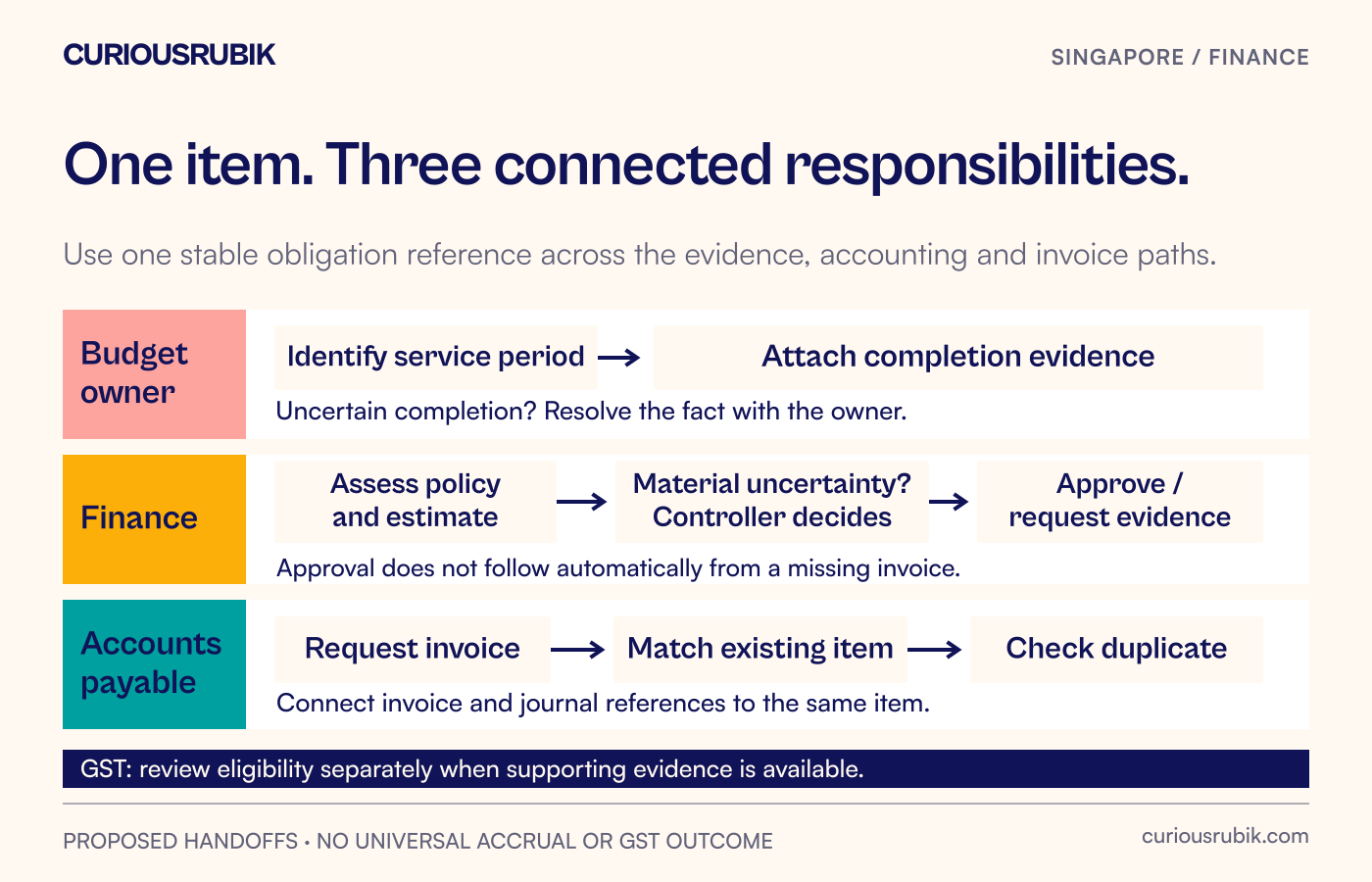
Read the diagram text
CURIOUSRUBIK SINGAPORE / FINANCE One item. Three connected responsibilities. Use one stable obligation reference across the evidence, accounting and invoice paths. Budget owner Finance Accounts payable Identify service period Attach completion evidence Uncertain completion? Resolve the fact with the owner. Assess policy and estimate Material uncertainty? Controller decides Approve / request evidence Approval does not follow automatically from a missing invoice. Request invoice Match existing item Check duplicate Connect invoice and journal references to the same item. GST: review eligibility separately when supporting evidence is available. PROPOSED HANDOFFS · NO UNIVERSAL ACCRUAL OR GST OUTCOME curiousrubik.com
Work through the amount before automating the entry
Return to the hypothetical contractor. Suppose the agreed fee is S$12,000, excluding any applicable GST. The project manager confirms that the contracted work was completed in September. Finance has the agreement and confirmation, but the supplier's final bill is missing.
Those facts give the accountant a basis to assess the September treatment. They do not turn S$12,000 into an automatically approved accrual. The accountant still checks the entity, scope, reporting period, existing postings and any dispute. A variation requested late in the project might change the estimate or require a separate assessment.
Now change one fact. The manager says the project is “mostly done” but cannot identify the unfinished work. Automatically using the purchase order value would hide uncertainty. Finance should ask for a supportable assessment of the work completed, record the limitation and escalate according to materiality. Holding this item for judgment does not require pausing unrelated reconciliations.
Change another fact. The supplier has already invoiced a sister company. The problem is now entity allocation and possible duplicate recognition. Chasing another invoice without investigating the existing one could make matters worse. The register should allow the reason for the exception to change while preserving the original history.
Keep GST recovery on its own track
An accounting estimate and an input-tax claim answer different questions.
For a GST-registered business, IRAS makes input-tax recovery conditional on the relevant requirements. Ordinary local purchases need a valid tax invoice or qualifying simplified tax invoice, alongside the other claim conditions. Approving an estimated expense does not, by itself, establish permission to claim GST. The finance reviewer should assess eligibility and the relevant claim period separately when the required evidence is available.
That separation should be visible in the process. Avoid a single “approved” field that automatically enables both accounting recognition and tax recovery. Use distinct decisions, with references to the evidence each reviewer relied on. Where documentation or treatment is unusual, a qualified tax reviewer should resolve the issue before a claim is made.
This also prevents a common design error: treating the absence of an invoice as proof that nothing belongs in the accounts, then treating the arrival of any invoice as proof that all tax shown is recoverable. Neither shortcut addresses the actual conditions.
The next month is part of this month's control
A close can look tidy while leaving a problem for the following month. Reversing an accrual automatically may remove the balance, but it does not demonstrate that the invoice arrived or that the original obligation disappeared.
For each item, decide what happens if the invoice remains absent. The accountant might need to reassess the estimate under the company's policy, investigate a change in the facts or retain an unresolved status for further review. The workflow should never silently retire the obligation merely because the scheduled reversal ran.
When the invoice arrives, accounts payable should connect it to the existing item before processing it. Finance can then compare the invoice with the earlier estimate, assess any difference and check for duplicate recognition. A variance is useful information: was it caused by an agreed scope change, incomplete completion evidence, an estimation weakness or a billing error?
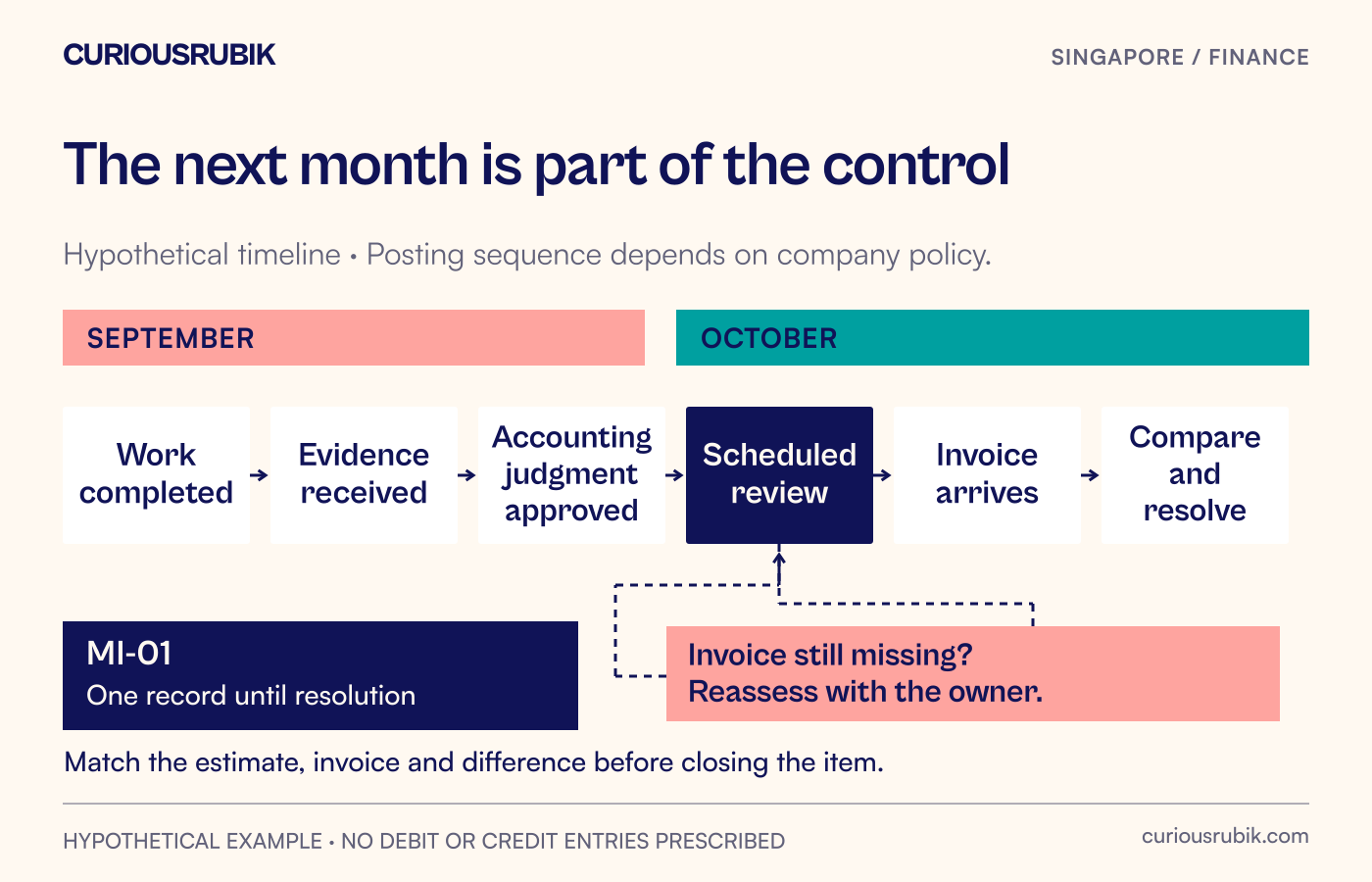
Read the diagram text
CURIOUSRUBIK SINGAPORE / FINANCE The next month is part of the control Hypothetical timeline · Posting sequence depends on company policy. SEPTEMBER OCTOBER Work completed Evidence received Accounting judgment approved Scheduled review Invoice arrives Compare and resolve Invoice still missing? Reassess with the owner. MI-01 One record until resolution Match the estimate, invoice and difference before closing the item. HYPOTHETICAL EXAMPLE · NO DEBIT OR CREDIT ENTRIES PRESCRIBED curiousrubik.com
Do not prescribe one journal sequence for every situation. The appropriate posting depends on the company's accounting method, timing and facts. What the operating process must preserve is the connection between the estimate, subsequent review and eventual resolution.
Automate preparation and follow-up with clear limits
Useful automation can identify open orders near month-end, request completion evidence from the right owner and prepare a list of possible accruals. It can also flag an invoice that resembles an unresolved item or a reversal with no corresponding resolution.
Keep the word “possible” meaningful. A prepared candidate should show why it was selected and what is missing. Finance must be able to reject it, amend it with a reason or request more evidence. A high-value disputed service should not pass because all required fields happen to contain text.
Build a practical fallback. If the evidence feed fails, tell the close owner which items may be missing from the queue. An empty queue should mean that the checks ran and found nothing, rather than that the checks did not run. Preserve manual additions and explain how they enter the same review process.
Judge the pilot after the invoice arrives
Test the register with one recurring category of missing invoices across two closes. Measure the time to an approved accounting decision, the number and value of aged unresolved items, repeat appearances and unexplained differences when invoices arrive.
Read the results together. A faster close with more aged estimates is not a satisfactory outcome. A larger exception list may initially be healthy if it makes previously hidden obligations visible. Discuss the causes with budget owners instead of judging the process by reminder counts.
Start with the oldest missing-invoice item from the last close. Ask who can confirm the work, who can approve the accounting judgment, and what event will finally close the record. If those answers are clear, automation has a process worth supporting.