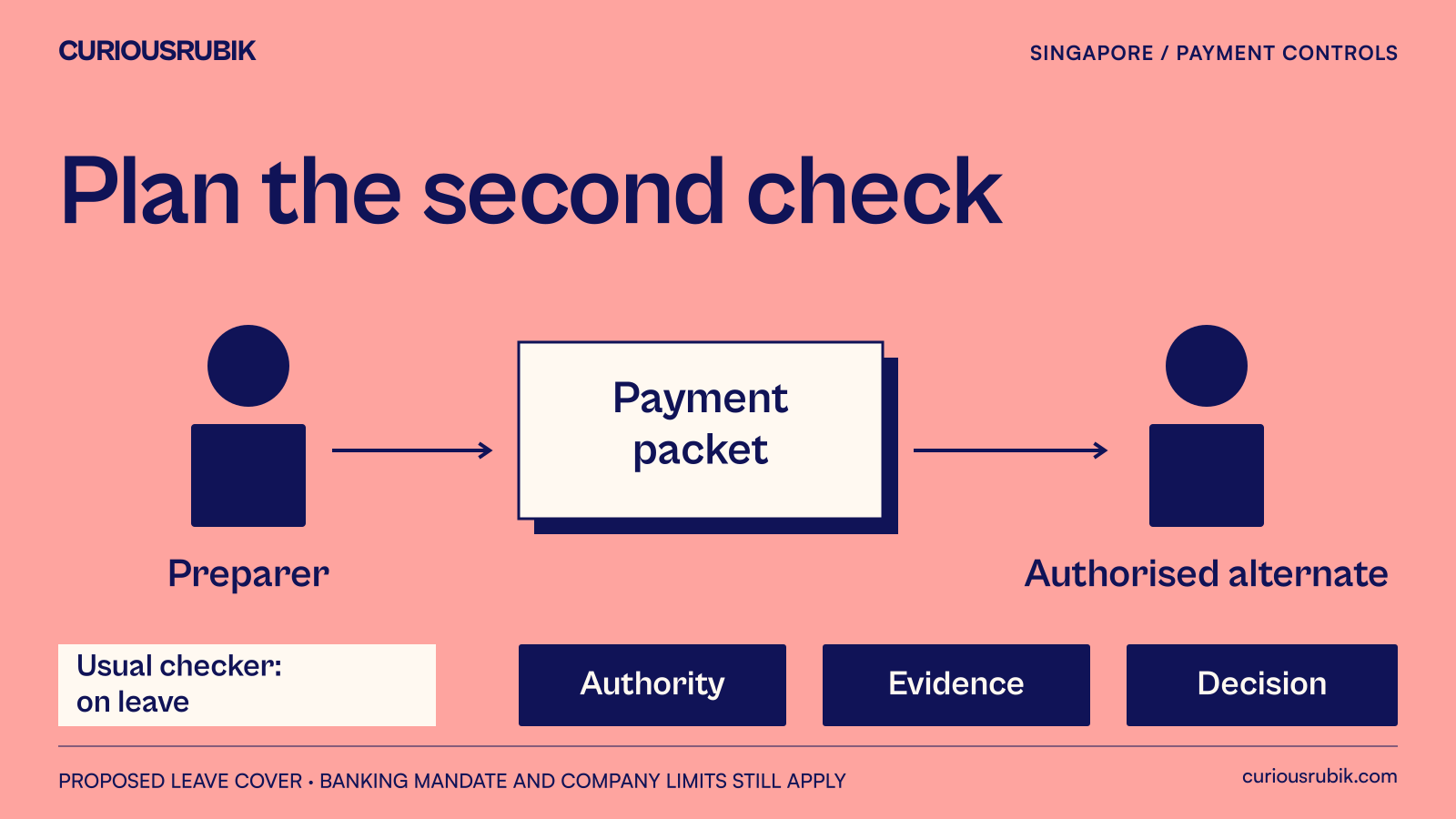
A two-person finance team can have a meaningful payment check on an ordinary day and no workable check when one person is away. The danger becomes clear when a payment is due, the usual checker is unreachable and somebody suggests using their account “just this once”.
Leave cover should be arranged before that moment. Name an authorised alternate, define the decisions they can make and test whether they can actually review and release the relevant payments. Preserve individual accountability throughout.
For a small Singapore company, this may involve an authorised director or another suitably competent person outside the finance team. The right arrangement depends on the company's authority structure, banking mandate and operational needs. A roster cannot create authority that those arrangements do not provide.
Write down what the absent person actually checks
Start with a recent payment run. List the decisions normally made by the preparer and checker. They may include confirming the obligation, examining receipt evidence, checking the payee, reviewing unusual instructions and approving the release.
Then ask which of those steps the proposed alternate understands and can perform. A senior title alone does not make someone an effective checker. They need to know what evidence is normal, what an exception looks like and when to stop and seek advice.
Distinguish commercial approval from payment verification. A department head may confirm that a supplier's work was completed without being authorised to release a payment. A director may have release authority but still need someone to supply the receipt or contract evidence. The coverage plan should connect those roles rather than treating one signature as proof of every underlying fact.
Record prohibited combinations too. If the alternate originated or materially changed a particular instruction, determine who will independently review it. Having the same person prepare and “check” the transaction in different screens does not provide an independent check.
Make the cover roster specific enough to use
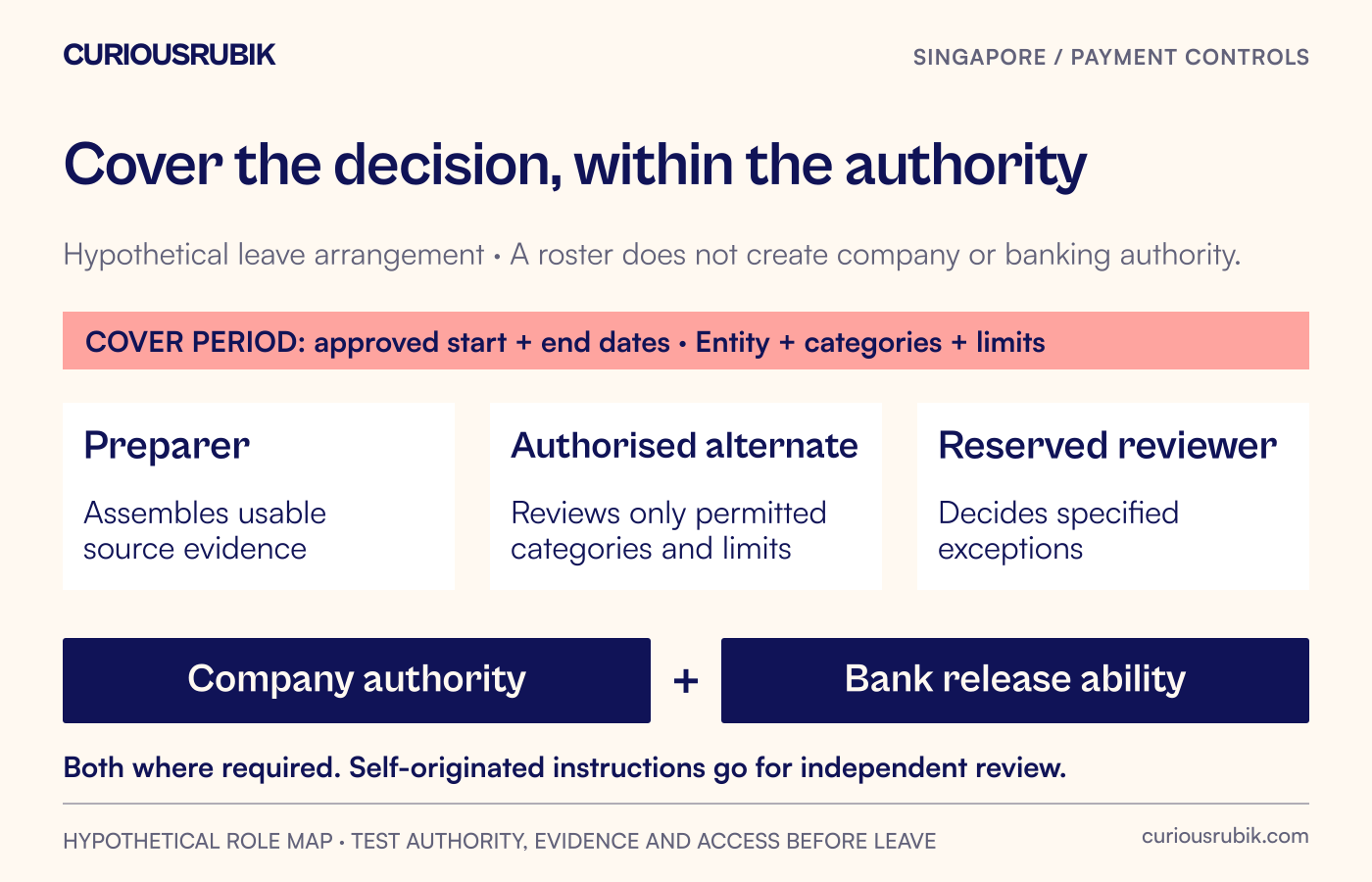
A practical payment-cover roster should state:
- The absence period and the person providing cover
- The legal entity and payment channels covered
- The permitted categories and financial limits
- Decisions reserved for another authorised person
- Evidence required before approval
- Contact and escalation arrangements when the alternate is unavailable
- When temporary authority and access end
Verify authority and access through the proper company and bank procedures. Do not wait until the first payment is due to discover that the alternate can view the file but cannot approve it. Any access change must follow the organisation's security process and applicable approval requirements.
In a hypothetical arrangement, an alternate may cover routine domestic supplier payments within approved limits while changed bank details, unfamiliar payees or unusual cross-border payments go to a reserved reviewer. Those categories are illustrative control choices, not legal thresholds.
Prepare the payment schedule before leave where possible. Identify essential due dates, known exceptions and documents likely to arrive late. Moving a normal payment run earlier may help, provided the business's cash and contractual decisions are properly approved. It does not justify paying an unsupported or not-yet-authorised amount.
Read the diagram text
CURIOUSRUBIK SINGAPORE / PAYMENT CONTROLS Cover the decision, within the authority Hypothetical leave arrangement · A roster does not create company or banking authority. COVER PERIOD: approved start + end dates · Entity + categories + limits Preparer Assembles usable source evidence Authorised alternate Reviews only permitted categories and limits Reserved reviewer Decides specified exceptions Company authority + Bank release ability Both where required. Self-originated instructions go for independent review. HYPOTHETICAL ROLE MAP · TEST AUTHORITY, EVIDENCE AND ACCESS BEFORE LEAVE curiousrubik.com
Give the alternate a reviewable payment packet
The packet should let a reviewer reach a decision without asking the preparer to narrate every transaction. Include the payee, amount and currency, obligation, relevant approval, receipt or service evidence, due date and any change from the established payment instruction.
Provide access to the underlying documents, not just a summary labelled “all matched”. Make unresolved differences prominent. A supplier credit awaiting confirmation, a changed invoice amount or an unusual advance should not be hidden among routine items because the total appears familiar.
The alternate records what they reviewed and the decision. If they need clarification, the preparer should amend the supporting information while preserving the history of the question and answer. If material payment data changes after approval, obtain the required new review. An approval of one version should not silently authorise a different payee or amount.
The aim is an independent decision on usable evidence. It is not to require the alternate to repeat every preparation step or to create a lengthy narrative for every unchanged invoice.
Rehearse three cases before relying on cover
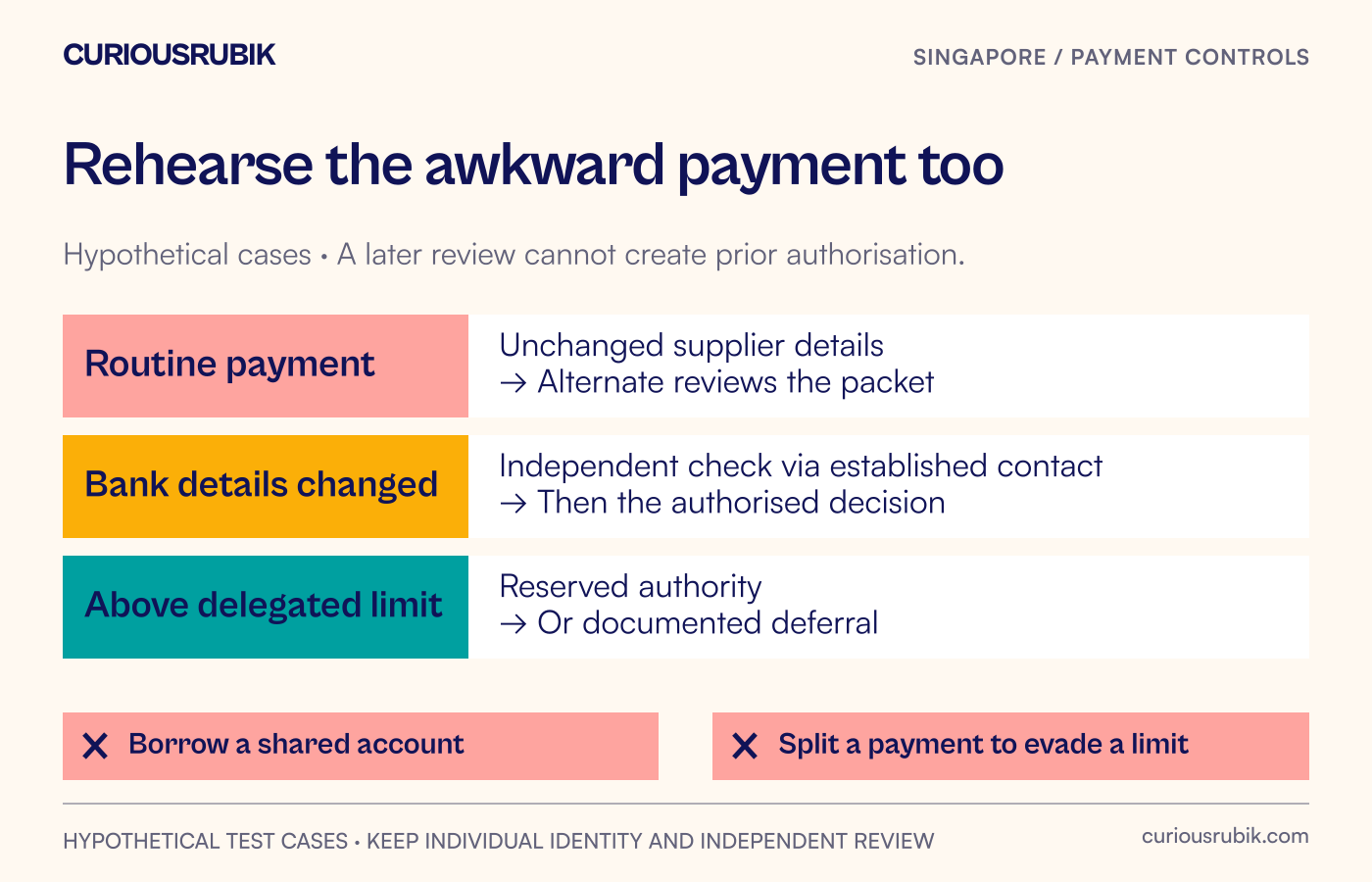
First, take a routine payment to an established supplier using unchanged details. Can the alternate see the approved obligation, receipt evidence and proposed payment? Can they record and carry out their decision within the authorised process?
Second, introduce changed bank details. Singapore Police Force advice highlights the need to verify unusual emailed payment instructions through another medium. The cover plan should specify who performs that verification using independently established contact details and who reviews the result. Familiarity with the supplier does not remove the need to examine the change.
Third, introduce an essential payment outside the alternate's limit. The correct result may be escalation, an authorised bounded exception or a decision to defer. The answer should not be to split the payment, lend an account or have the preparer sign twice.
Read the diagram text
CURIOUSRUBIK SINGAPORE / PAYMENT CONTROLS Rehearse the awkward payment too Hypothetical cases · A later review cannot create prior authorisation. Routine payment Unchanged supplier details → Alternate reviews the packet Bank details changed Independent check via established contact → Then the authorised decision Above delegated limit Reserved authority → Or documented deferral Borrow a shared account Split a payment to evade a limit HYPOTHETICAL TEST CASES · KEEP INDIVIDUAL IDENTITY AND INDEPENDENT REVIEW curiousrubik.com
A tabletop exercise often reveals practical gaps. The alternate may not have a current contact for the supplier. The evidence may be stored in the absent employee's personal folders. The bank's approval window may differ from the company's planned run. Resolve these issues before they become a real deadline problem.
When both ordinary routes are unavailable
An emergency procedure should identify the person who can decide on a genuine exception, the limits of that decision and the evidence that must follow. It should also acknowledge when no authorised route is available. In that situation, the business must manage the resulting delay through an authorised decision rather than disguising a control failure as normal approval.
Record the operational consequence, alternatives considered, specific payment and reason the ordinary cover failed. Preserve the actual time and nature of approval. A subsequent review can evaluate the decision and identify improvements, but cannot retroactively turn an unapproved release into a pre-approved one.
Repeated use of the emergency route indicates a coverage problem. It may reflect an unavailable alternate, unclear authority, poor evidence preparation or an unrealistic payment calendar. The finance lead should examine the cause rather than simply raising the emergency limit.
Keep the absent employee's leave genuine. A plan that routinely depends on them checking messages abroad has not created reliable coverage and may fail precisely when they are least reachable.
Automate routing without borrowing identity
Automation can activate the approved cover schedule, send the alternate a review packet and highlight reserved categories. It can retain who reviewed which version and flag payments that remain undecided as a deadline approaches.
The routing must remain inside the approved authority. If no qualified alternate is available, the payment should enter a visible exception queue. Automatically sending it back to the preparer or escalating to anyone with a senior job title creates a misleading appearance of control.
When leave ends, confirm that the ordinary route has resumed and temporary access or authority is addressed through the proper process. Review transactions still pending under the alternate. An expired cover assignment should not strand an essential payment or leave temporary privileges in place indefinitely.
ACRA's director guidance emphasises appropriate controls and accurate records. The roster described here is a recommended way to make those principles workable during absence, not a universal regulatory prescription or a guarantee against fraud.
Judge cover by what happened at the difficult moment
Measure payments released without the intended independent check, essential payments blocked by missing cover and frequency of emergency exceptions. Review the underlying cases rather than celebrating a zero-delay result that may have been achieved by bypassing the check.
Ask the alternate whether the evidence was sufficient and whether they understood their authority. Ask the preparer which information was repeatedly missing. Enterprise Singapore's continuity guidance recommends exercises and regular review; a payment-cover test is a practical application of that approach.
Before the next planned absence, run one routine payment and one deliberately awkward example through the proposed cover arrangement. If the team can show who decided, what they reviewed and why the decision was within authority, the roster is doing useful work.