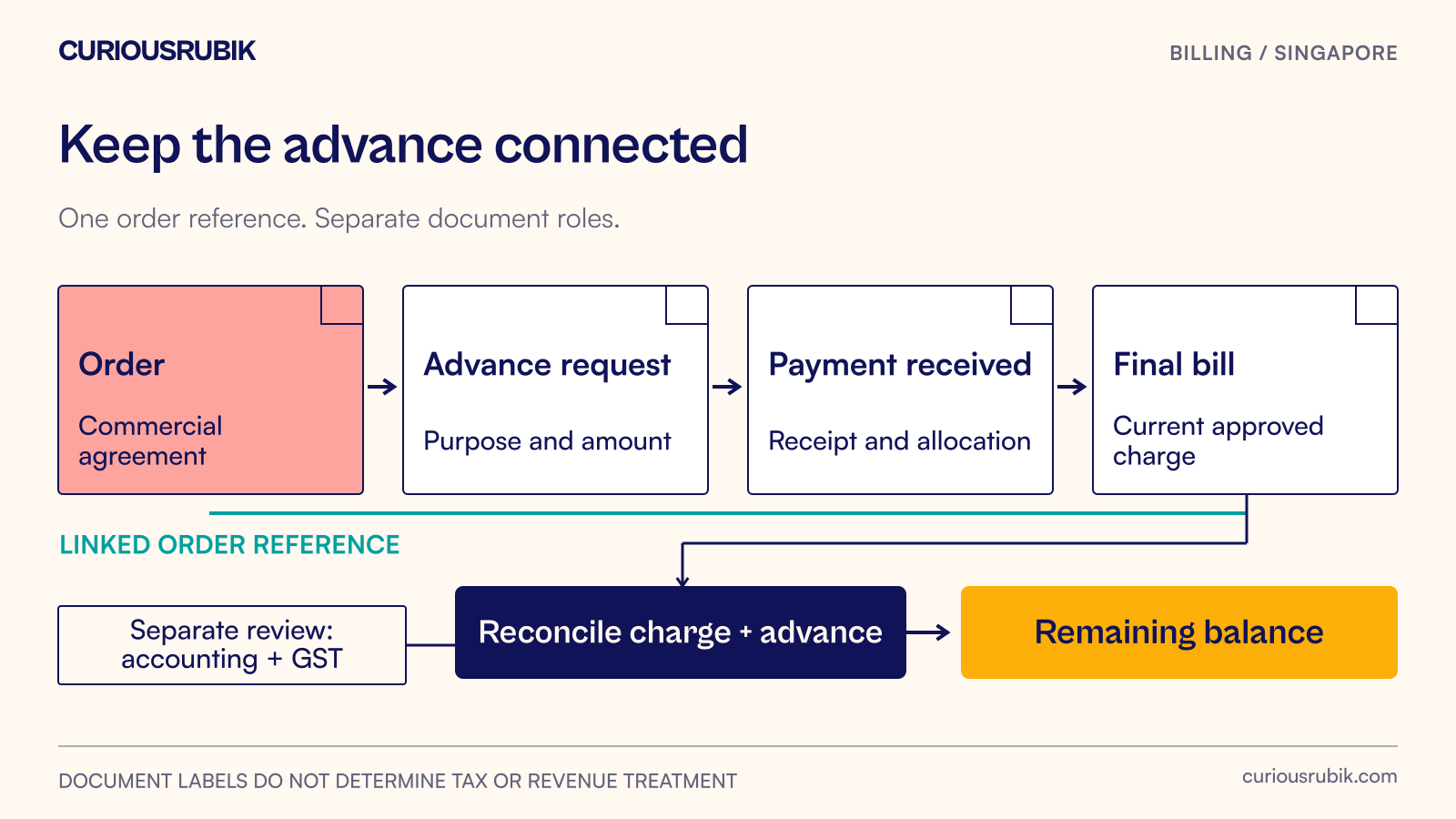
The customer has already paid an advance. The final invoice is issued for the full order, and the collections team asks for the full amount again. Nobody intended to double bill: the payment sits in one list, the advance request in another and the final invoice carries no reliable connection to either.
The useful control is a transaction chain that preserves the different purposes of each record. Give the order, request, receipt and final bill distinct identities, then reconcile the money across them before asking the customer to pay again.
Name the role of each document
The commercial order records what the parties agreed. A pro forma may communicate proposed charges or support an advance request. The payment record establishes what money was received and from whom. The final billing document records the relevant charge, while the reconciliation shows how earlier payments have been applied.
These roles should be clear in the document's wording and in the internal workflow. Do not let a file name decide the accounting or tax treatment. A document called “pro forma” may still need review of what it actually does, and a payment can have consequences before the final invoice exists.
For GST-registered businesses, IRAS states that most transactions follow the earlier of invoice issuance or receipt of payment for time of supply. Its guidance generally distinguishes pro forma documents that do not serve as bills from invoices that do. A qualified reviewer should apply the rules to the actual arrangement, including any special timing provisions.
The accounting question remains separate. Receiving money does not automatically establish that revenue should be recognised. Finance assesses that under the applicable reporting framework and the facts of the supply.
Build the reconciliation before producing the final bill
The billing lead should own the chain from advance request to closure. The cash team identifies and matches receipts; the commercial owner confirms the agreed order and changes; finance approves the treatment and final reconciliation.
Use these fields for each order:
- Customer and supplying legal entities
- Approved order reference and current commercial version
- Advance request reference, purpose and amount
- Receipt date, amount, currency and payment reference
- Confirmed allocation to the order or reason it remains unmatched
- Final approved charge and relevant billing references
- Amount of advance applied and any amount remaining unused
- Balance still payable or proposed refund, with approval status
- Accounting and GST review references
- Exception owner, next action and closure evidence
Keep a receipt's identity stable if it is split between orders. Record each allocation so the total cannot exceed the amount received. A free-text note copied into several orders can make the same advance appear available more than once.
The customer-facing document should make the outstanding amount intelligible. The internal reconciliation must also demonstrate that the same supply or payment has not been counted twice. The exact presentation depends on the arrangement and earlier documents; a qualified finance reviewer should decide how the final document connects with any prior billing.
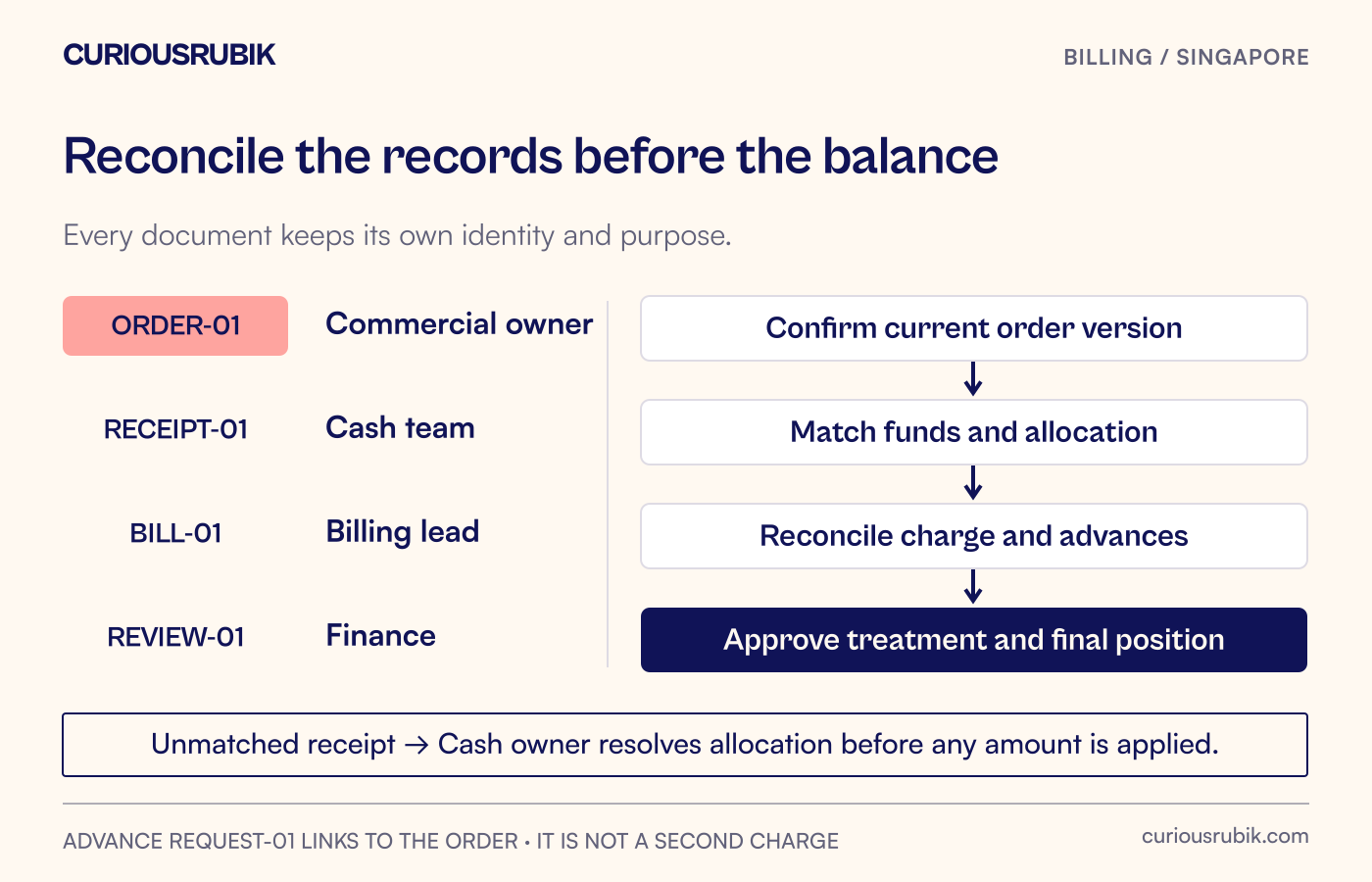
Read the diagram text
CURIOUSRUBIK BILLING / SINGAPORE Reconcile the records before the balance Every document keeps its own identity and purpose. ORDER-01 Commercial owner Confirm current order version RECEIPT-01 Cash team Match funds and allocation BILL-01 Billing lead Reconcile charge and advances REVIEW-01 Finance Approve treatment and final position Unmatched receipt → Cash owner resolves allocation before any amount is applied. ADVANCE REQUEST-01 LINKS TO THE ORDER · IT IS NOT A SECOND CHARGE curiousrubik.com
Test a changed order rather than a perfect one
Consider a hypothetical order initially agreed at S$10,000. The customer pays S$3,000 in advance. Before completion, an authorised scope change brings the final commercial amount to S$12,000. These figures exclude tax and currency effects so the example can isolate the linkage problem.
The reconciliation starts with the current approved S$12,000 charge, identifies the S$3,000 receipt and shows S$9,000 still payable if the full advance is available for this order. The original S$10,000 order version remains in the history as superseded commercial information. It does not become another amount to collect.
Now suppose only S$2,000 of the receipt was intended for this order and S$1,000 for another. Finance should not apply all S$3,000 because the bank narrative mentions the customer's name. The cash owner obtains the allocation evidence and records the split. The first order then has S$10,000 still payable, while the other allocation remains separately visible.
A third variation is cancellation after the advance. The workflow should bring the commercial terms, approved cancellation decision and tax treatment together. It should not automatically convert every unused advance into either a refund or revenue. The reviewer needs to establish what the business is entitled or required to do.
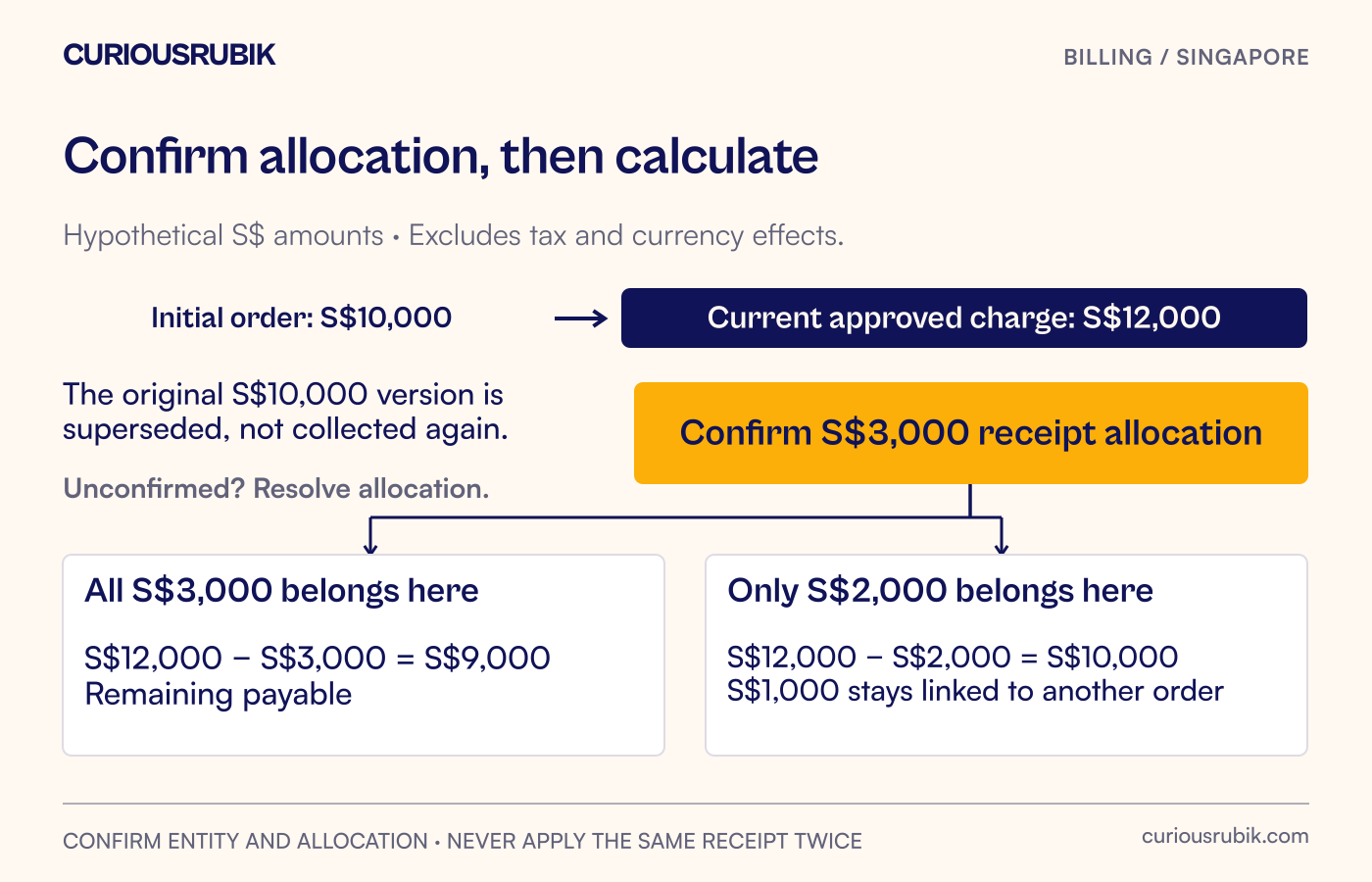
Read the diagram text
CURIOUSRUBIK BILLING / SINGAPORE Confirm allocation, then calculate Hypothetical S$ amounts · Excludes tax and currency effects. Initial order: S$10,000 Current approved charge: S$12,000 The original S$10,000 version is superseded, not collected again. Confirm S$3,000 receipt allocation All S$3,000 belongs here S$12,000 − S$3,000 = S$9,000 Remaining payable Only S$2,000 belongs here S$12,000 − S$2,000 = S$10,000 S$1,000 stays linked to another order Unconfirmed? Resolve allocation. CONFIRM ENTITY AND ALLOCATION · NEVER APPLY THE SAME RECEIPT TWICE curiousrubik.com
Find out what the deposit is securing
“Deposit” is an ambiguous label. It may describe partial payment for a supply or money held as security. For a GST-registered supplier, IRAS distinguishes those purposes: partial-payment deposits generally trigger GST on receipt, while refundable security deposits have different treatment when applied against payment due.
The word “refundable” alone does not settle the classification. A refundable advance can still form part of the purchase price. Record the contractual purpose, conditions for application or refund and how the money has actually been used. Route unclear arrangements to the GST reviewer before relying on a default treatment.
Do not generalise a treatment from a rental deposit to every other business arrangement. A security deposit, an advance for goods and a payment associated with cancellation can require different analysis. The operating process should preserve the facts that let the reviewer distinguish them.
Make the awkward receipts visible
An unidentified receipt is a queue item with an owner. It should not be applied to the oldest invoice simply to clear the bank reconciliation when the customer's intention is uncertain.
Record what is known: payer name, date, currency, amount and available narrative. The cash team coordinates with the account owner to obtain a remittance explanation through an appropriate channel. Keep any likely matches marked as proposals until confirmed under the company's controls.
Overpayments and currency differences also need explicit treatment. A receipt that appears slightly short may include bank charges; a difference could instead reflect a dispute or a payment for another document. Finance should resolve the cause before closing the chain.
When one customer group contains several legal entities, check both the paying entity and the entity whose obligation is being settled. A familiar group name is insufficient authority to offset balances across entities. Obtain the relevant evidence and approval for any permitted application.
Automate the connections that can be explained
Automation can suggest a receipt match, display unused advances and warn when a final bill repeats a reference already billed. It can also prevent allocations exceeding a recorded receipt and identify an order closed while money remains unapplied.
Keep the evidence beside the suggestion. A match based only on a similar amount is weaker than a confirmed order reference. Partial payments, split receipts and revised orders should enter an exception path that preserves the available facts.
Before activating a routine, test a repeated pro forma, two orders for the same customer, a cancelled order, a receipt in another currency and a final bill created after a scope change. The test passes when the team can explain the correct outstanding amount and the unresolved decisions, rather than merely generate a document.
Measure unmatched advance age, duplicate collection requests, unused balances on closed orders and corrections after final billing. Review whether a faster billing cycle has left more money unresolved.
Take one recently completed order with an advance. Ask a colleague to reconstruct the current charge, payments applied and remaining balance using only the linked records. If they need to ask three departments for the story, improve that chain before automating another invoice.