For Malaysian wholesale CFOs and finance heads who want supplier e invoices checked, matched and posted without a second typist.
Last reviewed: 23 November 2026. Rule details reflect LHDN pages checked on this date. Confirm your own position with your tax adviser.
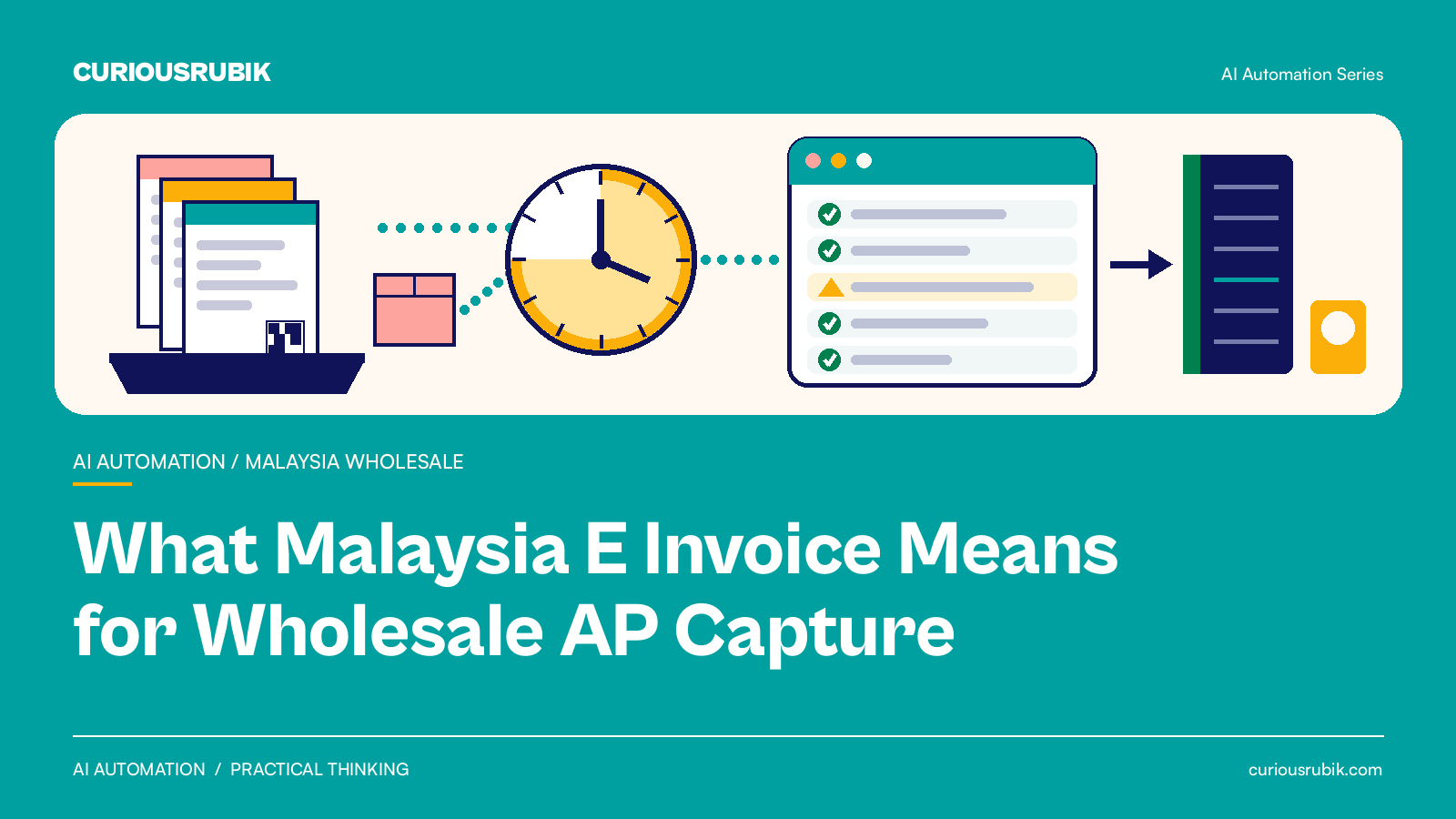
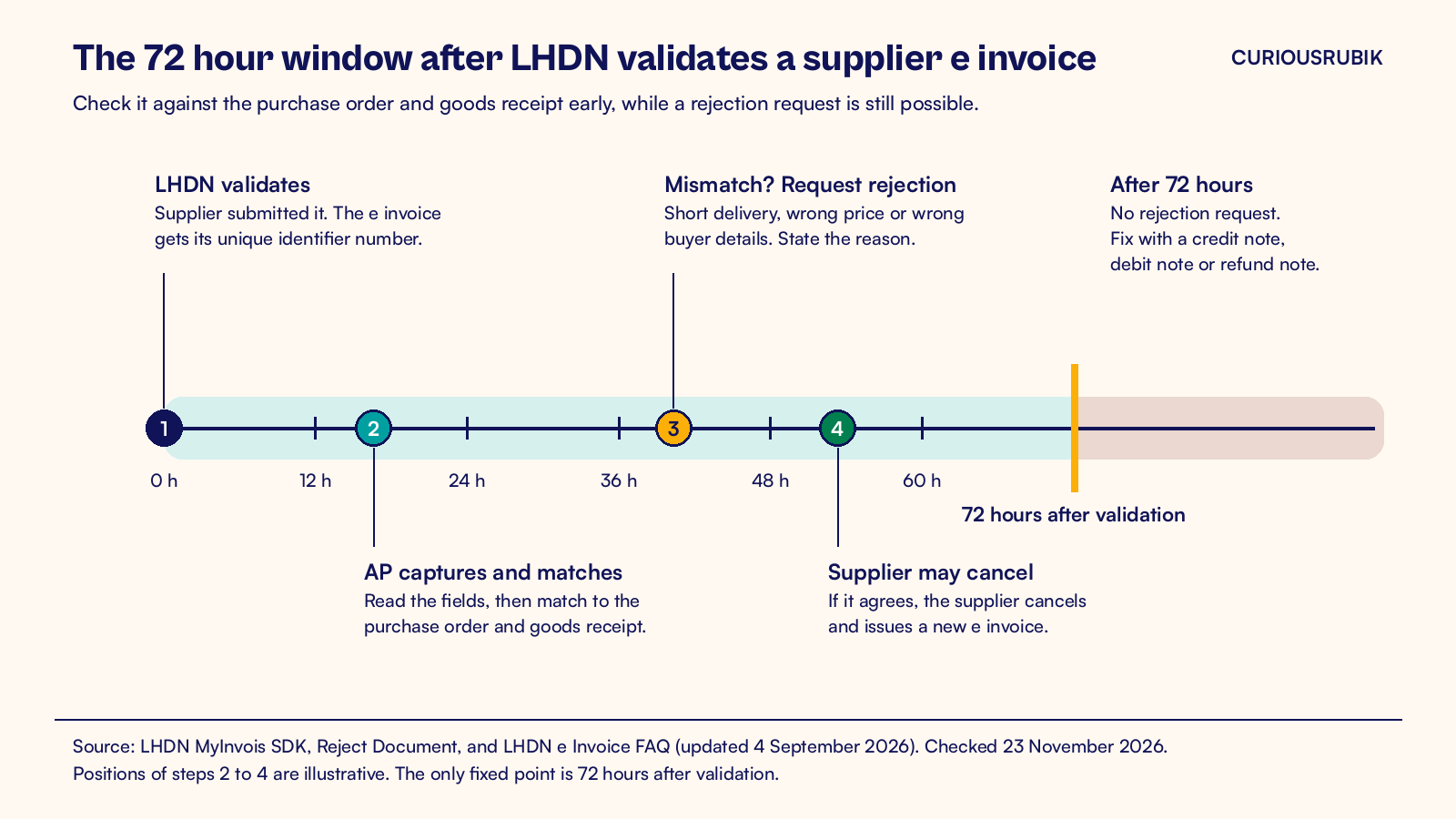
Malaysia e invoice puts LHDN validation in front of many supplier invoices, so wholesale AP capture now runs against a clock. You have 72 hours from validation to request a rejection. Capture that reads each invoice on arrival, matches it to the purchase order and goods receipt and flags problems early keeps that window open.
Key takeaways
- Businesses with annual turnover or revenue of RM3 million or more must issue e invoices, and so must some smaller firms in larger groups.
- After 72 hours from validation, a wrong invoice needs a credit, debit or refund note.
- Some documents are yours to raise, such as self billed e invoices for imported goods.
What is Malaysia e invoice, and which suppliers are in scope?
Malaysia e invoice is the national system where LHDN, the Inland Revenue Board of Malaysia, validates each invoice before the supplier shares it with the buyer. Suppliers submit it through the MyInvois Portal or an API, a direct link between systems. LHDN checks it and gives it a unique identifier number.
The LHDN e invoice implementation timeline, updated on 30 August 2026, sets these dates by annual turnover or revenue.
| Annual turnover or revenue | Start date |
|---|---|
| More than RM100 million | 1 August 2024 |
| More than RM25 million, up to RM100 million | 1 January 2025 |
| More than RM5 million, up to RM25 million | 1 July 2025 |
| Up to RM5 million | 1 January 2026 |
| Less than RM3 million | Exempt |
LHDN raised the exemption level from RM1 million to RM3 million from 1 September 2026. Its e invoice FAQ of 4 September 2026 says some group cases are not exempt. One example is a subsidiary of a holding company with turnover or revenue of at least RM3 million.
The same FAQ gives businesses up to RM5 million an interim relaxation period until 31 December 2027, with more room to issue consolidated e invoices. Add the exempt suppliers, and a wholesaler still receives a mix of validated and normal invoices.
What lands on the AP desk once suppliers issue e invoices?
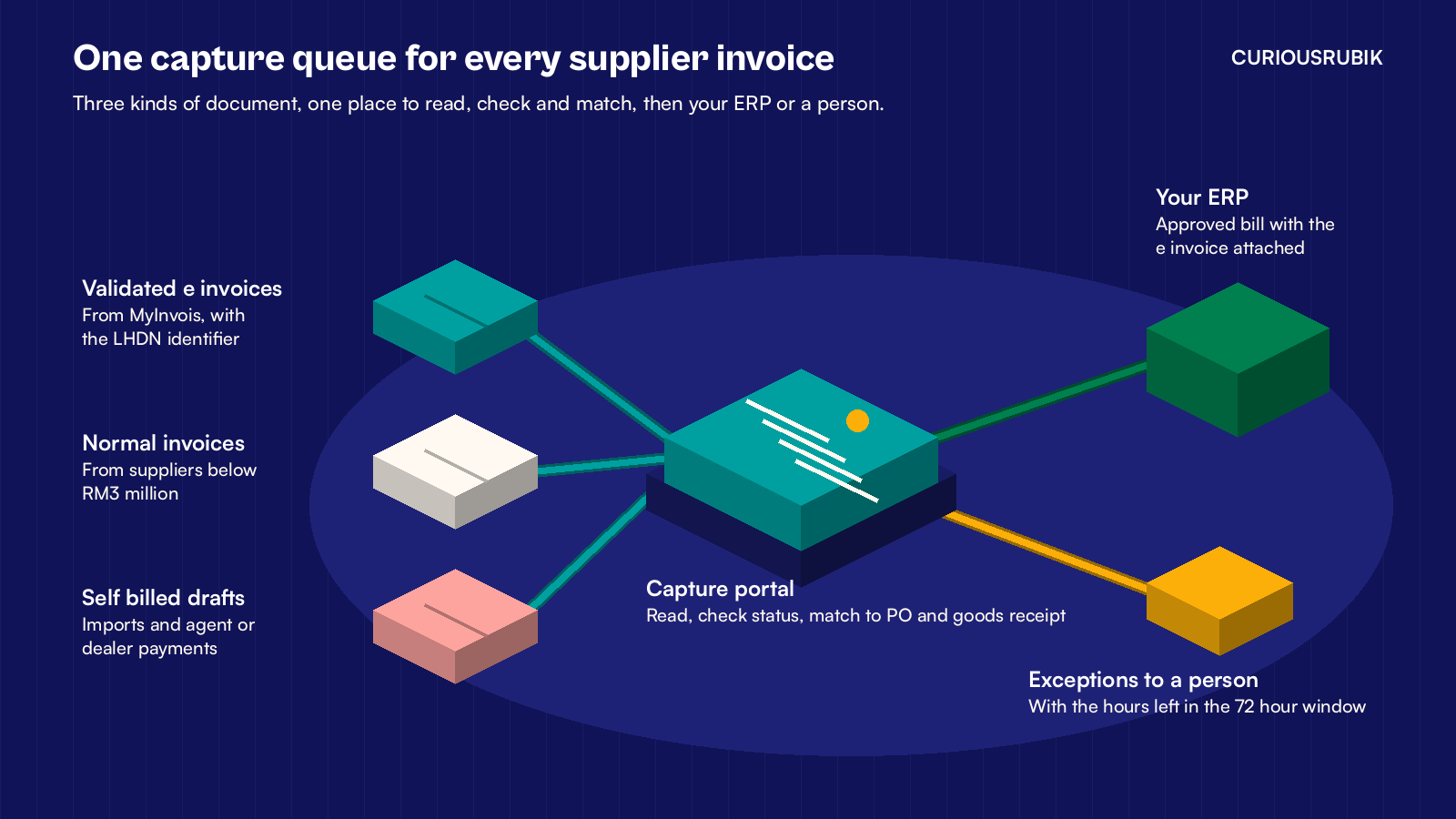
Accounts payable (AP) is the team and process that receives supplier invoices, checks them and gets them ready for payment. A wholesale AP desk now handles three kinds of document.
- Validated e invoices. The supplier shares the XML or JSON file, a visual copy such as a PDF with a QR code, or both. The supplier's own invoice number stays on the document, next to the LHDN identifier.
- Normal invoices. These come from suppliers below the RM3 million exemption level. The LHDN FAQ says a normal invoice from a supplier that does not yet issue e invoices still supports the purchase for tax purposes.
- Self billed e invoices you raise. These cover set cases, such as imported goods, foreign suppliers and payments to agents, dealers and distributors. For imported goods, the deadline is the end of the second month after the month of customs clearance.
The clock matters most. As the MyInvois reject document guide sets out, a buyer can request a rejection within 72 hours of validation. The supplier then decides whether to cancel and reissue. After 72 hours, any fix needs a credit note, debit note or refund note.
For a wholesaler, 72 hours is short. An invoice left in a shared mailbox over a long weekend can miss the window before anyone opens it.
How does Malaysia e invoice change wholesale AP capture?
AP capture used to mean typing supplier invoices into your system days after they arrived. Now it also has to check the e invoice status and catch mismatches early. An AI automation portal does this work in one controlled place and connects to your ERP or current system.
- Collect every invoice in one queue. Bring in e invoices issued to you through MyInvois, plus PDFs and scans from the AP mailbox.
- Read the fields. The model reads the supplier, tax identification number, lines, tax, totals and the LHDN identifier.
- Check the status. Confirm the e invoice is validated and not canceled. Flag a normal invoice from a supplier you expect to issue e invoices, so someone can ask why.
- Match to the purchase order and goods receipt. Quantity, price and tax are compared line by line.
- Route mismatches inside the window. Short deliveries, price differences and wrong buyer details go to a named person, showing the hours left in the 72 hour window.
- Prepare self billed drafts. For imported goods and agent or dealer payments, the portal drafts the self billed e invoice from your purchase records for a person to approve.
- Write the approved bill to your ERP. Attach the e invoice and its identifier, so an auditor can trace it.
A person still makes the calls that change money or tax. That means requesting a rejection, releasing payment, changing supplier bank details and accepting a tax amount that differs from the purchase order. The portal only prepares the evidence.
When you test the reading step, judge invoice extraction by the fields that could change the payment, not by an overall accuracy score. Later, suppliers can check invoice and payment status themselves through vendor portals.
A hypothetical Selangor distributor's AP desk
A hypothetical Selangor food distributor receives 1,200 supplier invoices a month. Two AP clerks key and match each by hand, at about 5 minutes per invoice. That is 6,000 minutes, or 100 hours, a month.
With capture and matching in a portal, 900 invoices match cleanly and need about 1 minute to approve. The other 300 have an exception and need about 4 minutes each.
| Invoices | Before | After |
|---|---|---|
| Clean matches | 900 x 5 min = 4,500 min | 900 x 1 min = 900 min |
| With an exception | 300 x 5 min = 1,500 min | 300 x 4 min = 1,200 min |
| Total a month | 6,000 min (100 hours) | 2,100 min (35 hours) |
That frees about 65 hours a month for supplier queries, month end and cash planning. Each exception also reaches a person on the day it arrives, well inside 72 hours. These are example figures, so measure your own baseline first.
The same pattern works for customer orders, as our guide to AI order entry for Singapore wholesalers shows. For the wider picture from capture to payment, read accounts payable automation beyond invoice processing.
What to check with your AP team this week
Five checks show where the time and risk sit, before any software decision.
- List your top 50 suppliers by invoice count and mark which ones already send validated e invoices.
- Count how many e invoices last month were checked against the goods receipt within 72 hours of validation.
- Find who raises your self billed e invoices for imports and agent payments, and how close to the deadline they run.
- Time 20 invoices from arrival to posting, so you know your minutes per invoice.
- Confirm your company name, address and tax identification number in each top supplier's records.
If the 72 hour count is low, start there. A late check turns a quick cancel and reissue into a credit note chase. Tax rules depend on your facts, so confirm the details with your tax adviser.
At CuriousRubik, we build these portals one workflow at a time for wholesale distribution teams. CuriousRubik can design an AI automation portal that connects supplier invoice capture to the systems you already run. You can book a consultation to walk through one workflow, agree what good looks like and see a working result before you decide the next step.
Related reading
Closing the Month When Supplier Invoices Are Still Missing
How to close on time when some supplier invoices have not arrived yet.
Accounts Payable Automation: Beyond Invoice Processing
What AP automation covers after the invoice is read, up to payment readiness.
AI Order Entry for Singapore Wholesalers Tired of Retyping
The same capture and check approach applied to customer orders.