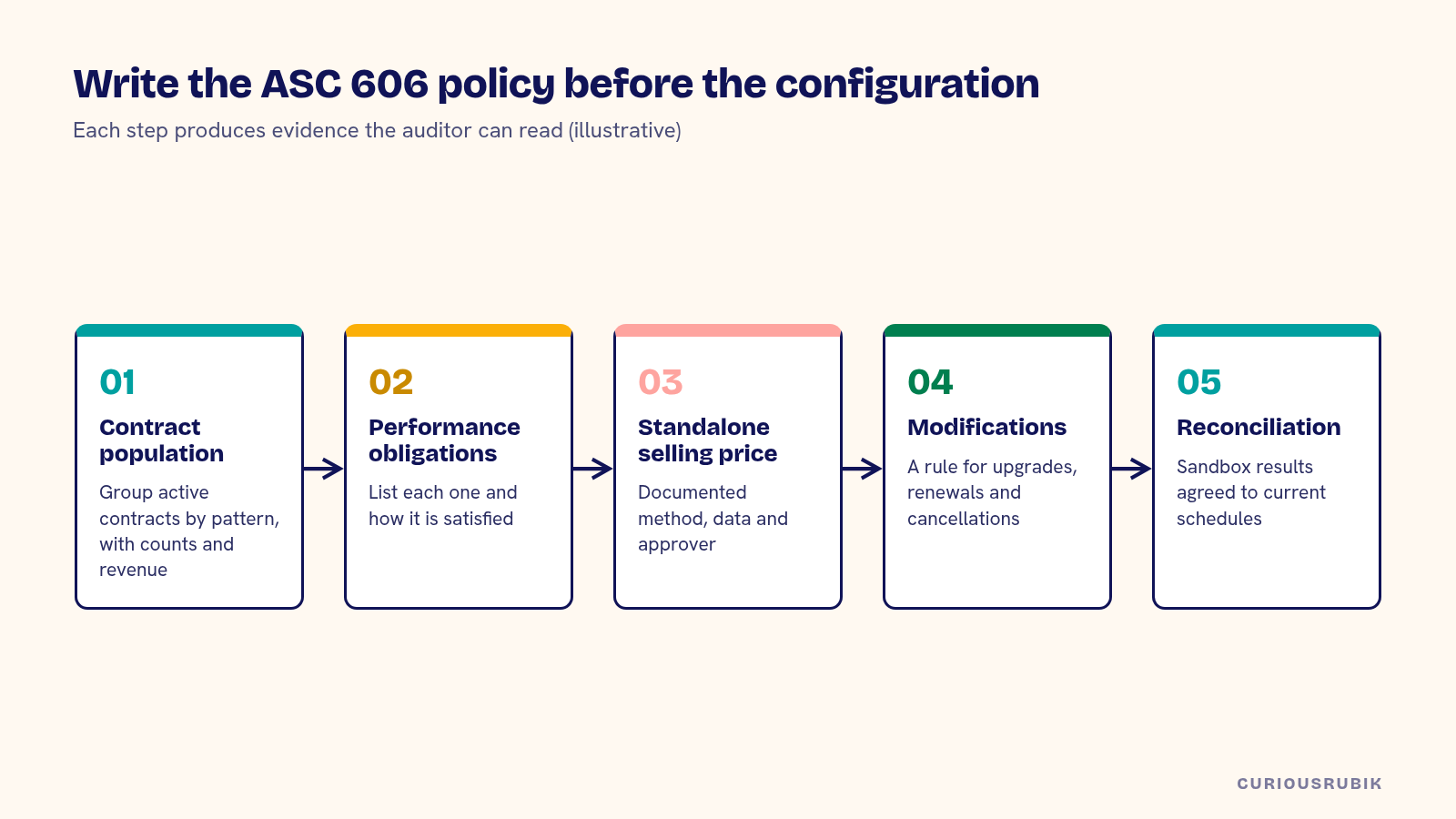
A NetSuite ASC 606 setup works when finance has documented its revenue policy before anyone configures Advanced Revenue Management. That means a contract population sorted by type, a list of performance obligations with their recognition pattern, standalone selling prices with a method behind them, a policy for contract changes, and a reconciliation test that proves the output against your current schedules. Configuration then follows the policy.
The usual mistake runs the other way. The team enables Advanced Revenue Management, builds a few revenue rules from the product catalog and loads open contracts. Three months later the auditors ask how the allocation was derived and nobody can show the link between policy and setup.
Sort your contracts into a population you can test
Pull every active contract and group it by structure. A typical US software or services company finds a handful of patterns: annual subscriptions billed upfront, multi-year deals with ramps, implementation services sold with a subscription, usage charges and hardware with support.
Count contracts and revenue by pattern. The patterns with the most revenue, and the ones with the most exceptions, drive the design. A contract type that appears twice a year might be better handled with a documented manual entry than a complex rule.
Check the data while you are there. Revenue rules depend on reliable start and end dates, term lengths and item lines on each order. If those live in a CRM or a contract system, find out how often they are wrong. A subscription with no end date or a services line priced at zero will flow straight into the revenue plans, and the error will surface weeks later as an unexplained deferred balance.
Write down the performance obligations
ASC 606 asks you to identify the distinct goods or services promised in each contract. For each pattern, list the performance obligations and how each one is satisfied: at a point in time, ratably over a term, or as work progresses.
Then map each obligation to the items you sell. In NetSuite, the item is where much of the revenue behavior is set, through revenue recognition rules and related settings. If one item covers two obligations, or two items represent one, the mapping needs fixing before configuration, either in the item catalog or in how sales enter orders.
Set standalone selling prices with a method
Where a contract has more than one performance obligation, the transaction price is allocated using relative standalone selling prices. NetSuite can store these and apply them during allocation, but it can't decide them. Finance needs a documented method for each item or item group, such as observable prices, ranges from historical sales or a cost-plus approach, with the data behind it.
Agree how often SSP is reviewed and who approves changes. An SSP table that was right two years ago and never revisited is a common audit finding.
Decide how contract changes are handled
Upgrades, downgrades, early renewals and cancellations all change revenue. Before configuration, decide for each common modification whether it is treated as a separate contract, a prospective change or a cumulative catch-up, and what evidence sales must provide.
NetSuite can process modifications to revenue arrangements, and the result depends on the policy and the data you feed it. Our guide to revenue arrangement changes after contract amendments shows the mechanics. The policy decision has to come first.
A hypothetical bundled contract allocation
A hypothetical US software company signs a contract for $120,000: a one-year subscription and an implementation service. Its documented SSPs are $100,000 for the subscription and $40,000 for implementation. All figures are illustrative.
| Obligation | SSP | Share of SSP | Allocated price | Recognition |
|---|---|---|---|---|
| Subscription, 12 months | $100,000 | 71.4% | $85,714 | Ratably, $7,143 a month |
| Implementation | $40,000 | 28.6% | $34,286 | As the work is completed |
| Total | $140,000 | 100% | $120,000 |
The invoice shows $90,000 for the subscription and $30,000 for services, because that is how sales priced it. Revenue follows the allocation instead. The controller tests the NetSuite revenue plans for this contract against the spreadsheet schedule finance has used until now. They agree to the dollar on the subscription. The implementation plan differs, because the spreadsheet used straight-line recognition while the policy says progress-based. That difference is a policy issue, and finance resolves it before go-live.
Prove the output with reconciliation tests
Before go-live, run open contracts through NetSuite in a sandbox and compare the results with your current schedules. Test at least these: deferred revenue by customer at the cutover date, revenue recognized in the first month, the allocation on a sample of bundled contracts and the treatment of a recent modification.
After go-live, reconcile deferred revenue in the GL to the revenue plans every month. Differences usually come from manual journals, plans that didn't update after an order change or migrated balances that never had plans. Our post on reconciling NetSuite deferred revenue to revenue plans sets out the monthly routine.
Plan the disclosures and the migration together
ASC 606 disclosures need data such as remaining performance obligations and contract balances. Decide which reports will produce them and test those reports during the project. Building them after the first audit request is harder. Give each disclosure a named owner in finance, and agree with the auditor which saved search or report is the source, so the same number appears every quarter.
Migrating open contracts is the riskiest part. Decide whether to load contracts with full history and let NetSuite rebuild revenue plans, or load remaining balances only. Each choice has consequences for comparatives and for how modifications behave later. If you bill subscriptions, read NetSuite for SaaS companies: billing and ASC 606 alongside this post.
Check NetSuite ASC 606 readiness before you configure
Run through this list with your controller and auditor before configuration starts:
- Are active contracts grouped into patterns, with counts and revenue for each?
- Is every performance obligation listed with its recognition pattern?
- Does each item map cleanly to one performance obligation?
- Is there a documented SSP method, with data and an approval owner?
- Is there a written policy for each common contract modification?
- Is a sandbox reconciliation planned against current schedules, with named contracts?
- Are disclosure reports specified and tested before go-live?
- Is the open contract migration approach decided and agreed with the auditor?
A CuriousRubik NetSuite implementation can treat a reconciled revenue cutover as an agreed outcome with acceptance criteria, priced under outcome-based NetSuite pricing. For the product mechanics, see NetSuite Advanced Revenue Management from Contract to Ledger. Revenue and tax design often meet on the same invoice, so check NetSuite sales tax setup for US nexus too.
Related reading: NetSuite Advanced Revenue Management from Contract to Ledger
Frequently asked questions
Does NetSuite make us ASC 606 compliant?
No software does that on its own. NetSuite's Advanced Revenue Management can automate allocation and recognition, but compliance depends on your policy, data and review controls.
Do we need Advanced Revenue Management for ASC 606?
Not always. Simple contracts may be handled with more basic revenue recognition features or manual schedules. Bundled contracts and frequent modifications usually justify it. Confirm licensing for your account.
Who sets standalone selling prices?
Finance, with a documented method and data. NetSuite stores and applies them.
What should we test before go-live?
Deferred revenue by customer at cutover, first-month recognized revenue, a sample of bundled allocations and a recent contract modification, each compared to your current schedules.
When should the auditors be involved?
Early. Share the policy, the SSP method and the migration approach before configuration, so their questions shape the design instead of the cleanup.