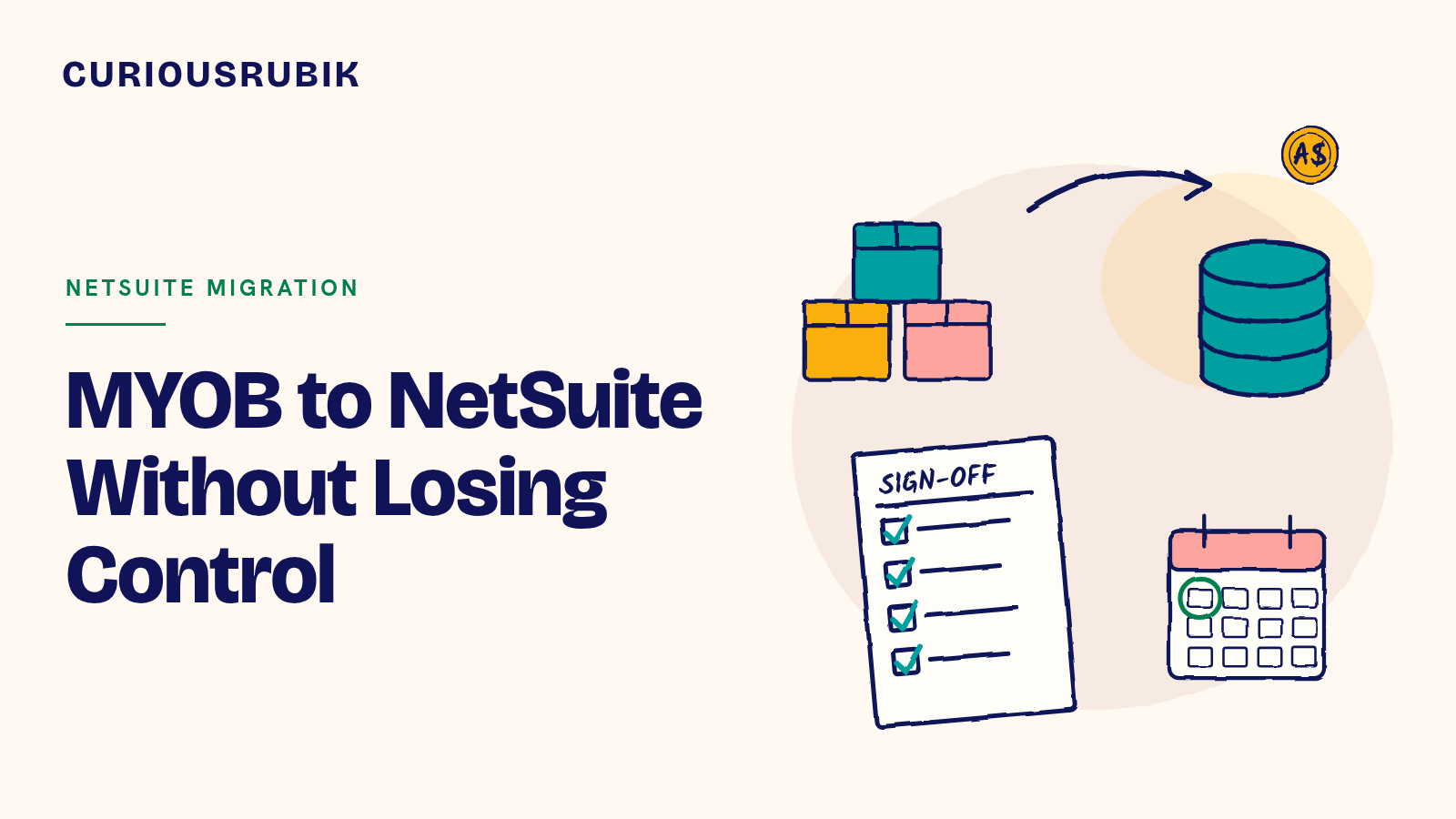
A move from MYOB to NetSuite keeps financial control when four boundaries are set before any data moves: a cutover date on a BAS period end, a tax code map that ties every MYOB code to a NetSuite code and BAS label, a payroll plan that respects STP year-to-date figures, and opening balances that finance signs off against MYOB reports. Get those right and the data load becomes routine work.
Most MYOB migrations go wrong in the same few places. Jobs and categories are mapped loosely, and project reports stop making sense. Payroll moves mid-year and STP figures need repair. The first BAS from NetSuite doesn't agree with the GL, and nobody knows whether the problem is migration or configuration.
Write down what MYOB can no longer do for you
Start with the problems that pushed you to move. Typical ones: a second entity being consolidated in Excel, stock that only reconciles after manual adjustments, purchase approvals that live in email, and an ecommerce platform posting summaries that hide the detail.
Each problem becomes a test you will run on migrated data before go-live. If the reason for moving was stock accuracy, the acceptance tests should prove stock accuracy. If you haven't settled on NetSuite yet, our comparison of NetSuite vs MYOB Acumatica may help first.
Choose a cutover date on a BAS boundary
Cut over at the end of a BAS period so each activity statement comes from one system. If you lodge quarterly, 1 July, 1 October, 1 January or 1 April are natural dates. The last BAS before the switch is prepared in MYOB. The first after it comes from NetSuite.
A 1 July cutover has extra appeal because it also aligns with the financial year and the payroll year. It also lands in the busiest weeks for most Australian finance teams. If you choose it, protect the team's time for EOFY work and plan the June close in MYOB in detail.
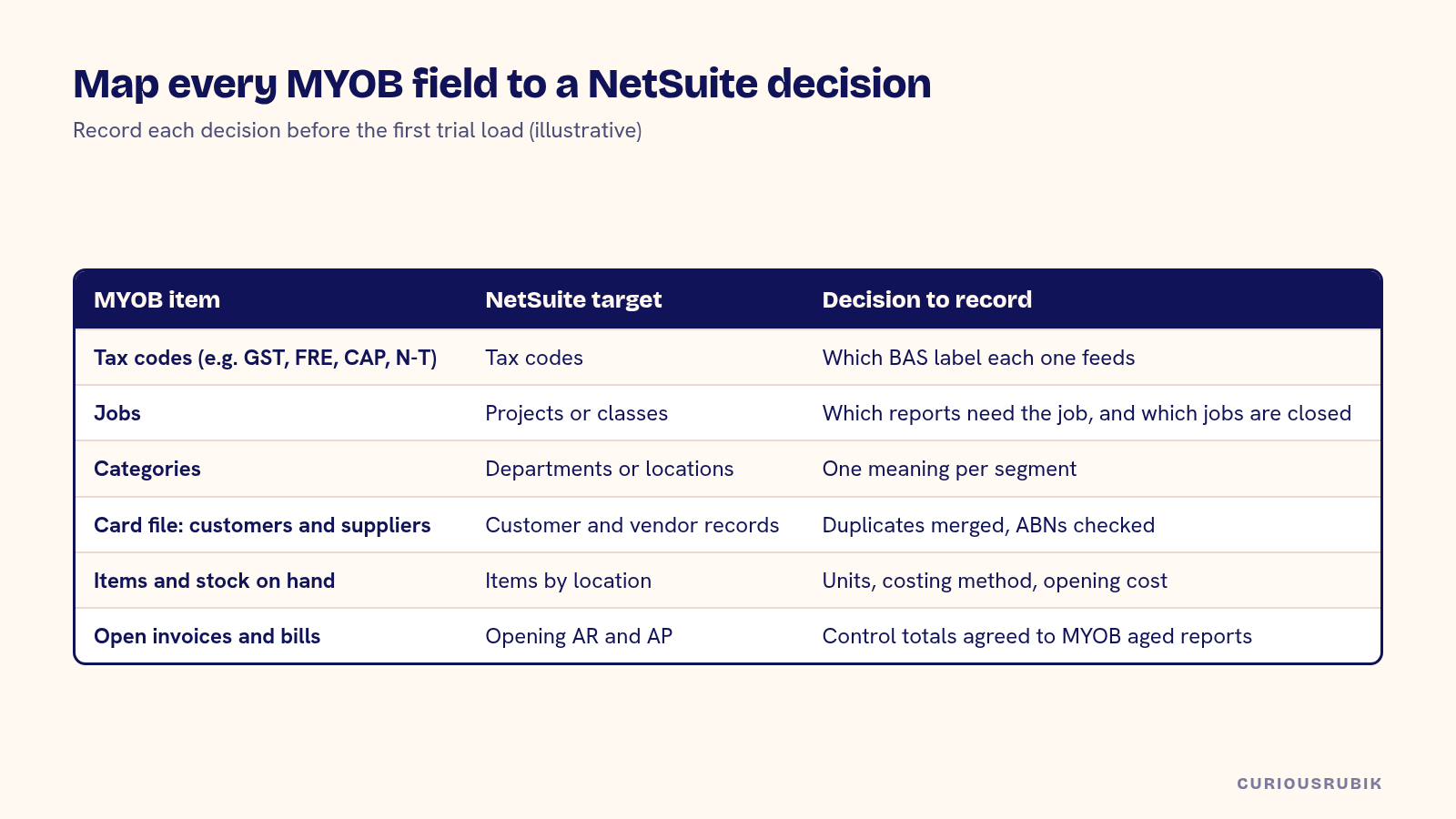
Map MYOB tax codes, jobs and categories
Export every tax code used in MYOB over the last year with transaction counts. MYOB files often contain codes such as GST, FRE, CAP and N-T, plus custom codes someone added years ago. Map each one to a NetSuite tax code and to the BAS label it should feed. Capital purchases, GST-free supplies, imports and input-taxed items need explicit decisions.
MYOB jobs and categories usually become NetSuite projects, classes, departments or locations. Base the decision on the reports you want from NetSuite. A job list with 2,000 entries, half of them closed years ago, should be cleaned before mapping.
Decide what history to bring across
NetSuite needs opening balances, open receivables and payables, stock on hand by location and open orders. Closed transaction history is a choice. Monthly summary balances for the prior one or two years usually support comparative reporting at much lower effort. Our guide to how much transaction history to migrate sets out the options.
Keep MYOB accessible in read-only form, or archive the reports you need, for as long as your record-keeping obligations and audit needs require. Test that someone can find a pre-migration invoice before you cancel the subscription.
Plan payroll around STP year-to-date figures
If payroll is moving off MYOB at the same time, treat it as its own workstream. Changing payroll software mid-year means your STP reporting must carry year-to-date amounts correctly from the old system to the new one, or employees may see duplicated or missing income in their records. Moving at 1 July avoids most of that work.
Since Payday Super began on 1 July 2026, super contributions are due within seven business days of each payday, so the new payroll setup and its super payment process must work from the first pay run. Rehearse a full pay cycle in parallel before cutover. For the NetSuite side of payroll, see NetSuite Single Touch Payroll integration and reconciliation.
A hypothetical opening balance sign-off
A hypothetical Brisbane manufacturer moves from MYOB AccountRight to NetSuite on 1 October after its September quarter BAS. The finance lead compares MYOB reports at 30 September with NetSuite after the final load. All figures are illustrative.
| Control total | MYOB report | NetSuite after load | Difference | Resolution |
|---|---|---|---|---|
| Trade debtors | A$1,318,400 | A$1,318,400 | 0 | Agreed |
| Trade creditors | A$742,150 | A$740,900 | A$1,250 | Supplier credit not loaded; reloaded |
| GST clearing | A$48,610 | A$48,610 | 0 | Agreed |
| Stock on hand | A$2,066,300 | A$2,066,300 | 0 | Agreed by location |
| Open purchase orders | 63 | 63 | 0 | Agreed |
The A$1,250 creditor difference comes from a supplier credit that failed validation in the load file. It is corrected and reloaded, and the difference report is attached to the sign-off. Without a control total for creditors, it would have appeared as an unexplained balance on the first supplier statement reconciliation.
Reconcile the first BAS and first close
Treat the first BAS from NetSuite as an acceptance test. Agree each label to the tax codes and the GL, and check that opening balances haven't generated GST a second time. Compare it with the same quarter last year from MYOB. Big swings in GST-free sales or capital purchases usually point to a mapping error. Our guide to tracing Australian GST from NetSuite transactions to the BAS covers the reconciliation in detail.
Then run the first month-end close as a timed rehearsal, with reconciliations for bank, debtors, creditors and stock. Note every step that still needs Excel. That list becomes your first improvement backlog.
Run the MYOB to NetSuite go-live checklist
Before you confirm the go-live date, check these:
- Is the cutover on a BAS period end, with the last MYOB BAS planned?
- Is every MYOB tax code mapped to a NetSuite tax code and BAS label?
- Are jobs and categories cleaned and mapped to the NetSuite segments you will report on?
- Is the history decision recorded, with retrieval of old records tested?
- If payroll is moving, is it timed to protect STP year-to-date figures, with a parallel pay run?
- Have control totals for debtors, creditors, GST, stock and open orders agreed in at least two rehearsals?
- Is the first BAS from NetSuite defined as an acceptance test with a named reviewer?
- Are the original reasons for moving written as tests on migrated data?
CuriousRubik data migration services can plan the cutover, run the rehearsals and agree the sign-off evidence with your finance team, and our NetSuite work for Australian businesses shows how migration fits into the first close. The same control-total method appears in Moving from QuickBooks to NetSuite Without Losing Financial Control. If your cutover falls near 30 June, combine this plan with the NetSuite EOFY checklist for Australian finance teams.
Related reading: NetSuite Opening Balance Reconciliation from Source Books to Sign Off
Frequently asked questions
Can we migrate from MYOB to NetSuite mid-quarter?
You can, but the BAS for that quarter then has to be combined from two systems. A cutover at a BAS period end is easier to prepare and review.
Should payroll move to NetSuite at the same time?
Payroll usually moves to a separate STP-enabled product that integrates with NetSuite. If you change payroll software, 1 July is the simplest date for STP year-to-date figures.
Do we need all our MYOB history in NetSuite?
Usually not. Open transactions, stock and opening balances are required. Closed history can often stay in MYOB read-only or in archived reports.
What are control totals?
Agreed figures, such as total debtors or stock on hand, that must match between MYOB and NetSuite after each load. They make the sign-off objective.
How many rehearsal loads do we need?
At least two full rehearsals with reconciled control totals. Add another if the first two show unresolved differences.