Last reviewed: 10 October 2026. Product details reflect this review date. Availability and behavior can vary by account, role and release.
Editorial ink illustration: Two colleagues compare a received tool purchase with its supporting record.
A nonprofit receives 5,000 for a named program and later records 2,000 of program spending. It is tempting to subtract the expenditure and announce that 3,000 remains restricted. That calculation is only meaningful after the finance owner confirms what the donor required, what the spending represents, and whether an authorized release has actually been recorded.
NetSuite nonprofit functionality can support recording restrictions on contributions and releasing revenue when the applicable donor restrictions have been satisfied. The software provides a way to represent the process; qualified nonprofit finance staff determine the accounting interpretation and approved treatment.
This lesson helps a finance user organize that work and reconcile the resulting records. It is a training explanation, not an accounting opinion or journal-entry instruction. Confirm the installed nonprofit SuiteApps, edition, regional availability, permissions, and configuration before applying the method to your account.
Keep three business facts separate
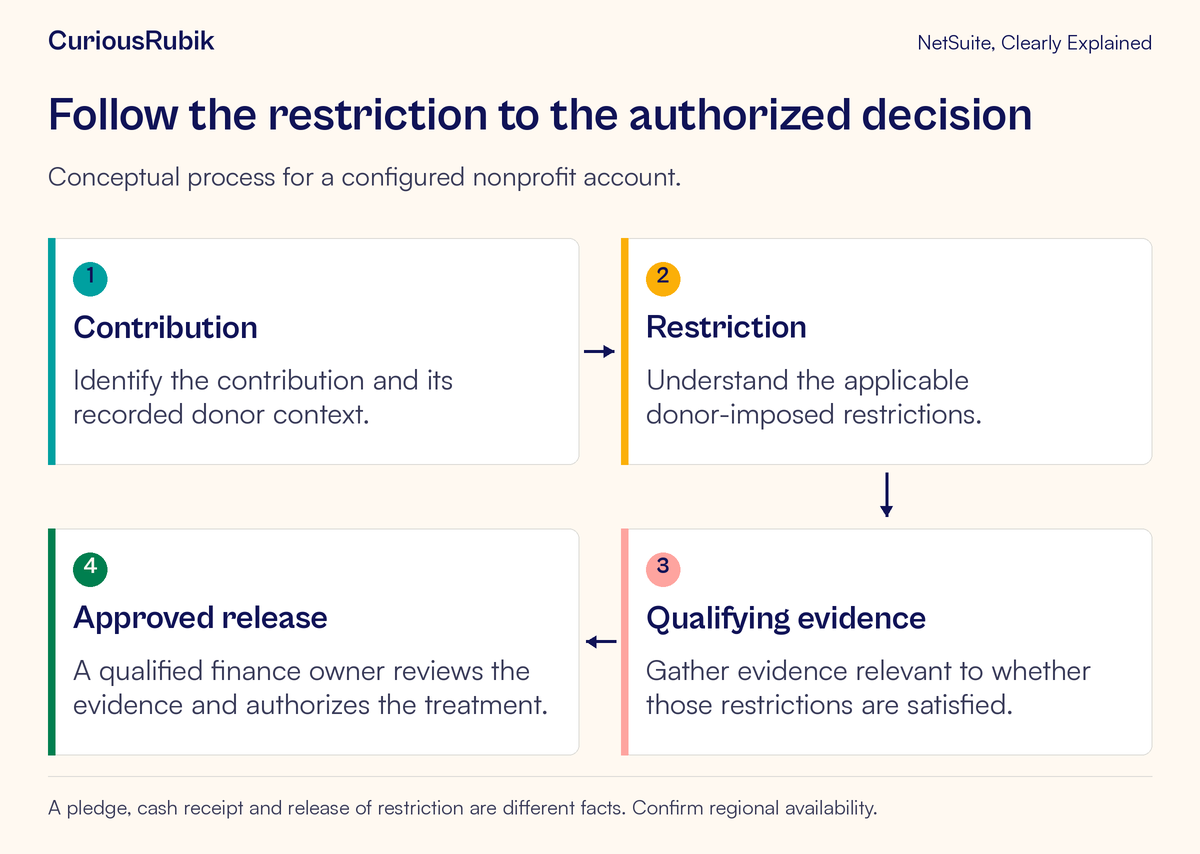
The first fact is the contribution and its associated donor context. The second is the restriction that governs how or when the contribution may be used under the finance team's interpretation. The third is the authorized release recorded when the relevant requirements have been satisfied.
A pledge, a cash receipt, and a release of restriction are also different events. Their timing and accounting treatment can differ. Seeing money in a bank account does not, by itself, explain whether a contribution remains restricted or whether a release is appropriate.
Use specific language in working notes. Instead of “The grant is used up,” write what the records establish: a contribution amount, a set of expenses, a reviewed release amount, and a remaining restricted balance within a defined scope.
Be careful with the word “condition.” In everyday conversation it can mean any donor requirement, while nonprofit accounting may use it more specifically. Have the qualified finance owner distinguish donor restrictions, conditional arrangements, and any other relevant treatment. A data-entry tutorial should not collapse those distinctions.
Read the donor purpose before choosing a code
Start from the approved donor documentation and the finance team's interpretation. Identify which contribution the document concerns, the relevant purpose or timing requirement, and any supporting detail needed for review.
A purpose example might identify a literacy program. A timing example might relate to a future period. Real agreements can include several requirements, and satisfying one may not satisfy the others. Do not infer release eligibility from a short transaction memo if the underlying terms are more specific.
The finance owner should decide which classifications and records express the approved interpretation in your configured account. That could involve the relevant restriction, program, grant, or other dimensions supported by the installed solution. Use your account's definitions rather than inventing fields because a diagram contains those words.
The lesson on accounts and segments helps explain why a transaction can carry several kinds of meaning. A program code helps identify an activity, but the code alone does not prove that spending satisfies a donor restriction.
Work through a fictional program contribution
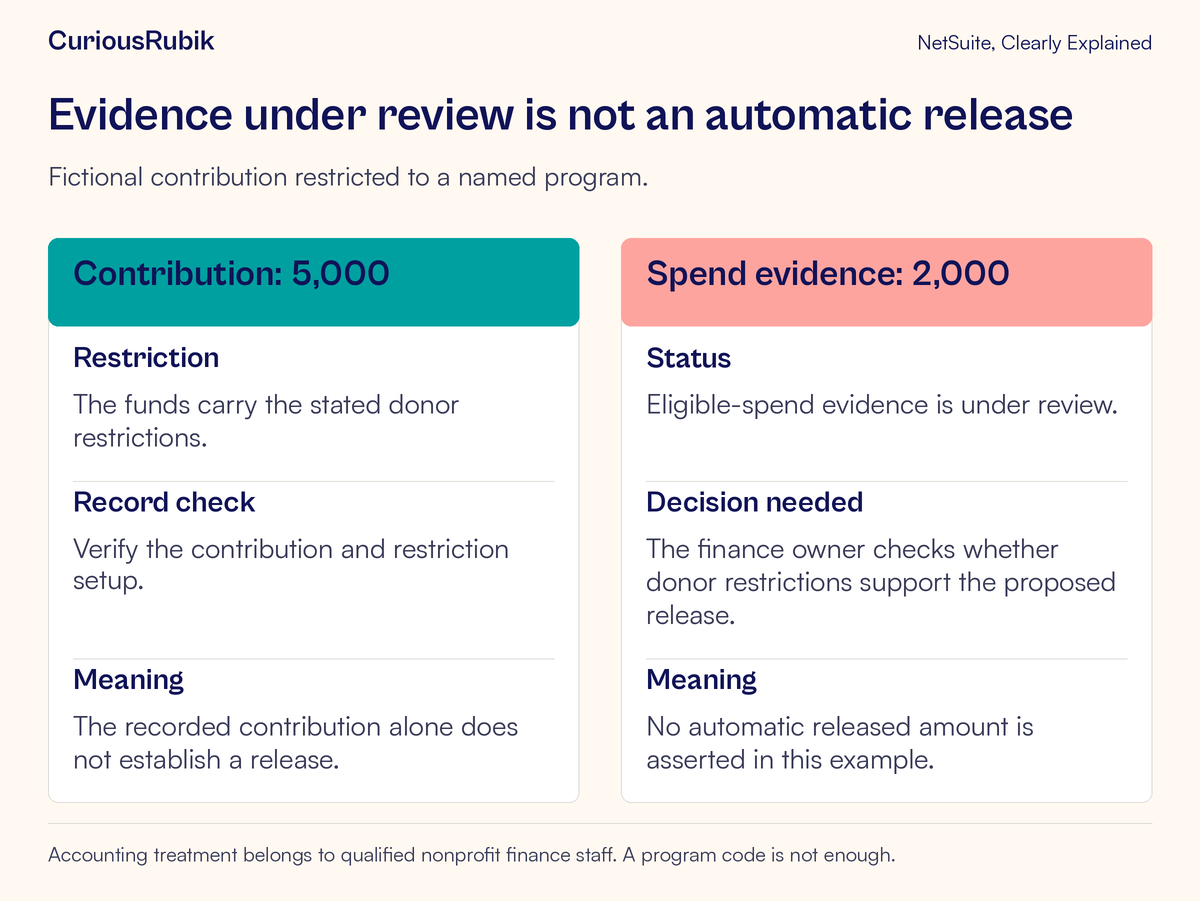
Consider Lantern Path, an invented nonprofit. It records a 5,000 contribution associated with its Neighborhood Reading program. For this exercise, the finance owner has classified the contribution as restricted under the organization's applicable accounting policy.
Later, the program team identifies 2,000 of expenditure it believes is relevant to the donor's purpose. The training record calls this “spending evidence under review.” It is not yet an approved release merely because the expenses have the program code.
The preparer assembles a review packet containing:
- The contribution reference and original amount
- The donor documentation or approved reference to it
- The finance-approved description of the restriction
- The relevant period and program scope
- The transactions making up the proposed 2,000
- The explanation of how those transactions relate to the restriction
- Any prior releases or adjustments that affect the available balance
The reviewer then asks whether the evidence supports the proposed treatment. Perhaps all 2,000 qualifies. Perhaps part belongs to another period, includes an ineligible activity, or was already included in a prior release. The example deliberately leaves that decision open until the qualified finance owner reviews it.
Turn expenditure into traceable evidence
A total is easier to trust when someone can reconstruct it. For Lantern Path, imagine the proposed 2,000 consists of two fictional transactions: 1,200 for approved program materials and 800 for a workshop activity. Those descriptions are only starting points for review.
For each transaction, check identity, date, amount, classification, supporting detail, and whether it was already considered in another release. Confirm that the total uses the intended currency and basis. If there are credits, corrections, or allocation rules, show how they affect the proposed amount.
Ask the reviewer to establish eligibility rather than relying on the preparer's label. A cost can belong to the Reading program without necessarily meeting every donor requirement. Equally, a classification error may hide an otherwise relevant transaction. The review needs both the underlying evidence and the configured accounting data.
Keep the packet proportionate. Include the information needed for the decision and references that allow an authorized reviewer to inspect the original records. Avoid copying unrelated donor or beneficiary information into a widely shared spreadsheet.
Define the release decision before processing it
The qualified finance owner should approve the amount, period, basis, and supporting evidence for a release. If the reviewer needs more information, record the item as pending rather than treating a proposed amount as completed work.
Once the decision is approved, an authorized user follows the organization's configured release procedure. The exact processing steps depend on the installed nonprofit solution and account setup. This lesson does not prescribe a universal button sequence, transaction type, or journal entry.
Capture the resulting record reference and verify what was actually recorded. Check the amount and classifications against the approved decision. If the process creates or updates additional accounting records, include those in the authorized verification procedure.
Separate approval from processing in the working record. A signed-off proposal that has not been entered and a posted result that lacks the required approval are different exceptions. Each needs a clear owner and next action.
Reconcile only the releases that actually occurred
Return to Lantern Path's 5,000. If, and only if, the finance owner approves 2,000 and the configured release is successfully recorded, a simple training reconciliation with no other activity would be 5,000 less 2,000, leaving 3,000.
That arithmetic is an illustration, not a conclusion about Lantern Path's real accounting, because the organization is fictional. If the reviewed amount is instead 1,600, the same simplified calculation would leave 3,400 after the authorized release is recorded. If the review is still pending, do not subtract the proposed amount as though processing were complete.
In an actual account, include opening balances, additional contributions, prior releases, reversals, corrections, and other applicable movements. Reconcile the same period, program, restriction, and currency scope. A comparison built from different populations can produce an apparent discrepancy even when each source is internally correct.
Keep both the proposed amount and the recorded amount visible in the review trail. This allows the team to explain why a program expense total and a restriction balance do not move in lockstep.
Verify the report from a small sample
Choose one contribution and trace it through the relevant restriction records, approved release evidence, and report. Confirm that the identifiers let a second authorized person follow the same path without relying on the preparer's memory.
Then test one meaningful exception. For example, identify spending that uses the same program code but falls outside the reviewed scope. The exercise should show that the release decision does not simply equal every expense carrying the program label.
Ask a reviewer to explain the remaining amount. The explanation should mention the contribution, approved recorded releases, relevant adjustments, and unresolved proposals. “The report says so” is weaker than a reconciliation that another person can reproduce.
If the organization works across jurisdictions, use a localization requirements map to identify which regional and account prerequisites need confirmation. Do not assume that a nonprofit feature or report available in one edition is universally available.
Investigate differences without rewriting history
If funds appear unrestricted unexpectedly, inspect the contribution's classification and the relevant restriction setup. Confirm that the report includes the intended restriction and period. Do not enter a correcting transaction until the cause and approved treatment are understood.
If the proposed release exceeds supporting evidence, review the transaction list, prior releases, and donor interpretation. Check for duplicate inclusion or a total that covers a broader program than the specific contribution.
If two reports disagree, align their date basis, filters, opening balances, currencies, and treatment of pending or posted activity. Establish whether the comparison is between the same accounting question before treating it as a system defect.
If an earlier release needs correction, follow the finance team's approved correction procedure and preserve the reason and record relationships. Deleting evidence to make a balance look right undermines the ability to explain what happened.
Avoid borrowing an unrelated revenue process merely because it uses the same word. Advanced Revenue Management arrangements and journals address a different product process. A nonprofit restriction release needs the appropriate nonprofit configuration and accounting review.
A checklist for a defensible release
- The contribution and donor documentation are identified
- A qualified finance owner interpreted the applicable restriction
- Program and other dimensions reflect that approved interpretation
- Supporting transactions are traceable and checked for prior use
- Proposed, approved, and recorded amounts are distinguished
- The authorized release record agrees with the decision
- Remaining balances reconcile within a consistent scope
- Unresolved evidence and required corrections have owners
- Reports can be explained without treating cash, expense, and release as the same event
For teams learning the record relationships and review routine, CuriousRubik's NetSuite training can support account-specific practice alongside the nonprofit's finance policies. The important habit is to connect each recorded release to an explicit decision and evidence that another reviewer can follow.