NetSuite OneWorld Design for Subsidiaries Currencies and Reporting
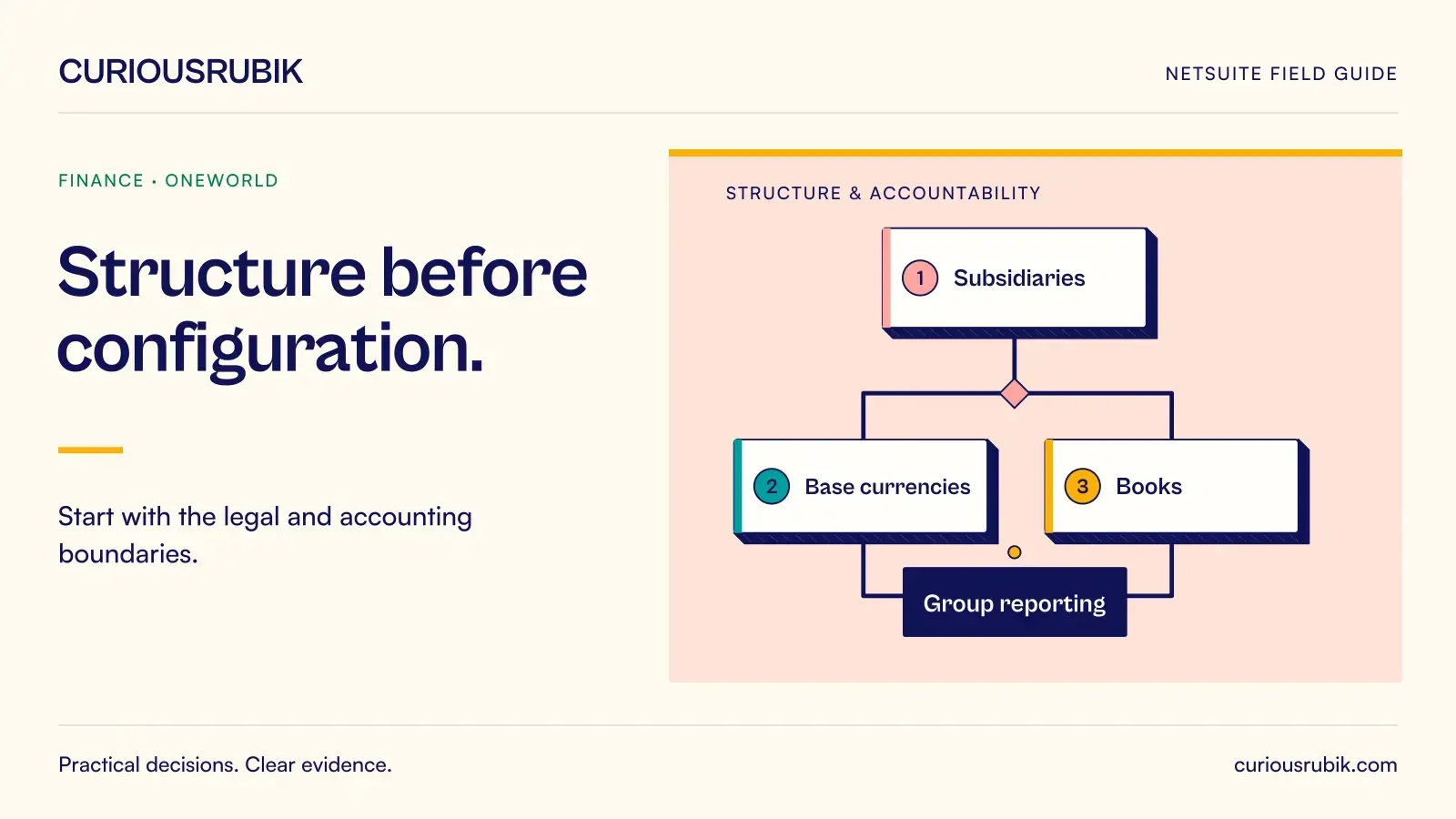
A subsidiary structure is difficult to fix through reporting alone. If legal entities, operating locations and management dimensions are confused during design, the consequences appear later in permissions, intercompany activity, currency processing and consolidation.
NetSuite OneWorld implementation should begin with the boundaries the business needs to preserve. Decide which organizations require separate accounting, which activities need operational tracking and which distinctions belong in management reporting. Then test the proposed structure against transactions and reports before creating production records.
This guide gives regional CFOs and architects a practical decision process. The hypothetical expansion example is a design illustration, not a statement of tax coverage or a recommendation for any particular legal structure.
Start with the legal and accounting map
List the existing legal entities, their ownership relationships, accounting responsibilities and reporting obligations. Have finance and appropriate advisers confirm the facts rather than reconstructing the structure from department names or sales territories.
For each entity, identify its books, currencies, banking relationships, counterparties and recurring intercompany activity. Record which decisions are settled and which depend on a planned acquisition, incorporation or restructuring.
Keep the legal map separate from the operating map. A warehouse may serve several business lines without being a separate legal entity. A regional sales team may require performance reporting without owning an independent ledger.
The OneWorld design should express the approved accounting structure while using appropriate dimensions for operational and management distinctions. Turning every reporting need into a subsidiary can create unnecessary complexity.
Use a boundary decision tree
For each proposed organizational unit, ask these questions in order:
- Does it represent a separate legal or accounting boundary that the implementation must preserve? If yes, investigate the appropriate subsidiary treatment with finance.
- Is it principally a physical operating site or stock location? If yes, assess the relevant location and inventory design rather than automatically creating an entity.
- Is it a management view such as region, product group or cost centre? If yes, evaluate suitable reporting dimensions and their transaction-level capture.
- Does it require a different accounting treatment or book rather than a different organization? If yes, evaluate the accounting-book requirement separately.
- Does it need a different access boundary? If yes, test roles and permissions within the proposed model before adding structural complexity.
These questions guide design; they do not replace account-specific configuration advice. Record the rationale for each decision so later expansion follows the same principles.
Decide base currencies early
A transaction currency answers what currency a document uses. A subsidiary's base currency determines its accounting context in the configured design. Group reporting may introduce another translation context.
Do not choose a base currency solely because most invoices currently use it or because the parent prefers its reports in that currency. The accountable finance owner should approve the choice based on the relevant accounting requirements.
In NetSuite, base-currency changes become restricted after currency-related records or transactions are saved. Treat the decision as an early design gate and verify the precise account conditions before configuration begins.
For every entity, document base currency, common transaction currencies, reporting currencies and the expected foreign-currency workflows. Test an invoice, settlement, relevant period-end processes and consolidation where applicable. A currency dropdown alone does not prove the complete design.
Work through a regional expansion example
Imagine a hypothetical group with a Singapore parent, an Australian operating entity and a planned Thai operating entity. The Australian business has two warehouses and three sales regions. The Thai business will initially share some suppliers with the group.
The legal entities form one set of design decisions. The Australian warehouses form another. Sales regions need a management-reporting design that does not automatically create new legal accounting boundaries.
The group must decide how shared suppliers are represented and made available, who owns changes and how local payment or document requirements are maintained. It also needs a tested intercompany scenario between the parent and each operating entity.
For the planned Thai entity, distinguish confirmed requirements from assumptions. Local documents and accounting treatment require appropriate review. OneWorld's multi-entity structure does not by itself establish complete local regulatory coverage.
Before approval, ask the team to produce an Australian warehouse margin report, a Thai entity financial report and a group consolidated view from the same hypothetical transaction set.
Evaluate accounting books independently
Some groups need differences in accounting policy, account mapping or reporting currency. Those needs may lead to a Multi-Book evaluation, but they should be specified before a feature is selected.
Write the required difference in plain language. For example, identify which transaction would produce different amounts or timing under two approved accounting policies. If the only difference is a report layout, a separate book may not be the appropriate starting point.
Confirm supported features, licensing and implementation prerequisites for the proposed design. Books can affect close procedures, reconciliations, access and maintenance, so include those responsibilities in the scope.
Avoid using additional books as a substitute for resolving unclear accounting policy. The system needs an approved treatment to implement.
Govern shared data and local exceptions
Customer, vendor and item records can create friction when global consistency meets local requirements. Decide which fields have a central owner and which need local review.
Use an approval process for structural changes such as adding entity availability or changing key classifications. Test the configured sharing model rather than assuming every record can be used identically across every subsidiary.
Include integrations in the data design. An external system needs stable entity and record identifiers, along with a clear rule for routing transactions. A wrong subsidiary assignment can be more consequential than a missing descriptive field.
Document how a new entity will be added later, including reference data, permissions, interfaces, reports and reconciliation tests.
Approve through reporting and transaction evidence
The design review should include more than an organization chart. Run transactions that cross the chosen boundaries and inspect the resulting entity and group reports.
Test ordinary users, local finance and group finance separately. Confirm that each can see and act on the records required for their role without unnecessary access.
Keep a decision register containing the choice, rationale, owner, assumptions and evidence. The register becomes essential when future teams ask why a region is a reporting dimension while another organization is a subsidiary.
OneWorld design questions
Should every office be a subsidiary?
No. Determine whether it represents a legal or accounting boundary, a location or a management distinction. The correct representation follows the approved business requirements.
Can we postpone currency decisions?
Resolve base-currency decisions early because later changes are restricted and can affect many records. Transaction and reporting currency needs should also be tested before production use.
Does OneWorld cover every local requirement?
Do not assume universal coverage. Validate the required documents, reporting, regional components and professional review for each country and business model.
What should the design sign-off include?
Include the entity map, currency decisions, book requirements, shared-data rules, access tests and representative reports. Record unresolved assumptions explicitly.
Review the structure before configuration
CuriousRubik can help scope a OneWorld design workshop around subsidiary, currency and reporting boundaries. Bring the current legal map and one realistic expansion scenario to make the decisions concrete.