To choose a NetSuite partner in Singapore, ask each shortlisted firm to prove the work your business will depend on: a GST return that reconciles, an InvoiceNow flow that handles a rejected document, a regional support model with named people, and acceptance criteria you can test. Ask for that evidence early, while you still have three options on the table.
Most selection processes in Singapore stall at the same point. Three partners give similar demos of a standard order-to-cash flow, all claim regional experience, and the decision falls to price. The differences that matter only show up when you ask for something specific.
Write down what your Singapore entity must prove
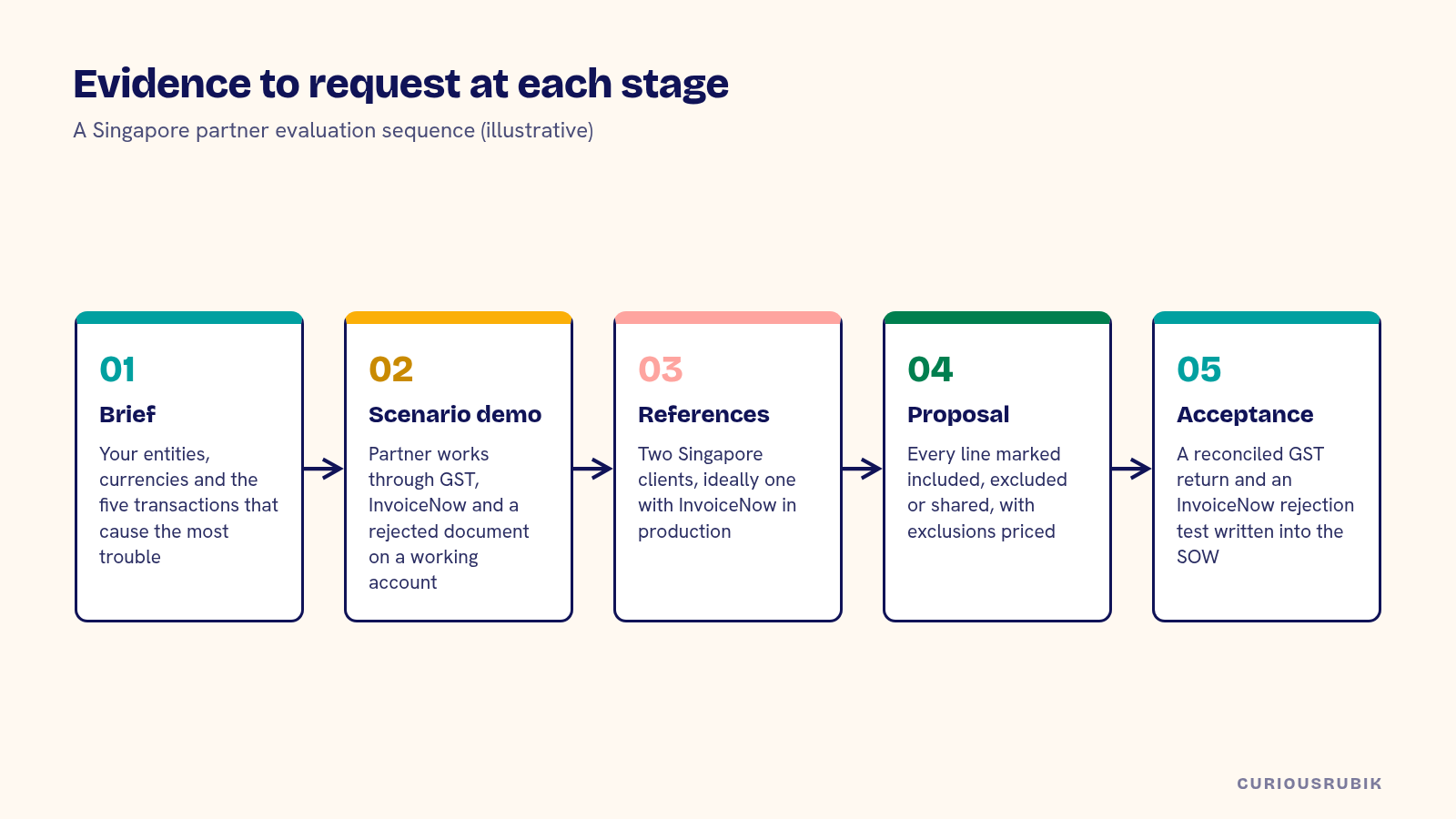
Before you meet anyone, write a one-page brief. It should say which entities go live, whether Singapore is the regional parent, and which currencies you invoice in. Add the reports finance must file or review locally, and the systems that feed NetSuite.
Then list the four or five transactions that cause your team the most trouble today. A USD sales invoice with SGD GST. An import with a permit that has to agree to the purchase. A credit note against an invoice from a prior GST period. An intercompany recharge to a Malaysian subsidiary. These become the scenarios every partner has to work through, and they keep the conversation on your business instead of the product tour.
Without a brief, each partner scopes a different project and the proposals can't be compared.
Ask for GST and InvoiceNow work you can inspect
IRAS is phasing in its GST InvoiceNow Requirement. New voluntary GST registrants are already in scope, and IRAS has announced that existing GST-registered businesses will follow in phases from 1 April 2028 to 1 April 2031, according to annual supplies. Check the IRAS page for your own implementation date, because the partner you appoint now may still be supporting you when it arrives.
Ask each partner to show, on a working account or in recorded detail with client data removed:
- how a GST-registered Singapore subsidiary is set up, including tax codes and the GST return mapping
- how invoice data reaches the Peppol network, which access point is used and who owns that contract
- what happens when a document is rejected or a transmission fails, and where finance sees it
- how the GST return is reconciled back to transactions before filing
A partner who has done this work will answer the third question quickly, because rejected documents are where the support tickets come from. If the answer is "the access point handles that", ask who in your finance team gets the alert and what they do next.
Test the regional support model with names and hours
Singapore companies often run entities across Southeast Asia, Australia or the US. Ask who will support you after go-live and from where. Get the names of the consultants on your project, their time zones and their hours of overlap with your finance team during month-end.
Then ask for the escalation path. A Severity 1 issue on the last working day of the month needs a person who can make a decision, reachable within your business hours. If the partner relies on an offshore team, that can work well. What matters is that the handover rules are written and that someone in a compatible time zone owns the outcome. Our guide to comparing NetSuite support in Singapore on SLAs and coverage covers what to put in the support agreement itself.
Check references against your scenarios
References are only useful when they resemble you. Ask for two clients with a Singapore entity live on NetSuite, ideally one with GST and InvoiceNow in production and one with multi-currency trading. Speak to the finance lead as well as the sponsor who signed the contract.
Useful questions for a reference call:
- What did the partner get wrong, and how did they fix it?
- How many people from the original project team were still on it at go-live?
- How long did the first GST return take to reconcile after go-live?
- Would you use the same consultants for your next phase?
The first question matters most. Every project has problems. You want a partner who found theirs early and told the client.
Read the proposal for what it leaves to you
Singapore proposals often look similar on scope and differ on responsibility. Look for phrases like "client to provide", "assumed standard" or "subject to discovery". Each one is work that might land on your team.
Common gaps include the access point subscription for InvoiceNow, data cleansing of customer and supplier UENs and GST registration numbers, bank payment file formats for your Singapore banks, and testing of the first GST return. Ask each partner to mark every line as included, excluded or shared. Then put a cost on the exclusions so the totals are comparable.
A hypothetical three-partner comparison
A hypothetical Singapore trading company has one GST-registered entity, a Malaysian subsidiary and 25 users. It invoices in SGD and USD. All figures here are illustrative, not market benchmarks.
| Evidence requested | Partner A | Partner B | Partner C |
|---|---|---|---|
| GST return mapping shown on a working account | Yes | Described only | Yes |
| InvoiceNow rejection handling demonstrated | Yes | No | Partial |
| Named consultants with SGT overlap | 2 named | "To be assigned" | 3 named |
| Singapore references with InvoiceNow live | 2 | 1 | 0 |
| GST return reconciliation in acceptance criteria | Yes | No | Yes |
| Proposal fee | S$165,000 | S$140,000 | S$150,000 |
Partner B is cheapest by S$25,000 against Partner A. But B has not shown rejection handling, has no named team and leaves the first GST reconciliation out of acceptance. If the finance lead estimates S$20,000 of internal and external effort to cover those gaps, B's adjusted figure is S$160,000, close to A, with more uncertainty attached.
Partner C looks strong in the demo but has no InvoiceNow references in production. That doesn't rule C out. It does mean you should ask for a specific InvoiceNow proof before signing, with a defined fallback if it fails.
Agree acceptance criteria before you sign
A partner that proposes testable acceptance criteria is telling you how they intend to be judged. For a Singapore implementation, those criteria might include a GST return for a test period that reconciles to transaction detail, a set of invoices transmitted through InvoiceNow including one forced rejection, and an SGD and USD bank reconciliation for the first live month.
Write these into the statement of work. If a partner resists measurable criteria, treat that as information. For the full set of contract-stage checks, see NetSuite partner questions to ask before signing the SOW.
Score each NetSuite partner in Singapore the same way
Before the final meetings, agree the weighting with your finance, operations and IT leads. Evidence of local compliance work, named team continuity and acceptance criteria usually deserve more weight than demo polish. Price comes last, once each proposal has been adjusted to the same scope.
Use this checklist for the final decision:
- Did the partner work through your own scenarios, using your brief?
- Did they show GST and InvoiceNow handling, including a rejected document?
- Are the consultants named, with confirmed hours of overlap with Singapore?
- Did at least one reference describe a problem and how it was fixed?
- Is every proposal line marked included, excluded or shared?
- Have you priced the exclusions and compared adjusted totals?
- Do the acceptance criteria include a reconciled GST return?
- Does the contract say what happens to the fee if acceptance fails?
CuriousRubik agrees the outcome, the acceptance criteria and a fixed outcome fee before work starts, with no hourly or daily rates. If you are shortlisting partners now, a CuriousRubik NetSuite implementation review can give you a scope and acceptance criteria to test every proposal against, ours included. You can also see how we work with Singapore-led businesses on NetSuite.
For a broader method, see How to Choose a NetSuite Partner Using Delivery Evidence, and use the four local scenarios for a Singapore partner demo to structure the sessions. If regional cover matters, test support coverage across Singapore and regional time zones before you sign. If you also run an Australian entity, the same method applies with different local tests, set out in how to choose a NetSuite partner in Australia.
Related reading: How to Choose a NetSuite Partner Using Delivery Evidence
Frequently asked questions
Does a NetSuite partner in Singapore need to be based in Singapore?
Not necessarily. What matters is that named people with Singapore GST and InvoiceNow experience are available during your business hours, and that someone in a compatible time zone owns escalations.
Is InvoiceNow part of a standard NetSuite implementation?
Do not assume it is. Ask whether the proposal covers the access point, the transmission setup, rejection handling and testing, and who pays the access point subscription.
How many partners should we shortlist?
Three is usually enough to compare. More than that and the scenario sessions become hard to run properly with the same team.
Should we choose the partner with the lowest fee?
Only after adjusting every proposal to the same scope. Price the exclusions and the responsibilities left to your team, then compare.
What if a partner refuses to name consultants before signing?
Ask for the profiles of the people who would be assigned and a contractual commitment on continuity. If they can't give either, weigh that risk in your scorecard.