Choose a NetSuite partner in Australia by asking each candidate to prove the local work your finance team will live with: a BAS that traces back to transactions, a payroll journal that reconciles to STP and super, bank files your bank accepts, and support from people awake during your close. Shortlist on that evidence first. Compare fees only after the scopes match.
The common trap is a polished demo of NetSuite's standard order-to-cash flow, run by a presales consultant who won't be on your project. It looks the same from every partner. The differences sit in the Australian detail and in who actually does the work.
Brief every partner on the same Australian scope
Give each shortlisted partner the same short brief. List the entities, ABNs and GST registrations. Say whether you lodge BAS monthly or quarterly, which payroll system you use and how many pay frequencies you run. Name the banks, the ecommerce or POS platforms and any 3PL.
Add five real transactions that cause friction today. Good candidates are a supplier bill with mixed GST and GST-free lines, an import with GST deferred or paid at the border, a customer credit note crossing a BAS period, a payroll journal split across cost centers, and a contractor payment that belongs on a taxable payments annual report if your industry has one.
When every partner answers the same brief, you can compare their thinking. When they don't, you are comparing four different projects.
Ask to see GST and BAS work traced to transactions
A partner with Australian delivery experience should be able to show how tax codes are designed, how GST on imports is handled and how the BAS labels are populated. More useful still, ask them to show how finance reconciles the BAS figures back to the GL and to transaction detail before lodgement.
Ask what went wrong on a recent project. Adjustments for prior periods, credit notes and foreign-currency bills are frequent sources of differences. A practitioner will describe the reconciliation report they built and the review step they put in front of the controller. A generalist will tell you NetSuite "supports Australian GST", which is true and doesn't answer the question.
Test the payroll boundary, including STP and Payday Super
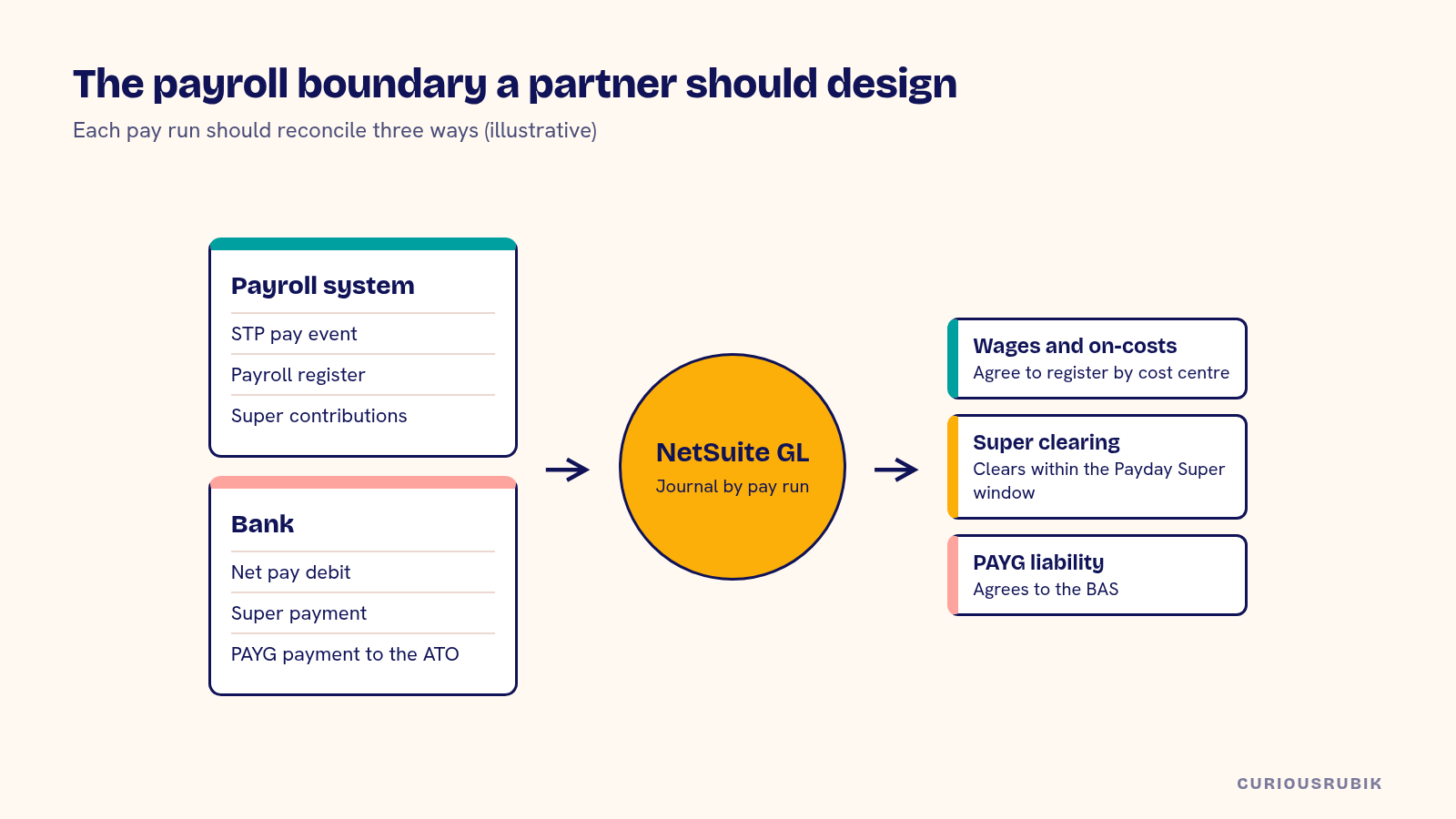
NetSuite is rarely the payroll engine for an Australian company. Most run an STP-enabled payroll product and post a journal into NetSuite. The partner's job is the boundary: the journal mapping, the cost allocation, the liability accounts and the reconciliation between payroll, the GL and the bank.
That boundary got harder on 1 July 2026, when Payday Super began. Employers must now pay super guarantee contributions so that they reach the employee's fund within seven business days of payday, with limited exceptions. The super liability now turns over every pay cycle instead of every quarter, and the reconciliation has to keep up.
Ask each partner how they would design the payroll journal and the super clearing account under Payday Super, and how finance would see an unpaid or rejected contribution. Confirm which party owns the payroll system configuration. Many partners exclude it, which is reasonable, as long as the proposal says so.
Check banking and payment file experience
Australian banks commonly accept payment files in the ABA (Cemtex) format, and each bank has its own submission channel and validation quirks. Ask which Australian banks the partner has connected NetSuite to, which method they used for payment files and bank statement import, and how a rejected file is handled.
This is unglamorous work, and that's exactly why it gets skipped in demos. A failed supplier payment run on the 15th of the month is a bigger problem than a missing dashboard.
Confirm who supports you, and when
Australia spans several time zones, and daylight saving applies in some states and not others. A Perth finance team and a Sydney head office are two or three hours apart depending on the season. Ask for the names of your project consultants, where they sit and their hours of overlap with your finance team at month-end and EOFY.
Then ask for the support model after go-live: response targets by severity, who handles a Severity 1 on the last business day of June, and how handovers work if part of the team is offshore. Get it in writing. Then check the dates against the plan, using realistic NetSuite implementation timeline ranges for Australia as a guide.
A hypothetical partner shortlist
A hypothetical Melbourne wholesaler has two entities, 35 users, quarterly BAS, weekly and fortnightly payroll in a separate STP-enabled system and two Australian banks. Three partners respond. These figures are illustrative.
| Evidence | Partner A | Partner B | Partner C |
|---|---|---|---|
| BAS reconciliation shown on a working account | Yes | Described | Yes |
| Payroll journal and super clearing under Payday Super | Designed and shown | "Client's payroll provider" | Described |
| ABA payment files with both banks | Both done before | One | Neither |
| Named consultants in AEST or AEDT hours | 3 | 1 | 2 |
| Fee | A$210,000 | A$175,000 | A$190,000 |
Partner B is A$35,000 cheaper than A. B has also pushed the payroll boundary to a third party and has experience with only one of the two banks. The finance lead estimates A$15,000 for payroll journal and reconciliation design, plus A$10,000 to cover the second bank and its testing. B's adjusted total is A$200,000, and the payroll gap now involves another vendor with its own timeline.
Partner C sits in the middle on price but hasn't connected either bank. That is fixable. It is also a reason to ask for a bank file test in the first phase, with acceptance attached.
Put Australian tests into acceptance
The statement of work should say how you will know the project is done. For an Australian implementation, sensible criteria include a test BAS that reconciles to transaction detail, a payroll journal for each pay frequency that agrees to the payroll register and to the super payment, an ABA payment file accepted by each bank in its test channel, and a first month-end close completed within an agreed number of days.
Partners who suggest their own measurable criteria are usually the ones who have been judged on them before. Acceptance also shapes the commercial model, which we compare in NetSuite consultant rates in Australia vs outcome fees.
Choose your NetSuite partner in Australia on adjusted scope
Before you decide, run each proposal through this checklist:
- Did the partner work through your five transactions using your brief?
- Did they show a BAS reconciled to transactions, with prior-period adjustments?
- Is the payroll boundary designed, including super clearing under Payday Super?
- Have they connected NetSuite to your banks before?
- Are your consultants named, with confirmed Australian-hours overlap?
- Is each proposal line marked included, excluded or shared, and are the exclusions priced?
- Do the acceptance criteria include the BAS, payroll and bank tests?
- Does the contract say what happens to the fee if acceptance is not met?
CuriousRubik works on agreed outcomes. We review feasibility, agree the result and the acceptance criteria, then charge one fee for that outcome, with no day rates. If you are comparing Australian proposals, a CuriousRubik NetSuite implementation review can give you a scope and acceptance tests to hold every partner to. See also how we approach NetSuite projects for Australian businesses.
To prepare the brief, work through A NetSuite Australia Implementation Discovery Checklist. For the two areas partners most often gloss over, see Trace Australian GST from NetSuite Transactions to the BAS and Reconcile Australian Payroll with NetSuite Finance and Cash. If your group also has a Singapore entity, compare notes with how to choose a NetSuite partner in Singapore.
Related reading: How to Choose a NetSuite Partner Using Delivery Evidence
Frequently asked questions
Does NetSuite run Australian payroll?
Usually not in Australia. Most companies use an STP-enabled payroll product and integrate the journal and liabilities with NetSuite. Confirm the options for your account with the partner and the payroll vendor.
Does Payday Super change a NetSuite implementation?
Yes, at the payroll boundary. Super liabilities now clear every pay cycle, so the journal design, the clearing account and the reconciliation need to handle that frequency.
Should our partner be in the same city?
Not necessarily. What matters is named people with Australian experience who are available during your business hours, especially at month-end and EOFY.
When is the best time to go live in Australia?
Avoid the weeks around 30 June unless the plan deliberately targets a 1 July start. Your timeline should allow for STP finalization and the June BAS on whichever system is live then.
How many references should we ask for?
Two is enough if they are relevant. Ask for at least one Australian client with a separate payroll system and BAS lodged from NetSuite data.