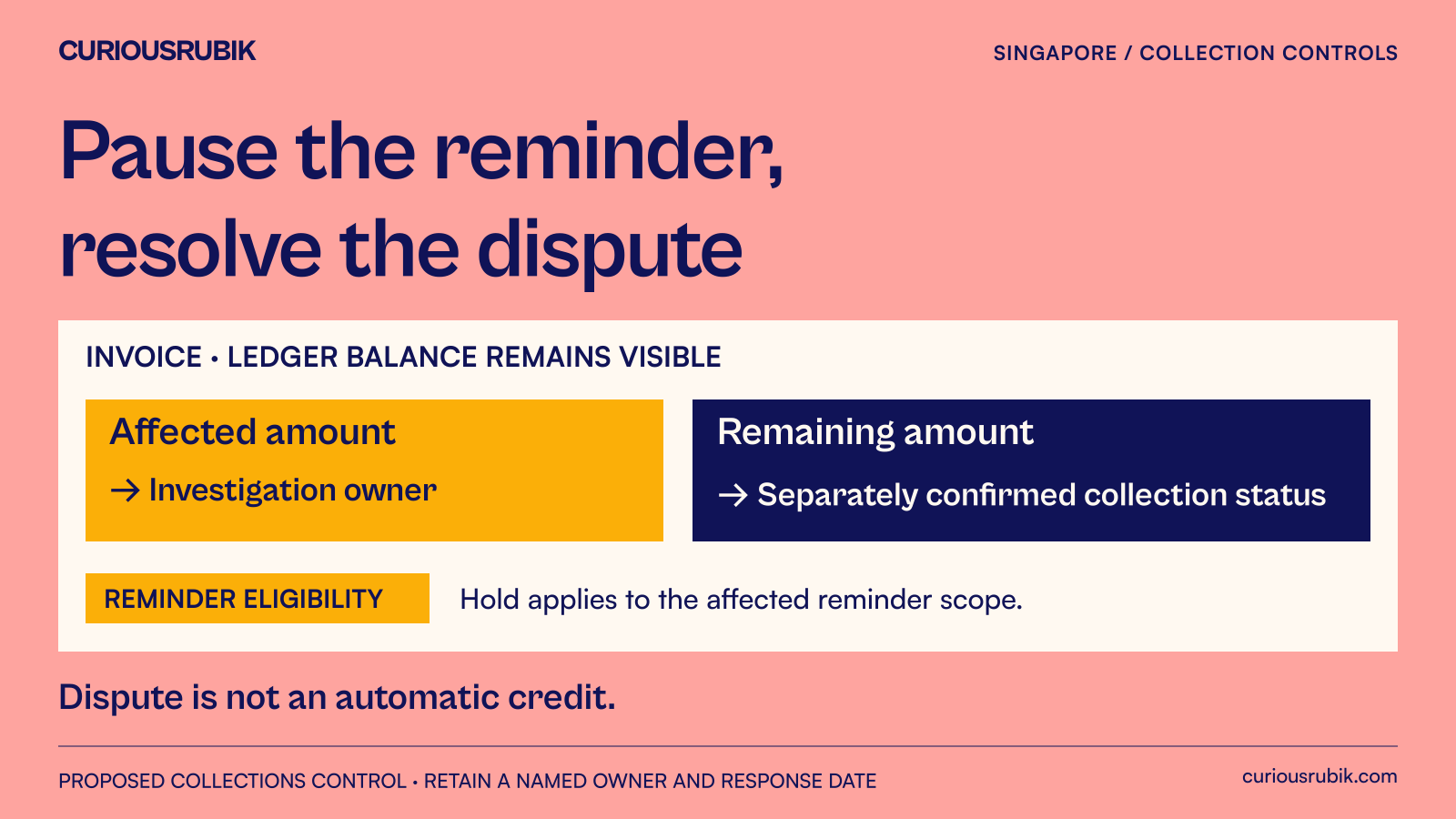
A customer reports a delivery shortfall and receives another standard payment reminder the next morning. The account manager is investigating, but the collections process knows only that an invoice is overdue. The reminder may be technically consistent with the ledger while contradicting the conversation the business is having with its customer.
The fix is a controlled dispute status linked to the affected balance. It should pause or reroute inappropriate reminders, assign someone to investigate and make the restart decision explicit. It should also preserve any undisputed amount and the original receivable history.
For a Singapore business, recording a dispute is a collections decision. It does not automatically authorise a credit note, write-off, revised payment term or GST adjustment. Those outcomes need their own evidence and approval.
Let the complaint reach the collections process
Disputes rarely arrive through one perfect channel. A customer may tell a delivery driver, email the salesperson or question a line on a statement. If that information stays in a personal inbox, the next collection run will continue using an incomplete picture.
Give customer-facing staff a simple intake route. Capture the customer and invoice, affected lines or amount, the customer's stated reason, when the issue was raised and any supporting evidence. Preserve the customer's explanation without treating it as an established finding.
An initial status such as “dispute reported, assessment pending” can temporarily reroute reminders while the credit controller establishes scope. Assign a prompt internal review date appropriate to the situation. This avoids forcing staff to prove the whole case before the process acknowledges a credible complaint, while preventing an indefinite hold based on an unexplained note.
The complaint may concern a delivery shortfall, price, quality, acceptance or incorrect billing details. Each points to a different evidence owner. The intake should identify that route without requiring the customer to repeat the issue to several departments.
Define states by the next decision
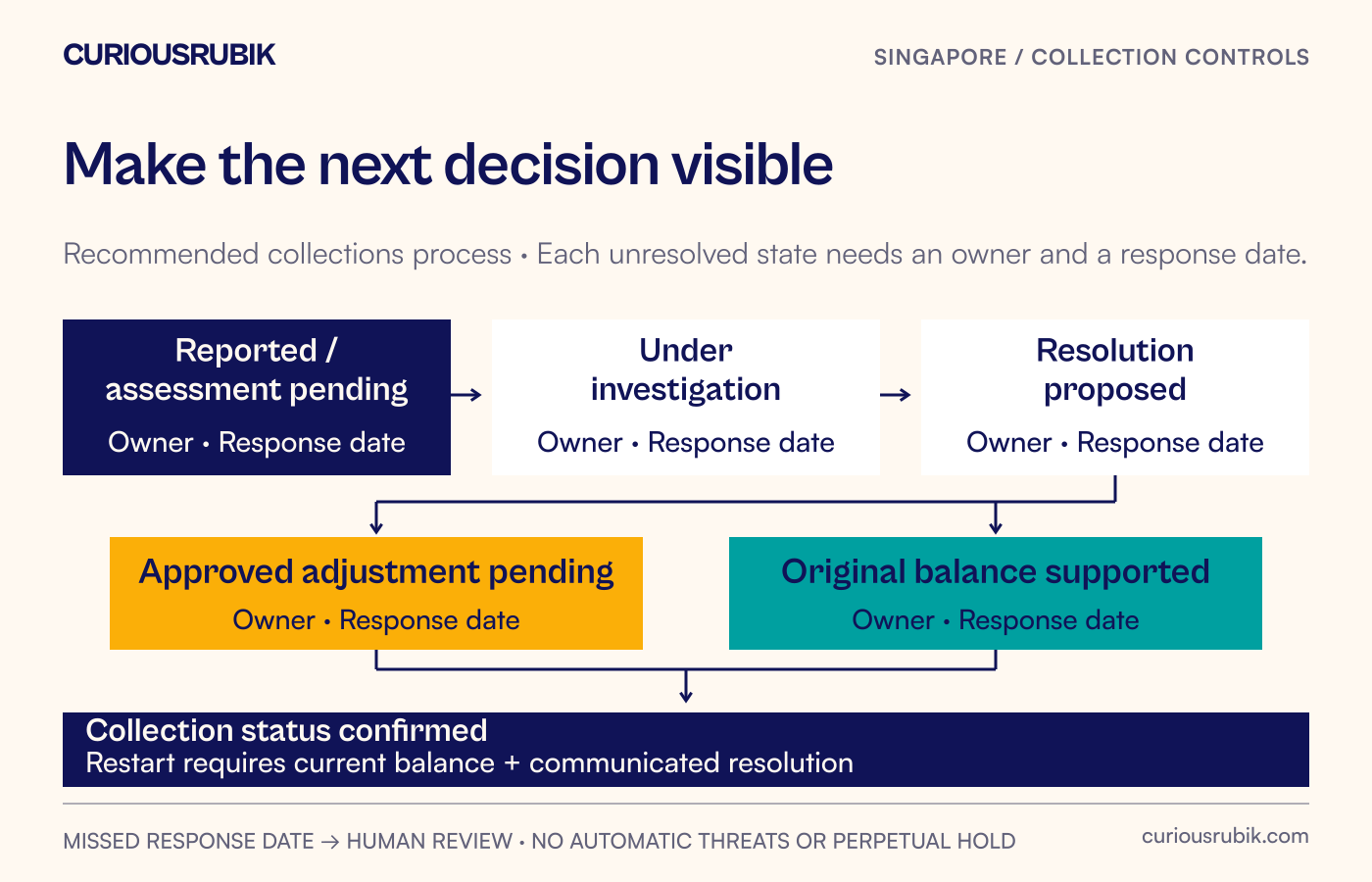
A practical dispute register can use a small number of states: reported and awaiting assessment, under investigation, resolution proposed, approved adjustment pending, and resolved with collection status confirmed. The exact names matter less than clear entry and exit conditions.
For an investigation, record the issue owner, evidence required and promised response date. For a proposed settlement, record who has authority to approve it. For an approved adjustment, identify the document still required and the finance owner. For a resolved item, record what the customer has been told and which amount is eligible for the next collection action.
Keep reminder eligibility as an explicit field or derived rule tied to these states. Do not assume that closing an investigation automatically restarts the standard sequence. The resolution may include a new agreed payment date, a pending credit or a request for further customer evidence.
Equally, do not let “disputed” become a permanent shelter for every overdue invoice. An overdue response date should trigger an owner review and escalation. It should not silently renew the hold or release a threatening reminder without considering what happened.
Read the diagram text
CURIOUSRUBIK SINGAPORE / COLLECTION CONTROLS Make the next decision visible Recommended collections process · Each unresolved state needs an owner and a response date. Reported / assessment pending Owner · Response date Under investigation Owner · Response date Resolution proposed Owner · Response date Approved adjustment pending Owner · Response date Original balance supported Owner · Response date Collection status confirmed Restart requires current balance + communicated resolution MISSED RESPONSE DATE → HUMAN REVIEW · NO AUTOMATIC THREATS OR PERPETUAL HOLD curiousrubik.com
Keep the disputed scope precise
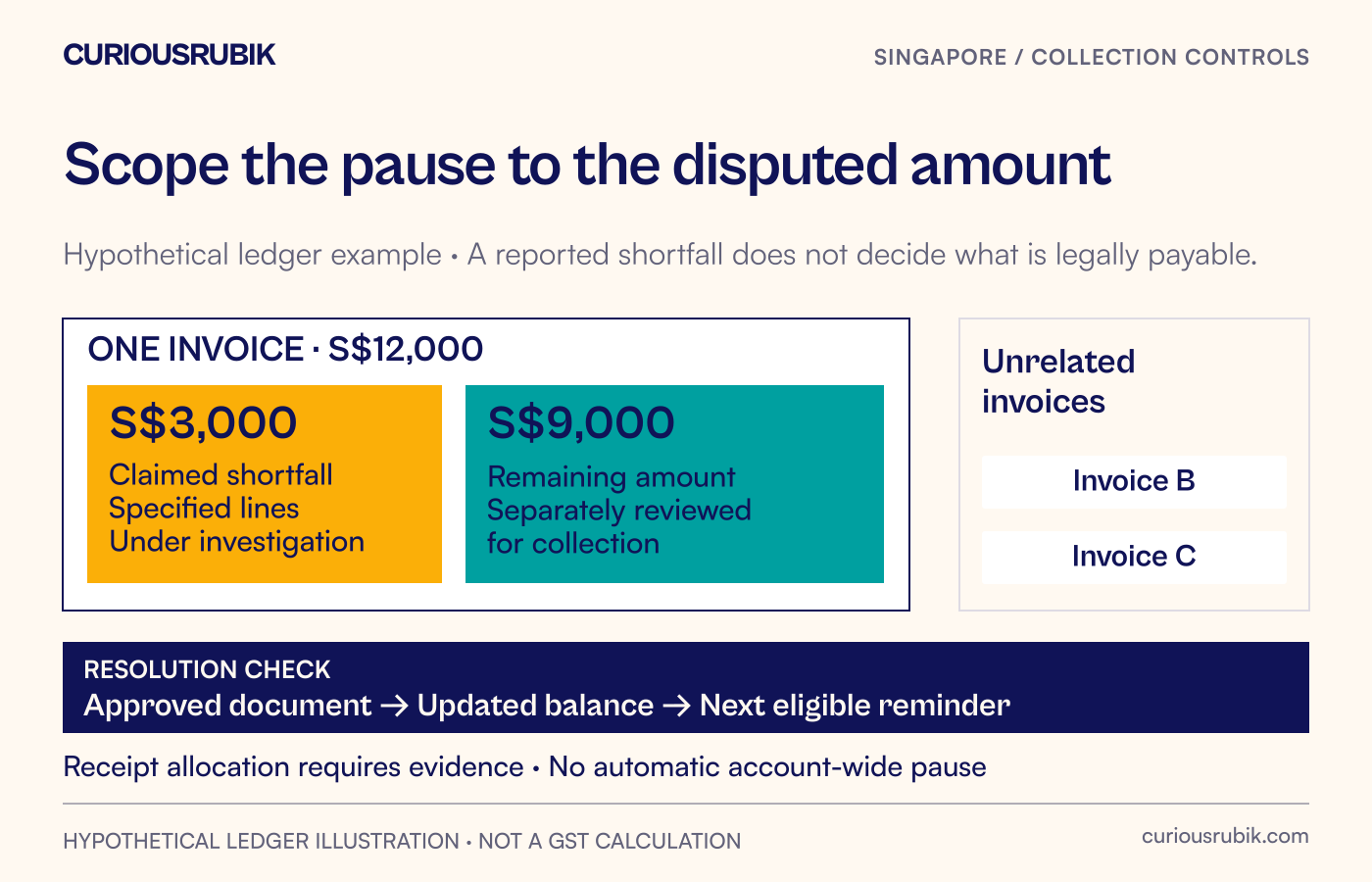
Consider a hypothetical invoice balance of S$12,000, of which the customer disputes S$3,000 for a claimed delivery shortfall. The remaining S$9,000 is not disputed on that stated basis. These are illustrative ledger amounts, not a GST calculation or a conclusion about what is legally payable.
Link the dispute to the relevant invoice lines and evidence. The investigation owner checks delivery records and customer communications. The credit controller decides the appropriate treatment of reminders for the S$3,000 while confirming the collection status of the other S$9,000 under the agreement and current correspondence.
Do not send a standard message demanding the entire S$12,000 while separately promising to investigate the shortfall. Nor should the whole customer account automatically stop receiving appropriate communications about unrelated invoices. The message and balance must reflect the scope actually under review.
Partial payments need care. A receipt may settle a specific invoice or represent payment of the undisputed portion, but the allocation must be established from the evidence and policy. Do not assume a matching amount proves the customer's intended allocation. Preserve the original invoice, receipts, dispute amount and approved adjustments so the remaining position can be reconstructed.
Read the diagram text
CURIOUSRUBIK SINGAPORE / COLLECTION CONTROLS Scope the pause to the disputed amount Hypothetical ledger example · A reported shortfall does not decide what is legally payable. ONE INVOICE · S$12,000 S$3,000 Claimed shortfall Specified lines Under investigation S$9,000 Remaining amount Separately reviewed for collection Unrelated invoices Invoice B Invoice C RESOLUTION CHECK Approved document → Updated balance → Next eligible reminder Receipt allocation requires evidence · No automatic account-wide pause HYPOTHETICAL LEDGER ILLUSTRATION · NOT A GST CALCULATION curiousrubik.com
Assign the investigation to the person who can resolve it
The dispute owner should be able to obtain the operational facts. For a delivery shortfall, that may be a logistics lead. For a price disagreement, it may be the commercial owner who can compare the accepted order and invoice. Finance can coordinate the balance, but should not become the default investigator for every issue.
The credit controller owns collection status and restart decisions. The account owner manages the relevant customer conversation. The person authorised to approve a concession or settlement must make that consequential decision explicitly; neither an investigation note nor a customer-service promise should silently create it.
Set a promised response date that the owner can meet, and record a revised date with an explanation if more evidence is needed. The process should show whether the business is waiting for its own warehouse, a carrier, the customer or an internal approval. That distinction helps managers address the delay rather than repeatedly asking the customer to wait.
Where the facts remain contested, escalate the substantive disagreement. More reminders are unlikely to settle whether goods were delivered or a price was agreed. Appropriate professional advice may be needed for a consequential dispute; a reminder workflow should not invent legal conclusions or threats.
Make resolution complete before restarting the sequence
A closed investigation can lead to several outcomes. The original charge may be supported. A correction may be approved. The parties may agree on a commercial adjustment. The evidence may remain insufficient and require a higher-level decision. Record which outcome applies and the authority behind it.
If an adjustment is approved, finance prepares and checks the appropriate document. IRAS's GST invoicing guidance describes credit-note situations and supporting details. Apply the relevant rules to the actual transaction, including its tax treatment; a dispute-status change is not a substitute for that work.
If the original amount remains due, the credit controller should confirm the next collection action after considering the resolution communicated to the customer. Do not replay every suppressed reminder in a burst. Resume at a deliberate point with the current amount, relevant date and factual context.
GST bad-debt relief is a separate conditional assessment. IRAS requires the applicable criteria and evidence; disagreement or overdue status alone does not establish eligibility. A commercial concession, accounting write-off and tax-relief claim should not be treated as interchangeable ways to close the queue.
Check eligibility at the moment a reminder is sent
A reminder list prepared yesterday can be wrong today. A new dispute may have arrived, a receipt may have been allocated or a credit may have been approved. Recheck the relevant status and balance at dispatch, not only when building the list.
Automation can suppress eligible disputed lines, assemble the investigation packet and remind the owner of a promised response date. It can retain a reason when an item is excluded from a collection run. That reason helps the credit controller distinguish a deliberate hold from a failed process.
Keep an operational fallback. If current dispute status cannot be confirmed, route affected messages for review rather than assuming the last known state is safe. The business should be able to explain what information each dispatched reminder used and how a late-arriving change was handled.
Measure wrong reminders as well as overdue debt
Track reminders sent despite an active relevant dispute, dispute age by cause and time from resolution to an appropriate collection restart. Review holds with no owner, expired response commitments and cases where approved credits are still missing.
Do not measure success solely by the size of the suppressed balance. A growing hold queue may indicate unresolved service problems. A shrinking queue may simply reflect premature closure. Review a sample against the underlying customer communication and operational evidence.
Begin with one invoice that has generated repeated exchanges. Map the customer's concern, disputed scope, investigation owner and current reminder rule. Then ask the credit controller what must be true before the next message is sent. That answer should become a visible decision in the process, rather than knowledge held only by the account manager.