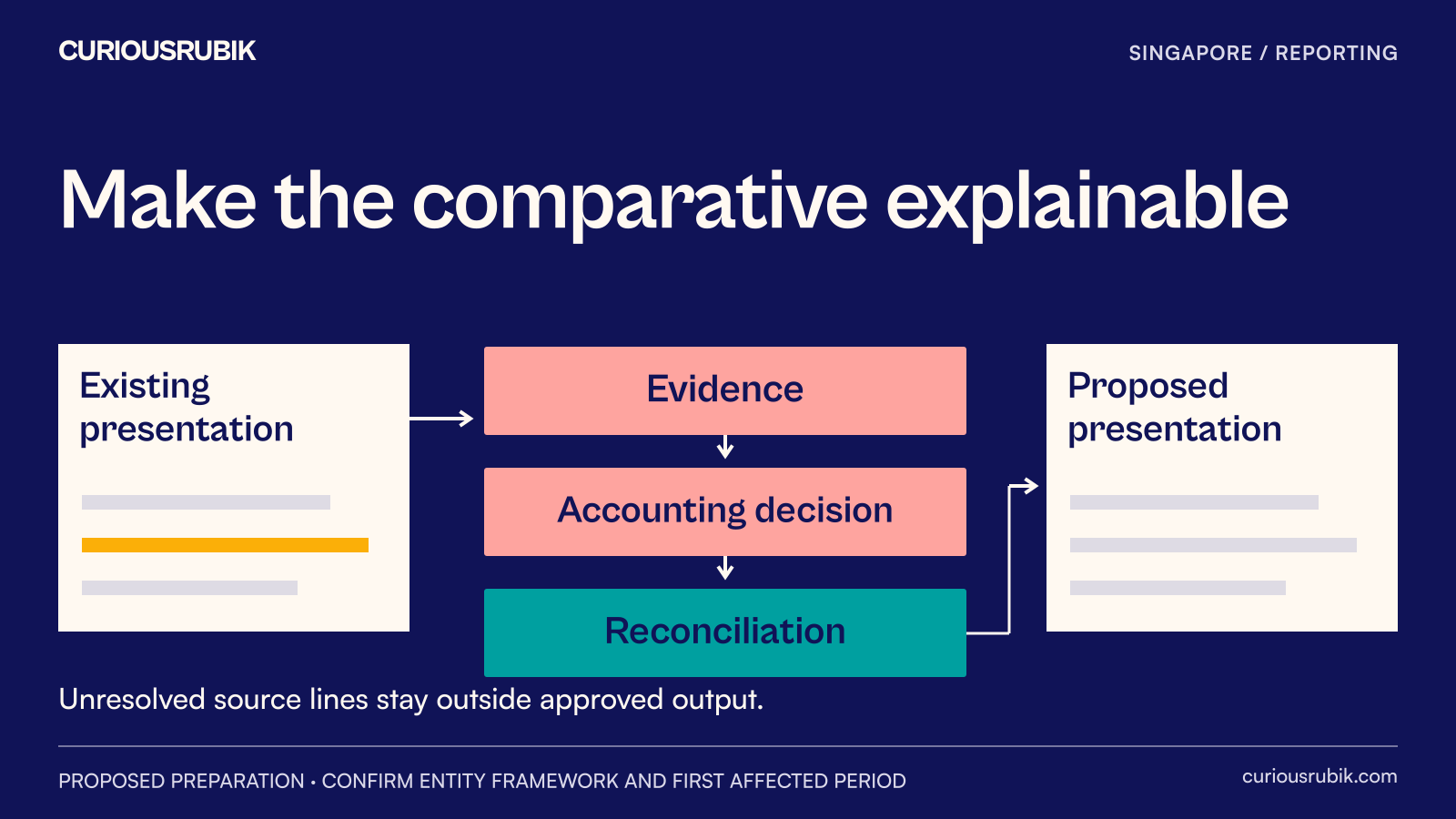
The difficult part of a new reporting layout may be explaining last year's figures in it. A team can build a polished statement template while still lacking the detail needed to show why an old balance belongs in a new category.
For Singapore finance leaders preparing for the relevant 2027 presentation changes, the practical priority is a traceable comparative mapping. Confirm which requirements apply, preserve the underlying data and resolve ambiguous balances while the people who understand them are still available. Treat the report layout as the visible output of that work.
First settle which transition the entity is making
Singapore entities do not all use the same reporting framework. ACRA lists SFRS(I)s, FRSs and other frameworks with their own applicability requirements. The financial reporting lead should record the entity's framework and financial-year start before adopting a transition timetable.
ACRA's Financial Reporting Practice Guidance No. 1 of 2025 states that SFRS(I) 18 applies to annual periods beginning on or after 1 January 2027, with retrospective application; early application is permitted. For a calendar-year entity first applying it in 2027, preparation of the 2026 comparative information is therefore a current operating task. An entity with another year-end needs its own date assessment.
ASC has also issued FRS 118. A company reporting under FRSs should check that standard's applicable requirements rather than assuming an SFRS(I) project plan applies unchanged. Obtain qualified accounting advice on scope and transition questions, including any group reporting requirements.
Put the agreed conclusion at the top of the preparation register: entity, framework, first affected period, comparative period, decision owner and source of the conclusion. This prevents different teams from working towards different versions of “next year”.
Diagnose the data gap before changing the chart of accounts
Take the current statement and supporting schedules. For each line likely to require attention, ask whether the existing records contain enough detail to support the new presentation decision.
A broad “other income” balance is a useful test. It may aggregate several economically different items. Renaming the total or moving it as one block will not resolve the underlying classification questions. The financial reporting lead needs the transaction detail, descriptions and relevant supporting documents.
That does not automatically require a new account for every possible category. The team might obtain the necessary detail from a supporting schedule or an additional transaction attribute. Compare the effort, reliability and reviewability of those options before redesigning the ledger.
Be especially careful with manual adjustments made outside routine processing. If the new mapping uses only the ordinary transaction feed, it may omit consolidation adjustments, late journals or reporting-only reclassifications. Identify all sources that contribute to the published figures and give each one a route into the comparative exercise.
Build a mapping register that can be challenged
Use a stable identifier for each source line or group of transactions. The register should make a proposed mapping reproducible by another accountant.
Include:
- Entity, reporting period and source version
- Existing line, source accounts and supporting transaction references
- Amount being mapped and any split between components
- Proposed presentation and the reason for it
- Relevant accounting question and supporting analysis
- Missing evidence, business owner and resolution date
- Qualified reviewer, decision and mapping version
- Reconciliation to both the source and the proposed output
The rationale is the important field. “Moved under new standard” does not explain why the treatment fits the facts. Write enough for the reviewer to understand the activity, the conclusion and any condition that could change it.
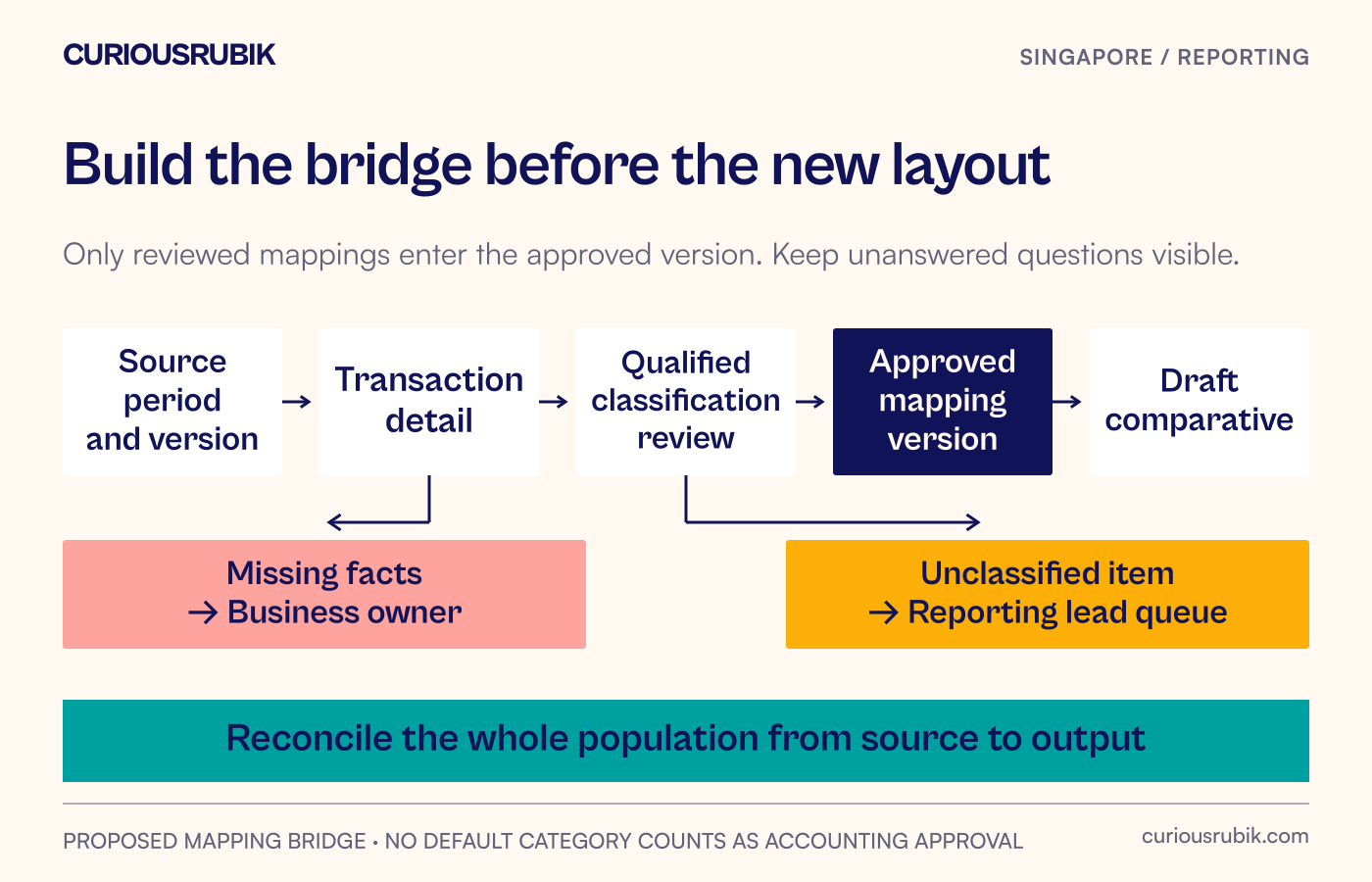
Keep unclassified items visible. A default category that absorbs every unmatched balance can make the reconciliation appear complete while concealing unfinished decisions. The report should show the amount and nature of the unresolved population before it is considered ready.
Read the diagram text
CURIOUSRUBIK SINGAPORE / REPORTING Build the bridge before the new layout Only reviewed mappings enter the approved version. Keep unanswered questions visible. Source period and version Transaction detail Qualified classification review Approved mapping version Draft comparative Missing facts → Business owner Unclassified item → Reporting lead queue Reconcile the whole population from source to output PROPOSED MAPPING BRIDGE · NO DEFAULT CATEGORY COUNTS AS ACCOUNTING APPROVAL curiousrubik.com
Work one ambiguous line all the way through
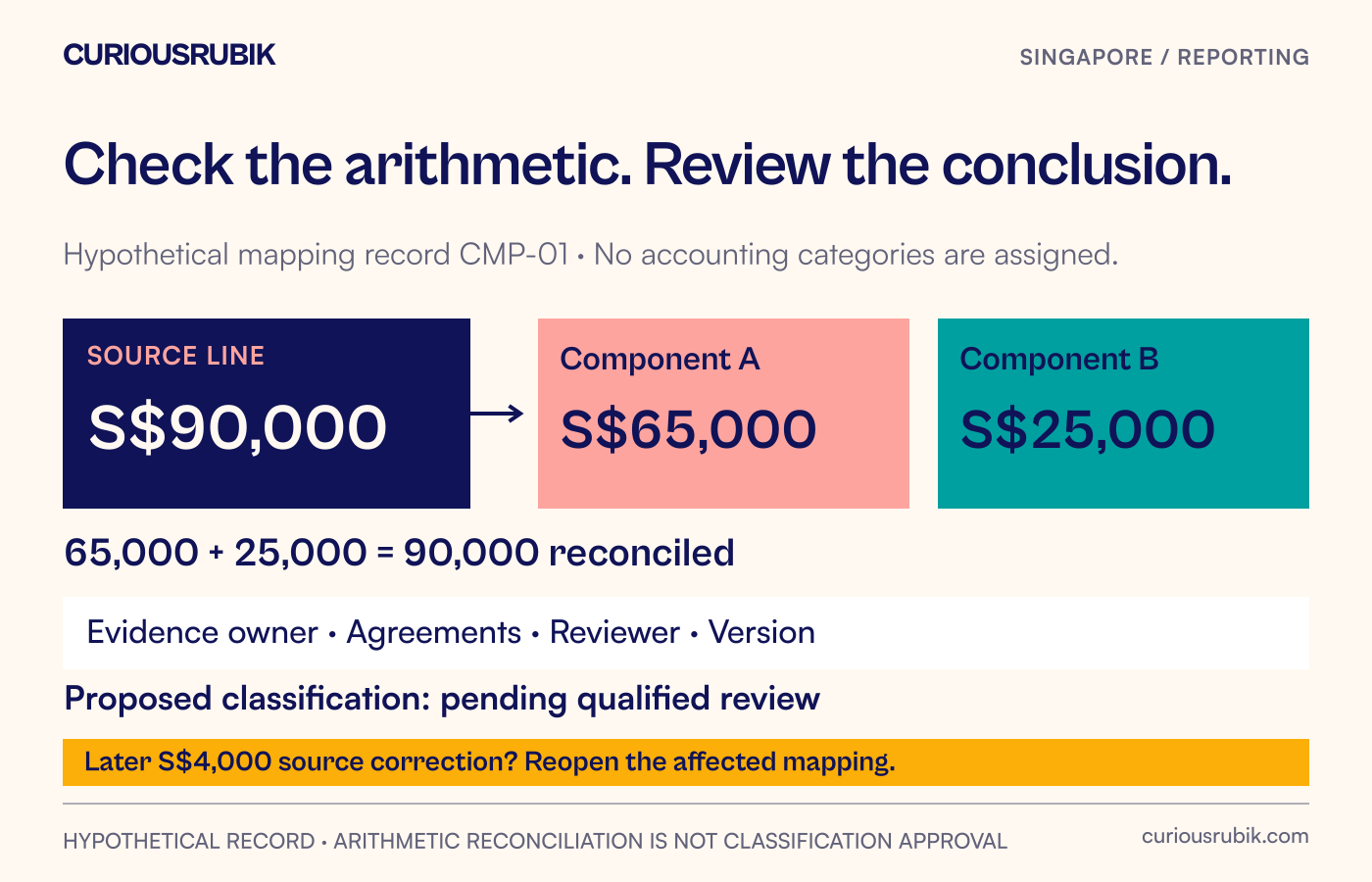
Consider a hypothetical calendar-year group preparing its 2026 comparative information. A S$90,000 line combines two types of receipt, but the monthly reporting schedule contains only the total. The figure is illustrative and no accounting classification is assumed here.
The preparer extracts the underlying transactions and identifies S$65,000 in one group and S$25,000 in another. The business owner explains what generated each group and supplies the relevant agreements. The reporting accountant then assesses their presentation under the applicable requirements.
The mapping register preserves the original S$90,000, the two components, the evidence and the approved conclusions. It demonstrates that S$65,000 plus S$25,000 reconciles to the original amount. If the reviewer decides that further distinctions are needed, the team can revise the mapping without losing the original population.
Now introduce a late S$4,000 correction to the source period. A robust process detects the change, identifies the affected mapping and requests the necessary review. It does not quietly append the correction to whichever output line happened to receive the previous total.
The value of the exercise is not the number of balances mapped automatically. It is whether a reviewer can follow a material figure from the proposed statement back through the judgment to the source evidence.
Read the diagram text
CURIOUSRUBIK SINGAPORE / REPORTING Check the arithmetic. Review the conclusion. Hypothetical mapping record CMP-01 · No accounting categories are assigned. SOURCE LINE S$90,000 Component A S$65,000 Component B S$25,000 65,000 + 25,000 = 90,000 reconciled Evidence owner · Agreements · Reviewer · Version Proposed classification: pending qualified review Later S$4,000 source correction? Reopen the affected mapping. HYPOTHETICAL RECORD · ARITHMETIC RECONCILIATION IS NOT CLASSIFICATION APPROVAL curiousrubik.com
Inventory performance measures without labelling every KPI an MPM
SFRS(I) 18 introduces disclosure requirements for management-defined performance measures, with a specific definition. It concerns qualifying subtotals of income and expenses used in public communications outside the financial statements to convey management's view of overall financial performance, subject to the standard's exclusions. An internal operational KPI is not automatically an MPM.
The operating task is to inventory what the entity communicates and give a qualified reviewer the context to assess it. Record each measure's name, calculation, where it appears, purpose and owner. Include changes in labels and definitions across periods. Two similar names may hide different calculations, while one calculation may be presented under several names.
Ask the reviewer to decide the scope and required disclosures. The communications or planning team should not make that judgment simply because it owns the presentation file. It can, however, explain how and why the measure is used and supply earlier versions.
Where a measure changes, preserve the explanation and reconcile the versions. This supports an intelligible transition and reduces the chance that different public materials describe performance differently without anyone noticing.
Run a parallel preparation with a controlled exception queue
Choose a completed period and produce a draft under the proposed mapping alongside the existing report. Keep the source data fixed for that test, with any subsequent corrections logged separately.
Reconcile totals, investigate unmapped balances and review the lines whose classification depends on judgment. Ask someone other than the preparer to reproduce a selected mapping from its evidence. Include a late correction and an unusual transaction in the test; ordinary recurring balances alone may give false confidence.
Automation can propose mappings, check for missing inputs, compare versions and flag changed measure definitions. A proposed classification should show the rule or prior decision used. A new transaction with different facts needs review, even if its description resembles an approved example.
The financial reporting lead owns the exception queue. Business owners supply explanations; qualified accountants determine presentation and disclosure. If unresolved items are accumulating faster than reviewers can assess them, narrow the test or add review capacity before expanding automatic processing.
Finish with evidence of readiness
Useful measures include the value and number of unmapped balances, mappings reopened after review, reconciliation differences and time taken to obtain business explanations. Record how many decisions depend on a source that cannot yet be reproduced.
A low exception count is meaningful only if the full population was tested. A finished template with incomplete source coverage should remain a draft. Before treating the transition as ready, obtain the necessary accounting review and confirm that the team can repeat the preparation for the next period.
Begin with one material line that currently combines different activities. Ask whether another accountant could reconstruct its proposed comparative presentation from the available records. If the answer is uncertain, resolve that evidence gap now, while the transition still has room for a careful decision.