For owners of Thai import and export firms who want matching shipping documents and cash that arrives sooner.
Last reviewed: 25 November 2026. The Department of Foreign Trade notice on ASEAN e Form D issuance through DFT SMART C/O was checked on this date.
Trade document automation in Thailand means building the commercial invoice, packing list and other shipping papers from one checked record instead of retyping each one. In the hypothetical Bangkok trader below, document work falls from 150 to 45 hours a month and documents reach the buyer or bank four days sooner.
What does trade document automation in Thailand cover?
Trade document automation is the use of software to prepare and check shipping papers from one shipment record. The software reads your orders, packing records and shipping notices, then flags differences in the fields you choose to check.
A Thai export shipment can involve several documents. The exact set depends on the goods, destination, transport and payment terms. It often includes:
- the commercial invoice your sales team raises
- the packing list with cartons, net weight and gross weight from the warehouse
- the shipping instruction you send to the forwarder
- the carrier's transport document, such as a bill of lading for sea freight or an air waybill for air freight
- proof of origin when the buyer claims a lower duty rate under a trade agreement, such as ASEAN Form D where it applies
- the product, value and weight data your customs broker needs for the export declaration
- the documents the bank requires under a letter of credit or collection instructions
Some of this is already electronic.
Thailand's Department of Foreign Trade has issued ASEAN e Form D certificates through its DFT SMART C/O system since 28 April 2025. Approved data goes to the destination country through the National Single Window and the ASEAN Single Window.
The destination receives the approved certificate data electronically. Your team still checks that the invoice and packing list agree with it.
Where do shipping documents go wrong today?
In many trading offices the same facts are typed more than once. A carton count can start in a warehouse spreadsheet and end up retyped on the packing list, the shipping instruction and the carrier's draft.
Sales types the invoice from the sales order. The warehouse sends a packing spreadsheet after loading. The forwarder emails a booking as a PDF. The carrier returns a draft bill of lading.
Then someone compares them by eye, often late in the day.
Here are mismatches worth checking for:
- carton count or gross weight differs between the packing list and the draft bill of lading
- the product description on the invoice conflicts with the description the letter of credit requires
- the documents name different parties to receive the goods or the arrival notice
- the origin application and the broker's data show different tariff codes where both should use the same code, for example when an item description decided the classification
- the shipping terms or port on the invoice conflict with the booking where those details are required
Each one can mean a carrier amendment fee, a bank discrepancy, a buyer who cannot clear the goods, or a container waiting at the port. The cost that owners feel most is slower cash. A document error can delay collection when the bank or buyer needs a corrected pack.
What changes when every document comes from one record?
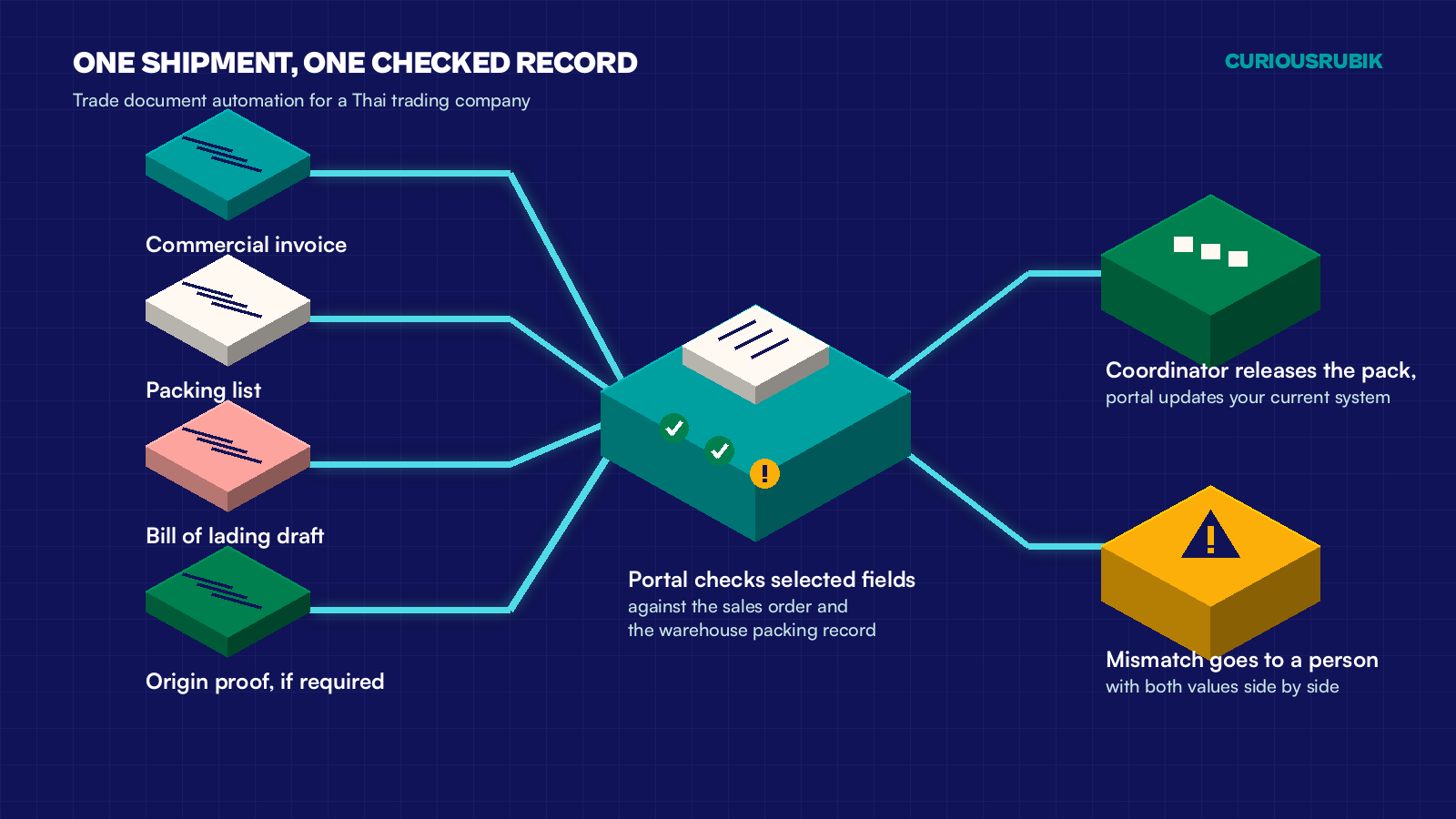
CuriousRubik's AI automation portals give the team one controlled workspace for the shipment. The portal connects to your ERP or current system, so the sales order and customer records stay where they are. Software reads the incoming files and flags differences. A coordinator resolves them and approves release.
How a shipment pack is built
- The portal reads the sales order, the buyer's purchase order, the letter of credit terms if there are any, and the forwarder's booking.
- The warehouse confirms the carton count and weights in the portal before the carrier's shipping instruction cutoff.
- The portal uses the checked record to prepare the commercial invoice, packing list and shipping instruction.
- When the carrier's draft bill of lading arrives, the model reads it and checks it against the shipment record.
- Any difference goes to an exception list with both values side by side.
- A coordinator clears the exceptions and approves the final pack, including the issued transport document where required.
- The portal writes the invoice and shipment status back to your ERP or current system.
What stays with a person
A named person still approves price exceptions, credit overrides and any change to a tariff code. A person also approves changes to supplier bank details, releases payments and resolves any tax difference that changes what you pay or file. Disputes over letter of credit wording go to the bank.
The portal shows the evidence. It does not make those calls. It also helps to make one person responsible for the export evidence, so a flagged pack never waits without an owner.
A hypothetical Bangkok trader before and after
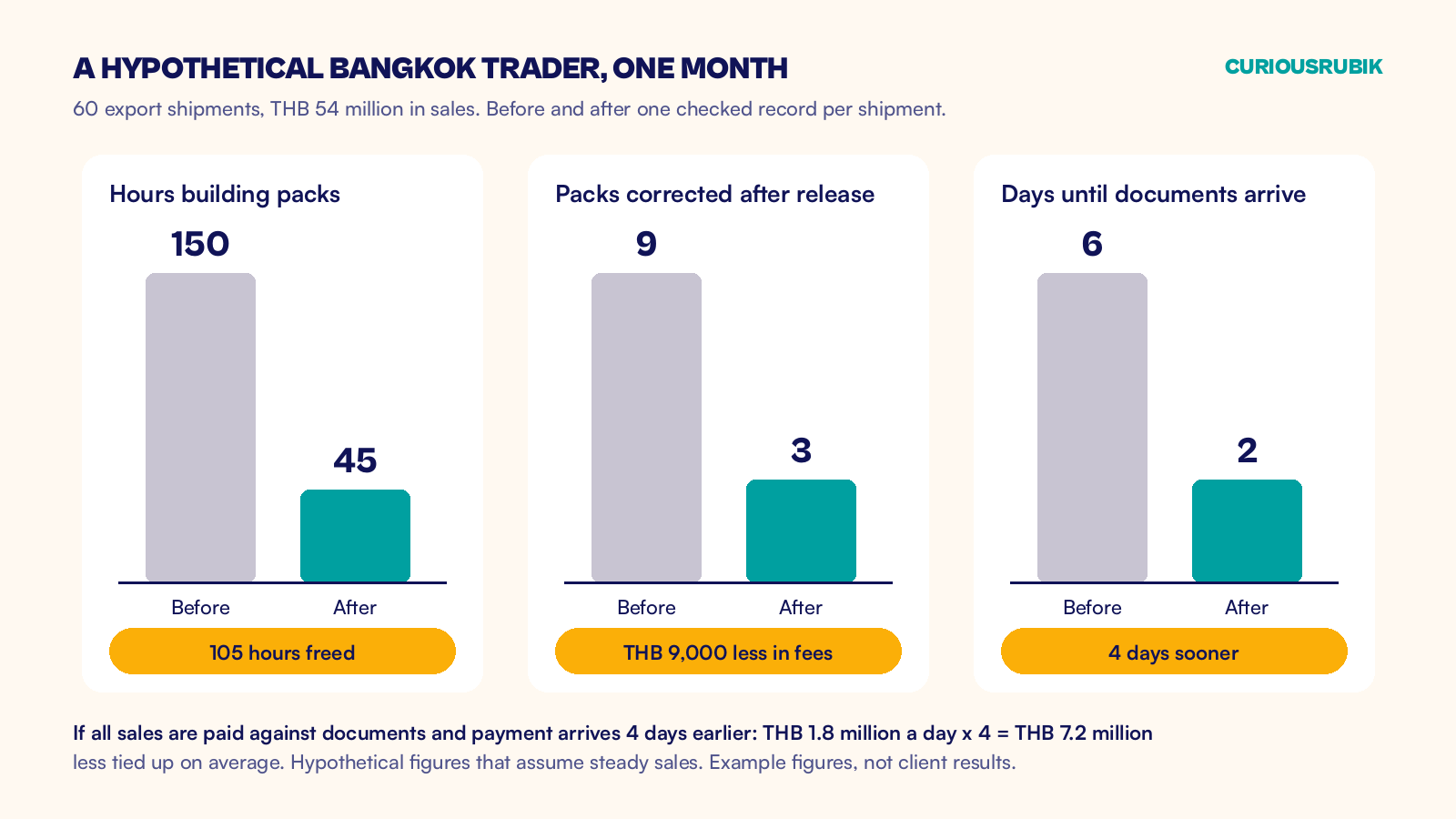
A hypothetical Bangkok trader exports packaged food ingredients to buyers in Vietnam, the Philippines and Australia. It ships 60 export orders a month with an average invoice of THB 900,000. That is THB 54 million in sales a month.
Today two coordinators build each pack by hand. It takes about 2.5 hours per shipment.
Nine of the 60 packs need a correction after the forwarder or bank spots a mismatch. Each correction costs about THB 1,500 in amendment fees. Documents reach the buyer or bank about six days after loading.
After the portal goes in, a coordinator spends about 45 minutes per shipment checking exceptions. Corrections after release fall to three a month. Documents reach the buyer or bank about two days after loading.
| Measure per month | Before | After |
|---|---|---|
| Hours building packs | 60 x 2.5 = 150 hours | 60 x 0.75 = 45 hours |
| Packs corrected after release | 9 | 3 |
| Amendment fees | 9 x THB 1,500 = THB 13,500 | 3 x THB 1,500 = THB 4,500 |
| Days from loading until the buyer or bank has the documents | 6 days | 2 days |
That frees about 105 hours a month and saves THB 9,000 in fees. The larger effect is cash.
Daily sales average THB 1.8 million over a 30 day month. Assume sales are steady, all of them are paid against documents and payment arrives four days earlier. On those assumptions, THB 1.8 million times four days means about THB 7.2 million less tied up on average. If only some sales qualify, use their daily value.
Under a letter of credit, the bank pays on the credit terms once the documents comply. With cash against documents, the bank releases the documents when the buyer pays. The buyer can still delay or decline payment.
If your due date runs from the bill of lading date, earlier documents do not move it. They still help you avoid delays caused by errors.
These are example figures, not client results. Time five shipment packs this week before you set your own target.
How should a Thai owner judge a pilot?
Start with one lane, such as one buyer country or one forwarder, for six weeks. Measure the same things before and after:
- Hours per shipment pack, from sales order to release.
- Share of packs corrected after release.
- Days from loading until the buyer or bank has the documents.
- Amendment and bank discrepancy fees each month.
- Days from loading to payment for sales paid against documents.
Test the reading on your own files, including Thai and English documents and scanned forms from forwarders. Good results on clean PDFs do not prove much. The test that matters is the messy booking that arrives at 6 PM.
Charan's view on where to start
Start with your item master, the product records in your current system. If one product has three descriptions and three weights, the portal will match faster but still to the wrong answer. Check which descriptions and weights your team uses on each document. Ask your broker to confirm the tariff codes for each market and document before you build the rules.
Then pick the lane where late documents cost you the most cash, not the lane with the most shipments. The owner should see the result in collected cash and fewer fees, as well as in saved hours.
At CuriousRubik, we start these projects with one shipment pack and the people who build it today. That works well for wholesale distribution and trading teams, and it follows how we approach workflow automation.
CuriousRubik can design an AI automation portal that connects trade document work to the systems you already run. You can book a consultation to walk through one shipment pack, agree what good looks like and see a working result before you decide the next step.
Related reading
Make one person responsible for completing the export evidence
Why export evidence needs one owner who closes every gap.
An item description should not silently decide an import classification
How loose item descriptions lead to the wrong tariff code.
AI Order Entry for Singapore Wholesalers Tired of Retyping
How to capture WhatsApp and PDF orders once and check only the exceptions.