For operations heads at Singapore chilled and frozen food distributors who want fewer wrong deliveries, less waste and faster invoices.
Last reviewed: 24 November 2026. Enterprise Singapore and IMDA figures were checked on this date.
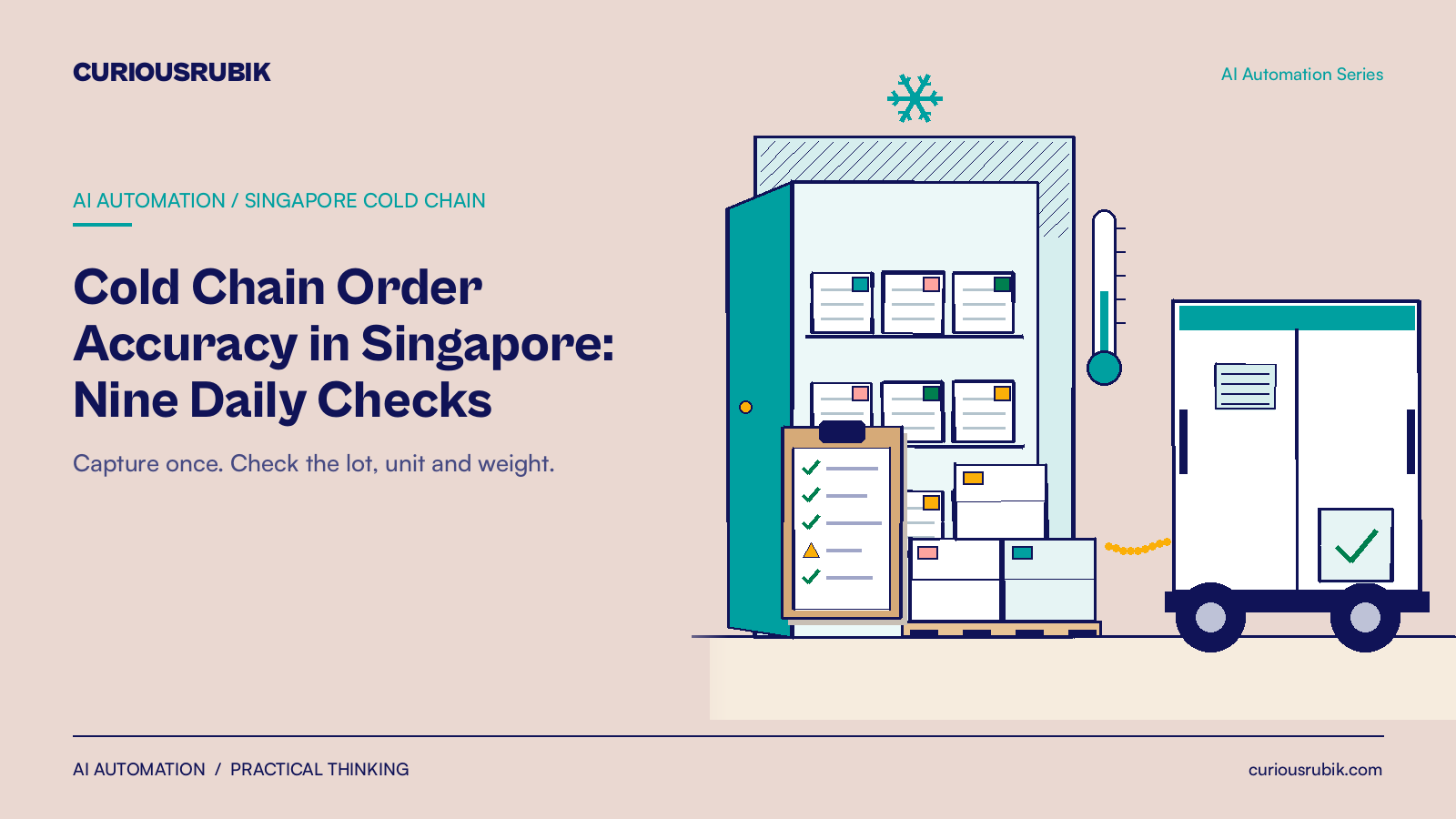
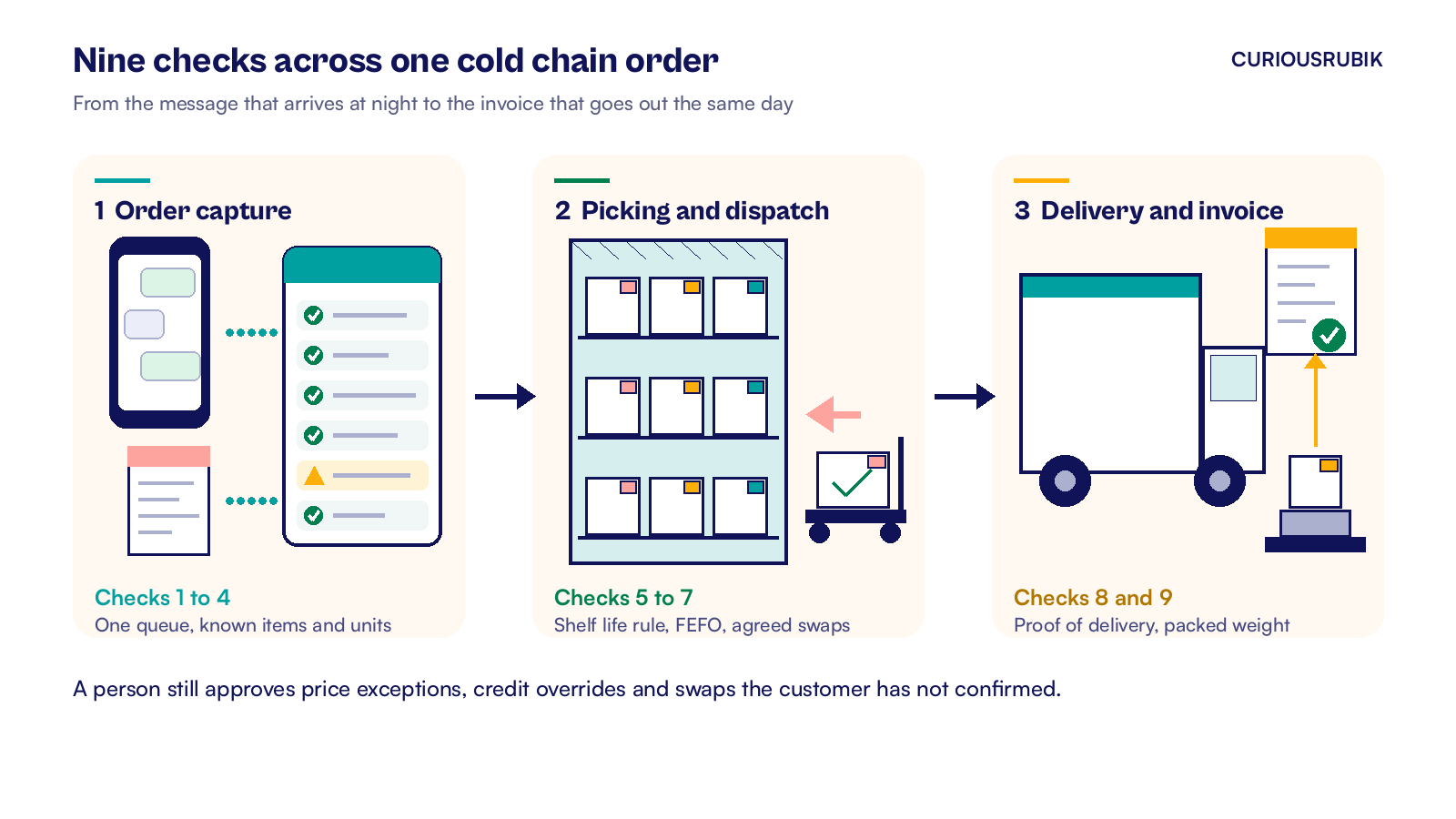
Cold chain order accuracy in Singapore depends on checks at three points: when the order arrives, when the chiller team picks it and when the driver hands it over. Capture each WhatsApp or emailed order once, match it to the right item, unit and lot date, and let a person clear only the exceptions before the truck leaves.
What does cold chain order accuracy in Singapore cover?
Cold chain order accuracy is the share of orders delivered with the right item, quantity, unit and lot, in the right delivery slot. It also covers temperature, packed weight and price.
Many Singapore chilled and frozen distributors serve restaurants, hotels, caterers and supermarkets. Chefs send orders late at night by WhatsApp. Buyers email PDF purchase orders. Someone then retypes all of it into the current system before the cold room starts picking.
In cold chain work, short shelf life means a wrong item or a missed date soon becomes waste, a credit note and a late invoice.
Where do daily order errors come from, and what do they cost?
Most errors start at capture, well before anyone opens the chiller door.
- Unit mix ups. "10 chicken" can mean 10 birds, 10 kg or 10 cartons.
- Catch weight items. Meat, poultry and seafood are often sold by actual weight, so the invoice must use the packed weight.
- "Same as usual" orders. Whoever retypes it must recall what usual means for each outlet.
- Lot and date gaps. The customer wants stock with a set number of days left, but nobody checks before picking.
- Late changes. A second message at 6 AM changes the first one, and both get entered.
Enterprise Singapore and IMDA described one case in their February 2026 food manufacturing digital plan factsheet. Toh Thye San Farm, a poultry distributor, had up to 10 customer order mistakes a day while it relied on manual processes. After the farm added AI enabled ordering that captures WhatsApp orders, the factsheet reported 20 percent higher order accuracy and up to eight hours of labor saved per mistake avoided. This is a government case study, not a CuriousRubik client.
A wrong order costs more than the credit note. Someone takes the call, finds the stock, sends a second van and fixes the invoice. Chilled goods that come back often cannot be sold again.
Which checks belong at order capture?
An AI automation portal is a controlled workspace that reads each incoming order and matches it to your customers, items and prices. It then writes a clean sales order into your ERP or current system. The first four checks run there, and a person reviews only what does not match.
- Capture every channel into one queue. WhatsApp messages, emailed PDFs and phone notes land in the same list. Why: an order sitting in one phone is the order that gets missed.
- Turn each line into a known item and unit. The model maps "10 chicken" to the item and unit this outlet usually buys. Why: a unit mix up sends the wrong quantity even when the item is right.
- Expand "same as usual" from history. The portal proposes the outlet's standing order for a quick check. Why: memory should not decide what a kitchen receives.
- Merge late changes into the open order. A second message for the same outlet and date updates the first order. Why: a revised order should not become a second order on the truck.
Which checks belong at picking and dispatch?
- Check the customer's shelf life rule before picking. If a supermarket needs a set number of days left, the pick list offers only lots that qualify. Why: a short dated delivery is often rejected at the door.
- Pick first expiry, first out. FEFO means the lot with the nearest expiry date leaves first. Why: less stock expires on the shelf.
- Flag substitutions before the truck leaves. If an item is short, the portal sends the customer a proposed swap and records the reply. Why: an agreed swap is a sale, but a surprise swap is a return.
How do you close the loop at delivery and invoice?
- Record what was handed over. The driver confirms quantities, notes rejected lines and adds a photo or signature as proof of delivery. Why: the invoice should match what the customer accepted, and a failed delivery needs one next action.
- Invoice catch weight items at packed weight. The weight from the packing scale flows to the invoice line, and any price outside its limit goes to a person. Why: invoices go out the same day, with no weights retyped.
A person still approves price exceptions, credit overrides, credit notes above an agreed amount and any swap the customer has not confirmed. See human in the loop automation for how to design those review points.
A hypothetical Singapore distributor's month
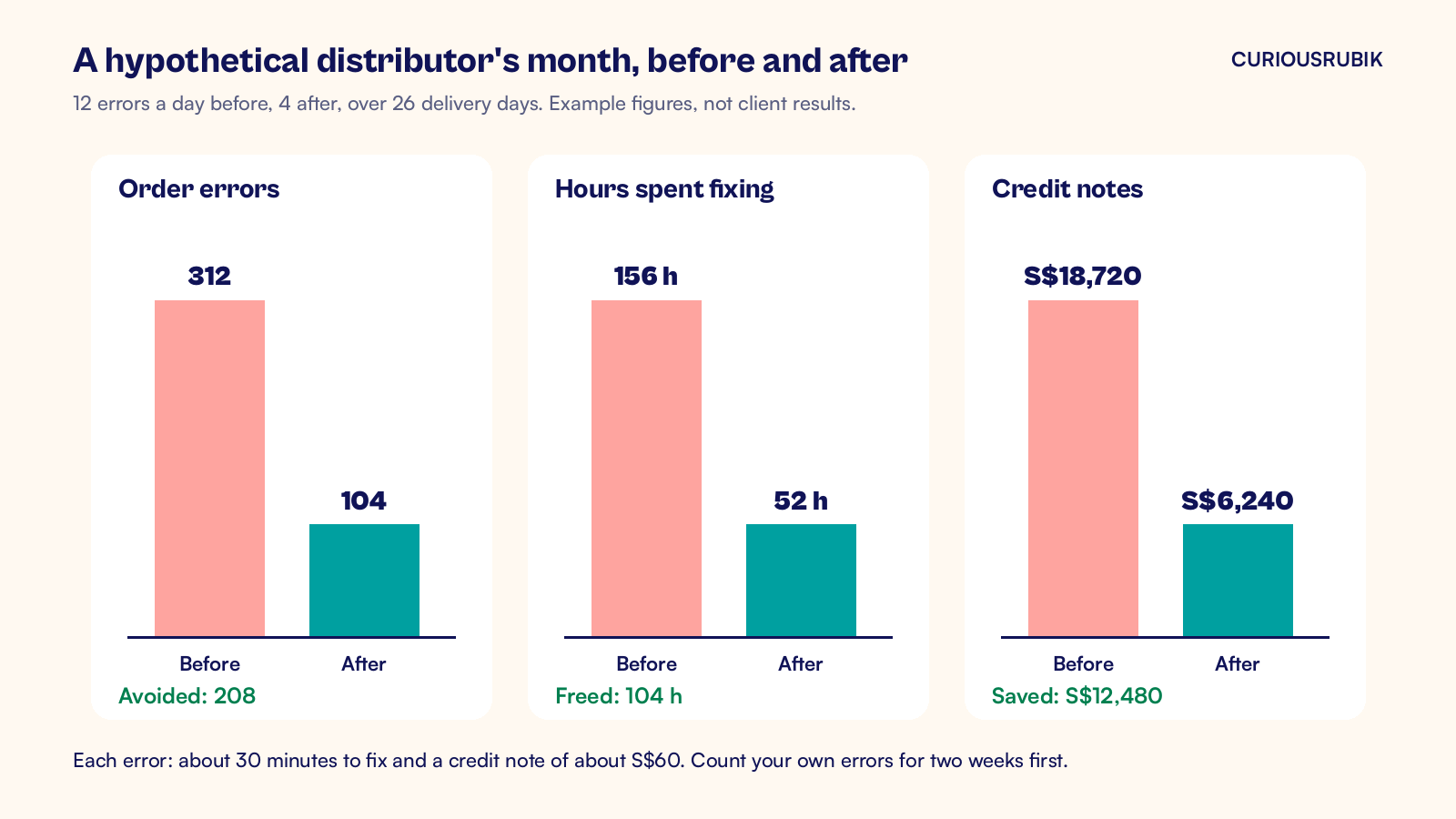
A hypothetical chilled and frozen distributor in Singapore makes 12 order errors a day over 26 delivery days a month. Each error takes about 30 minutes to fix and ends in a credit note of about S$60. After the nine checks, errors fall to 4 a day.
What changes in a month
| Measure per month | Before | After |
|---|---|---|
| Order errors | 12 x 26 = 312 | 4 x 26 = 104 |
| Hours spent fixing | 312 x 0.5 = 156 hours | 104 x 0.5 = 52 hours |
| Credit notes | 312 x S$60 = S$18,720 | 104 x S$60 = S$6,240 |
That frees about 104 hours and S$12,480 in credit notes a month. These are example figures. Count your own errors for two weeks before you set a target.
Which check should you fix first?
Pick one row for a four week pilot.
| If this keeps happening | Fix this check first | Track this each week |
|---|---|---|
| Wrong quantity or unit | Check 2, item and unit matching | Wrong item credit notes |
| Two deliveries for one order | Check 4, merging late changes | Duplicate orders |
| Goods rejected for short dates | Checks 5 and 6, shelf life and FEFO | Rejected lines per 100 deliveries |
At CuriousRubik, we build these portals one workflow at a time for wholesale distribution and food supply teams. CuriousRubik can design an AI automation portal that connects cold chain order capture to the systems you already run. You can book a consultation to walk through one workflow, agree what good looks like and see a working result before you decide the next step.
Related reading
AI Order Entry for Singapore Wholesalers Tired of Retyping
How to capture WhatsApp and PDF orders once and check only the exceptions.
Approve the refund and the credit note as related decisions
Why a credit note and its refund should be approved together.
How to Identify the Processes That Actually Deserve Automation
A way to choose which process to automate first.