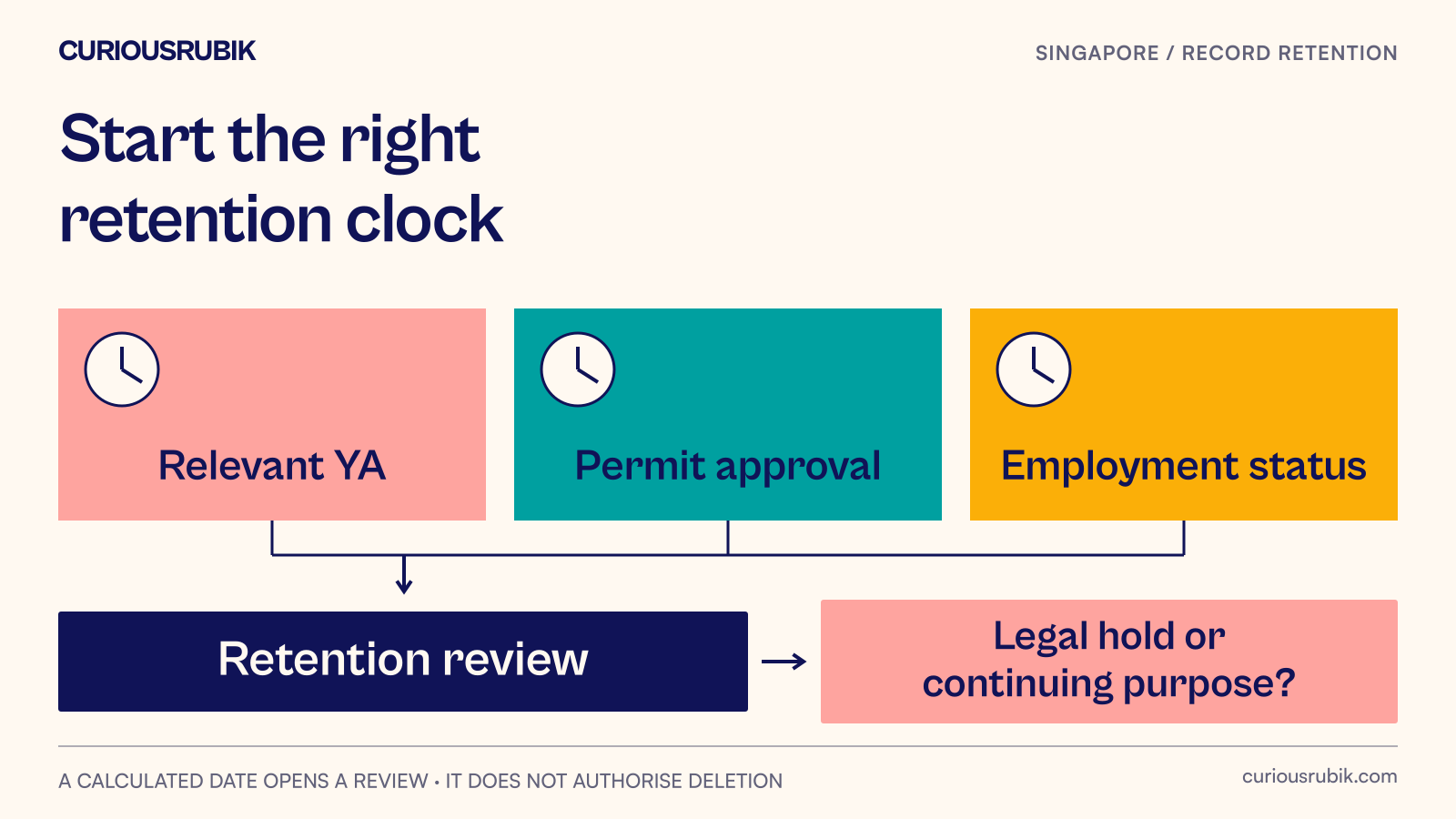
A rule that deletes every file five years after upload is easy to automate. It is also likely to apply the wrong clock to some records. Upload date may have no relationship to the relevant tax year, permit approval, employee departure or end of the purpose for which personal data was held.
A defensible retention schedule begins with record classes and their purposes. For each class, establish the applicable duty, the event that starts its clock, any continuing reason to retain it and the person who can resolve a conflict. Only then should a system calculate review dates or prepare disposal actions.
The following examples explain why Singapore tax, trade, payslip and personal-data records need separate treatment. They are a starting point for specialist review, not a complete retention policy for every business or document.
Put the trigger beside the period
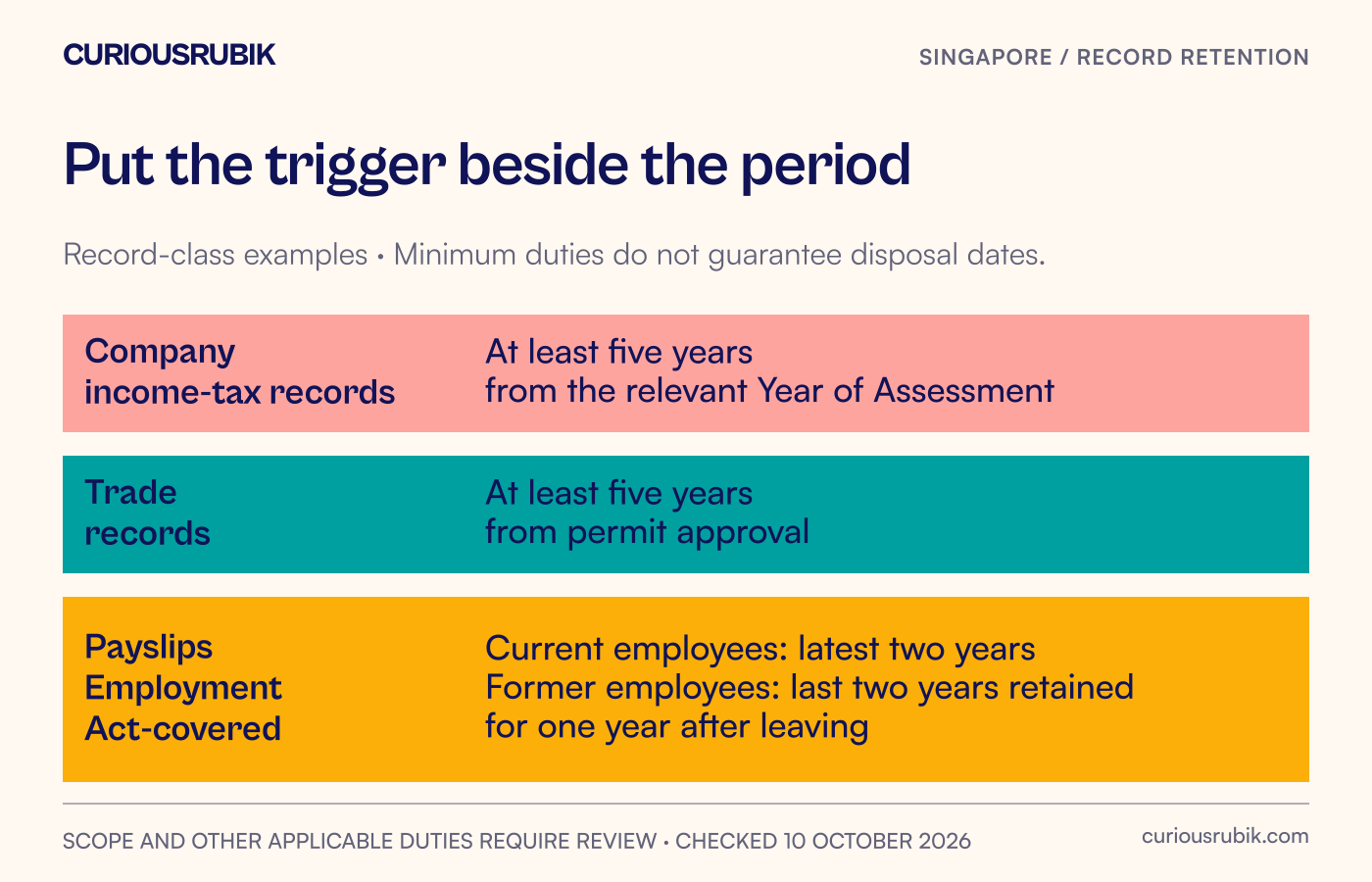
For company income-tax records, IRAS requires retention for at least five years from the relevant Year of Assessment. That formulation is different from five years after an invoice was scanned or a folder was created.
Singapore Customs requires traders and declaring agents to keep relevant trade documents for at least five years from permit approval. A document supporting both accounting and trade purposes therefore needs its applicable obligations assessed together. The similar number of years does not make the start events interchangeable.
MOM's itemised-payslip guidance has another formulation for employees covered by the Employment Act. Employers keep the latest two years for current employees; for former employees, the last two years are retained for one year after departure. This is the payslip rule, not a universal instruction to destroy all payroll or employee information at that point.
Other legal, tax or business purposes can still affect the same records. A retention matrix should state its scope precisely, including what it does not decide. Labelling an entire personnel folder “payslips” is not an adequate classification.
Read the diagram text
CURIOUSRUBIK SINGAPORE / RECORD RETENTION Put the trigger beside the period Record-class examples · Minimum duties do not guarantee disposal dates. Company income-tax records At least five years from the relevant Year of Assessment Trade records At least five years from permit approval Payslips Employment Act-covered Current employees: latest two years Former employees: last two years retained for one year after leaving SCOPE AND OTHER APPLICABLE DUTIES REQUIRE REVIEW · CHECKED 10 OCTOBER 2026 curiousrubik.com
Add the purpose test for personal data
PDPC's retention guidance requires organisations to cease retaining personal data, or remove the means of associating it with individuals, when the original purpose is no longer served and retention is no longer necessary for legal or business purposes, subject to the applicable law.
That does not erase another valid record-keeping duty. Nor does it justify keeping every copy indefinitely because the organisation might find it useful one day. The records and privacy owners need a specific, supportable reason and an appropriate scope.
Consider a payroll report kept as accounting support and copied into several working folders. The required record may need to remain, while unnecessary duplicate copies and extra personal fields deserve separate review. Deleting all copies would lose evidence; keeping every working copy forever would ignore the different purposes and access risks.
The schedule should identify an authoritative retained record, necessary supporting evidence and convenience copies. Verify dependencies before disposing of a duplicate. A file with the same name can contain an annotation or approval that does not exist elsewhere.
Read one retention row as a decision
A useful matrix row contains the record class, owner, purpose, source obligation, start event, minimum period or review condition, storage location, permitted access, relevant holds and disposal approval route.
Take a hypothetical trade file linked to an import permit. The permit date supports one clock, while accounting documents in the file may have another applicable purpose. The owner identifies the original records needed to explain the transaction and checks whether an inquiry remains open. The row's result is a reviewable retention position, not a deletion instruction generated from the folder name.
For payslips, the records owner needs reliable employment-status and departure information as well as the issued records. A missing departure date should create an exception for HR to resolve, rather than start an assumed clock from the last file modification.
For a customer contact list, the relevant question may be whether its approved purpose continues and which legal or business reasons, if any, support retention. A finance retention rule should not be copied onto that list merely because both files live in the same shared drive.
Handle one document serving several purposes
Where a document supports multiple obligations, the responsible specialists must determine when the required evidence can lawfully be disposed of. Simply choosing the shortest period risks premature deletion. Simply keeping every associated personal field for the longest imaginable period can be excessive.
Ask whether the needed evidence can be retained in a narrower form without damaging its reliability or breaching another requirement. Any redaction, aggregation or anonymisation needs to preserve what the relevant purpose requires. Removing direct identifiers does not automatically make information anonymous if people remain identifiable from other details.
Document the reasoning and authority for the selected approach. The records coordinator keeps the schedule consistent; tax, employment, trade, legal or privacy specialists resolve the duties within their scope. An administrator should not be asked to make those interpretations when a deletion job is waiting to run.
Read the diagram text
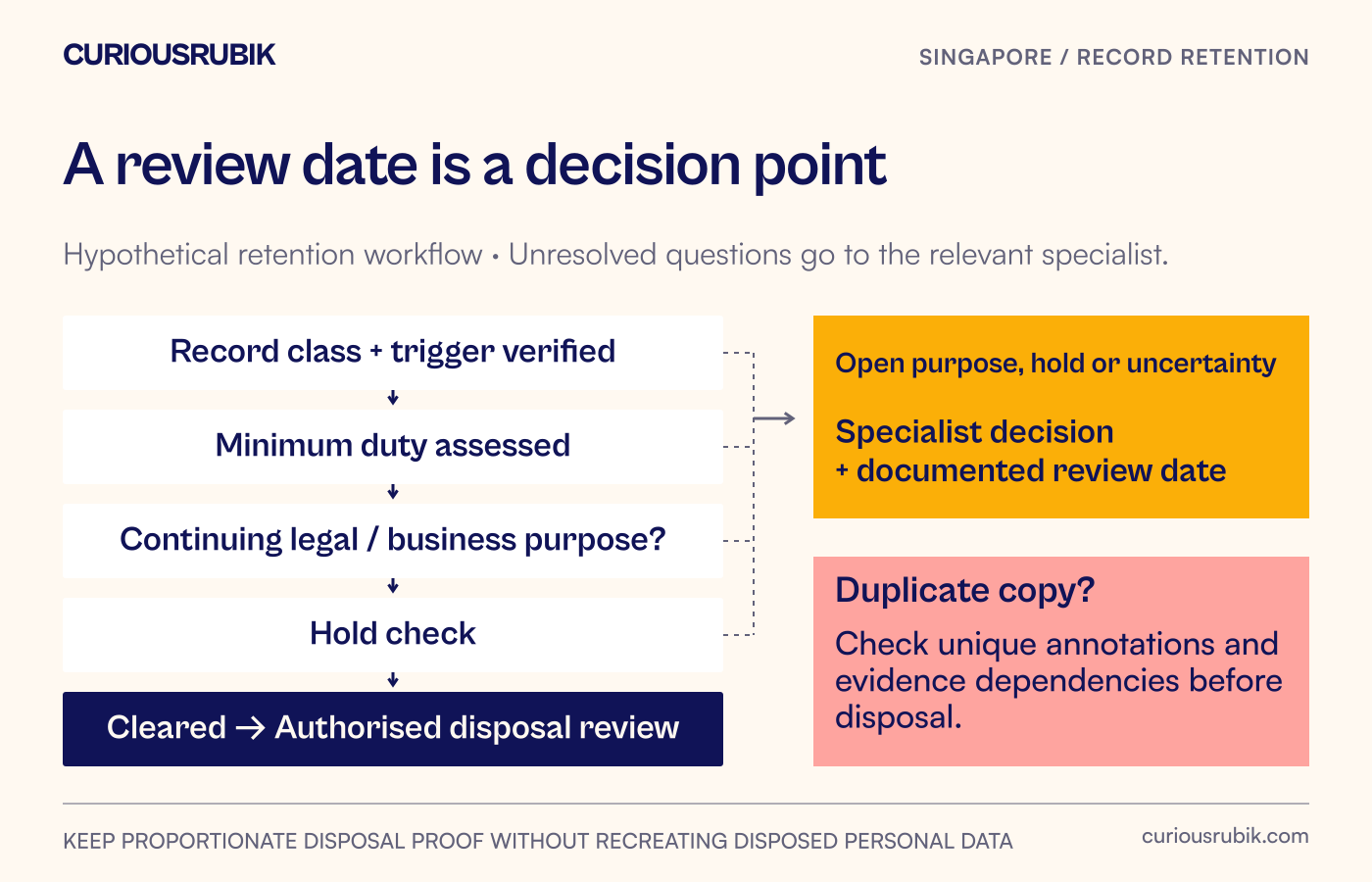
CURIOUSRUBIK SINGAPORE / RECORD RETENTION A review date is a decision point Hypothetical retention workflow · Unresolved questions go to the relevant specialist. Record class + trigger verified Minimum duty assessed Continuing legal / business purpose? Hold check Cleared → Authorised disposal review Open purpose, hold or uncertainty Specialist decision + documented review date Duplicate copy? Check unique annotations and evidence dependencies before disposal. KEEP PROPORTIONATE DISPOSAL PROOF WITHOUT RECREATING DISPOSED PERSONAL DATA curiousrubik.com
Treat a hold as a controlled exception
An inquiry, dispute or litigation-related instruction may require relevant records to be preserved. The responsible legal or compliance owner should define the scope, affected locations, start date and release authority. The routine schedule must be able to recognise that hold.
Avoid a vague “keep everything” note with no owner. It is difficult to apply correctly and equally difficult to end. Where the initial scope must be broad, have the responsible person review and refine it as the facts become clearer.
A hold should not disappear because a case folder moves or an employee leaves. Link it to the relevant record class or matter and confirm that people responsible for disposal know it applies. Release requires the authorised decision and a fresh check of any remaining retention purpose.
Make automation prepare an accountable disposal decision
Automation can calculate review dates from verified trigger events, identify missing classifications and list candidate duplicates. It can assemble the records and evidence for an authorised review. It should flag uncertainty rather than filling a missing date with the upload timestamp.
Before disposal, check scope, continuing purposes, holds, recovery arrangements and approval. The business also needs to understand copies held by providers, archives and backups. A deletion from an active folder may not complete the intended disposal, while a broad purge may affect evidence outside the approved scope.
Keep a proportionate disposal record: what class or batch was addressed, authority, date, method and any exceptions. Do not retain the personal data being disposed of merely to prove that it was disposed of. The evidence should establish the action without unnecessarily recreating its contents.
Start with the rule most likely to misfire
Measure records without a defined purpose or trigger, attempted disposal blocked by a valid hold and completed actions lacking approval evidence. Review unnecessary duplication as well as early-deletion risk. A policy that never disposes of anything has not necessarily solved the problem.
Begin with one scheduled deletion rule. Ask which record classes it reaches and whether its date field matches their actual retention triggers. Have the relevant specialists review that mapping before the next run. A small correction to the clock can be more valuable than a large folder clean-up performed on the wrong basis.