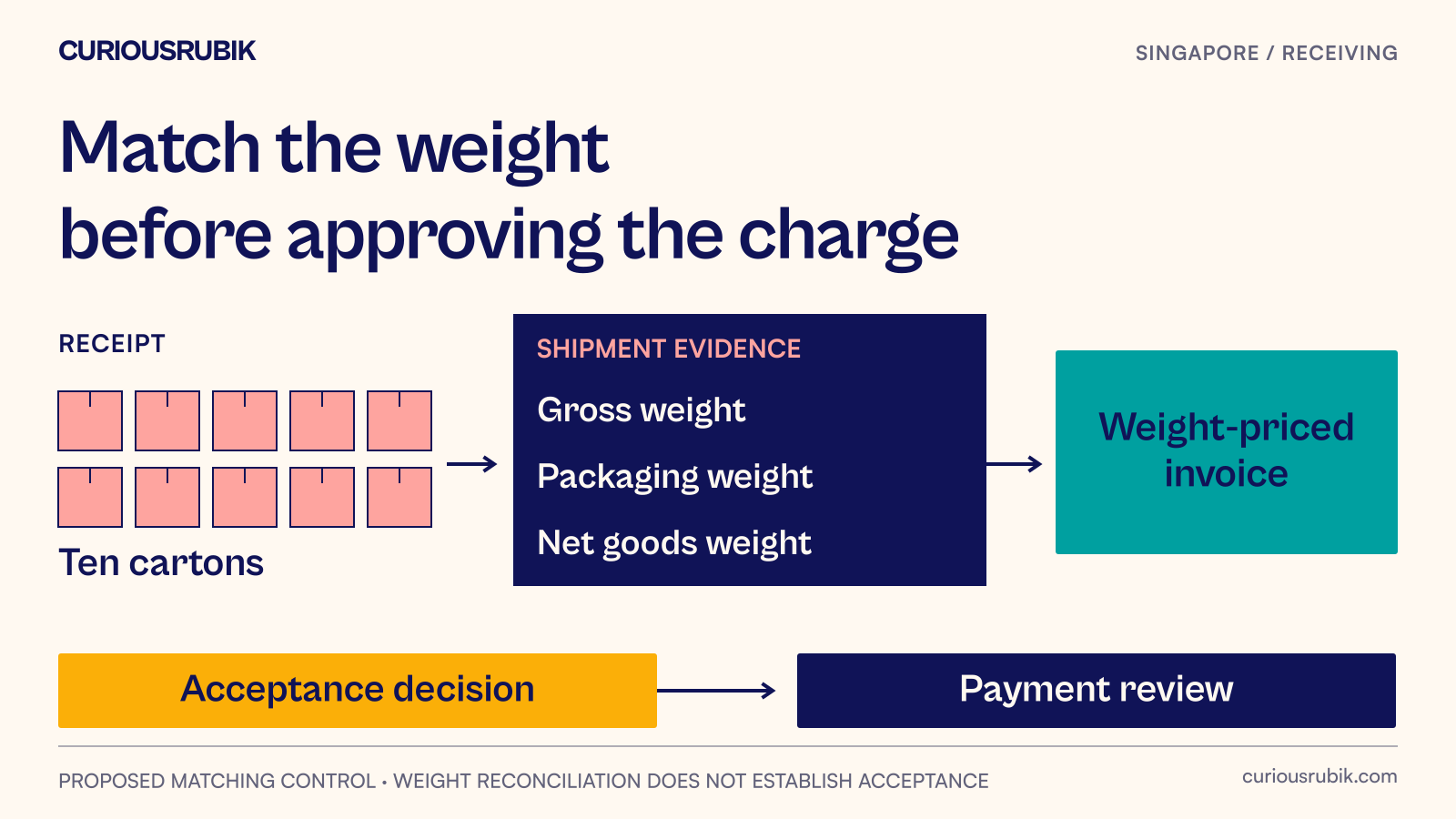
The warehouse confirms that ten cartons arrived. The supplier invoices for 200 kilograms. Finance cannot tell whether the invoice matches the receipt, because a carton count and a weight are different pieces of evidence.
Multiplying by a standard carton weight may look like the quickest answer. It is unreliable when actual contents vary, packaging contributes to the measured weight or part of the shipment is rejected. The purchasing process needs to establish the agreed charging basis and connect it to shipment-specific evidence.
For a Singapore distributor, that means keeping physical receipt, weight verification, commercial acceptance and payment approval distinct. The warehouse records what arrived. Purchasing resolves what the agreement makes chargeable. Finance pays against the resulting evidence and approved decision.
Begin with the price basis on the agreement
Before checking arithmetic, ask what the buyer agreed to buy. Is the price per kilogram of goods, per kilogram including specified packaging, or per carton with an indicative weight? Does the agreement use the supplier's dispatch weight, the receiver's accepted weight or another agreed measurement basis?
The answer should be visible in the order and supporting terms. “Ten cartons at the usual rate” is insufficient if previous deliveries had variable weights. A buyer's expectation and a supplier's invoice can each be internally consistent while describing different commercial arrangements.
Record the product, price unit, agreed weight basis and treatment of packaging. Define the evidence that will support the charge and how a discrepancy will be raised. Where moisture, processing or handling can change weight, the parties may need specialist input on a suitable contractual basis. The worksheet should expose that question rather than assume a universal method.
This is a commercial-control recommendation. It does not prescribe a legal measurement method, certify weighing equipment or determine whether a particular tolerance is lawful.
Keep three quantities in the receipt
The receiver should distinguish the number of packages, the measured weight including the relevant packaging and the weight of the goods used for the commercial comparison. Gross weight includes packaging; tare is the packaging weight deducted to derive net weight on that basis. Record the basis actually used, rather than applying those labels to unexplained numbers.
The evidence may include a supplier weight statement, receiving measurement, package identification and a record of how packaging weight was established. Note whether figures were measured or estimated and which shipment they describe. A generic product weight is not equivalent to a measurement of the delivered shipment.
If the business does not weigh every receipt, make that limitation clear. A carton count with an accepted supplier weight certificate is a different control from independent receiving measurement. Decide which approach is appropriate for the product, contract and risk, and retain the authority for that decision.
The receiving team should not be asked to guess a net weight just to complete a mandatory field. An unresolved figure needs a named evidence owner and a visible status that prevents an unsupported match from appearing complete.
Reconcile a hypothetical shipment without forcing agreement
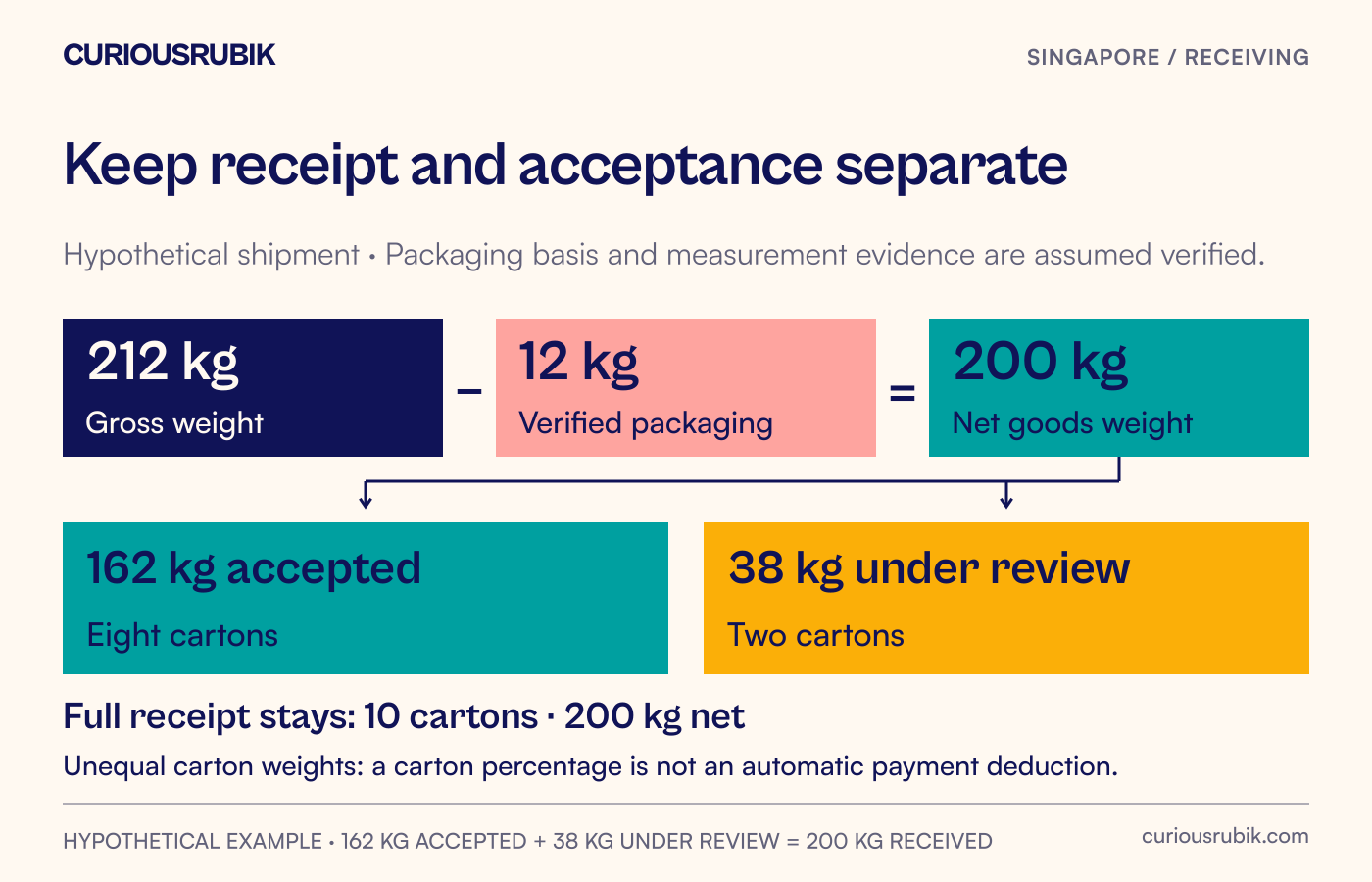
Suppose the order is for goods priced by net kilogram. Ten cartons arrive. The receiving evidence records 212 kilograms gross and establishes 12 kilograms of packaging, giving 200 kilograms net. The supplier invoice also charges 200 kilograms. All figures in this example are hypothetical; the method assumes the packaging basis and measurement evidence have been appropriately agreed and verified.
The calculation is 212 minus 12 equals 200. It connects the package receipt to the weight-priced invoice. It does not prove the goods met specification, that every carton was accepted or that the price and other charges are correct. Those checks remain necessary.
Now suppose two cartons are set aside because the contents appear damaged. Their shipment-specific net weight is recorded as 38 kilograms. The other eight cartons contain 162 kilograms net. The full physical receipt remains ten cartons and 200 kilograms net, while commercial acceptance of the 38 kilograms is unresolved.
Do not calculate the disputed weight as two-tenths of the invoice simply because two of ten cartons are affected. The cartons in this example have different actual weights. Equal package counts do not imply equal chargeable quantities.
Read the diagram text
CURIOUSRUBIK SINGAPORE / RECEIVING Keep receipt and acceptance separate Hypothetical shipment · Packaging basis and measurement evidence are assumed verified. 212 kg Gross weight 12 kg Verified packaging 200 kg Net goods weight − = 162 kg accepted Eight cartons 38 kg under review Two cartons Full receipt stays: 10 cartons · 200 kg net Unequal carton weights: a carton percentage is not an automatic payment deduction. HYPOTHETICAL EXAMPLE · 162 KG ACCEPTED + 38 KG UNDER REVIEW = 200 KG RECEIVED curiousrubik.com
Put the claim with the person who can decide it
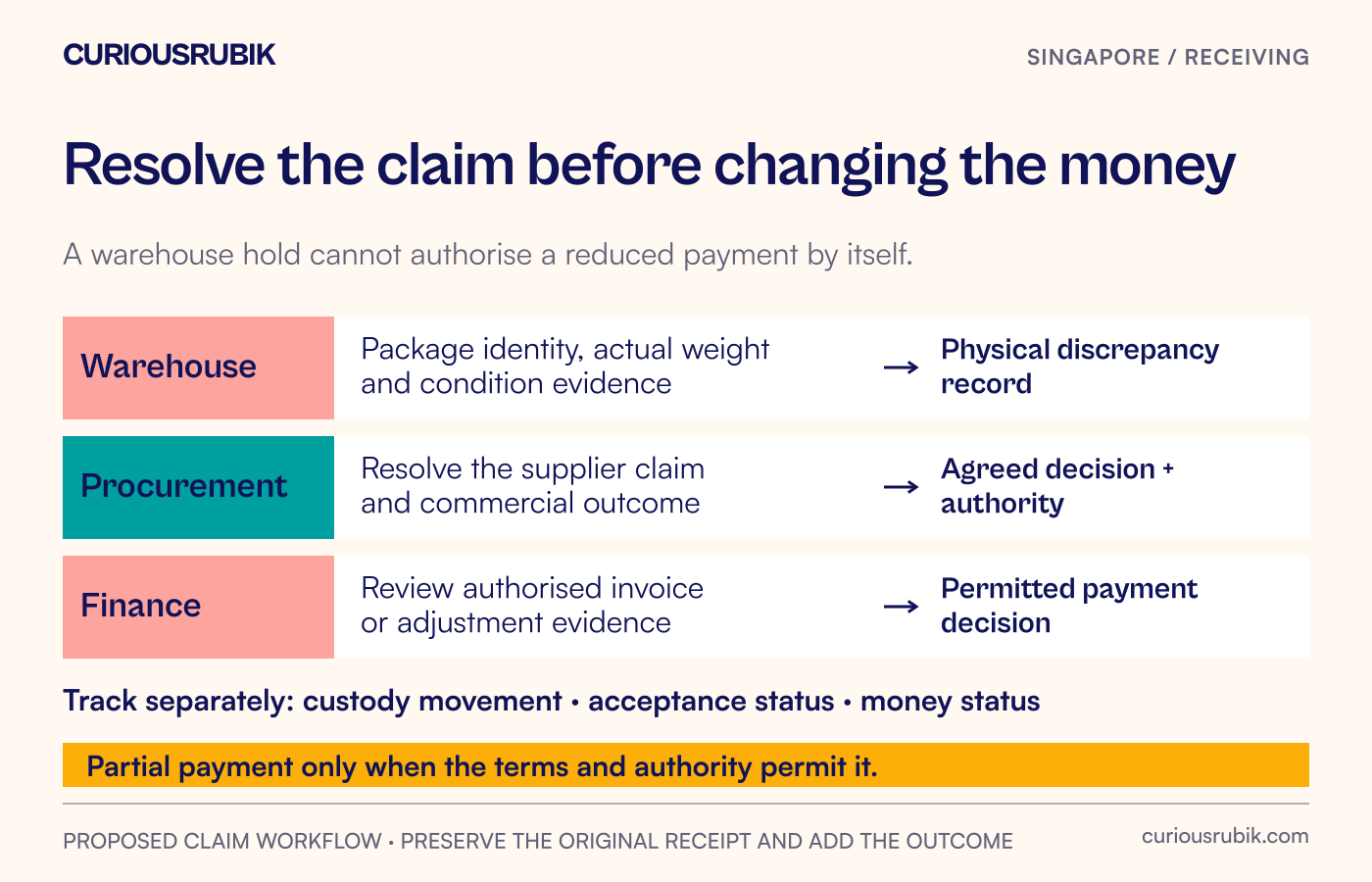
The warehouse lead owns the physical discrepancy and condition evidence. The buyer or account-facing procurement owner contacts the supplier about the commercial position. Finance decides payment processing within its authority using that outcome.
The resolution log should identify the affected packages, weight, condition, supporting evidence, notification date and supplier response. If the contract sets claim requirements or deadlines, the responsible owner verifies and records them. Do not insert a standard deadline copied from an unrelated supplier.
A supplier may agree to collect the affected goods, replace them or issue an adjustment. Another case may establish that the original charge remains valid. Record the actual decision and its authority. A receiving hold is not automatically a rejection, a return or permission to reduce payment.
If payment of the supported portion is proposed, purchasing and finance must confirm that the arrangement permits it and that the necessary approval exists. In the hypothetical case, 162 kilograms is the physically accepted quantity. That fact alone does not authorise finance to pay 81 percent of every invoice charge, since freight or other charges may use a different basis.
Let the record show what changed after inspection
The two cartons might later be accepted following inspection. They might leave on a documented return. They might remain on site while the parties agree a disposition. Each event changes a different part of the record.
Maintain the original receipt and add the outcome. Record custody changes when the goods move, acceptance changes when the responsible owner decides, and financial adjustments when the appropriate document is approved. Do not overwrite the received quantity to make it agree with a reduced invoice.
IRAS requires company records to explain business transactions. Retaining the weight evidence and commercial decision supports that explanation. The proposed reconciliation sheet supplements the original order, receipt and invoice; it does not replace their required supporting records.
For imported shipments, keep the original commercial invoice and packing list connected to the receipt evidence and relevant permit reference. Singapore Customs requires traders and declaring agents to retain relevant trade documents for at least five years from permit approval. Preserve the source quantities alongside the measured receiving weights so differences can be explained; do not overwrite the import documents with the later accepted quantity.
Read the diagram text
CURIOUSRUBIK SINGAPORE / RECEIVING Resolve the claim before changing the money A warehouse hold cannot authorise a reduced payment by itself. Warehouse Package identity, actual weight and condition evidence Physical discrepancy record Procurement Resolve the supplier claim and commercial outcome Agreed decision + authority Finance Review authorised invoice or adjustment evidence Permitted payment decision Track separately: custody movement · acceptance status · money status Partial payment only when the terms and authority permit it. PROPOSED CLAIM WORKFLOW · PRESERVE THE ORIGINAL RECEIPT AND ADD THE OUTCOME curiousrubik.com
Automate only the comparison that the evidence supports
A useful matching rule first checks the agreed price unit and weight basis. It then compares the supplier's chargeable quantity with the verified quantity for that shipment, displaying gross, tare and net where relevant. It should identify missing evidence rather than substitute a nominal carton weight without approval.
Separate arithmetic differences from commercial exceptions. A subtraction error can be corrected with a clear audit trail. Disputed packaging weight, damaged goods or a disagreement about the charging basis need a responsible person. A broad tolerance should not swallow those cases merely because the total invoice variance is small.
Test the process with an ordinary receipt, unequal carton weights, a partial hold and an invoice with a separately priced delivery charge. Measure invoices matched on unsupported assumptions, time spent obtaining weight evidence and repeat disputes by supplier or product. Also check whether the design creates unnecessary holds where the approved evidence is already sufficient.
Start with one weight-priced supplier invoice and the corresponding receipt. Ask whether another person can explain the chargeable quantity without relying on “that is what a carton usually weighs”. If not, clarify the price basis and shipment evidence before automating the match.