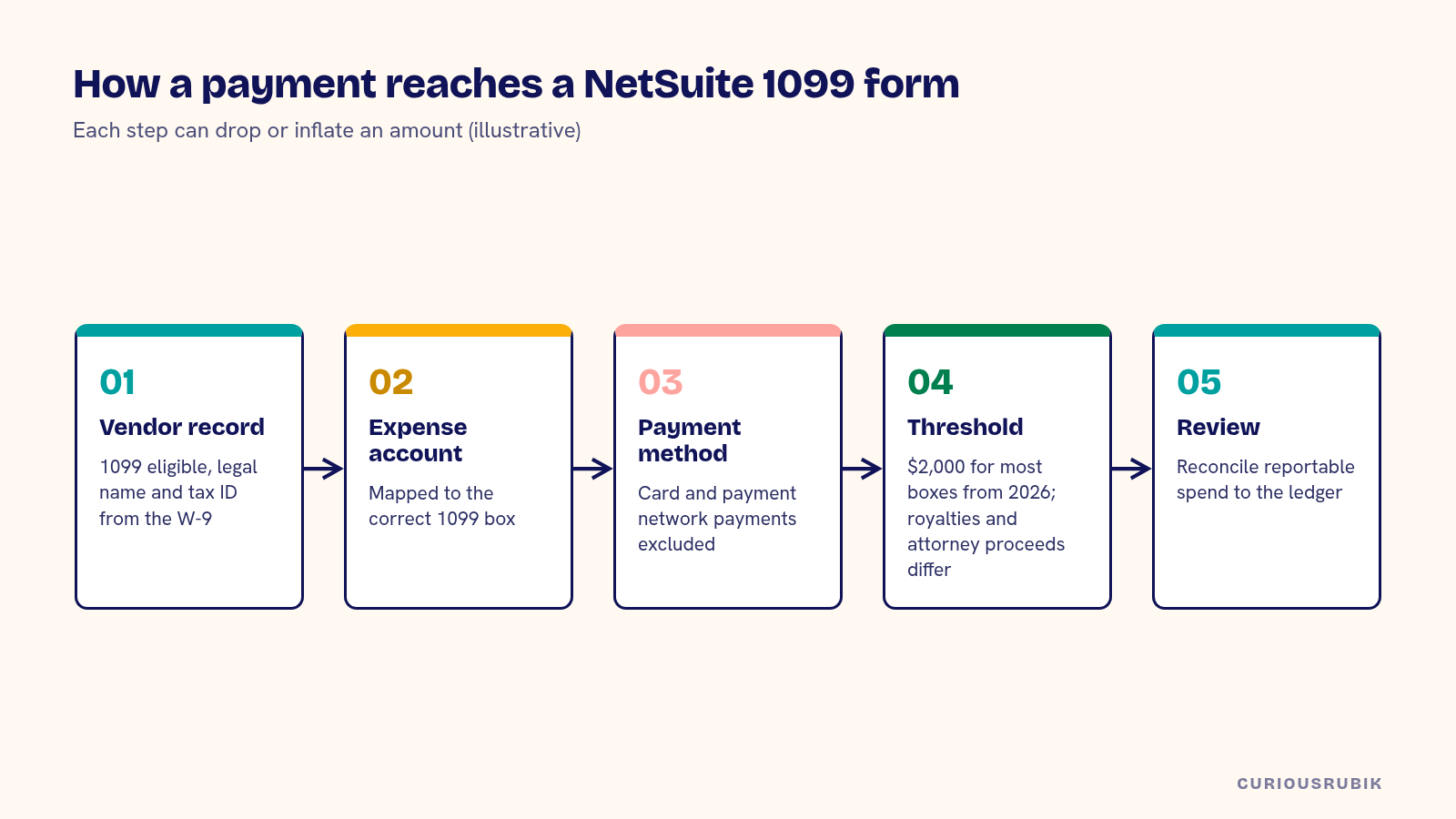
Accurate NetSuite 1099 reporting depends on three things being right before January: the vendor records, the mapping of expense accounts to 1099 boxes, and the payments you exclude because they were made by card or through a payment network. Fix those in November and December and the January 31 deadline for 1099-NEC becomes a review exercise instead of a scramble.
This year has an extra change. For payments made after December 31, 2025, the general reporting threshold for 1099-NEC and many 1099-MISC boxes rose from $600 to $2,000, with inflation indexing from 2027. Royalties stay at $10 and gross proceeds paid to attorneys stay at $600. Your NetSuite setup and review saved searches need to reflect the thresholds that changed and keep the ones that didn't.
Clean the vendor records first
Every reportable vendor needs a legal name that matches their W-9, a tax ID, a correct address and the 1099 eligible flag set on the vendor record. Start with a saved search of vendors paid this year, showing those fields and the total paid.
Look for the usual problems. Duplicate vendors split one contractor's payments across two records, so neither crosses the threshold. A trading name on the vendor record doesn't match the name the IRS holds for the tax ID. Corporations are flagged as eligible when they usually aren't, and attorneys are left unflagged when they usually should be. Our post on cleaning customer and vendor duplicates explains how to merge records without losing history.
Collect missing W-9s before December
Pull a list of eligible vendors with no tax ID or an old W-9 on file. Ask for current forms now, while vendors are still responsive. If a vendor won't provide a TIN, backup withholding rules may apply to future payments, so involve your tax adviser.
Store W-9s as file attachments on the vendor record, or in a document system linked from it. Restrict who can edit tax IDs and bank details, and require approval for changes. Our guide to NetSuite vendor bank detail change controls shows how to put a review step in place.
Map expense accounts to the right 1099 boxes
NetSuite reports 1099 amounts based on how expense accounts are mapped to 1099 categories in its 1099 setup. If contractor fees post to an account that isn't mapped, those payments won't appear. If a mapped account also takes reimbursed expenses or product purchases, the totals will be inflated.
Review each mapped account with the controller. Check that nonemployee compensation points to the 1099-NEC box, rents and other income point to the right 1099-MISC boxes, and royalties and attorney proceeds are handled separately because their thresholds differ. Check the current setup page and options in your account, since menu paths can change between releases.
Exclude card and payment network payments
Payments made by credit card, debit card or a third-party payment network are generally reported by the payment settlement entity on Form 1099-K, so you shouldn't include them on your 1099-NEC. In NetSuite, those payments often look the same as a check or ACH payment against a vendor bill unless the payment method or account tells them apart.
Decide how you will identify them. A dedicated clearing account for card payments to vendors, or a consistent payment method, makes the exclusion easy to apply and easy to evidence. Test it with a few known card payments before year-end.
Run a reconciliation before you file
Build a saved search that shows, for each eligible vendor, total payments by account and payment method, with the amount that will report and the amount excluded. Compare it with the 1099 report. Then compare the total reportable amount with the ledger for the mapped accounts, and explain the difference.
Duplicate bills are worth a separate check, because a bill paid twice and later refunded can still show as reportable. The controls in preventing NetSuite duplicate vendor invoices help reduce this before it reaches year-end.
A hypothetical December review
A hypothetical Texas engineering firm pays 140 contractors and service providers through NetSuite. In early December, its AP lead runs the review saved search. All figures are illustrative.
| Finding | Count | Action |
|---|---|---|
| Vendors paid between $600 and $1,999 | 22 | No 1099-NEC needed for 2026 payments; keep W-9s on file |
| Duplicate vendor pairs for the same contractor | 3 | Merge; two pairs now cross $2,000 |
| Eligible vendors with no tax ID | 7 | Request W-9s; escalate two to tax adviser |
| Card payments posted to a mapped account | $18,400 | Reclassify to card clearing account |
| Attorney payments not flagged | 2 vendors | Flag and map legal fees correctly |
The firm files 1099-NEC forms for 61 vendors in January, down from the prior year because of the higher threshold, and keeps the review search with its year-end file. Your counts will differ. The review sequence carries over to most accounts.
Plan filing and corrections
Decide early whether you will e-file through an IRS system, a filing service or a NetSuite add-on, and test the export format. Most businesses filing 10 or more information returns in total must file electronically. Keep a record of what was filed and the data it came from.
Corrections happen. When a vendor disputes an amount, trace it through your reconciliation search, issue a corrected form if needed, and fix the vendor record so the problem doesn't repeat next year.
Fix the process for next year in January
The best time to improve 1099 reporting is straight after filing, while the problems are fresh. Make the 1099 flag and tax ID mandatory for new vendors in the contractor categories, through a vendor onboarding form or a workflow that blocks approval until the W-9 is attached. Give contractor fees their own expense account if they share one with other spend.
Agree how card payments to vendors are recorded, and train AP and the people who hold company cards. Then schedule the review saved search to run quarterly. A quarterly check takes minutes and turns December into a confirmation. The threshold will be indexed from 2027, so add a yearly calendar reminder to check the new amount as well.
Use this NetSuite 1099 year-end checklist
Before you generate forms, check each of these:
- Are vendor names and tax IDs matched to current W-9s?
- Are duplicate vendors merged and the 1099 flag set correctly?
- Are corporations, attorneys and other exceptions handled deliberately?
- Is every contractor expense account mapped, and nothing else mapped?
- Are the 2026 thresholds applied, with royalties and attorney proceeds kept separate?
- Are card and payment network payments excluded with evidence?
- Does reportable spend reconcile to the ledger?
- Is the e-filing method tested and the filing record retained?
Our NetSuite managed support team runs year-end 1099 reviews for US accounts, and our page for US companies on NetSuite covers the wider compliance work. If sales tax is your next concern, read NetSuite sales tax in the US: nexus and setup. For revenue reporting, see NetSuite ASC 606 revenue recognition, and for budget context, NetSuite implementation cost in the US.
Related reading: NetSuite Vendor Bank Detail Change Controls
Frequently asked questions
What is the 1099-NEC threshold for 2026?
For payments made after December 31, 2025, it is $2,000, with inflation indexing starting in 2027. Check IRS instructions for each box.
Does NetSuite file 1099s with the IRS?
NetSuite produces 1099 reports and forms. Electronic filing usually goes through an IRS system, a filing service or an add-on.
Should card payments to contractors be on a 1099-NEC?
Generally no. They are usually reported by the payment settlement entity on Form 1099-K.
Why is a vendor missing from our 1099 report?
Common causes are an unset 1099 flag, payments posted to unmapped accounts or the vendor's payments split across duplicate records.
When is Form 1099-NEC due?
It is generally due to recipients and the IRS by January 31.