For US CFOs and operations leaders at growing midsize companies deciding how NetSuite will support the next stage of growth.
Last reviewed: 21 October 2026. Product details reflect this review date. Availability and behavior can vary by account, role and release.
NetSuite for midsize companies puts finance, orders, inventory, sales tax and reporting in a single cloud system. It scales by adding users, modules and subsidiaries to the same account, so you don't need to replace it when you open a new entity or channel. It suits many US companies with $10 million to $500 million in revenue.
The real question for a midsize company isn't whether NetSuite can handle growth. It can. The question is how to set it up so cost and effort grow at a steady pace with the business.
Why choose NetSuite for midsize companies?
A midsize company has outgrown entry level tools but doesn't have a large IT department. NetSuite is built for that gap. Oracle hosts and updates it, so your team spends time on the business, not on servers or upgrade projects.
Three features matter most at this stage. First, one data model means finance, sales and operations work from the same records. Second, NetSuite OneWorld runs several subsidiaries and currencies in one account. Third, SuiteCloud lets you add workflows, scripts and integrations without changing the core product.
How does NetSuite licensing work for a growing company?
NetSuite licensing has three parts. You pay for the base platform, for full user licenses and for any extra modules, such as advanced inventory or revenue management. Employees who only enter time, expenses or approvals can use lower cost self service access.
That structure rewards an honest user count. In many midsize companies, a large share of staff only approve, submit or view. They don't need full licenses.
Count your users by role
- List everyone who will touch the system.
- Mark who creates or edits transactions every day. These are full users.
- Mark who only submits time, expenses or approvals. These use self service access.
- Mark who only reads dashboards. Check whether shared reports cover them.
- Add the hires you expect over the next three years.
This simple count often changes a quote more than any discount. It also helps you plan training, since full users need deeper training than people who only approve or submit.
How does NetSuite handle multi entity growth and US sales tax?
Midsize US companies often add a second entity for a new state, a new product line or an acquisition. NetSuite OneWorld treats each one as a subsidiary in the same account. Intercompany sales, eliminations and consolidated reports run inside the system.
Sales tax is the other pressure point. Each state sets its own rules, rates and filing dates. Since the 2018 Wayfair ruling, states can require you to collect tax once you pass their economic nexus threshold. NetSuite calculates sales tax on each transaction and can connect to a tax engine for rates and filing. Our guide to NetSuite sales tax setup for US nexus explains the steps. If you run several entities, our post on NetSuite multi entity accounting for US groups shows how intercompany and consolidation work.
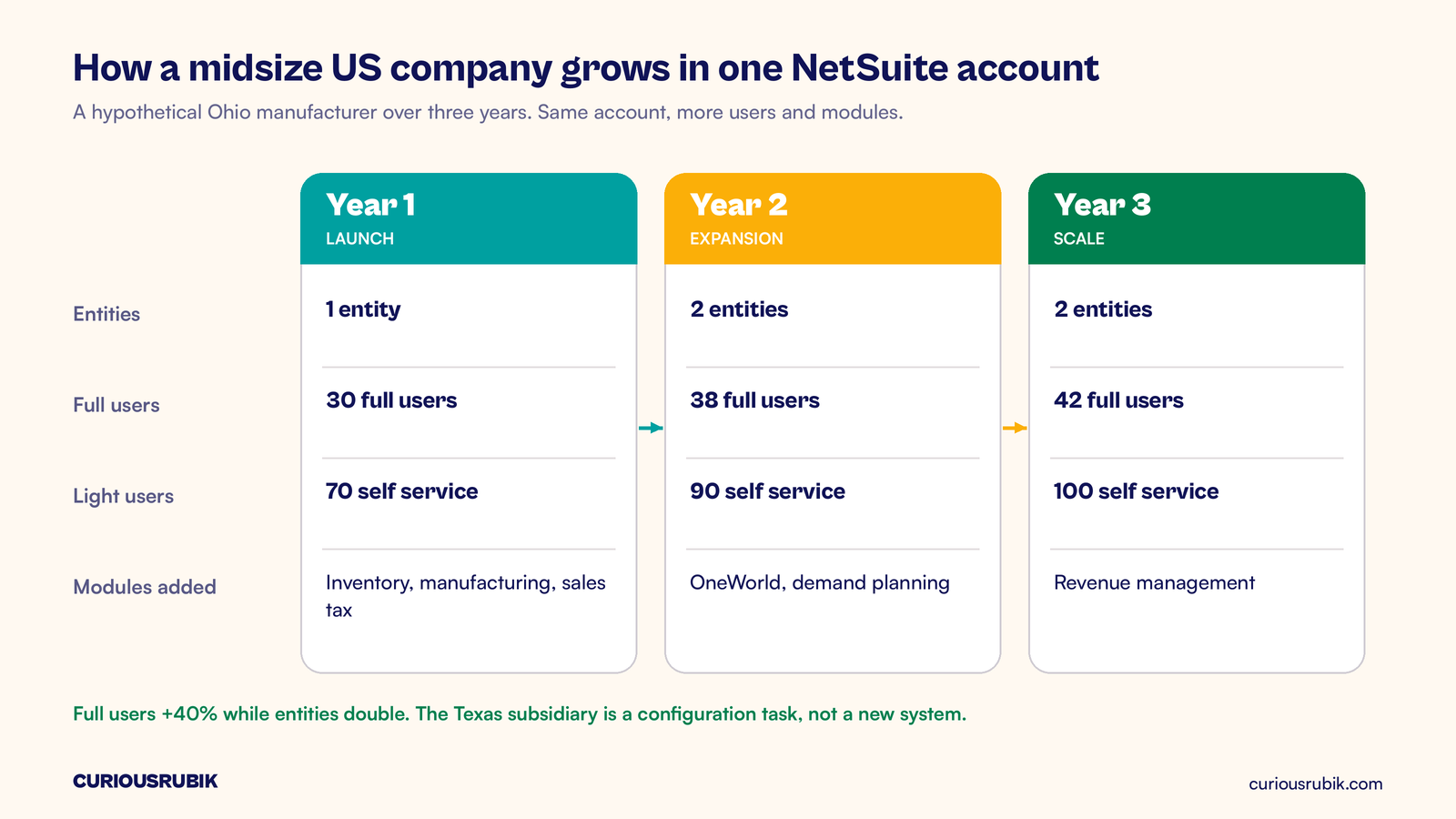
A hypothetical Ohio manufacturer's three year plan
A hypothetical Ohio manufacturer has $45 million in revenue, 120 staff and plans to open a Texas subsidiary in year two. Here is how its NetSuite setup grows.
| Stage | Entities | Full users | Self service users | Modules added |
|---|---|---|---|---|
| Year 1 launch | 1 | 30 | 70 | Inventory, manufacturing, sales tax |
| Year 2 expansion | 2 | 38 | 90 | OneWorld, demand planning |
| Year 3 scale | 2 | 42 | 100 | Revenue management |
Full users grow from 30 to 42, a 40% increase, while the number of entities doubles. The account stays the same. The Texas subsidiary is added as a configuration task, not a new implementation.
In year one, the company also cuts its month end close from 12 days to 6. That happens because inventory, purchasing and the ledger now share the same data.
These figures are illustrative. Your plan will come from your own growth targets.
What should midsize companies prepare before they buy?
Good preparation leads to a tighter scope and a better quote. Work through these points with your leadership team.
- Name the three workflows that cause the most delay today, such as quote to cash or stock counts.
- Map your entities, states with sales tax nexus and currencies for the next three years.
- Decide which systems will stay, such as a CRM, ecommerce platform or payroll provider.
- Pick an internal project owner with real time to give.
- Set a target go live date tied to a business calendar, such as a quarter start.
Our NetSuite implementation cost guide for the US and our post on how to shortlist three NetSuite partners in the US help with the next steps.
How long does a midsize NetSuite implementation take?
A single entity with finance, purchasing and inventory usually goes live in 3 to 5 months. Adding manufacturing, several subsidiaries or complex integrations often extends that to 6 to 9 months. The biggest factors are data quality and how quickly decisions get made.
A phased plan helps. Many midsize companies launch finance and inventory first, then add manufacturing or advanced modules once the team is settled. Each phase gets its own testing, training and sign off, so problems stay small. It also spreads cost across two budget years, which many midsize finance teams prefer.
How CuriousRubik supports midsize US companies
At CuriousRubik, we start with one bounded problem, such as the inventory close or the sales tax setup, and prove it in NetSuite before the wider rollout. Learn more about our NetSuite implementation approach and our NetSuite services in the United States.
Frequently asked questions
What counts as a midsize company for NetSuite?
There is no strict line. As a rough guide, NetSuite suits many US companies from about $10 million to $500 million in revenue, with 50 to 1,000 staff. The better signal is complexity: several entities, inventory, sales tax in many states or a need for live reporting across teams.
Does NetSuite charge for every employee?
No. Full user licenses are for people who create and edit transactions. Employees who only enter time, expenses or approvals can use lower cost self service access. Count users by role before you request a quote, because the mix of full and light users drives much of the subscription cost.
Can NetSuite grow with an acquisition?
Yes. With NetSuite OneWorld, an acquired company becomes a new subsidiary in your existing account. You set its currency, tax and chart of accounts view, then migrate its opening balances. Consolidated reporting includes it from the first close, which makes acquisitions far easier to absorb.
Do we need an IT team to run NetSuite?
Not a large one. Oracle hosts the system and runs two updates a year. Most midsize companies have one or two internal administrators and use a partner for larger changes and support. That setup keeps running costs steady while the business grows.
How often is NetSuite updated?
Oracle releases two major NetSuite updates each year. Every customer is upgraded on a scheduled date after a preview period for testing. Your configuration and most customizations carry forward, so you get new features without a separate upgrade project or extra license cost.
Related reading
NetSuite Implementation Cost in the US (USD Guide)
What drives the cost of a NetSuite rollout in the US and how to budget for it.
NetSuite Multi Entity Accounting for US Groups
How US groups run subsidiaries, intercompany and consolidation in NetSuite OneWorld.
NetSuite Module Selection Before Contracting
How to decide which NetSuite modules you need now and which can wait.