A point of view for Singapore founders and sales leads on running customers, quotes and cash on one NetSuite record.
Last reviewed: 22 October 2026. Product details reflect this review date. Availability and behavior can vary by account, role and release.
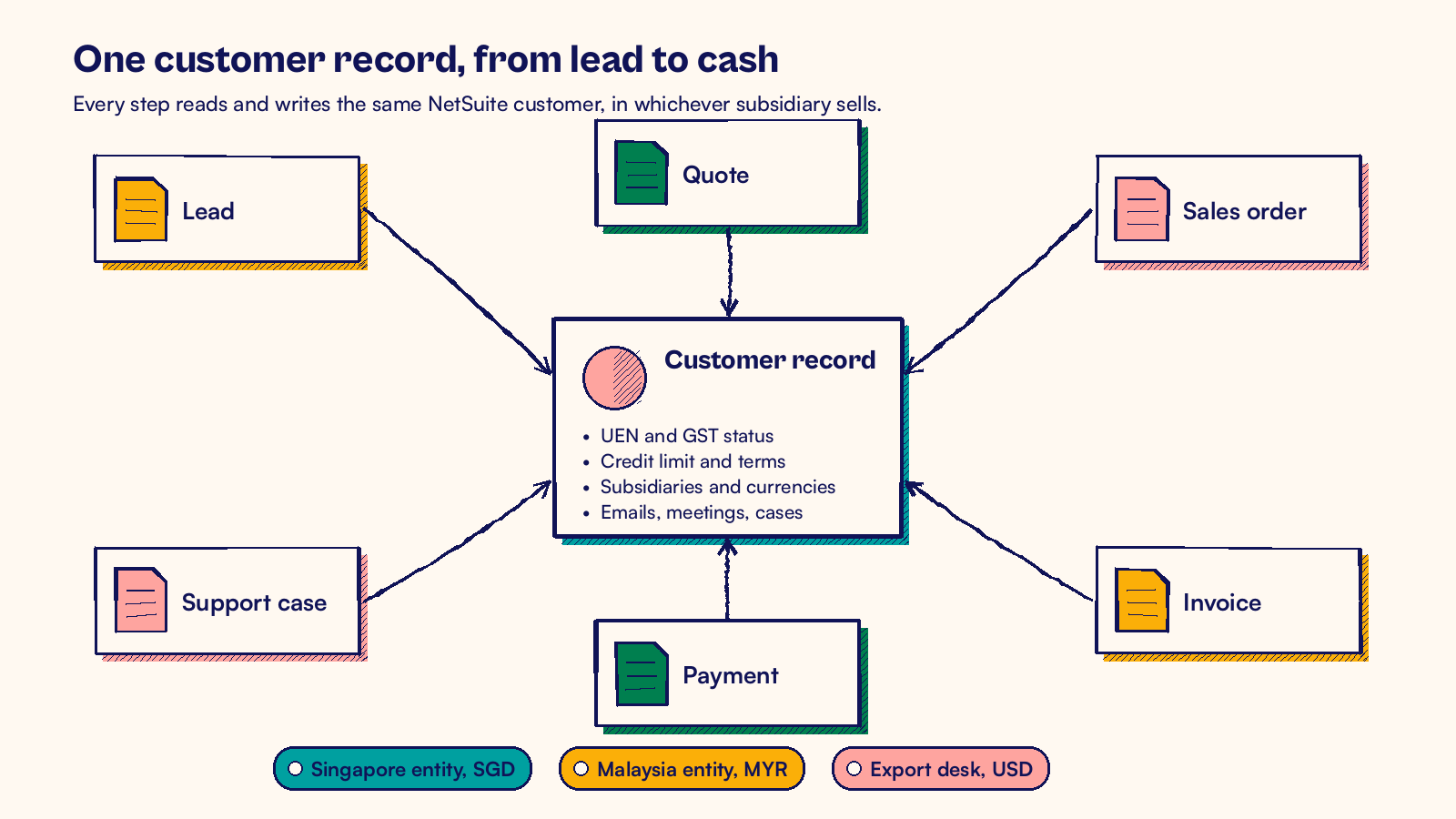
NetSuite CRM in Singapore works best when sales and finance share one customer record. Leads, quotes, orders, invoices, payments and support cases sit in the same NetSuite database. Sales sees the credit limit and overdue invoices before it quotes. Finance gets the right UEN, GST status and currency on every invoice, with nobody typing them twice.
Key takeaways
- The costly errors in a sales process happen at the handoff between a sales tool and the finance system.
- One NetSuite customer record can serve a Singapore company and its Malaysia or other regional subsidiaries.
- Clean customer data now makes InvoiceNow easier later.
- Move sales in stages, and retire the old tool on a fixed date.
What is NetSuite CRM?
NetSuite CRM is the customer relationship part of NetSuite. It holds leads, prospects, opportunities, quotes, sales orders, cases and marketing campaigns in the same database as your invoices and payments. Nothing has to sync overnight. When a sales rep opens a customer, the orders, invoices and open balance are already on the screen.
Most growing Singapore businesses start the other way. Sales lives in a separate sales tool or a spreadsheet. Finance lives in the accounting system. A person, or an integration, carries the customer across.
Why should sales live in the ERP?
Our view is simple. The handoff between sales and finance is where most customer errors begin. A customer is created twice under two spellings. Credit terms agreed by sales never reach the invoice. A quote uses an old price list. Each fix is small, but the cost repeats every week.
A good integration narrows the gap. Two systems still hold two copies of each customer, though, and someone has to keep them in step. When sales works inside NetSuite, there is one copy. The quote becomes the sales order, and the sales order becomes the invoice. Our guide to the NetSuite order to cash process shows how that flow runs once sales is on board.
This matters a lot in Singapore. Many regional businesses sell from a Singapore entity, a Malaysia entity and often a USD export desk. Each customer needs the right subsidiary, currency and tax code from the first quote.
How does NetSuite CRM in Singapore handle regional subsidiaries?
With NetSuite OneWorld, one customer can be shared across subsidiaries, while each transaction still belongs to one subsidiary and currency. Our post on sharing NetSuite customers and vendors across subsidiaries explains the setup.
The table shows where each customer fact usually lives, and where it lives with NetSuite CRM.
| Customer fact | With a separate sales tool | With NetSuite CRM |
|---|---|---|
| Billing address, UEN and GST status | Typed in sales, then again in finance | Entered once on the customer record |
| Credit limit and overdue balance | Seen by finance after the order | Visible to sales at quote time |
| Subsidiary and currency | Chosen again when the order reaches finance | Set on the customer and carried to the quote |
| Emails and meetings | Kept in personal inboxes | Logged on the customer record |
| Support cases | Held in a separate help desk | Shown next to orders and invoices |
Clean customer data also prepares you for InvoiceNow. IRAS is extending the InvoiceNow requirement in phases until every GST registered business is covered by April 2031. Existing GST registered businesses with annual supplies above S$4 million join on 1 April 2031. An electronic invoice is only as good as the customer data behind it.
Capture email and meetings where the customer lives
Sales history often sits in one person's inbox. When that person leaves, the context leaves too. NetSuite 2026.2 extends the NetSuite Connector for Outlook with Outlook Premium support. It can sync email and calendar events, with attachments, to NetSuite records.
The real gain is context. A finance lead chasing an overdue invoice can see the last three conversations with the buyer before picking up the phone.
A hypothetical Singapore distributor moves sales into NetSuite
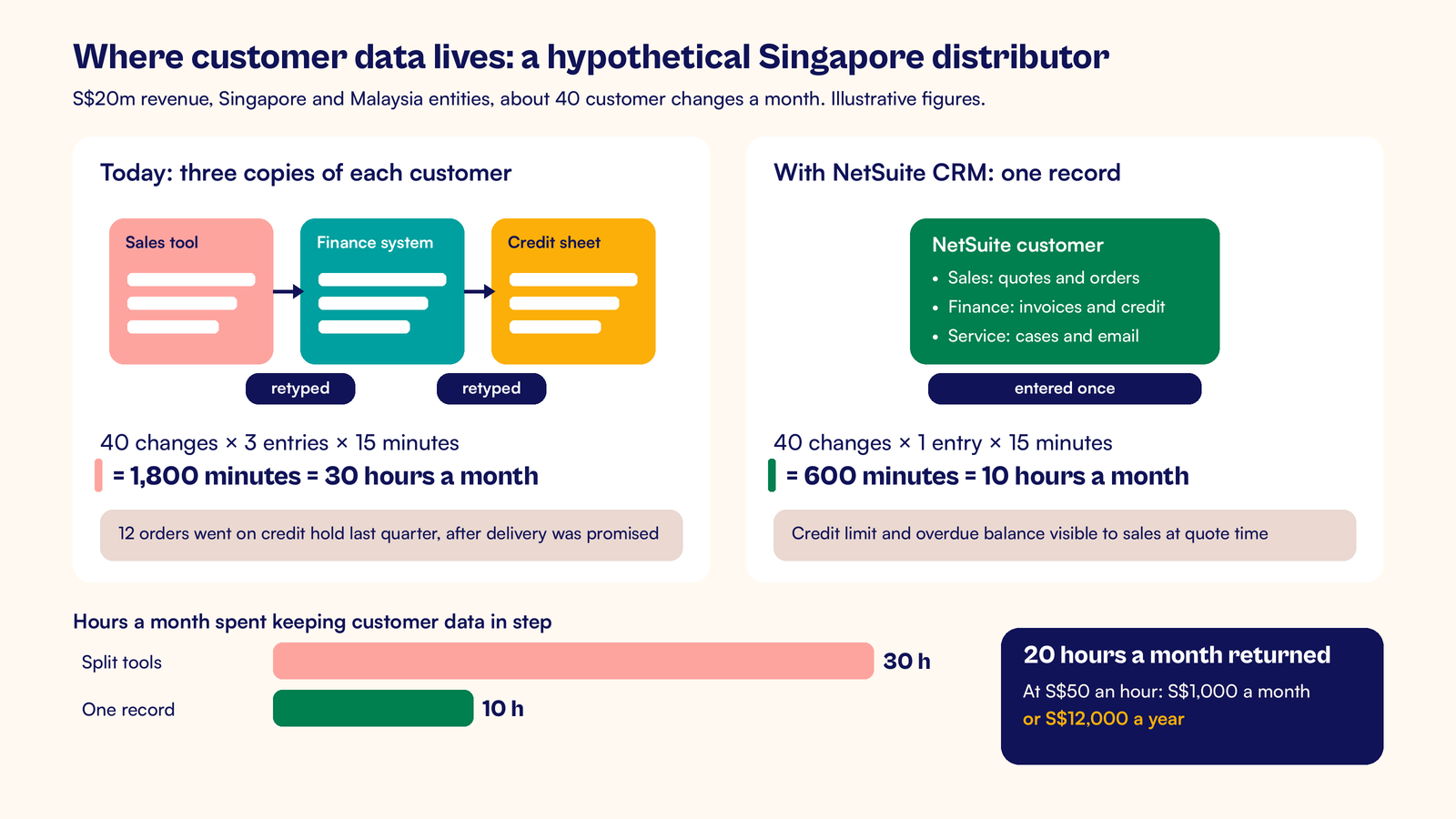
A hypothetical S$20m Singapore distributor sells from Singapore and a Malaysia office. It adds or changes about 40 customer accounts a month. Today each change is typed in three places: the sales tool, the finance system and a credit spreadsheet. Each entry takes about 15 minutes.
- Today: 40 changes × 3 entries × 15 minutes = 1,800 minutes, or 30 hours a month.
- With NetSuite CRM: 40 changes × 1 entry × 15 minutes = 600 minutes, or 10 hours a month.
- Time returned: 20 hours a month. At a loaded cost of S$50 an hour, that is S$1,000 a month, or S$12,000 a year.
The bigger gain is harder to count. Last quarter, 12 of its orders went on credit hold after sales had already promised delivery. With the credit limit and overdue balance on the customer record, the rep sees the problem before quoting and calls finance first.
How do you move sales into NetSuite without disrupting the team?
Run it as a sales project, with IT in support. Follow these steps.
- Name one owner for the customer record, usually the sales operations or finance lead.
- Clean the customer list first: merge duplicates, confirm UEN and GST status, and set each subsidiary and currency.
- Map your sales stages to a short list of NetSuite opportunity statuses.
- Build the quote template with price levels, GST and payment terms, so a won quote becomes a sales order without retyping.
- Connect Outlook for the sales team, so email history lands on the record.
- Train reps on one customer view: open quotes, open orders, overdue invoices and cases.
- Retire the old sales tool on a fixed date, once the first monthly pipeline report in NetSuite matches.
Choosing who helps you matters as much as the plan. Our guide on how to choose a NetSuite partner in Singapore lists the questions to ask.
At CuriousRubik, our NetSuite implementation team sets up CRM and finance on the same customer record and moves your sales team over in stages. See our NetSuite services in Singapore and our ERP and CRM resource page.
Frequently asked questions
Is CRM included in NetSuite?
Core CRM features come with NetSuite and share its database. These include leads, opportunities, quotes, sales orders, cases and campaigns. Some advanced options, such as extra marketing or commerce modules, are licensed separately. Check your NetSuite quote for what your edition includes, and ask your partner which features your sales process really needs.
Can NetSuite CRM serve customers across Singapore and Malaysia?
Yes. With NetSuite OneWorld, one customer record can be shared with more than one subsidiary. Each quote, order and invoice still belongs to one subsidiary, with its own currency and tax code. Sales sees the full relationship, while each entity keeps its own books and its own GST or SST reporting.
Does NetSuite CRM work with Outlook?
Yes. The NetSuite Connector for Outlook links email and calendar events to NetSuite records. NetSuite 2026.2 adds Outlook Premium support, with automated email and calendar sync and attachments captured in NetSuite. Availability can vary by account and release, so confirm the option in your own account before you plan the rollout.
How does NetSuite CRM help with InvoiceNow?
InvoiceNow sends invoices electronically, so the customer details on each invoice must be right. When sales and finance share one NetSuite customer record, the UEN, address and GST status are entered once and checked once. That gives your InvoiceNow setup clean data to send from the first invoice.
Related reading
NetSuite CRM Integration When Customer Subsidiary Routing Changes
What to check when a customer moves between subsidiaries and the CRM link has to follow.
How to Choose a NetSuite Partner in Singapore
The questions to ask before you pick a partner for your Singapore rollout.
Why CRM Should Be Designed Around Customer Journeys, Not Departments
Why the customer's path, not the org chart, should shape your CRM.