For a Singapore SME, Business Central vs NetSuite usually comes down to four things: who maintains the Singapore GST and InvoiceNow functions, how many suppliers sit behind the design, whether a second entity is coming, and the five-year cost in SGD. Business Central often wins on price for a single Singapore company. NetSuite tends to pay off once entities, channels or regional reporting multiply.
The trap is assuming both products arrive ready for Singapore in the same way. They don't, and the difference decides who you call when IRAS changes a rule.
Confirm who maintains the Singapore localization
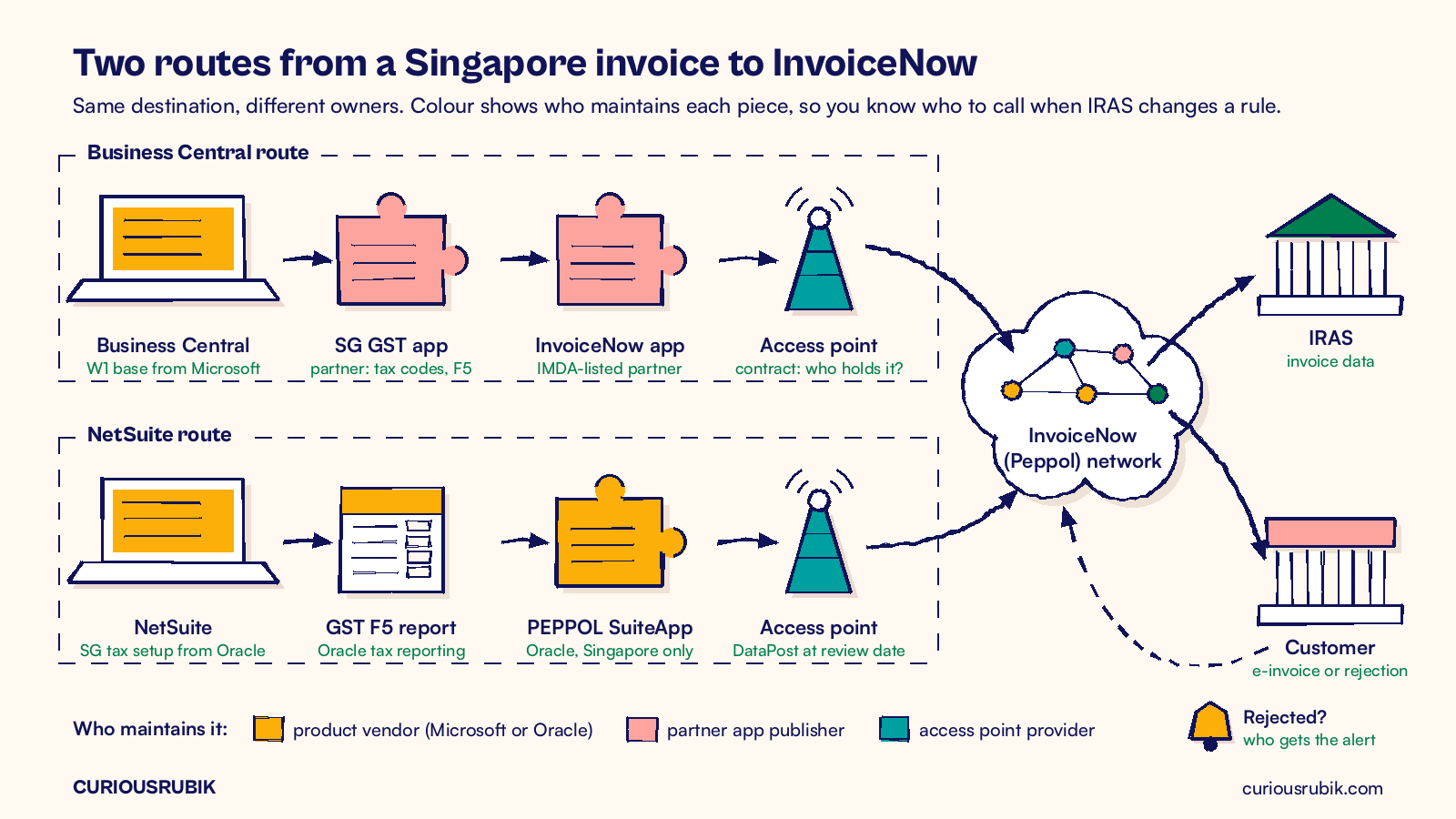
Microsoft lists Singapore as a partner-localized country for Business Central. The base product is the international (W1) version, and the Singapore GST setup, GST reports, the F5 return layout and InvoiceNow connection come from partner apps published on Microsoft's marketplace. Several Singapore partners publish these apps, and they differ in scope. Some prepare the F5 figures, some also submit to IRAS, some include InvoiceNow and some don't.
NetSuite's Singapore tax setup and reporting come from Oracle, with the Singapore PEPPOL-Ready e-Invoicing SuiteApp handling InvoiceNow through a supported access point. Fewer moving parts on paper, though you still depend on Oracle's release schedule and the access point provider.
Ask each side one question in writing: when IRAS changed the GST rate to 9% on 1 January 2024, who updated the tax codes, the return layout and the e-invoice templates, and how long did it take? A named owner and a date is a good answer. "The system handles it" is not.
Run one GST F5 quarter through both systems
Give both partners the same 40 to 60 transactions from a real quarter and ask them to produce the F5 boxes on a working environment. Include the cases that cause rework for Singapore finance teams:
- a standard-rated SGD sale and a zero-rated export to Malaysia
- a USD sales invoice where GST must be reported in SGD
- an import where GST was paid on the permit, not on the supplier invoice
- an imported service that falls under reverse charge, if you are in scope
- a credit note raised in a later quarter than the original invoice
Then trace two boxes back to the source transactions. Box 5 (total value of taxable purchases) and Box 7 (input tax claimed) are where permits, reverse charge and blocked input tax claims tend to hide. Our guide to the NetSuite GST F5 return shows the evidence pack a reviewer should expect from either system. If the partner fixes something with a manual journal during the session, write it down. That journal will come back every quarter.
Test InvoiceNow in both directions, including rejections
IRAS is bringing all GST-registered businesses into the GST InvoiceNow Requirement in phases. New voluntary registrants are already in scope. Existing GST-registered businesses follow from 1 April 2028 to 1 April 2031, based on total supplies reported in 2025, and IRAS began notifying businesses of their dates in mid-2026. Check your own date, then plan earlier if large customers or government agencies already ask for Peppol invoices.
The session should cover more than one clean outbound invoice. Send a sales invoice, a credit note and an invoice to a customer whose Peppol ID is wrong. Receive three supplier invoices, one with a price that doesn't match the purchase order. Then ask to see where each document's status is visible and who gets alerted when one is rejected.
For Business Central, the InvoiceNow function usually comes from a partner app listed as an InvoiceNow-Ready Solution with IMDA, connected to an access point. For NetSuite, the SuiteApp connects through Oracle's supported access point (DataPost at the time of review). In both cases, ask who holds the access point contract and who monitors failed transmissions after go-live. Our post on handling Peppol exceptions in NetSuite for Singapore lists the exceptions worth scripting.
Count the suppliers behind each design
Write down every vendor in each proposed design: the licence reseller, the implementation partner, each app or SuiteApp publisher and the access point provider. Then write the support route for a failed GST report or a stuck e-invoice. If the answer involves three companies and nobody owns the triage, you have found a cost the quote doesn't show.
Update cadence matters here. Business Central receives two major release waves a year, in April and October, plus monthly updates. NetSuite has two major releases a year. Every app in the design has to keep up with those releases, so ask each app publisher how quickly their last three versions followed Microsoft's or Oracle's release, and who runs your regression test before each one.
Judge the partner bench as closely as the product
Singapore has a deep Microsoft partner market, and many Business Central partners have sold fixed-scope packages to SMEs for years. NetSuite partners are fewer and often work across Southeast Asia. Neither fact tells you which team will do your work.
Ask for the named consultant who will configure GST and InvoiceNow, the number of Singapore go-lives they have led on that product in the last two years, and the support hours in Singapore time. Ask how they handle the year-end GST and audit queries, which arrive months after the project team has left. Our guide to choosing a NetSuite partner in Singapore has a question set you can use for both shortlists.
Plan where a second entity would sit
Many Singapore SMEs open a Malaysian or Indonesian company within a few years. Business Central runs each legal entity as a separate company, with intercompany and consolidation functions between them. NetSuite runs subsidiaries inside one account through OneWorld, which is a different edition and changes the subscription.
Don't pay for a group design you may never need. Do ask each partner to show, with a rough price, how a Malaysian company would be added: its own tax setup, Malaysia's e-invoicing requirements, intercompany sales and a consolidated SGD report. If the second entity is likely, our post on NetSuite intercompany for a Singapore regional HQ shows what the monthly work looks like once it exists.
Price Business Central vs NetSuite in SGD over five years
Model both products on the same users, the same scope and the same five years: subscription, apps or SuiteApps, access point fees, implementation, support retainer and internal time. Ask whether each figure is quoted in SGD or USD, what the renewal uplift cap is and whether licences can be reduced at renewal.
Grants change the arithmetic for some SMEs. Enterprise Singapore stopped taking new Productivity Solutions Grant applications on 29 September 2026, and support now runs through the EDGE Grant. Earlier PSG lists included pre-approved Business Central packages from several Singapore partners, with customization excluded. Confirm current EDGE terms and eligibility with Enterprise Singapore before you sign or pay a deposit, and read our post on preparing EDGE evidence before changing ERP scope.
A hypothetical Singapore distributor's five-year comparison
A hypothetical kitchen equipment distributor in Ubi has S$14 million revenue, 38 staff and 18 ERP users, 10 of them full users. It runs one Singapore company, files GST quarterly and exports about a quarter of its sales to Malaysia. Its 2025 supplies put its InvoiceNow date at 1 April 2031, but a hotel group and a government agency already want Peppol invoices. The board has approved a Malaysian sales company for year two, expects an Indonesian company by year four and wants one consolidated SGD report each month. All figures are illustrative and exclude GST.
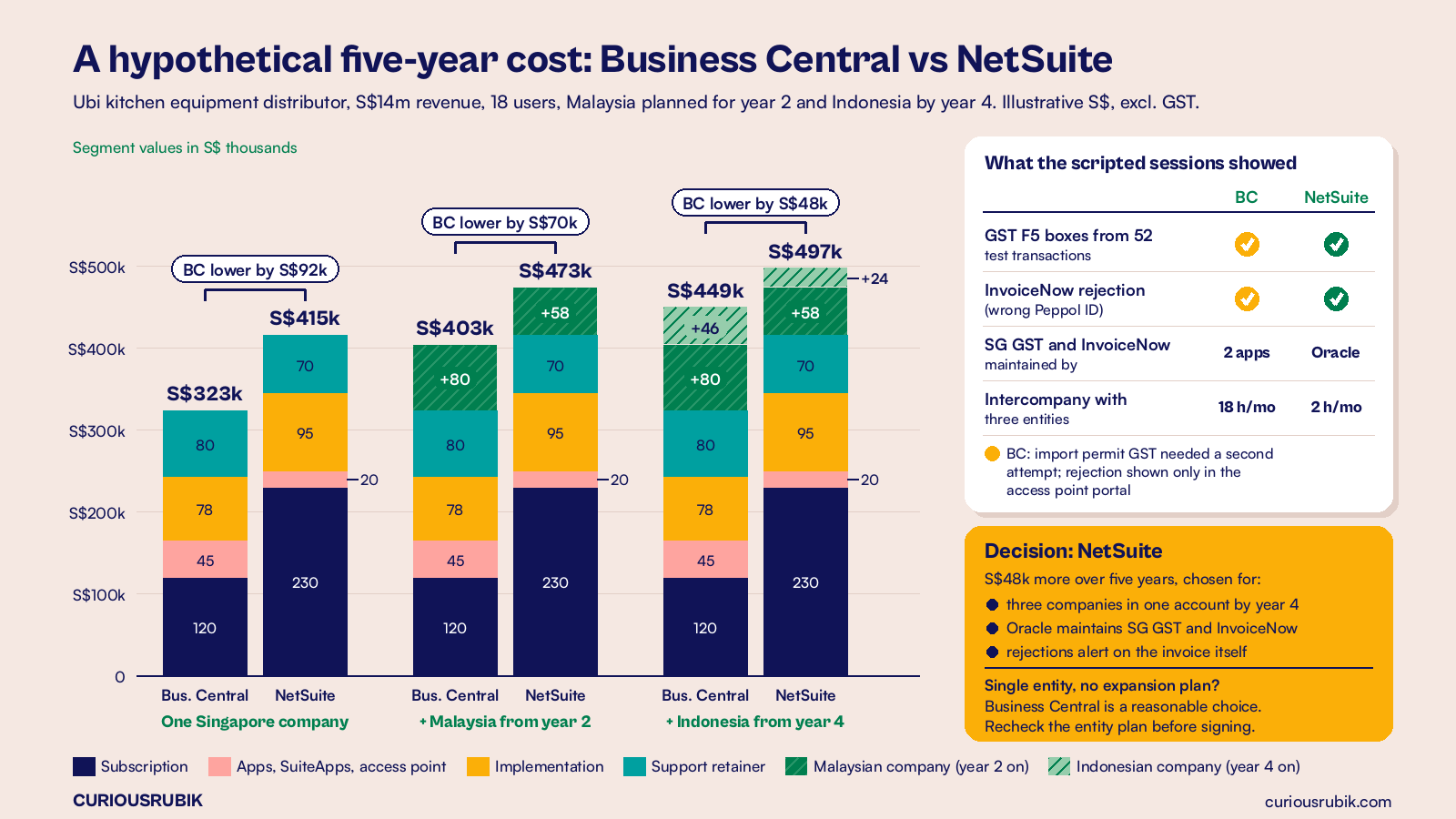
Both systems produced the F5 boxes from the 52 test transactions. The Business Central session needed a second attempt for import permit GST, which the partner fixed in the app setup. Both sent and received the InvoiceNow test documents, but the rejection test differed. NetSuite flagged the invoice with the wrong Peppol ID on the transaction and alerted the receivables clerk. The Business Central partner's app logged it only in the access point portal, which nobody in finance planned to check daily. Another Business Central app may handle this better, which is why the test is worth scripting.
| Five-year cost (S$) | Business Central | NetSuite |
|---|---|---|
| Subscription | 120,000 | 230,000 |
| Apps, SuiteApps and access point | 45,000 | 20,000 |
| Implementation | 78,000 | 95,000 |
| Support retainer | 80,000 | 70,000 |
| Total, one Singapore company | 323,000 | 415,000 |
| Malaysian company from year two | +80,000 | +58,000 |
| Total with Malaysia | 403,000 | 473,000 |
| Indonesian company from year four | +46,000 | +24,000 |
| Total with Malaysia and Indonesia | 449,000 | 497,000 |
The Business Central entity lines include S$30,000 and S$25,000 to set up each new company, a Malaysian localization and MyInvois app (S$24,000) and an Indonesian tax app (S$10,000) from two more publishers, and S$37,000 of intercompany matching and consolidation in spreadsheets (about 10 hours a month, 18 once Indonesia opens). The partner's fixed-price package left that outside the system; automating it in Business Central would have added implementation cost. NetSuite's lines cover the OneWorld change and higher subscription, subsidiary setup with Oracle's Malaysia e-invoicing SuiteApp, a partner add-on for Indonesian e-Faktur and about two hours a month of intercompany review.
On these figures Business Central stays cheaper in every case: by S$92,000 for one company, S$70,000 with Malaysia and S$48,000 with all three entities. The finance director still chose NetSuite, for three written reasons. First, the entity plan: three companies in one account by year four, with intercompany and the consolidated SGD report in the system, not in a spreadsheet that grows with each entity. Second, Singapore GST and InvoiceNow maintained by Oracle, rather than two partner apps plus a new publisher per country, each keeping pace with Microsoft's release waves. Third, InvoiceNow rejections that surface on the transaction, which matters now because the hotel group and the agency already want Peppol invoices. That was worth about S$9,600 a year to the business.
A single-entity Singapore SME with no expansion plan could reasonably choose Business Central on the same figures, provided its partner's apps pass the F5 and rejection tests. Our comparison of NetSuite vs Dynamics 365 for Singapore businesses covers the larger regional HQ case, and the Australian version, Business Central vs NetSuite in Australia, shows a wholesaler weighing a similar entity plan.
Write down the assumptions behind the choice
An ERP choice made for a five-year horizon rests on a few assumptions. Write them down before you sign, while nobody is defending a decision already made. For the Ubi distributor they were Malaysia in year two, Indonesia by year four, intercompany volume close to the estimate and Oracle keeping the Singapore e-invoicing SuiteApp in step with IRAS. If the board delays both entities before contracts are signed, the gap moves back towards S$92,000 and the case for Business Central gets stronger.
Other common assumptions are monthly intercompany hours, app publishers meeting release windows, weekly InvoiceNow exceptions and the renewal uplift. Recheck them against real numbers before each renewal. If two no longer hold, run the scripted F5 and InvoiceNow sessions again with the current partner and one alternative. CuriousRubik's business consulting team runs these side-by-side evaluations for Singapore companies, including the scripted sessions and the five-year SGD model. See our NetSuite work in Singapore for how we work with local finance teams.
Frequently asked questions
Does Business Central include Singapore GST out of the box?
Not from Microsoft. Singapore is partner-localized, so GST reports, the F5 layout and InvoiceNow come from partner apps. Check which app your partner uses and what it covers.
Is NetSuite InvoiceNow-ready in Singapore?
NetSuite's Singapore PEPPOL-Ready e-Invoicing SuiteApp supports Peppol exchange and the GST InvoiceNow flow to IRAS through a supported access point. Test it on your own invoices, including credit notes and rejections.
When do existing GST-registered businesses have to use InvoiceNow?
Between 1 April 2028 and 1 April 2031, depending on total supplies in 2025. Use the IRAS notification or date calculator, and confirm your position with your tax adviser.
Is Business Central always cheaper than NetSuite for an SME?
Not always. It is often cheaper for a single Singapore company. The gap usually narrows as entities, apps and channels are added, and price is only one input, so model five years on your own scope and entity plan.
Can grants cover an ERP project in Singapore?
Sometimes. PSG closed to new applications on 29 September 2026 and the EDGE Grant replaced it. Confirm eligibility with Enterprise Singapore before you commit, because customization is usually not covered.
Related reading
NetSuite or Business Central for Your Implementation Requirements
How to compare NetSuite and Business Central against your own requirements, with scripted scenarios and evidence rather than feature lists.