NetSuite vs Xero for Singapore companies is a trigger-point decision, not a feature checklist. Stay on Xero while one legal entity, light inventory and simple approvals still fit. Move when entities, stock, multi-level approvals or InvoiceNow volume force work outside the ledger every month. The right question is which three operating limits you already hit, not which product brochure looks newer.
The trap is treating the move as a migration project before you have proved the pain. Teams ask for a Xero export, a NetSuite quote and a go-live date, then discover mid-scope that the real problem was one subsidiary, one warehouse or one approval chain. This post is the Singapore-specific decision: the trigger points. For the generic business case, see when moving from Xero to NetSuite makes business sense. For the cutover itself, use Switching from Xero to NetSuite in Singapore.
Name the trigger points that Xero no longer covers
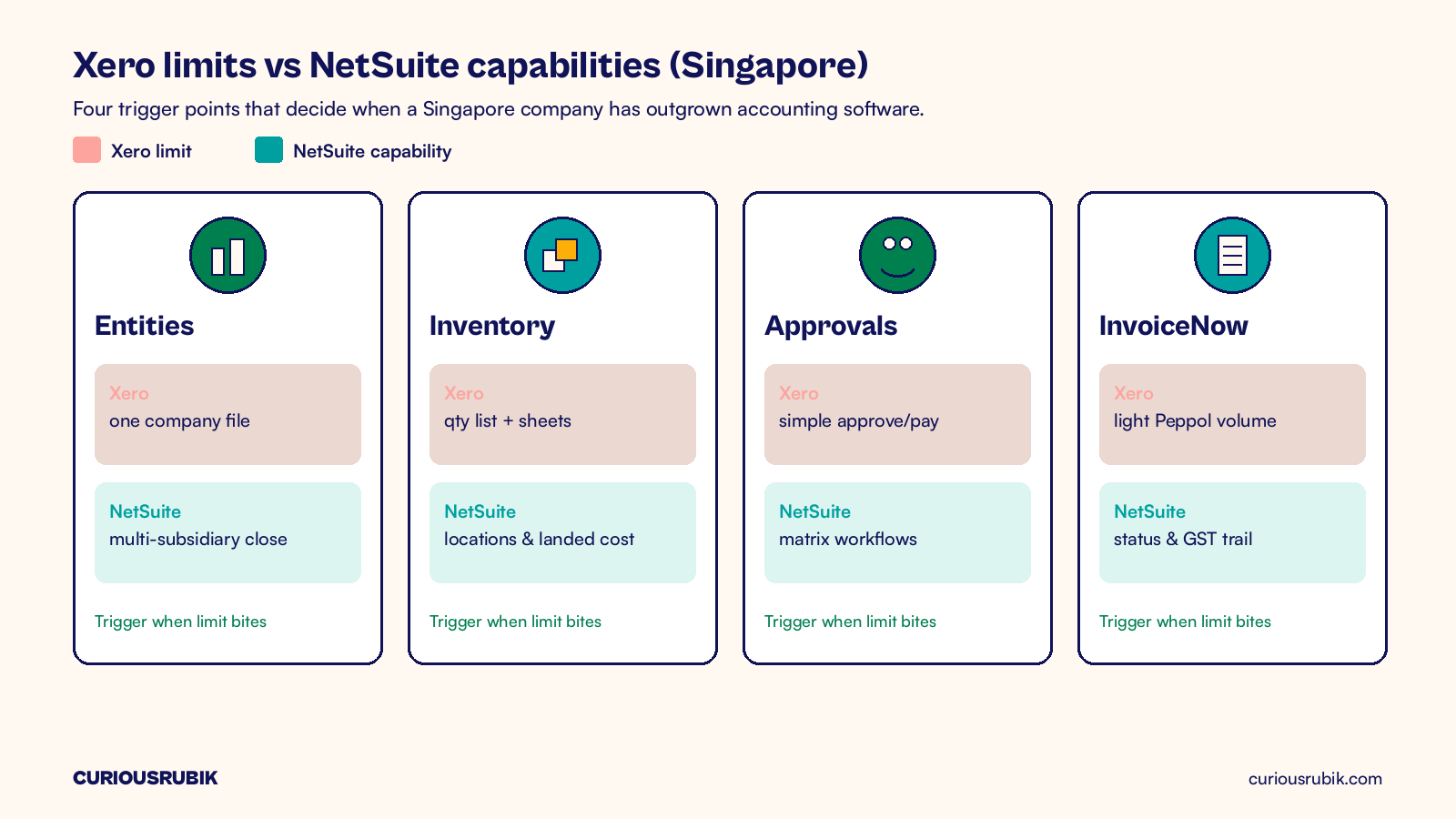
Write down the four limits that show up first in Singapore growth: more than one legal entity that must close together, inventory that needs locations and landed cost, approvals that span departments and InvoiceNow or Peppol volume that cannot sit in a mailbox. If none of those are true, keep Xero and tighten process. If two or more are true and growing, NetSuite enters the shortlist.
Keep the list concrete. "We have grown" is not a trigger. "We close two Singapore companies plus a Malaysia sales arm every month from three Xero files and a consolidation spreadsheet" is. The decision pack should quote those sentences so every stakeholder sees the same evidence.
Count the legal entities and currencies you already run
Xero works well for a single Singapore company in SGD. It stretches when you add a holding company, a trading subsidiary, a Malaysia or Indonesia branch and invoices in USD or CNY. Intercompany recharges, group reporting and multi-currency revaluation then live in spreadsheets that nobody owns after month end.
Count entities that must report together, not entities that exist on paper. Note the functional currency of each and whether stock or services cross the border. Our guide to multi-currency NetSuite setups for Singapore teams shows what changes once FX sits inside the ERP. If your group already needs that discipline, Xero is past its useful boundary for the books of record.
Test inventory and fulfilment against spreadsheet workarounds
If stock is a list of SKUs in Xero with quantity adjusted by hand, you are already running a parallel system. Singapore distributors often add bonded locations, 3PL feeds, serial or lot tracking and landed cost on import. Those steps break when the source of truth is a spreadsheet emailed after goods receipt.
Walk one order from purchase to pick to invoice and list every file outside Xero that the warehouse or finance team opens. If that list is longer than two and grows each quarter, inventory is a NetSuite trigger, not a data-entry problem. NetSuite will not fix unclear ownership of locations, but it can hold locations, costs and commitments in one place once you define them.
Map approval chains that live outside the ledger
Purchase orders approved in chat, expense claims signed on paper and vendor bills paid after a WhatsApp thread are common while volume is low. They fail when spend limits, dual approval or audit sampling arrive. Xero can carry simple approve-and-pay flows. It is a poor place to encode a matrix of department, amount, project and secondary approver.
Draw the real chain for one PO above S$5,000 and one vendor bill above S$10,000. If the chain leaves the system for more than one hop, that is an approvals trigger. Put the required matrix on one page before you talk to any NetSuite partner, so the quote covers workflow design rather than "we will figure approvals out later".
Check InvoiceNow and GST readiness on both sides
Singapore e-invoicing through InvoiceNow and Peppol, plus GST F5 evidence, change the cost of staying on a light ledger. Sending a few Peppol invoices from Xero can work. Running customer and supplier documents at volume, with exception handling and a clean GST trail, needs clearer document status and tax coding than a small-business file usually carries.
Confirm how each system will hold GST codes, InvoiceNow document states and the evidence pack for the F5. Our notes on NetSuite Peppol and InvoiceNow exceptions in Singapore and NetSuite GST F5 return preparation show the kind of evidence IRAS and auditors expect. If your current file cannot produce that pack without a week of cleanup, compliance is already pushing you toward an ERP, whether or not you like the label.
A hypothetical Singapore distributor outgrowing Xero
Take a Singapore trading company with S$18 million revenue, one Xero file in SGD and two full-time finance staff. In the last year they opened a Malaysia sales company billing in MYR, started holding stock in a Jurong warehouse and a 3PL in Tuas, and began sending InvoiceNow documents to three key buyers. Month end now uses four spreadsheets: intercompany, stock valuation, FX and consolidation.
Finance spends about 12 person-days each month on those sheets. At an internal cost of S$450 a day, that is roughly S$5,400 a month, or S$64,800 a year, before counting errors found after the GST return. A NetSuite OneWorld design for two entities, multi-currency, inventory locations and InvoiceNow is a capital project, but the annual spreadsheet cost alone already funds a meaningful portion of a scoped implementation. The decision is not "Xero is free". The decision is whether S$64,800 of recurring manual work plus growing control risk is still acceptable.
Change one fact and the answer flips. If the Malaysia company is dormant, stock is only 40 SKUs with no 3PL and InvoiceNow volume is under ten documents a month, stay on Xero and buy process discipline instead. The hypothetical only argues for NetSuite when entities, inventory and e-invoicing stack together.
Shortlist NetSuite only when three triggers stack
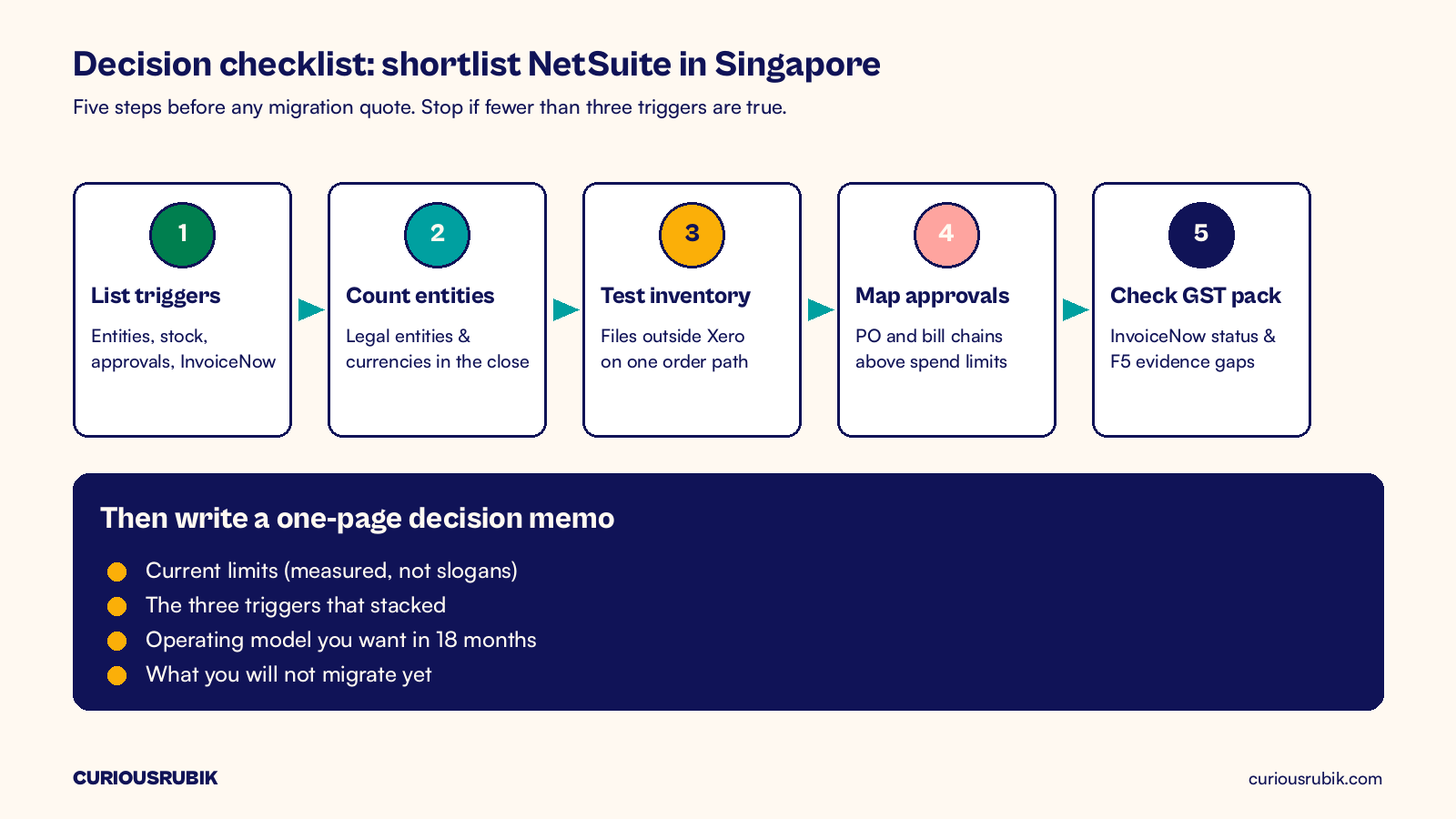
Do not replace Xero because a competitor runs NetSuite. Shortlist NetSuite when at least three of these are true and measured: more than one operating entity in the close, inventory with locations or landed cost, multi-step approvals with audit needs, multi-currency material to the P&L and InvoiceNow or GST evidence that outgrows the current file.
Then write a one-page decision memo: current limits, the three triggers, the operating model you want in 18 months and what you will not migrate yet. Take that memo to partners. It keeps the conversation on outcomes and prevents a quote that only migrates charts of accounts while the real pain sits in stock and approvals.
Plan the decision pack before any migration quote
A migration quote without a decision pack becomes a price for moving data, not a price for fixing the operating model. Include the entity map, the inventory location list, the approval matrix, the InvoiceNow volume and the GST evidence gaps. Only then ask for scopes that prove those gaps close.
CuriousRubik's NetSuite implementation services can help Singapore teams turn that pack into an accepted scope, including work across NetSuite projects in Singapore. When you are ready to move, follow the cutover discipline in Switching from Xero to NetSuite in Singapore rather than inventing a parallel plan.
Frequently asked questions
Is NetSuite just a larger Xero?
No. Xero is accounting software built for small and mid-size single-entity books. NetSuite is an ERP that holds financials, inventory, orders and multi-subsidiary control in one system. Comparing them only on invoice screens hides the entity, stock and approval differences that drive the switch.
Do we need NetSuite only for InvoiceNow?
Not by itself. Low InvoiceNow volume can often sit in Xero or a light add-on. NetSuite becomes relevant when InvoiceNow volume arrives together with multi-entity books, inventory or approval controls that already force work outside Xero.
Can one subsidiary stay on Xero?
Sometimes, for a dormant or very simple entity. If that subsidiary trades stock or recharges with the Singapore parent every week, two systems usually recreate the spreadsheet problem you are trying to leave. Decide the boundary in writing before you buy licenses.
How long does a Xero to NetSuite move take in Singapore?
It depends on entities, inventory, custom fields and InvoiceNow cutover, not on the export button. Many two-entity Singapore scopes land in a few months once data and GST rules are clean; larger distributors take longer. Treat timeline as a function of proven scope, not a fixed catalogue number.
Should we migrate mid-GST period?
You can, if the cutover date, opening balances and first F5 from NetSuite are rehearsed. A mid-period move without a GST evidence plan creates unexplained box differences. Prefer a period boundary when the business can wait; if it cannot, fund a rehearsal that proves the first return from NetSuite.
Related reading
When Moving from Xero to NetSuite Makes Business Sense
The generic decision frame for leaving Xero: what "outgrown" means in operating terms and how to avoid migrating for the wrong reason.