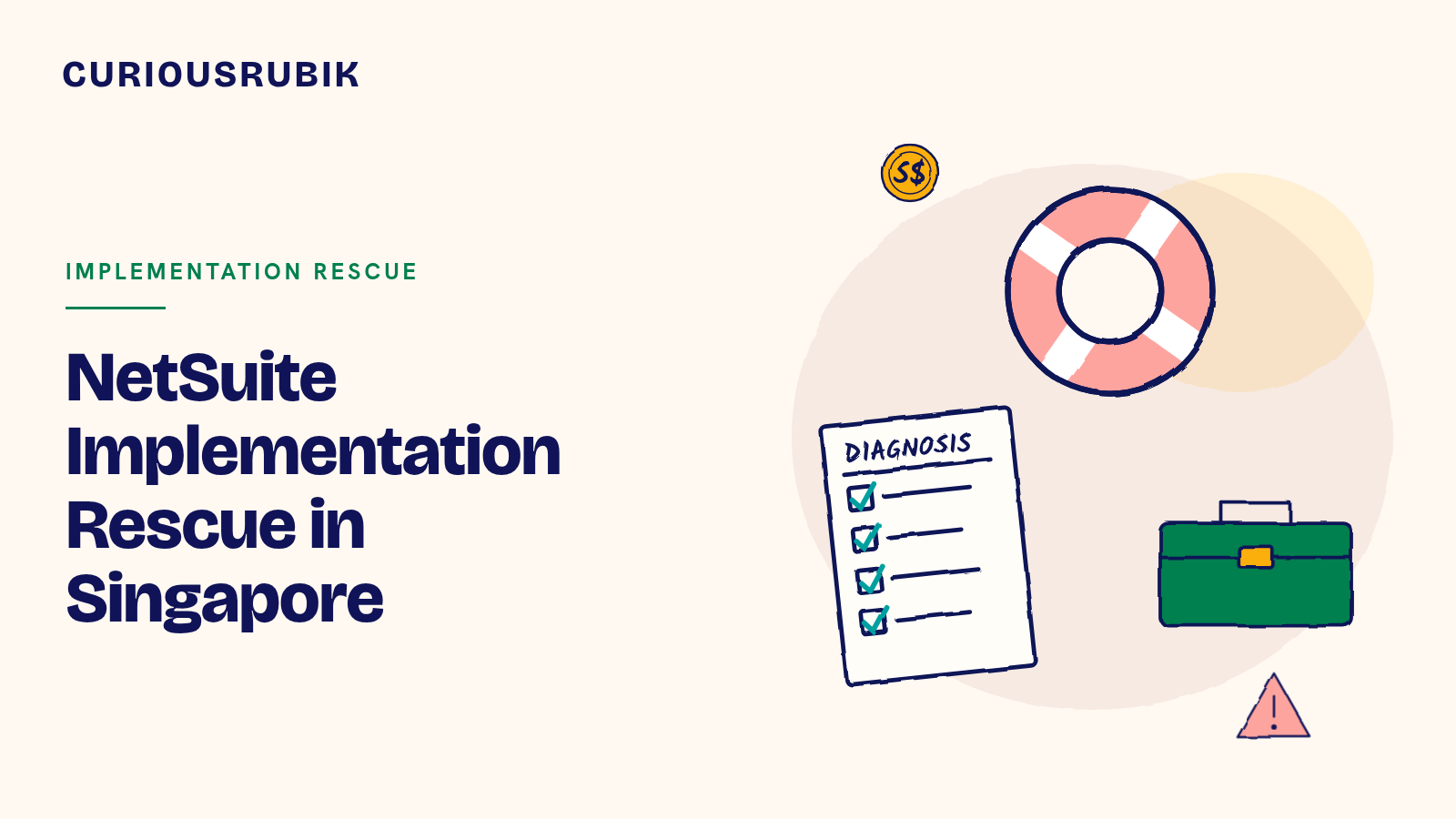
A NetSuite implementation rescue in Singapore starts with a diagnosis, before anyone rebuilds anything. Secure administrator access and the project records, list every open defect with its business consequence, test the Singapore-specific pieces such as GST, InvoiceNow and bank files against real transactions, and agree what a recovered state looks like. Only then decide whether to fix, re-scope or replace.
Stalled projects in Singapore tend to share a few symptoms. Go-live has slipped twice. The partner's team has changed. Finance still runs the GST return from the old system. Nobody can say with confidence which of the open issues would stop the business on day one.
Secure access, documents and decisions first
Before any analysis, make sure your company holds what it owns. That means administrator access to production and sandbox, the integration credentials, the SuiteApp licenses, the design documents and the decision log. If the relationship with the current partner is strained, do this quietly and early.
Confirm who at your company is the account owner with Oracle, and check the contract renewal date. A stalled project with a renewal three months away needs a different plan from one with two years left.
Tell the people who use the system what is happening. Finance and operations staff who have tested the same broken process three times are often the best source of evidence in a diagnosis, and the least likely to volunteer it if they think the project is about to be blamed on them. Give them a single contact and a short form to record what fails, with the transaction number and the date.
List open issues by business consequence
Most rescue projects inherit a long defect list with no priorities that mean anything to the business. Rebuild it. For each open item, record the process it affects, what happens if it isn't fixed by go-live, and the workaround if one exists.
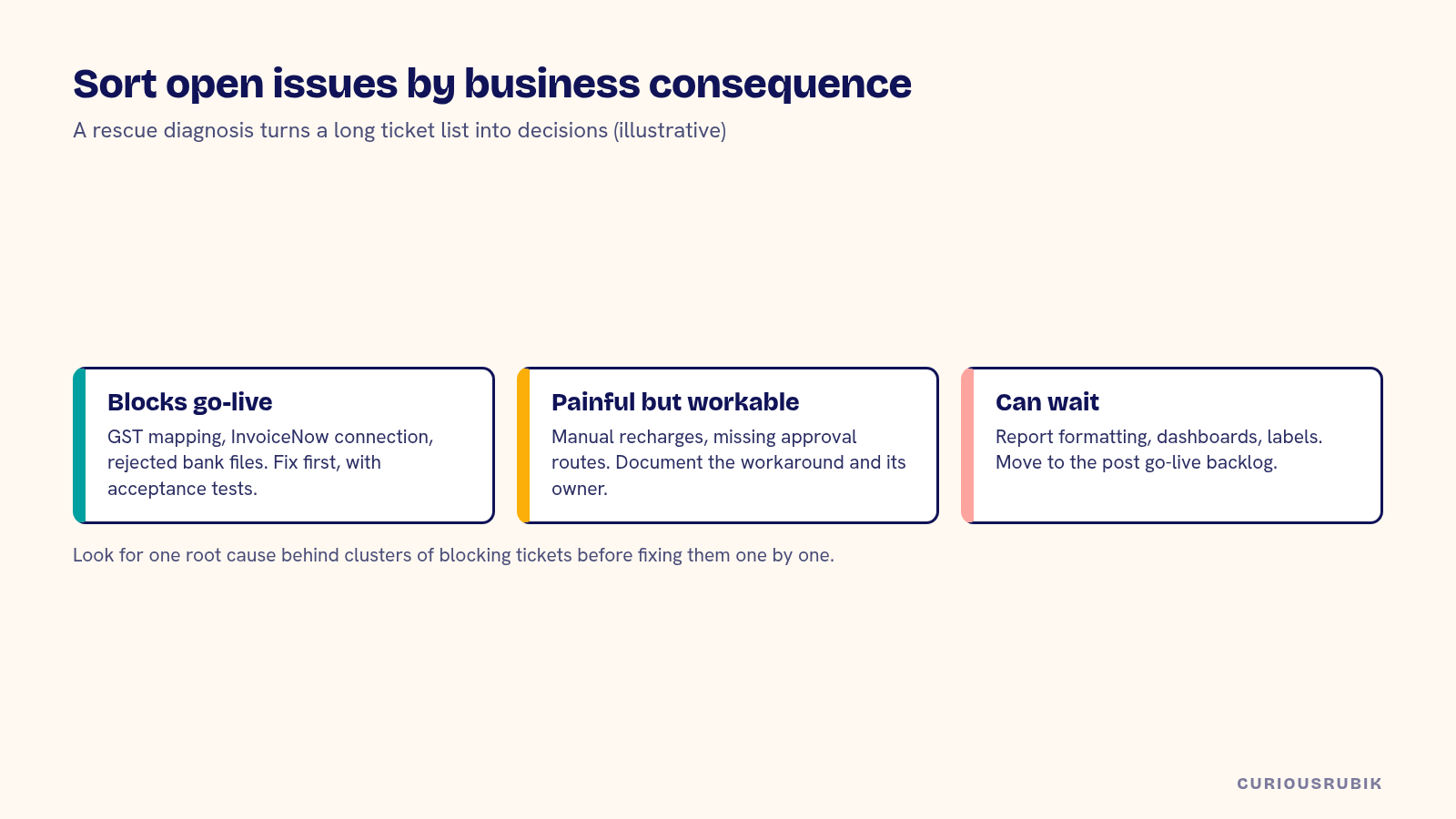
Then sort the list into three groups: blocks go-live, painful but workable, and can wait. The first group is often shorter than the full list suggests. Knowing which items are in it changes the conversation with the board.
Test the Singapore-specific pieces on real transactions
Several items are more likely to be unfinished in a Singapore project, because they sit at the end of the plan and depend on third parties:
- GST tax codes and return mapping, tested against a full period of real invoices and bills
- InvoiceNow sending and receiving through the access point, including a rejected document
- payment files and bank statement import for your Singapore banks
- multi-currency revaluation and intercompany with regional subsidiaries
- the payroll journal and CPF reconciliation, if payroll is in scope
Run each one with production-like data and write down the result. A feature that "works in sandbox" on three test invoices isn't the same as a GST return that reconciles.
Read the configuration for root causes
Some stalled projects suffer from many small defects with one cause. Common ones are a chart of accounts that doesn't match the reporting need, subsidiaries set up in a way that blocks intercompany, custom scripts layered over standard features that would have worked, and migration files built by hand with no repeatable process.
Look for those patterns before fixing individual tickets. Fixing fifty symptoms of a subsidiary design problem one by one is slower than changing the design once, if the change is still possible.
Decide whether to fix, re-scope or replace
With the diagnosis in hand, there are three honest options. Fix: the design is sound and the remaining work is finite. Re-scope: go live with a smaller release that the business can run, and move the rest to a second phase. Replace: the design can't support the business and continuing costs more than restarting the affected area.
Re-scoping is often the least painful choice. A Singapore entity can go live on core finance, GST and InvoiceNow while warehouse integration follows a quarter later, provided the interim process is designed and owned.
A hypothetical rescue diagnosis
A hypothetical Singapore regional distributor is eight months into a NetSuite project planned for six. There are 214 open tickets. A two-week diagnosis produces this summary. All figures are illustrative.
| Group | Tickets | Examples | Decision |
|---|---|---|---|
| Blocks go-live | 17 | GST return mapping incomplete, InvoiceNow not connected, bank file rejected by one bank | Fix in a four-week sprint with acceptance tests |
| Painful but workable | 61 | Manual intercompany recharge, missing approval routing for one entity | Workarounds documented, fixed in phase 2 |
| Can wait | 136 | Report formatting, dashboard requests, field labels | Backlog after go-live |
Nine of the 17 blocking tickets trace to one cause: the GST tax codes were cloned from another country's template. Rebuilding the tax code set fixes all nine. The company goes live ten weeks later on a reduced scope, with the warehouse integration moved to a second release.
Agree proof before the next payment
Whoever does the recovery work, agree what "recovered" means in testable terms before money changes hands. For a Singapore project that might be a GST return for a test period that reconciles to transactions, InvoiceNow documents sent and received including a rejection, a bank payment file accepted by each bank and a first close completed within an agreed number of days.
CuriousRubik works this way on rescue engagements. You bring us the exact problem. We agree what resolution means and the evidence that will show it, then demonstrate it. You pay only if the agreed resolution is demonstrated. A focused proof establishes the agreed result. It doesn't mean every production dependency or rollout step is complete, so the plan for the rest is written down too.
Run the NetSuite implementation rescue checklist
Before committing to a recovery plan, confirm each of these:
- Does your company hold administrator access, credentials, licenses and documents?
- Is the Oracle renewal date known and factored into the plan?
- Is every open issue grouped by business consequence?
- Have GST, InvoiceNow, bank files and intercompany been tested on real transactions?
- Have root causes been identified behind clusters of defects?
- Is there a clear decision to fix, re-scope or replace, with reasons?
- Is "recovered" defined as tests with named approvers?
- Is the next payment tied to that proof?
If your project has stalled, a CuriousRubik NetSuite implementation review can start with a diagnosis and an agreed proof, and our NetSuite work with Singapore-led businesses covers the regional design questions that often sit behind a stall. For the method in more depth, read NetSuite Implementation Rescue Starts with a Diagnosis and How to Check Whether Your ERP Project Is Really on Track. If you decide to change partners, plan the overlap with when to end the overlap while switching NetSuite partners in Singapore, and use the US guide on how to switch NetSuite partners for the handover checklist.
After go-live, the same diagnosis method feeds NetSuite optimization for Singapore companies, and the support model you choose next should be tested against NetSuite support in Singapore: SLAs and coverage.
Related reading: NetSuite Implementation Rescue Starts with a Diagnosis
Frequently asked questions
How long does a rescue diagnosis take?
Often one to three weeks, depending on account size and how much documentation exists. The aim is a decision about the next step. A full redesign, if needed, comes later.
Should we fire the current partner?
Not before the diagnosis. Some stalled projects recover with the same partner and a clearer scope. Secure access and documents first so you can choose freely.
Can we go live on a smaller scope?
Often, yes. Core finance, GST and InvoiceNow can go live while other areas follow, provided the interim process is designed and has an owner.
What does "pay only if the resolution is demonstrated" cover?
The agreed problem, scope and acceptance evidence for that proof. The remaining implementation work is defined and agreed separately.
What if the design can't be fixed?
Then replacing the affected area may cost less than continuing. The diagnosis should show the cost of each option so the decision is explicit.