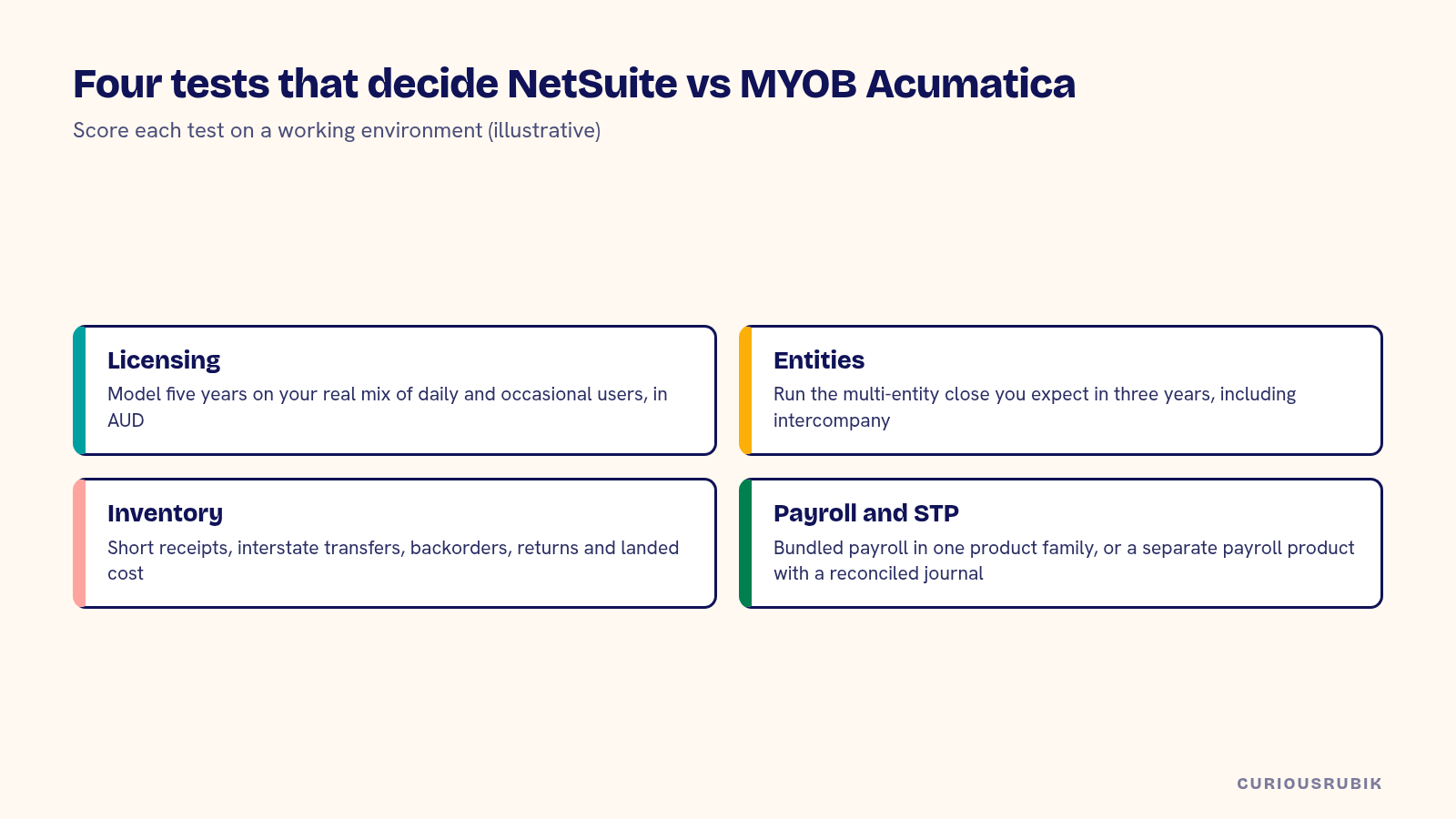
When an Australian business outgrows MYOB Business or AccountRight, the shortlist often comes down to NetSuite vs MYOB Acumatica, the product MYOB sold as MYOB Advanced until its 2024 rename. Choose by testing four things: how each prices your user and transaction mix, how it handles your entity structure, how it runs your stock, and where payroll and STP will live. The right answer depends on which of those carries the most weight for you.
Both are cloud ERP platforms with Australian customers and partners. Both will pass a generic demo. The decision gets clearer once you stop asking "which is better" and start asking which set of trade-offs your finance and operations teams would rather live with.
Recognize the signs that you have outgrown MYOB
The trigger is rarely one feature. It is usually a pattern: month-end takes longer each quarter, stock figures need a spreadsheet to be believed, a second entity is planned and someone is already consolidating it by hand, or the ecommerce platform posts summaries that nobody can reconcile.
Write down the three or four problems that cost the most time today, in hours per month if you can estimate them. That list becomes your test script, and it stops the evaluation drifting toward features you don't need.
Model licensing on your real user mix
The two platforms price differently. NetSuite typically combines a base subscription, named user licenses and modules. Acumatica's global model is known for pricing on resources and transaction volume instead of named users. Ask MYOB how that applies to the MYOB Acumatica edition and modules you would license, because local packaging may differ.
The difference matters most if you have many occasional users, such as warehouse staff, approvers or sales reps who check stock. Count them. A business with 15 heavy finance users and 60 light users may see the two models diverge sharply. A business with 20 users who all work in the system daily may see little difference. The same licensing contrast appears in the US market, which we test in NetSuite vs Acumatica for US mid-market companies.
Model five years on both, including expected growth and renewal terms. Put the numbers in AUD and include partner support.
Test the multi-entity close you will have in three years
If you run one entity today and expect two or three, test with the future structure. NetSuite OneWorld runs multiple subsidiaries in one account, with consolidation, intercompany and multi-currency built around that design. MYOB Acumatica supports multiple companies and branches as well. Ask both to show the same close: an intercompany recharge, an elimination and consolidated reporting in AUD, plus one entity in another currency if you expect overseas expansion.
Watch for steps that happen in Excel. A consolidation that works in a demo with two clean entities can look different with real intercompany volume.
Run your inventory and fulfillment scenarios
Inventory is often what forces the move off MYOB. Script the processes that hurt today: receiving against a purchase order with a short delivery, transferring stock between a Sydney and a Brisbane warehouse, picking for a backorder, handling a return that may or may not be resalable, and costing landed freight.
Ask each partner to run those on a working environment with your item types. If you sell through Shopify or a marketplace, include an order with a partial refund. Many evaluations score inventory on a feature checklist and discover the real fit only during UAT.
Decide where payroll and STP will live
This is a real difference between the two. MYOB has localized Acumatica for Australia and New Zealand, including MYOB Acumatica Payroll, so payroll and STP reporting can sit in the same product family. NetSuite is rarely the Australian payroll engine. Most NetSuite customers in Australia run a separate STP-enabled payroll product and post journals into NetSuite.
Neither approach is wrong. A single vendor for ERP and payroll reduces integration work. A separate payroll product lets you choose the best tool for your awards and pay rules, at the cost of an integration and a reconciliation. Since Payday Super began on 1 July 2026, that reconciliation runs every pay cycle, so test it either way. The Microsoft alternative raises similar questions, covered in Business Central vs NetSuite in Australia.
A hypothetical NetSuite vs MYOB five-year comparison
A hypothetical Adelaide wholesaler has one entity today, plans a New Zealand entity in year two, and has 18 daily finance and operations users plus 40 occasional users. It runs weekly payroll for 120 staff. The figures below are illustrative estimates the finance lead might build from quotes. They are not market prices.
| Five-year view (AUD) | NetSuite | MYOB Acumatica |
|---|---|---|
| Software subscription | $260,000 | $230,000 |
| Implementation | $190,000 | $170,000 |
| Payroll product and integration | $70,000 | Included in subscription above |
| Partner support | $90,000 | $90,000 |
| Total | $610,000 | $490,000 |
On cost alone, MYOB Acumatica wins by $120,000 in this example, partly because payroll sits inside its subscription. The finance lead then scores the scripted sessions. NetSuite performs better on the New Zealand consolidation and the Shopify refund flow, and MYOB Acumatica on payroll and warehouse transfers. Whether the consolidation advantage is worth $120,000 over five years is a business judgment. The table makes it an explicit one.
Check the partner and support model
Both platforms are delivered largely through partners in Australia. The partner's experience with your industry, your payroll complexity and your integrations will affect the result as much as the product. Ask for two references running the same processes, and for the names of the consultants who would work on your project.
Ask too about upgrades. NetSuite ships two major releases a year. Acumatica runs its own release cycle, which MYOB localizes. Find out how each partner tests your customizations before an update reaches production.
The migration effort from MYOB is broadly similar for both. Customer and supplier records, open invoices and bills, stock on hand by location and opening balances all need mapping, cleansing and a reconciled trial load. Ask each partner how many rehearsal loads they include and who signs off the opening trial balance. If NetSuite wins, our plan for moving from MYOB to NetSuite without losing control sets out the cutover.
Make the move-up decision with evidence
Use this checklist before you sign:
- Have you written down the problems that are pushing you off MYOB, with time costs?
- Is licensing modeled on your real mix of heavy and occasional users?
- Did both platforms run the multi-entity close you expect in three years?
- Were your inventory scenarios run on working environments with your item types?
- Have you decided where payroll and STP will live, and tested the reconciliation?
- Does the five-year cost include payroll, integrations and partner support?
- Have you spoken to references running similar processes?
- Do you know who tests updates against your customizations?
CuriousRubik business consulting can write the scenario scripts and the five-year model with you, so the comparison rests on your own processes. For wider context, see NetSuite ERP Evaluation in Australia Through Local Workflows and Cost and Build an AUD Total Cost Model for Your NetSuite Decision.
Related reading: Compare NetSuite and ERP Approaches Through Your Hardest Workflows
Frequently asked questions
Is MYOB Advanced the same as MYOB Acumatica?
Yes. MYOB renamed MYOB Advanced Business to MYOB Acumatica in 2024. It is MYOB's Australian and New Zealand version of the Acumatica cloud ERP.
Is MYOB Acumatica cheaper than NetSuite?
Sometimes, particularly with many occasional users or when bundled payroll replaces a separate product. Model five years on your own user mix before concluding.
Can NetSuite handle Australian payroll?
Usually through integration. Most Australian NetSuite customers use a separate STP-enabled payroll product and post journals into NetSuite.
Which is better for multiple entities?
Test it. NetSuite OneWorld is designed around multiple subsidiaries in one account, and MYOB Acumatica supports multiple companies. Run your own intercompany and consolidation scenario on both.
Should we move straight from MYOB Business to NetSuite?
Many companies do. Plan the data migration and opening balances carefully, and decide early how much history to bring across.