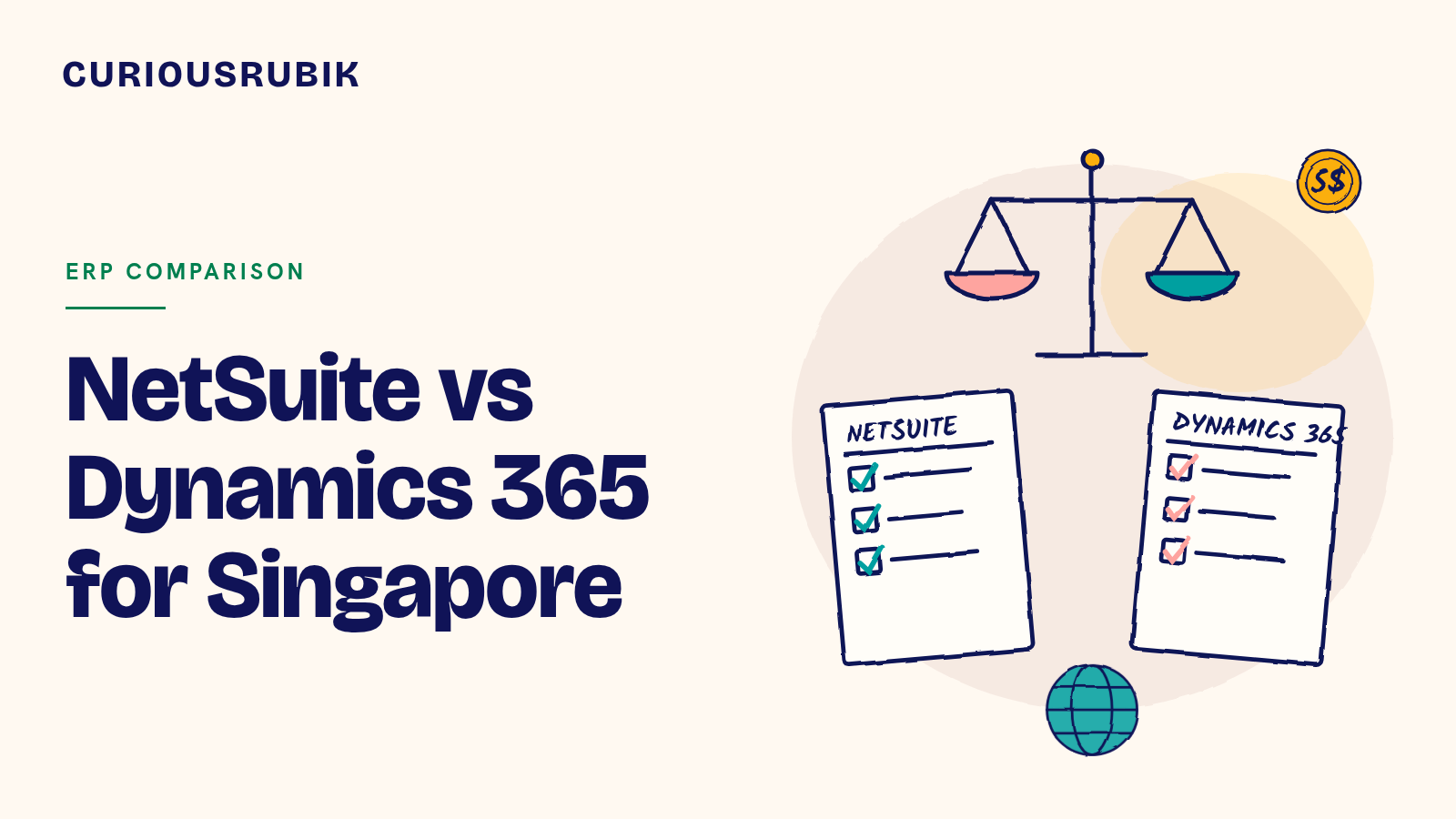
For a Singapore business, the choice of NetSuite vs Dynamics 365 is best made by running your hardest workflows through both: a GST return, an InvoiceNow exchange, a multi-currency regional close and one operational process that is unusual to you. Feature lists from either vendor will look complete. The scripted test will show which one your team can actually run.
Start by pinning down which Microsoft product you mean. "Dynamics 365" covers Business Central, aimed at small and midsize companies, and Dynamics 365 Finance and Supply Chain Management, aimed at larger and more complex operations. This post compares NetSuite mainly with Finance and Supply Chain Management, because that is where Singapore regional headquarters usually land when they look beyond NetSuite. If Business Central is on your list, the trade-offs are different. A US multi-entity view of the same comparison is in NetSuite vs Dynamics 365 Finance for US multi-entity companies.
Decide which operating model you are buying for
A Singapore regional HQ with five or six subsidiaries across Southeast Asia has different needs from a single-entity Singapore distributor. Write down the entities, base currencies, transaction currencies, intercompany flows and who closes each ledger. Then add your growth plan for the next three years.
That page decides much of the comparison. NetSuite OneWorld runs multiple subsidiaries in one account with shared master data and consolidation built in. Dynamics 365 Finance handles multiple legal entities too, typically with more configuration options and more design decisions. Neither is better in the abstract. The question is how much configuration depth your processes need, and how much your team can maintain.
Script the GST and InvoiceNow scenarios
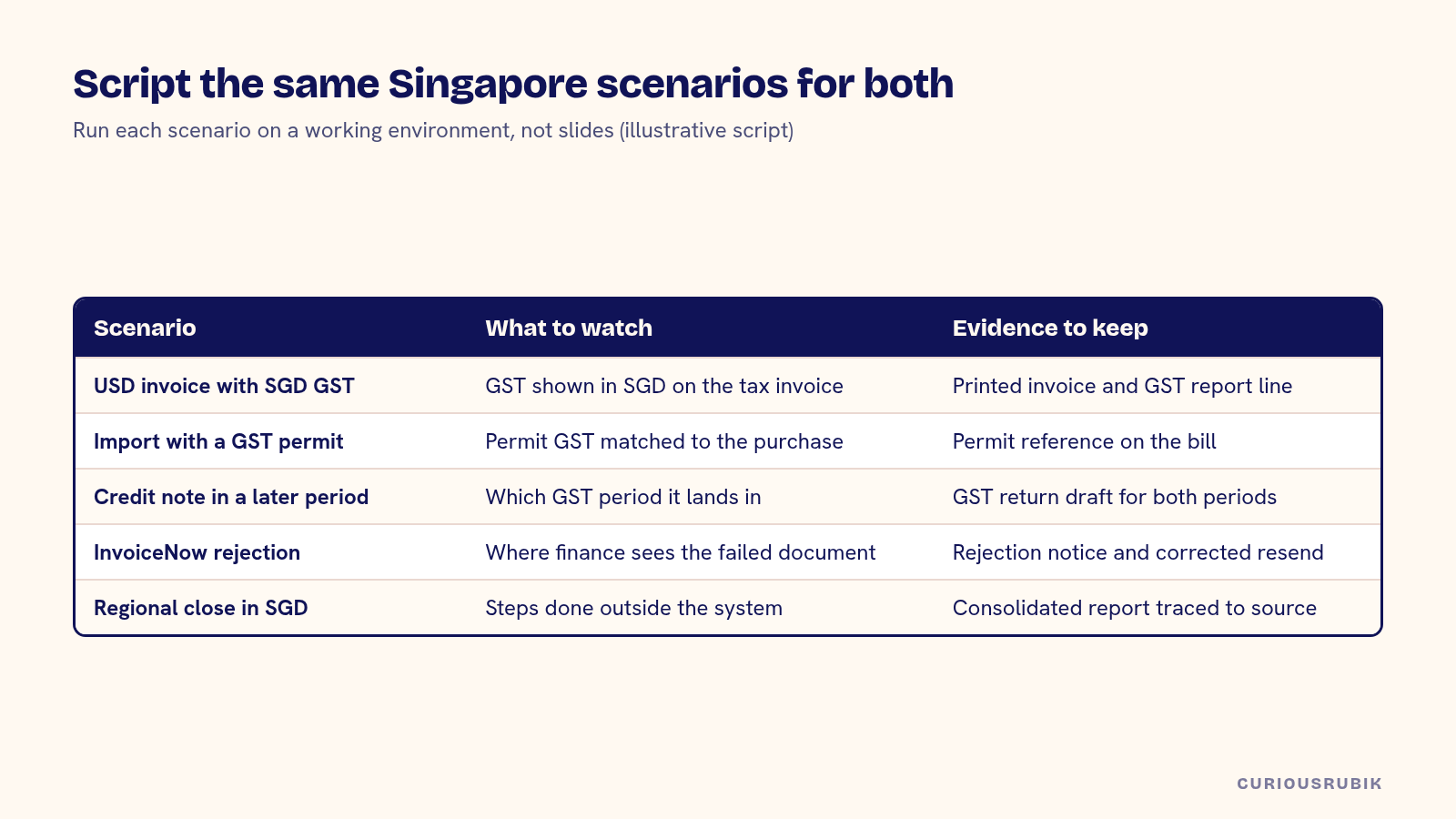
Ask both vendors, or their partners, to run the same Singapore tax scenarios on a working environment:
- a standard-rated SGD sale and a zero-rated export
- a USD sales invoice where GST must be shown in SGD
- an imported purchase with GST paid on the import permit
- a credit note raised in a later GST period than the original invoice
- an invoice sent through InvoiceNow, with one document rejected and corrected
IRAS has announced that existing GST-registered businesses will be brought into the GST InvoiceNow Requirement in phases from April 2028 to April 2031, and new voluntary registrants are already in scope. Ask each side how invoice data reaches the Peppol network, whether through native functionality, an add-on or an access point provider's connector, and who maintains that connection after go-live. The answer changes both cost and support ownership.
Test multi-currency and the regional close
Run a short close on each system: a revaluation of open USD and MYR balances, an intercompany recharge from Singapore to a Malaysian subsidiary, an elimination and a consolidated report in SGD. Watch how many steps happen outside the system.
Pay attention to the controller's review. Can finance trace a consolidated number back to the subsidiary transaction without exporting to a spreadsheet? Both platforms can produce consolidated statements. The difference shows up in how the review work feels for the person doing it at 9 p.m. on working day three.
Compare the upgrade and maintenance burden
NetSuite is multi-tenant SaaS with two major releases a year. Customizations built with SuiteScript and SuiteFlow generally carry forward, but they still need regression testing in the release preview window. Dynamics 365 Finance and Supply Chain Management is also delivered as a cloud service, with Microsoft shipping regular service updates. Extensions are built in X++ and deployed through Microsoft's lifecycle tooling, which gives more control and asks for more developer discipline.
Ask each partner how many hours a year they would expect your account to spend on update testing, given the extensions in their proposed design. Then ask who does it.
Price the full subscription and the people around it
Licensing models differ. NetSuite typically combines a base subscription, user licenses and modules. Dynamics 365 is priced mainly per user, with different license types for full and lighter users. Model both on your actual user mix, including approvers who only need occasional access.
Then add the people. A Dynamics 365 Finance environment of any complexity usually needs developer skills on call. NetSuite accounts often run with a strong administrator plus partner support. Your existing Microsoft footprint matters here: if your team already supports Azure, Power BI and Power Automate, some of that effort is already paid for.
Read the commercial terms as closely as the price. Check the minimum term, the renewal uplift cap, the billing currency and whether licenses can be reduced at renewal if headcount falls. A Singapore company billed in USD carries a currency exposure on its ERP subscription that rarely shows up in the evaluation spreadsheet. Ask both vendors to put these terms in the quote, so the five-year model uses real numbers.
A hypothetical NetSuite vs Dynamics 365 scorecard for a regional HQ
A hypothetical Singapore regional HQ has four subsidiaries (Singapore, Malaysia, Indonesia and Vietnam), 60 users and an ecommerce channel. The finance director scores each platform from 1 to 5 after scripted sessions. Weights reflect this company's priorities. All values are illustrative.
| Criterion | Weight | NetSuite | Dynamics 365 Finance |
|---|---|---|---|
| GST and InvoiceNow scenarios completed in session | 25% | 4 | 4 |
| Regional close traced without spreadsheets | 20% | 4 | 3 |
| Fit for the warehouse and ecommerce process | 20% | 3 | 4 |
| Upgrade and maintenance effort | 15% | 4 | 3 |
| Five-year cost including internal roles | 20% | 4 | 3 |
| Weighted score | 100% | 3.80 | 3.45 |
For this company NetSuite edges ahead, mainly on close review and maintenance effort. A manufacturer with complex production planning might weight the operational row at 40% and see the opposite result. The scorecard is useful because it forces the weights into the open before the sales teams arrive. If SAP is also on the shortlist, run the same exercise using NetSuite vs SAP S/4HANA Cloud for Singapore HQs.
Make the decision your finance team can defend
Before you decide, check that the comparison covered these points:
- Is the Microsoft product named precisely, Business Central or Finance and Supply Chain Management?
- Did both platforms run the same GST scenarios on a working environment?
- Was InvoiceNow shown end to end, including a rejected document, with the access route named?
- Did each run a short regional close with revaluation and intercompany?
- Has the yearly update testing effort been estimated in hours, with an owner?
- Does the five-year cost include internal roles and partner support?
- Were weights agreed before the scripted sessions?
- Are you comparing partners as well as products, since the partner will carry much of the delivery risk? Our guide on how to choose a NetSuite partner in Singapore covers that half of the decision.
If you want an independent view before shortlisting, CuriousRubik business consulting can help you write the scenario scripts and weightings and score both platforms against your own processes. For the method, see Compare NetSuite and ERP Approaches Through Your Hardest Workflows. To keep the money side consistent, compare NetSuite pricing in Singapore with a consistent SGD scope, and for the entity design questions read Design NetSuite for a Singapore Regional Headquarters with Clear Local Ownership.
Related reading: NetSuite or Business Central for Your Implementation Requirements
Frequently asked questions
Is Dynamics 365 Business Central the same as Dynamics 365 Finance?
No. Business Central targets small and midsize businesses, while Finance and Supply Chain Management targets larger, more complex operations. Compare NetSuite against the one you would actually license.
Do both platforms support Singapore GST?
Both vendors offer Singapore tax functionality, but the detail varies by product, version and add-on. Have each one demonstrate your own GST scenarios instead of relying on a feature list.
Which is easier to maintain after go-live?
It depends on how much you extend each one. Heavily extended environments on either platform need disciplined release testing, so ask for an estimate of the yearly effort.
Does an existing Microsoft 365 setup favor Dynamics?
It can reduce some integration and skills effort. It doesn't decide the ERP fit, so still run the scripted scenarios.
How long should a scripted comparison take?
Plan for at least one half-day session per platform, plus preparation time for the scripts and sample data. Rushed sessions tend to fall back to standard demos.