For Australian finance leads who want NetSuite to show, pay run by pay run, that super reached each fund on time.
Last reviewed: 9 November 2026. Product details reflect this review date. Availability and behavior can vary by account, role and release.
For NetSuite Payday Super tracking, record the super liability for every pay run and watch each one against its due date. Payday Super started on 1 July 2026. Super for each payday must now reach the employee's fund within 7 business days, so a quarterly balance no longer proves you are on time.
What did Payday Super change for your ledger?
Payday Super is the rule that moves the super guarantee from a quarterly deadline to a deadline for each payday. The Australian Taxation Office describes the main changes for payments made from 1 July 2026.
- Super must be received by the employee's fund, with enough detail to allocate it, within 7 business days after you pay the employee. Some cases, such as a new employee's first contribution, get longer.
- Super is worked out on qualifying earnings. That term takes in ordinary time earnings, commissions, salary sacrifice amounts and other payments that were part of salary and wages for super.
- The rate stays at 12 percent.
- You report both qualifying earnings and the super liability through Single Touch Payroll, the system for sending payroll reports to the ATO.
- The ATO assesses a super guarantee charge if a contribution is late. The charge includes interest that compounds daily and an administrative uplift, and penalties can apply on top.
A business day is any day other than a weekend or a public holiday that applies to a whole state or territory. That includes a state wide holiday in a state where you have no staff.
Before 1 July, a company could post one super accrual journal each month, pay the funds in the quarter and tie it all off once a quarter. That worked when the deadline was 28 days after the quarter end. It does not show you much when the clock runs per payday.
Why should NetSuite Payday Super tracking use the pay run?
In my view, the pay run is the right unit, because it is the unit the law now uses. A single super payable balance can tell you how much you owe. It cannot tell you whether a payment from three weeks ago is late.
Here is the setup I would put in place.
- One liability entry per pay run. Your payroll provider or payroll integration sends a summary journal for each pay run. It should debit super expense and credit a Superannuation Payable account, with the pay date and pay run number on the entry.
- A due date on every entry. Store the date by which the fund must receive the money. Your payroll team can work it out from the pay date and a calendar of state and territory holidays. Put it in a custom transaction field, so it shows in searches.
- A saved search of unconfirmed receipts. Add a custom status field and a fund receipt date to each pay run entry. Search entries with no confirmed receipt, ordered by due date. Journal lines do not close like invoices, so an account filter alone cannot show which pay runs remain unresolved.
- An email alert. Store an alert date on each entry, set three business days before the due date. Schedule a second saved search to email the payroll lead and the finance lead when an open entry reaches that date.
- A clear way to confirm receipt. Match the bank payment to the pay run for accounting purposes. Keep its receipt status open until the provider confirms the fund received the money and allocation details. Link that evidence to the entry, including any rejected amounts.
Quarterly habit compared with pay run habit
| Question | Quarterly habit | Pay run habit |
|---|---|---|
| What do you accrue? | One journal each month | One entry per pay run |
| What shows a late item? | Nothing until quarter end | A due date and days to go in a saved search |
| When do you reconcile? | Once a quarter | Every week against the provider's super report |
| Who gets an alert? | Nobody | The payroll lead and the finance lead |
This design uses NetSuite custom fields and saved searches, with receipt evidence supplied by payroll. Test the search and email schedule with your administrator.
This also helps the people who check the numbers. Our guide to superannuation and payroll liability reconciliation shows how to tie the balance back to the payroll provider. Run that tie out weekly now, not quarterly.
What do qualifying earnings change in the ledger?
Super now follows qualifying earnings. This brings ordinary time earnings and other eligible payments into one measure. Commissions and salary sacrifice amounts may already have attracted super under the earlier rules. Ask your payroll provider and tax adviser to confirm the treatment of each earning code.
My advice is to take the qualifying earnings figure from the payroll provider and not rebuild it inside NetSuite. The provider holds the earning codes, so it can say which payments count. NetSuite should hold the result and prove it ties out.
Add one check to your weekly routine. The super expense for the pay run should normally match the provider's super report, which is 12 percent of qualifying earnings. If it does not, look at the earning code mapping first.
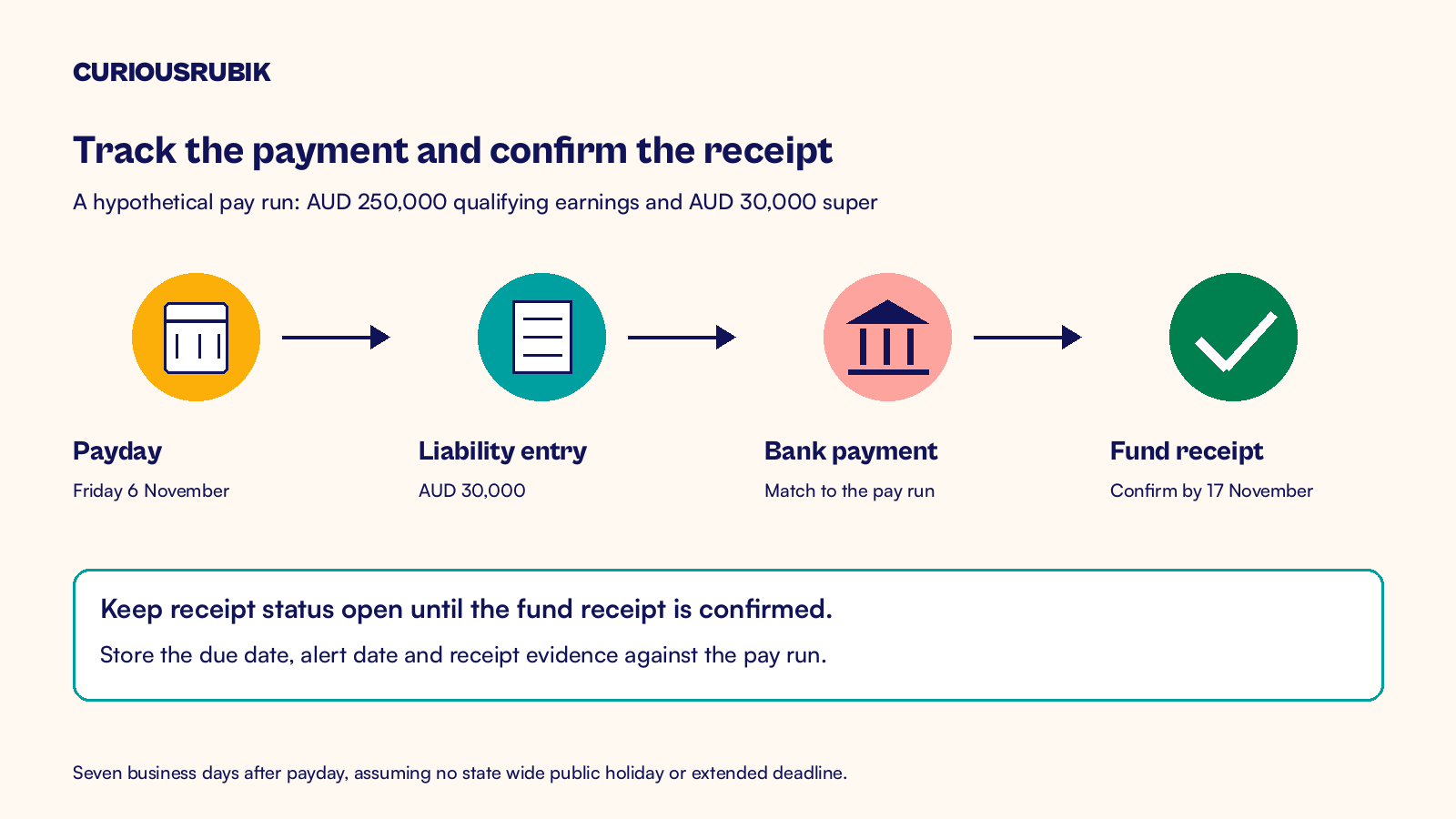
A hypothetical pay run shows the timing. A company pays AUD 250,000 of qualifying earnings on Friday 6 November 2026. Super at 12 percent is AUD 30,000.
Counting Monday 9 November as business day one, the seventh business day is Tuesday 17 November. The fund must receive the money by then, assuming no state wide holiday falls in between.
NetSuite shows one liability entry of AUD 30,000 with that due date. If the fund confirms receipt on Wednesday 11 November, mark the receipt status complete with four business days to spare. If receipt remains unconfirmed on Monday 16 November, the search flags it with one day to go. The stored alert date was Thursday 12 November.
The ATO suggests paying super on payday. That gives you the most room, and it keeps the weekly check quiet.
What should you ask your payroll provider and bank?
The ledger can only track what it is told. A few questions to your payroll provider will make the data far more useful.
- How is super paid? Ask whether the provider sends it through a clearing house and how long the route takes. The ATO notes that the New Payments Platform allows near real time payments, but some providers still take longer.
- When is it released? Payment on payday gives the most buffer. A release a few days later uses up part of your seven days before the fund even sees the money.
- Which report shows the fund receipt date? You need that date to mark receipt complete. You also need it as evidence if the ATO ever asks.
- What happens when a fund rejects a payment? The ATO says error messages are now clearer. Funds have 3 business days to allocate or return a contribution. Ask how the provider tells you, and who on your team sees it.
- Which clearing house do you use now? The ATO's Small Business Superannuation Clearing House closed on 1 July 2026, so teams that used it needed another route.
Put the answers in one page of notes and keep it with the payroll process. When someone new joins finance, that page saves them a week.
What should you do this month?
Four months of pay runs have passed since 1 July. That is enough history to learn from, so use it.
- List every pay run from July to October with its pay date.
- Next to each one, write the date the fund received the money. Use fund receipt evidence from the provider, rather than the date money left your bank.
- Count the business days between the two dates. Mark any that took longer than seven.
- Note which routes were slowest, so you know where to ask your provider for a faster release.
If you find a late payment, talk to your tax adviser early. The ATO describes a voluntary disclosure option that can reduce the administrative uplift, and an adviser can tell you how it applies to your case.
Then set up the saved search and the weekly check, so the next pay run is covered. If your payroll went live recently, our guide to the first 60 days after an Australian go live lists the payroll checks to repeat.
My view is simple. Super used to be a quarterly clean up, and it is now a weekly routine. Finance teams that treat each pay run as its own small close will stay calm when the rules tighten. NetSuite already holds the data they need.
At CuriousRubik, we build the searches, alerts and reconciliations that finance teams use every week. Our NetSuite reporting team can set up your super liability tracking and connect it to your payroll data. We also support NetSuite customers across Australia.
Related reading
NetSuite Superannuation and Payroll Liability Reconciliation
How to tie the super liability back to your payroll provider.
NetSuite Payroll Integration for Australian Businesses
How employee data, hours and pay run journals move between payroll and NetSuite.
NetSuite Hypercare in Australia: The First 60 Days After Go Live
The checks to run in the first pay run, payment run and close.