NetSuite ASC 842 lease accounting works when the lease data and policy decisions are settled before anyone opens a configuration screen. You need a complete lease register, a discount rate for each lease, an agreed classification and a monthly reconciliation of the lease schedules to the general ledger. Get those right and the setup itself is the smaller part of the job.
The trap is starting with the tool. A team installs a lease module, keys in the three leases everyone remembers and calls it done. Then the auditor asks about the equipment agreement signed by operations, the vehicle leases sitting with the fleet manager and the office renewal that changed the rent last spring. The system was fine. The inventory of leases was not.
Build a complete lease register before configuring NetSuite ASC 842
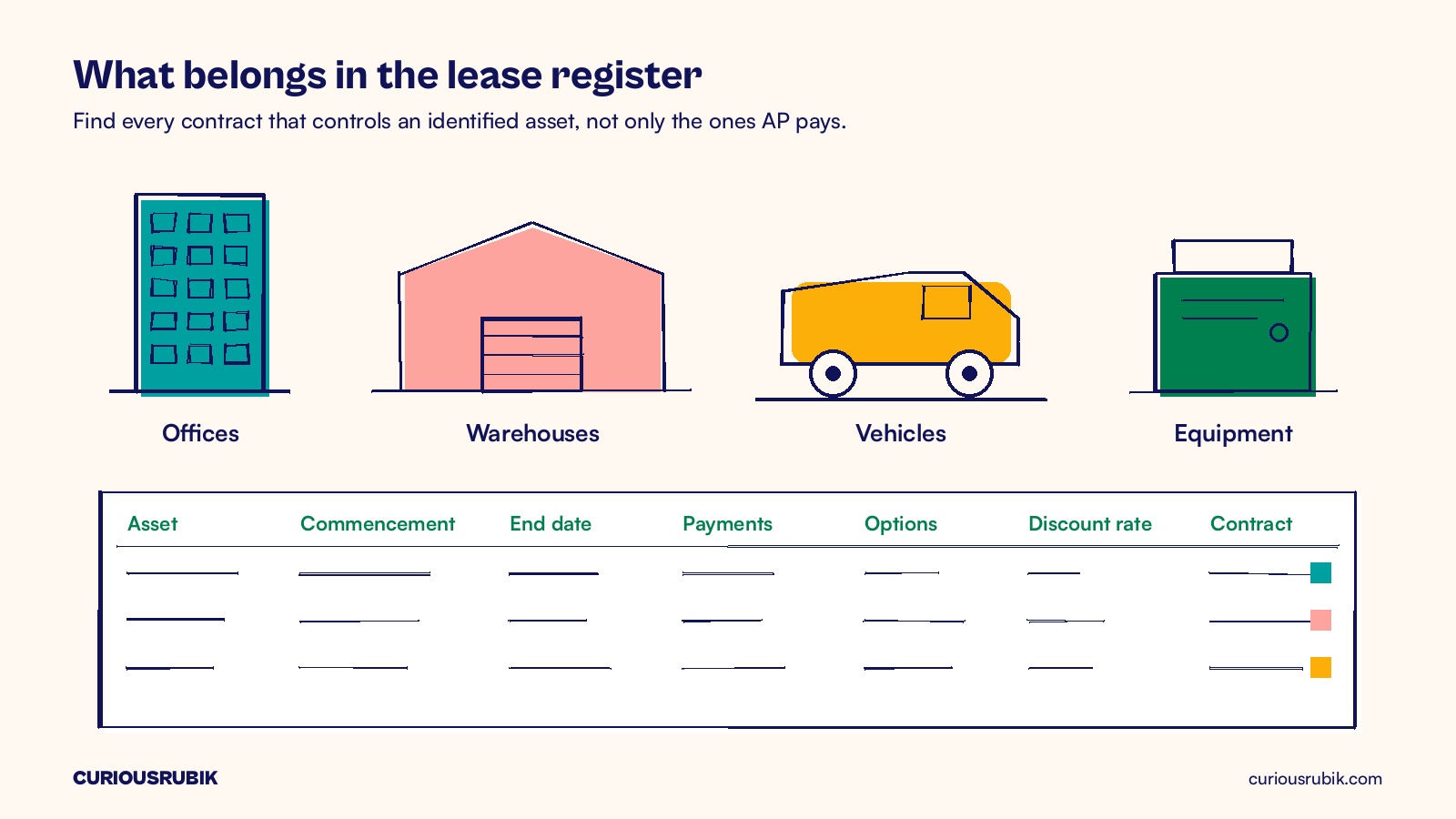
Start with a spreadsheet, not NetSuite. List every contract that might give you the right to control an identified asset for a period of time: offices, warehouses, vehicles, forklifts, copiers, servers in a colocation cage and any service contract that quietly includes dedicated equipment. Ask purchasing, facilities and IT, not only accounts payable, because some leases never show up as a vendor bill you would recognize.
For each lease, capture the same fields: lessor, asset, location, subsidiary, commencement date, end date, renewal and termination options, payment schedule, escalation terms, any incentive received, initial direct costs and the department that will carry the cost. Attach the signed contract to each row. If a field is missing, write down who owns finding it. That register becomes your opening data load and the first thing an auditor samples.
Decide the policy elections in writing
ASC 842 lets a company make several elections, and each one changes what you configure. The common ones are the short-term lease exemption for leases of 12 months or less, the practical expedient to combine lease and non-lease components by asset class and a materiality threshold below which you do not capitalize. Private companies have extra options, including a risk-free rate election.
Put each decision in a one-page policy memo, approved by the controller and reviewed with your auditor. Then translate it into rules the system can follow, such as "combine components for vehicles, separate them for real estate". Elections that live only in someone's head get applied inconsistently, and the inconsistency shows up in the first audit sample.
Set the discount rate source for every lease
The lease liability is the present value of the remaining payments, so the discount rate drives every number that follows. Use the rate implicit in the lease when you can determine it. Most lessees cannot, so they use an incremental borrowing rate, which should reflect a secured borrowing over a similar term.
Decide who provides the rates, how often they are refreshed and how they map to lease terms. A simple table by term band, such as up to 3 years, 3 to 5 years and over 5 years, approved each quarter by treasury, is easier to defend than a different rate typed into each lease. Store the rate and its source on the lease record so anyone can see why a schedule looks the way it does.
Classify each lease and agree the journal pattern
Every lease is either an operating lease or a finance lease, and the two hit the income statement differently. An operating lease produces one straight-line lease cost. A finance lease splits into amortization of the right-of-use asset and interest on the liability, which front-loads the expense. Document the classification test for each lease and keep the evidence with the register.
Then agree the journal pattern before configuration. Name the accounts for the right-of-use asset, the current and non-current lease liability, lease cost, amortization and interest. Decide which segments each entry carries, such as subsidiary, department and location, so lease cost lands where the budget owner expects it. This is the same discipline we describe in NetSuite ASC 606 requirements before configuration: the rules come first and the setup follows them.
A hypothetical office lease from commencement to month 12
Take a US company signing a five-year office lease at $10,000 a month, paid at the end of each month, with no incentives and no initial direct costs. Treasury sets an incremental borrowing rate of 6% a year, or 0.5% a month. The present value of 60 payments of $10,000 at that rate is about $517,256, so on commencement the company records a right-of-use asset and a lease liability of $517,256 each.
The lease is classified as operating, so the income statement shows $10,000 of lease cost every month. Underneath, the month 1 liability accrues $2,586 of interest and the $10,000 payment reduces it by $7,414, leaving $509,842. The right-of-use asset amortizes by the same $7,414 plug, so both balances still match. By month 12 the liability is about $425,803.
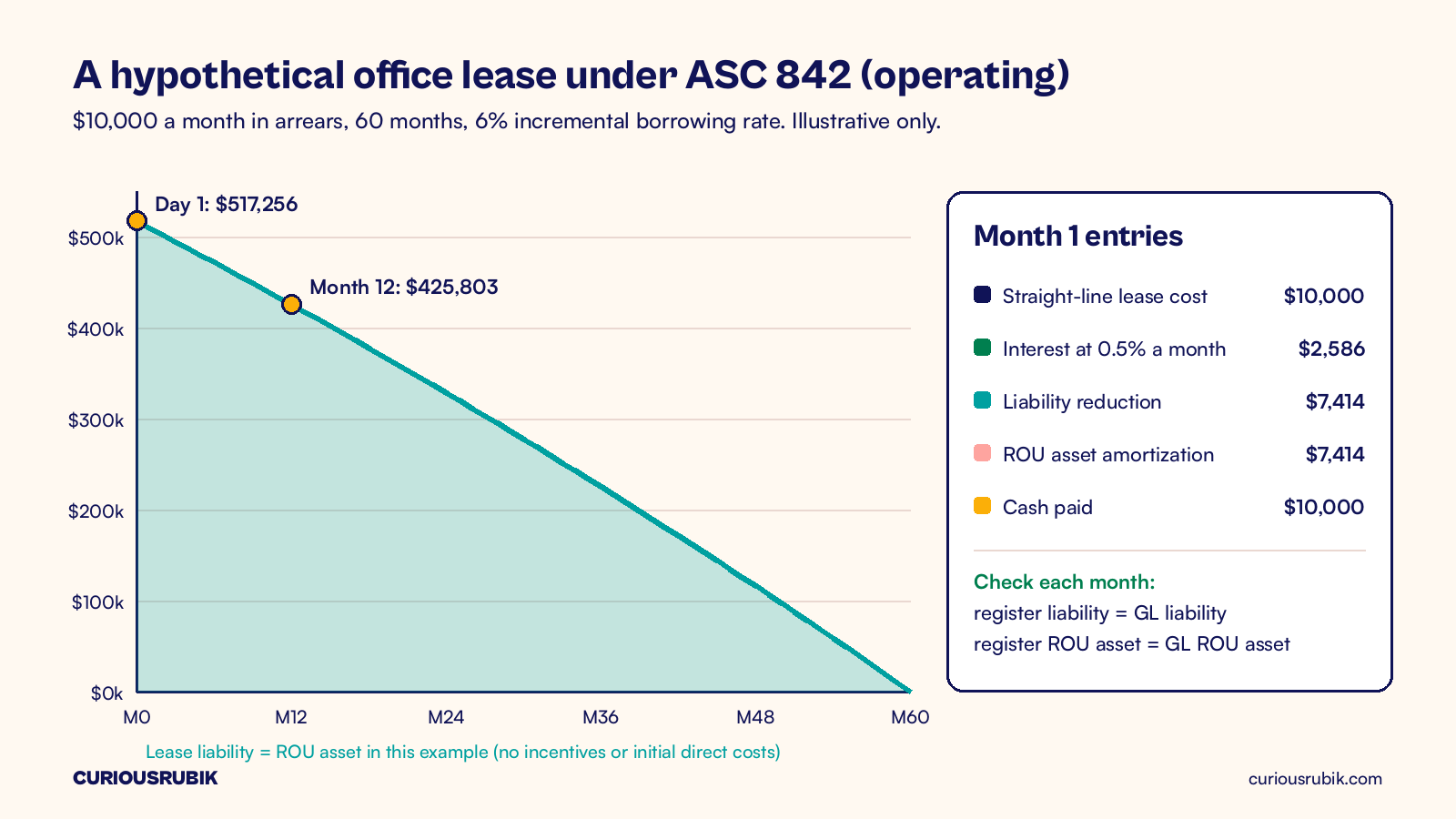
Now change one fact. If the landlord had paid a $30,000 tenant incentive at signing, the right-of-use asset would start at $487,256 while the liability stayed at $517,256, and the two balances would no longer move together. That is exactly the case a test plan should include, because a schedule that only works for clean leases will fail on the first real contract.
Plan for modifications, renewals and terminations
Leases change. Rent steps up, a floor is added, a renewal option becomes reasonably certain or a site closes early. Each of these can require a remeasurement of the liability and an adjustment to the asset, often at a new discount rate. Decide who reports a change, how fast it must reach finance and how the original schedule is preserved for the audit trail.
Test at least one modification, one early termination and one renewal before go-live. Check that the new schedule starts from the right date, that the old one stops and that the adjustment entry posts to the accounts named in your policy. Teams that skip these tests usually find the gap at year end, under time pressure.
Reconcile the lease schedules to the general ledger
Every month, the lease register should tie to the ledger: total lease liability, split into current and non-current, total right-of-use assets and the period's lease cost, amortization and interest. Build that reconciliation into the close and give it an owner and a reviewer. Our NetSuite month end close checklist with reconciliation evidence shows how to fit a check like this into the calendar.
If you are heading toward an IPO or an external audit for the first time, treat the lease reconciliation as a key control. Keep the signed reconciliation, the schedule report and the journal list for each month. The same evidence approach appears in our guide to SOX controls in NetSuite for pre-IPO companies.
Choose how NetSuite will hold the leases
Only now pick the mechanism. Depending on your account, lease accounting may run through Oracle's lease capability in the Fixed Assets Management SuiteApp, a third-party SuiteApp or a controlled schedule outside NetSuite that posts journals in. Confirm what your edition and licenses include with the account owner, and check which disclosures and maturity analyses each option can produce before you commit.
Whichever option you choose, load the register you already built, rerun the hypothetical above and compare the results to an independent spreadsheet to the cent. If the lease module shares data with fixed assets, read NetSuite fixed assets implementation starts with a proven opening register as well, because the same opening-balance discipline applies. CuriousRubik's NetSuite implementation services can help you turn the register, policy memo and test cases into an accepted lease setup, and we work with finance teams across NetSuite projects in the United States.
Related reading: NetSuite Prepaid Expense and Amortization Reconciliation
Frequently asked questions
Does NetSuite handle ASC 842 out of the box?
Not automatically. Lease accounting usually needs a specific module or SuiteApp, and what is included depends on your edition and licenses. Confirm it with your account owner before you plan the project.
Do short-term leases need to go into NetSuite?
Not if you elect the short-term exemption for leases of 12 months or less. Keep them in the register anyway, flagged as exempt, so you can show the auditor the population was complete.
Which discount rate should a private company use?
Use the rate implicit in the lease if it is readily determinable. Otherwise use an incremental borrowing rate, or the risk-free rate if you elect that private company option by asset class. Confirm the choice with your auditor.
Can we migrate leases mid-year?
Yes, but load each lease with its remaining payments and the balances as of the cutover date, and reconcile them to the prior system before the first close. A mid-year move without that tie-out tends to create unexplained differences.
How is ASC 842 different from ASC 606 in NetSuite?
ASC 606 governs how you recognize revenue from customer contracts. ASC 842 governs how you record leases you hold as a lessee or lessor. Both reward the same approach: settle the rules and data first, then configure.
NetSuite ASC 842 lease accounting works when the lease data and policy decisions are settled before anyone opens a configuration screen. You need a complete lease register, a discount rate for each lease, an agreed classification and a monthly reconciliation of the lease schedules to the general ledger. Get those right and the setup itself is the smaller part of the job.
The trap is starting with the tool. A team installs a lease module, keys in the three leases everyone remembers and calls it done. Then the auditor asks about the equipment agreement signed by operations, the vehicle leases sitting with the fleet manager and the office renewal that changed the rent last spring. The system was fine. The inventory of leases was not.
Build a complete lease register before configuring NetSuite ASC 842
Start with a spreadsheet, not NetSuite. List every contract that might give you the right to control an identified asset for a period of time: offices, warehouses, vehicles, forklifts, copiers, servers in a colocation cage and any service contract that quietly includes dedicated equipment. Ask purchasing, facilities and IT, not only accounts payable, because some leases never show up as a vendor bill you would recognize.
For each lease, capture the same fields: lessor, asset, location, subsidiary, commencement date, end date, renewal and termination options, payment schedule, escalation terms, any incentive received, initial direct costs and the department that will carry the cost. Attach the signed contract to each row. If a field is missing, write down who owns finding it. That register becomes your opening data load and the first thing an auditor samples.
Decide the policy elections in writing
ASC 842 lets a company make several elections, and each one changes what you configure. The common ones are the short-term lease exemption for leases of 12 months or less, the practical expedient to combine lease and non-lease components by asset class and a materiality threshold below which you do not capitalize. Private companies have extra options, including a risk-free rate election.
Put each decision in a one-page policy memo, approved by the controller and reviewed with your auditor. Then translate it into rules the system can follow, such as "combine components for vehicles, separate them for real estate". Elections that live only in someone's head get applied inconsistently, and the inconsistency shows up in the first audit sample.
Set the discount rate source for every lease
The lease liability is the present value of the remaining payments, so the discount rate drives every number that follows. Use the rate implicit in the lease when you can determine it. Most lessees cannot, so they use an incremental borrowing rate, which should reflect a secured borrowing over a similar term.
Decide who provides the rates, how often they are refreshed and how they map to lease terms. A simple table by term band, such as up to 3 years, 3 to 5 years and over 5 years, approved each quarter by treasury, is easier to defend than a different rate typed into each lease. Store the rate and its source on the lease record so anyone can see why a schedule looks the way it does.
Classify each lease and agree the journal pattern
Every lease is either an operating lease or a finance lease, and the two hit the income statement differently. An operating lease produces one straight-line lease cost. A finance lease splits into amortization of the right-of-use asset and interest on the liability, which front-loads the expense. Document the classification test for each lease and keep the evidence with the register.
Then agree the journal pattern before configuration. Name the accounts for the right-of-use asset, the current and non-current lease liability, lease cost, amortization and interest. Decide which segments each entry carries, such as subsidiary, department and location, so lease cost lands where the budget owner expects it. This is the same discipline we describe in NetSuite ASC 606 requirements before configuration: the rules come first and the setup follows them.
A hypothetical office lease from commencement to month 12
Take a US company signing a five-year office lease at $10,000 a month, paid at the end of each month, with no incentives and no initial direct costs. Treasury sets an incremental borrowing rate of 6% a year, or 0.5% a month. The present value of 60 payments of $10,000 at that rate is about $517,256, so on commencement the company records a right-of-use asset and a lease liability of $517,256 each.
The lease is classified as operating, so the income statement shows $10,000 of lease cost every month. Underneath, the month 1 liability accrues $2,586 of interest and the $10,000 payment reduces it by $7,414, leaving $509,842. The right-of-use asset amortizes by the same $7,414 plug, so both balances still match. By month 12 the liability is about $425,803.
Now change one fact. If the landlord had paid a $30,000 tenant incentive at signing, the right-of-use asset would start at $487,256 while the liability stayed at $517,256, and the two balances would no longer move together. That is exactly the case a test plan should include, because a schedule that only works for clean leases will fail on the first real contract.
Plan for modifications, renewals and terminations
Leases change. Rent steps up, a floor is added, a renewal option becomes reasonably certain or a site closes early. Each of these can require a remeasurement of the liability and an adjustment to the asset, often at a new discount rate. Decide who reports a change, how fast it must reach finance and how the original schedule is preserved for the audit trail.
Test at least one modification, one early termination and one renewal before go-live. Check that the new schedule starts from the right date, that the old one stops and that the adjustment entry posts to the accounts named in your policy. Teams that skip these tests usually find the gap at year end, under time pressure.
Reconcile the lease schedules to the general ledger
Every month, the lease register should tie to the ledger: total lease liability, split into current and non-current, total right-of-use assets and the period's lease cost, amortization and interest. Build that reconciliation into the close and give it an owner and a reviewer. Our NetSuite month end close checklist with reconciliation evidence shows how to fit a check like this into the calendar.
If you are heading toward an IPO or an external audit for the first time, treat the lease reconciliation as a key control. Keep the signed reconciliation, the schedule report and the journal list for each month. The same evidence approach appears in our guide to SOX controls in NetSuite for pre-IPO companies.
Choose how NetSuite will hold the leases
Only now pick the mechanism. Depending on your account, lease accounting may run through Oracle's lease capability in the Fixed Assets Management SuiteApp, a third-party SuiteApp or a controlled schedule outside NetSuite that posts journals in. Confirm what your edition and licenses include with the account owner, and check which disclosures and maturity analyses each option can produce before you commit.
Whichever option you choose, load the register you already built, rerun the hypothetical above and compare the results to an independent spreadsheet to the cent. If the lease module shares data with fixed assets, read NetSuite fixed assets implementation starts with a proven opening register as well, because the same opening-balance discipline applies. CuriousRubik's NetSuite implementation services can help you turn the register, policy memo and test cases into an accepted lease setup, and we work with finance teams across NetSuite projects in the United States.
Related reading: NetSuite Prepaid Expense and Amortization Reconciliation
Frequently asked questions
Does NetSuite handle ASC 842 out of the box?
Not automatically. Lease accounting usually needs a specific module or SuiteApp, and what is included depends on your edition and licenses. Confirm it with your account owner before you plan the project.
Do short-term leases need to go into NetSuite?
Not if you elect the short-term exemption for leases of 12 months or less. Keep them in the register anyway, flagged as exempt, so you can show the auditor the population was complete.
Which discount rate should a private company use?
Use the rate implicit in the lease if it is readily determinable. Otherwise use an incremental borrowing rate, or the risk-free rate if you elect that private company option by asset class. Confirm the choice with your auditor.
Can we migrate leases mid-year?
Yes, but load each lease with its remaining payments and the balances as of the cutover date, and reconcile them to the prior system before the first close. A mid-year move without that tie-out tends to create unexplained differences.
How is ASC 842 different from ASC 606 in NetSuite?
ASC 606 governs how you recognize revenue from customer contracts. ASC 842 governs how you record leases you hold as a lessee or lessor. Both reward the same approach: settle the rules and data first, then configure.