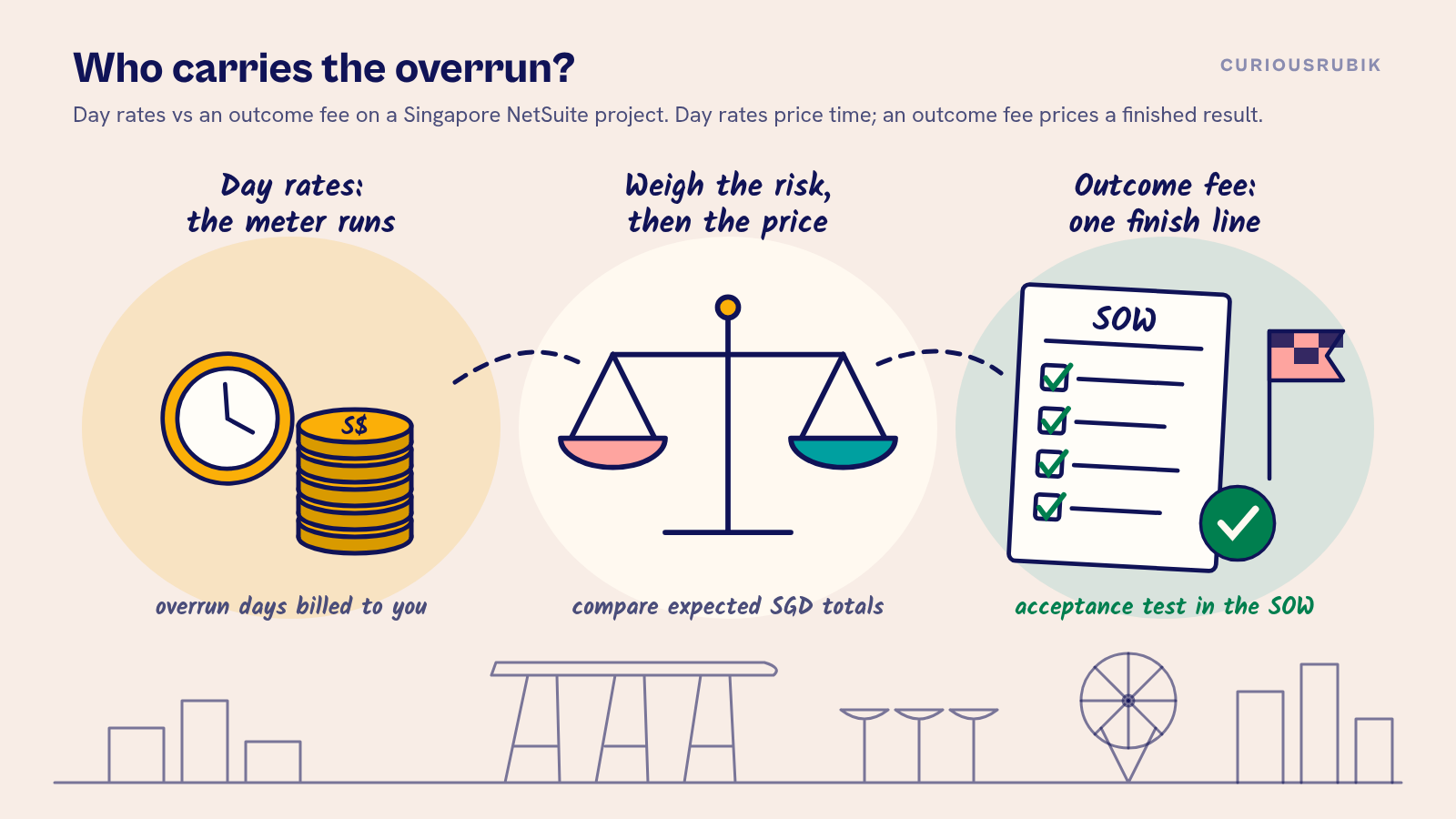
NetSuite consultant rates in Singapore are usually quoted per day or per hour, so they price time. An outcome fee prices a finished result. To compare the two, rebuild every rate-based proposal around the same defined result, add the overrun you can reasonably expect, convert everything to SGD on the same GST basis and then ask who pays if the estimate is wrong.
Most Singapore buyers start by asking what a fair day rate looks like. That number tells you very little on its own. A partner charging less per day can still cost more if its estimate leaves out testing, InvoiceNow exceptions or GST return mapping. The useful comparison is the expected cost of the result and the party carrying the risk.
Rebuild every proposal around the same result
Write down the outcomes you are buying before you read a single rate card. For a Singapore company these are often things like "sales invoices transmit through InvoiceNow and rejections reach a named owner", "the GST F5 draft reconciles to the ledger" or "opening balances from Xero match the trial balance at cutover". Each one needs a sentence describing what finished looks like.
Then take each time-and-materials proposal and map its days to those outcomes. List the roles, days and rate behind each deliverable and multiply it out. Where a proposal has a line called "configuration" with no link to any outcome, ask the partner to split it. If the days cannot be mapped, the proposal cannot be compared.
Price the overrun before you compare NetSuite consultant rates in Singapore
Estimates carry uncertainty, and under day rates that uncertainty belongs to you. Ask each partner which deliverables are most likely to run long and by how much. In Singapore accounts the usual candidates are e-invoicing exception handling, bank file formats, data migration from older systems and any regional entity whose processes nobody has documented yet.
Add a contingency to each rate-based quote using the partner's own answers and its own rates. Write the reason next to each figure so the number can be challenged. Under an outcome fee the partner has already priced that contingency into the fee and carries it if the work runs over. That transfer of risk is most of what the higher headline buys.
Put every quote in SGD on the same GST basis
Regional partners often quote in USD, and some quote part of the work from outside Singapore. Convert every quote to SGD at one stated exchange rate on one date, and note which quotes are fixed in SGD and which will move with the currency. A USD day rate that looks cheaper in March can look different by the final invoice.
Check whether each quote includes or excludes GST. The prevailing Singapore GST rate is 9%. If a partner bills from overseas, ask your tax adviser how GST on imported services applies to your business, because GST-registered businesses that cannot claim full input tax may need to account for it under reverse charge. Put travel, licenses and SuiteApp costs on separate lines so the services figure stays comparable. Our post on how to compare NetSuite pricing in Singapore with a consistent SGD scope covers the license and subscription side of the same exercise.
Read what an outcome fee actually includes
An outcome fee is only as good as its definition of done. Read the agreement for four things: the result, the acceptance test, the scope boundary and your own obligations. If any of the four is vague, the fee is a fixed price with a loose finish line, and disputes will follow.
Ask what happens when acceptance fails. A sound agreement says how many retests are allowed, who fixes which kind of defect and whether the fee changes. Our explanation of outcome-based NetSuite pricing walks through the structure, and the questions in how to choose a NetSuite partner in Singapore help you test whether a partner can stand behind one.
A hypothetical comparison in SGD
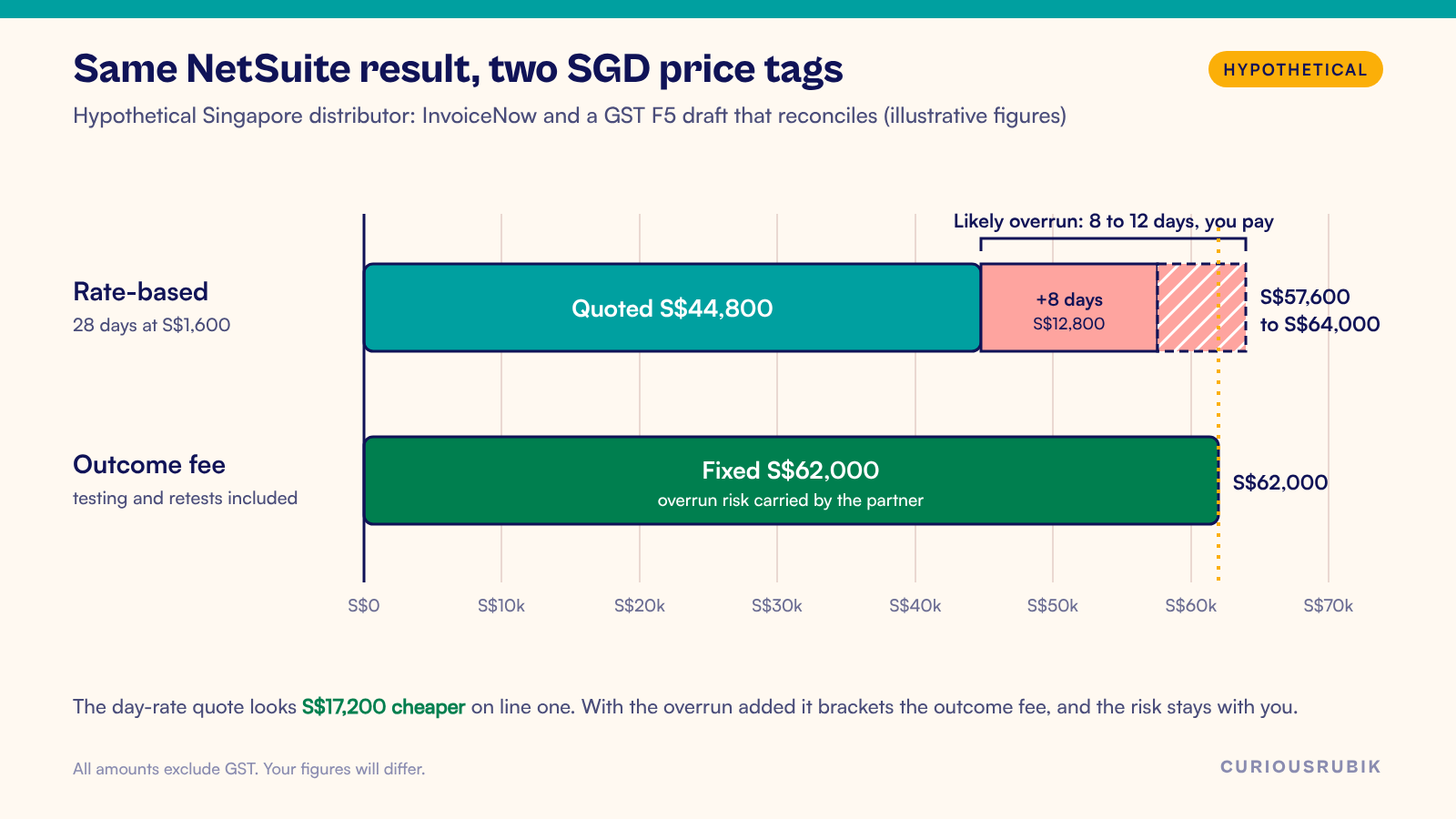
A hypothetical Singapore wholesale distributor needs NetSuite order-to-cash live with InvoiceNow transmission and a GST F5 draft that reconciles to the ledger each quarter. Two proposals arrive. All figures below are illustrative, exclusive of GST and invented for this example.
| Line | Rate-based proposal | Outcome proposal |
|---|---|---|
| Quoted amount | 28 days at S$1,600 = S$44,800 | S$62,000 for the agreed outcome |
| Testing and rework | Not itemized | Included, with two retest cycles |
| Likely overrun from InvoiceNow rejections and F5 box mapping | 8 to 12 days = S$12,800 to S$19,200 | Carried by the partner |
| Expected total | S$57,600 to S$64,000 | S$62,000 |
| Acceptance test | "UAT sign-off" | Two consecutive quarterly F5 drafts reconcile to the ledger and every rejected invoice has an owner |
The rate-based proposal looks S$17,200 cheaper on the first line. Once the overrun its own team described is added, it lands between S$57,600 and S$64,000, which brackets the S$62,000 outcome fee, and the distributor still carries the risk of going past the top of that range. The outcome proposal also states a finish line the finance team can check. Your figures will differ. The method is the part to keep.
Check who will do the work and from where
A rate card lists roles, and the role you are quoted is not always the person you get. Ask for the named consultants behind each estimate, their experience with Singapore GST and InvoiceNow, and how much of their week your project will have. A senior rate for work done mostly by a junior changes the comparison. So does a lead shared across several projects.
If part of the team works from another country, agree the overlap hours with your Singapore staff and who attends workshops in person. Under an outcome fee staffing is the partner's decision, but write the names of the design lead and your day-to-day contact into the agreement, along with what happens if either leaves.
Look at how each model rewards the partner
Under day rates the partner earns more when the project takes longer. Most partners handle that professionally, but the incentive still shows up in small ways: generous change request estimates, slow escalation of design problems and long hypercare.
Under an outcome fee the partner earns the same whether the work takes twenty days or thirty. It has a reason to raise problems early and to push back on scope that does not serve the result. Your side has a reason to deliver data, decisions and testers on time, because late inputs are usually written in as grounds to amend the agreement.
Keep day rates for work that cannot be defined yet
Rates still fit some work. Open-ended discovery on an undocumented account, a few days of advisory help and staff augmentation for an internal team are hard to express as outcomes. For those, agree a cap, a weekly burn report in SGD and a clear point where the work stops for a decision.
Many Singapore projects mix the two. A short paid diagnosis on a small fixed fee, followed by an outcome fee for delivery, works well when the starting point is uncertain. Agree the dates your team owes and the change rule at the same time: changes to the outcome are priced as amendments, and changes to the partner's method stay the partner's problem. If you are budgeting for the period after go-live, see sizing a Singapore NetSuite support retainer from the work your team actually receives.
CuriousRubik does not charge hourly or daily rates. We review feasibility, agree the result and its acceptance test, then charge one fee for that outcome. Our outcome-led consulting approach explains how that works, and our page on NetSuite projects in Singapore shows the outcomes we usually agree. If you are comparing the same decision across markets, the NetSuite consultant rates in Australia post applies this method to AUD quotes.
Related reading: NetSuite Partner Questions to Ask Before Signing the SOW
Frequently asked questions
What is a typical NetSuite consultant day rate in Singapore?
It varies by firm, seniority, specialty and where the consultant is based, and any published figure dates quickly. Compare the expected cost of a defined result instead of the rate alone.
Is an outcome fee always more expensive than day rates?
Not always. The headline is often higher because it includes the partner's risk. Add a realistic overrun to each rate-based quote before deciding which is cheaper.
Should NetSuite quotes in Singapore include GST?
Check every quote and compare them on the same basis. Local suppliers that are GST-registered charge GST at the prevailing rate, and services bought from overseas may fall under reverse charge for some businesses, so confirm with your tax adviser.
Can we pay a USD quote and still budget in SGD?
Yes, but agree the exchange rate assumption up front and record which payments move with the currency. A fixed SGD fee removes that variable from your budget.
Who carries the risk under an outcome fee?
The partner carries the risk of extra effort needed to reach the agreed result. You remain responsible for your data, decisions, testers and dates.