A realistic NetSuite implementation timeline in Australia is set by three things: the scope you agree, the capacity of your own finance and operations team, and the local calendar. EOFY on 30 June, quarterly BAS dates, STP finalization and the December to January holiday period all limit when you can test, cut over and close your first month. Plan the go-live date backwards from those constraints, then check that each phase has the people it needs.
Most timelines go wrong in the same place. The plan assumes your team can test, clean data and run business as usual at the same time. In Australia, that clash is sharpest in June, July and the summer break.
Choose the go-live date from the calendar backwards
Start with the dates you can't move. For most Australian companies, these include 30 June and the weeks after it, quarterly BAS lodgment, STP finalization by 14 July and the FBT year ending 31 March. Add your own peaks: retail trading periods, a stocktake or a board reporting cycle.
Then pick a go-live month that leaves room for one clean month-end close before the next pressure point. Going live on 1 July can work, because it gives a clean financial year in NetSuite, but only if testing and data loads happen in April and May while your team is preparing for EOFY. Many companies find a go-live after the BAS for a quarter, such as early in a new quarter, easier to staff.
Plan phases around your own team's time
A partner's plan shows their consultants' effort. Add your own. For each phase, estimate how many days your controller, AP and AR leads, warehouse lead and IT contact will spend in workshops, testing and data work. Then compare that with what they can give while running the business.
Our post on how much time your team needs for an ERP project has a method for estimating it. If the numbers don't fit, move the date or reduce the scope. Hoping usually means the partner waits for decisions and the plan slips anyway.
Expect these phases and typical sequence
Most Australian mid-market projects follow a similar sequence: discovery, design, build and configuration, data migration cycles, system and user acceptance testing, training, cutover and hypercare. Discovery and design often take several weeks each. Build and testing usually take the largest share. Data runs alongside build in repeated test loads.
The length of each depends on scope, integrations and data. The best way to test a proposed plan is to ask the partner which phase they would shorten if the date had to move forward, and what risk that adds. Our Australian implementation discovery checklist shows what discovery should produce.
Build in time for payroll, STP and BAS testing
Australian projects carry testing that generic plans miss. Payroll journals and super liabilities need to reconcile in NetSuite. If payroll changes system, STP reporting needs to continue without gaps. The first BAS from NetSuite needs to be traced from transactions to the return.
Plan a parallel period for payroll, or at least a reconciled pay run, before cutover. Plan a BAS dry run using test data from a full quarter. Include the super guarantee check for each test pay run, the PAYG withholding total and the clearing account balance.
Integrations need their own test window. A 3PL, an ecommerce platform or a bank file usually depends on a third party's test environment and their availability. Ask each provider for test dates early, and plan at least one end-to-end cycle where an order flows from the channel through dispatch to invoice and payment. Third-party delays are a common reason testing runs late, and they are hard to recover once the cutover date is fixed.
Avoid the summer and EOFY clashes
Many Australian businesses slow down from mid-December to late January as staff take summer leave. A go-live in early January can leave you with half a team for hypercare. A go-live in late June puts cutover on top of EOFY and stocktake.
If you must use one of those windows, staff it deliberately. Agree leave arrangements early and make sure the partner's hypercare team is available too. Our NetSuite EOFY checklist for Australian finance teams lists what EOFY demands from finance.
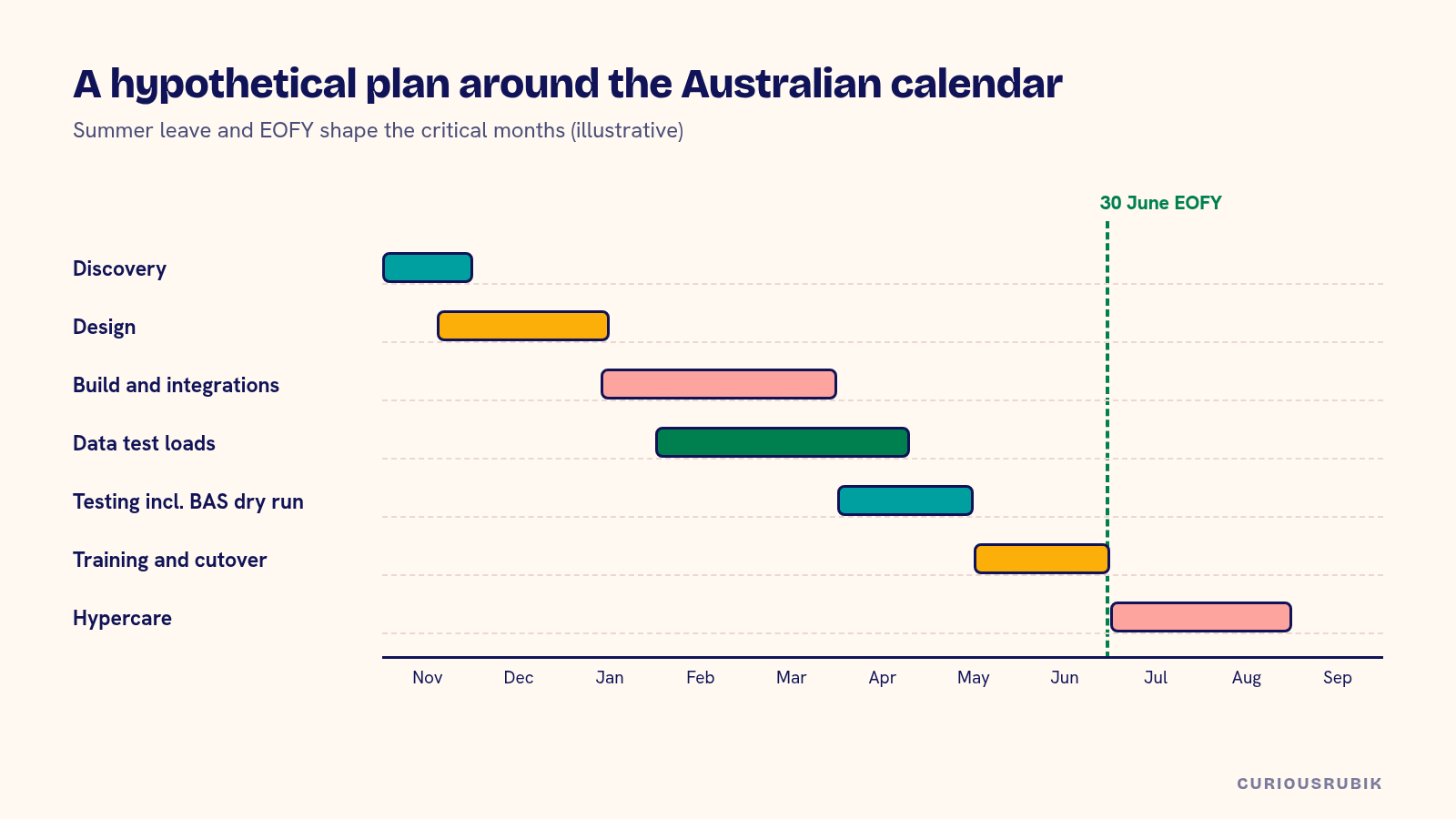
A hypothetical timeline for a Perth distributor
A hypothetical Perth industrial distributor with two entities, 60 users and integrations to a 3PL and a B2B portal plans its NetSuite project in October. All timings are illustrative.
| Phase | Weeks | Months | Notes |
|---|---|---|---|
| Discovery | 4 | November | Requirements and fit-gap |
| Design | 5 | Late November to mid-January | Paused for two weeks over Christmas |
| Build and integrations | 10 | Mid-January to March | 3PL and portal built in parallel |
| Data cycles | 3 test loads | February to April | Final load at cutover |
| Testing | 6 | April to mid-May | Includes BAS dry run and payroll reconciliation |
| Training and cutover | 3 | Late May to June | Go-live 1 July |
| Hypercare | 8 | July and August | Covers EOFY close and first BAS |
The plan reaches a 1 July go-live, and EOFY lands inside hypercare. The controller pushes back. The team settles on a 1 October go-live instead, keeping EOFY on the old system and giving three extra months for testing. Your timeline will differ. The reasoning applies widely.
Protect the timeline with decisions and change control
Most delays come from late decisions and scope growth. Agree who makes decisions, how quickly, and how a change is assessed for its effect on the date. Keep a visible decision log. If a change adds weeks, decide whether it goes in now or after go-live.
Commercial terms can help. Under rates, delay usually costs you. Under an outcome fee, the partner has a reason to keep the plan tight. Our comparison of NetSuite consultant rates in Australia vs outcome fees explains the difference. For selecting the partner who builds the plan, see how to choose a NetSuite partner in Australia.
Use the NetSuite implementation timeline checklist
Before you commit to a go-live date, check each of these:
- Are EOFY, BAS, STP and FBT dates marked on the plan?
- Does the go-live allow one clean close before the next pressure point?
- Is your team's time estimated for every phase?
- Are summer leave and EOFY workload covered?
- Are payroll reconciliation and a BAS dry run in the test plan?
- Are data test loads scheduled with sign-off dates?
- Is hypercare staffed by both your team and the partner?
- Is there a decision log and a change process that shows date impact?
Our NetSuite implementation team plans projects around the Australian calendar, and our page for Australian NetSuite projects shows how we work with local teams. To test whether you are ready to start, read Test the Local Boundaries of a NetSuite Australia Implementation.
Related reading: A NetSuite Australia Implementation Discovery Checklist
Frequently asked questions
How long does a NetSuite implementation take in Australia?
It depends on scope, integrations, data and your team's capacity. Build the plan from those, then check it against the local calendar.
Is 1 July a good go-live date?
It gives a clean financial year, but it puts testing near EOFY. It works only if your team can staff April to July.
Should we avoid going live in January?
Many teams are on leave. If you go live then, agree leave and hypercare staffing in advance.
What Australian tests are often missed?
Payroll journal and super reconciliation, STP continuity and a BAS dry run from NetSuite data.
How do we keep the timeline from slipping?
Make decisions quickly, keep a decision log and assess every change for its effect on the date.