For Singapore finance and operations leads who need an SGD implementation budget they can explain and defend, stage by stage.
Last reviewed: 1 November 2026. Product details reflect this review date. Availability and behavior can vary by account, role and release.
NetSuite implementation cost in Singapore is the services budget to design, configure, migrate, test and launch NetSuite. It sits apart from the yearly subscription. Plan it by stage: discovery, design, build, integrations, data migration, testing and training, then go live and hypercare. Singapore scope such as GST, InvoiceNow, bank files and extra entities moves the total most.
- Budget by stage, not as one number, so you can see where the money goes and what each stage delivers.
- Add your own team's time. It never appears on an invoice, but it decides whether the dates hold.
- Ask whether the partner charges GST on the fee, and confirm the input tax treatment with your tax adviser.
- Keep a contingency of about 10 percent and agree in writing what it can be spent on.
What does NetSuite implementation cost in Singapore cover?
An implementation budget is the money you set aside for the work that turns a NetSuite subscription into a working system for your business. It covers people and time: workshops, configuration, data loads, testing, training and support after launch.
It does not cover the NetSuite subscription itself. Oracle quotes the subscription separately, based on your edition, users and modules. Keep the two apart in your business case, because one is a yearly cost and the other is mostly a one time project cost.
A good quote is built from the stages of the project. Each stage has a clear output, an owner on your side and a number of weeks. If a quote shows only one total, ask the partner to split it by stage. That split is also the best way to compare day rates with fixed outcome fees, which our post on NetSuite consultant rates in Singapore explains.
A hypothetical Singapore distributor's budget, stage by stage
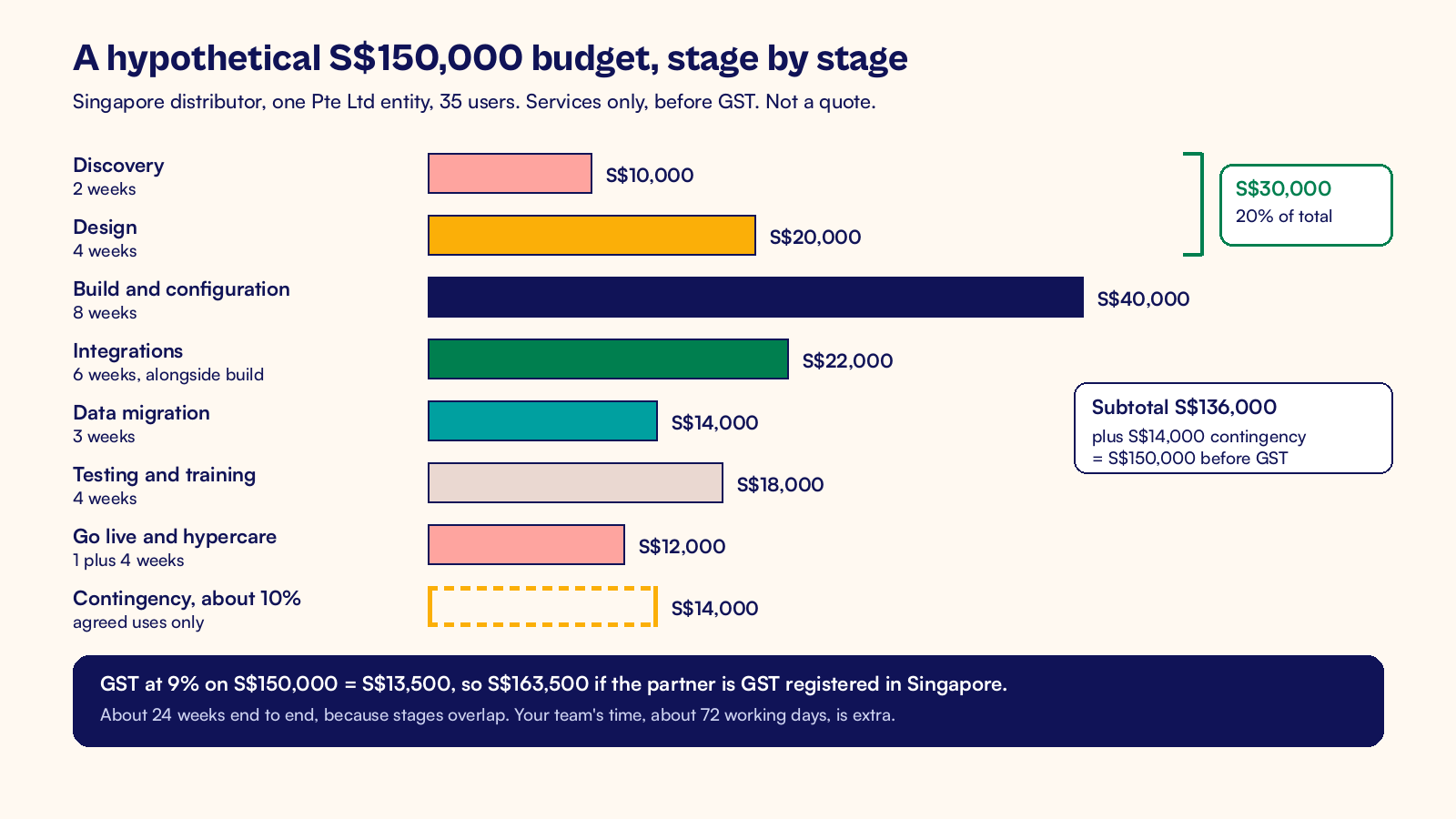
A hypothetical industrial parts distributor in Singapore has one Pte Ltd entity, 35 NetSuite users and a warehouse in Jurong. It is GST registered and files a quarterly GST F5 return. It wants three integrations: an InvoiceNow connection, a bank payment file and a monthly journal from its payroll provider.
The figures below are services only, before GST. They are an example to show the shape of a budget, not a price list or a quote.
| Stage | Weeks | Main output | Your owner | Budget (SGD) |
|---|---|---|---|---|
| Discovery | 2 | Scope, process list, project plan | Finance lead | 10,000 |
| Design | 4 | Signed design for each process | Process owners | 20,000 |
| Build and configuration | 8 | Configured account in sandbox | NetSuite administrator | 40,000 |
| Integrations | 6, alongside the build | InvoiceNow, bank file and payroll journal tested | IT lead | 22,000 |
| Data migration | 3 | Opening balances and open items loaded and reconciled | Finance lead | 14,000 |
| Testing and training | 4 | Signed user acceptance tests, trained users | Process owners | 18,000 |
| Go live and hypercare | 1 plus 4 | Live system, first month closed | Project sponsor | 12,000 |
| Subtotal | 136,000 | |||
| Contingency, about 10 percent | Project sponsor | 14,000 | ||
| Total before GST | 150,000 |
Discovery and design
Discovery turns a wish list into a scope. The partner runs short workshops with finance, sales, purchasing and the warehouse, then writes the process list and the plan.
Design goes one level deeper. For each process, the team agrees the forms, approvals, reports and data that NetSuite will use. Design sign off is the point where scope should freeze.
Together these two stages take S$30,000 of S$150,000, or 20 percent. That share feels high to some buyers. It is the cheapest place to find a problem, because nothing has been built yet.
Build, integrations and data migration
Build is the largest line at S$40,000. The team configures the chart of accounts, items, locations, tax codes, approvals, forms and saved searches in a sandbox. Integrations run alongside the build and take S$22,000 here.
That line covers three pieces of work. The InvoiceNow connection sends invoices from NetSuite through an access point and brings back the responses. The bank file lets accounts payable pay suppliers from a NetSuite payment batch.
The payroll journal brings each month's wages, CPF and deductions into the ledger as one summary entry. Each piece is tested on its own, then together in the last build weeks.
Data migration starts in the last two build weeks. The team loads customers, vendors, items, open invoices, open bills, stock on hand and opening balances, then reconciles each one to the old system. Our guide to NetSuite data migration in Singapore covers the load order and the checks.
Testing, training and go live
Testing and training take S$18,000. Your process owners run real scenarios in the sandbox, from a quote to a paid invoice and from a purchase order to a vendor payment. Users are trained on their own roles, not on every screen.
Go live and hypercare take S$12,000. Hypercare is the support period right after launch, when the partner stays close while your team runs the first invoices, payments and month end. Here it lasts four weeks and ends after the first close.
How the weeks add up
The stages overlap, so the project runs about 24 weeks from kickoff to the end of hypercare, not the 32 weeks you get by adding the column. Our NetSuite implementation timeline for Singapore shows typical week ranges for each stage.
Your team's time
The distributor's finance lead, sales lead and warehouse lead each spend about one day a week on the project for 24 weeks. That is 72 working days that never appear on the partner's invoice. Plan backfill for month end and busy periods, or the dates slip and the cost follows.
What the contingency covers
Contingency is money held back for scope you could not see at the start, not for new wishes. In this example it is S$14,000. Agree with the partner that it can pay for items such as an extra data cleanup round, a missed tax code case or one more training session.
New reports, new integrations or a second entity are change requests. Each one is priced and approved on its own. Ask for a monthly note of what has been drawn, so the sponsor sees it well before it runs out.
GST on the services fee
If your partner is GST registered in Singapore, it charges GST at 9 percent on the fee. On S$150,000 that is S$13,500, for S$163,500 in total. A GST registered business can usually claim this as input tax, subject to the normal rules.
If an overseas partner does the work, the rules are different. Under reverse charge, a GST registered business accounts for GST on imported services only if it is not entitled to full input tax credit. Confirm your own position with your tax adviser before you sign.
Which Singapore requirements move the budget most?
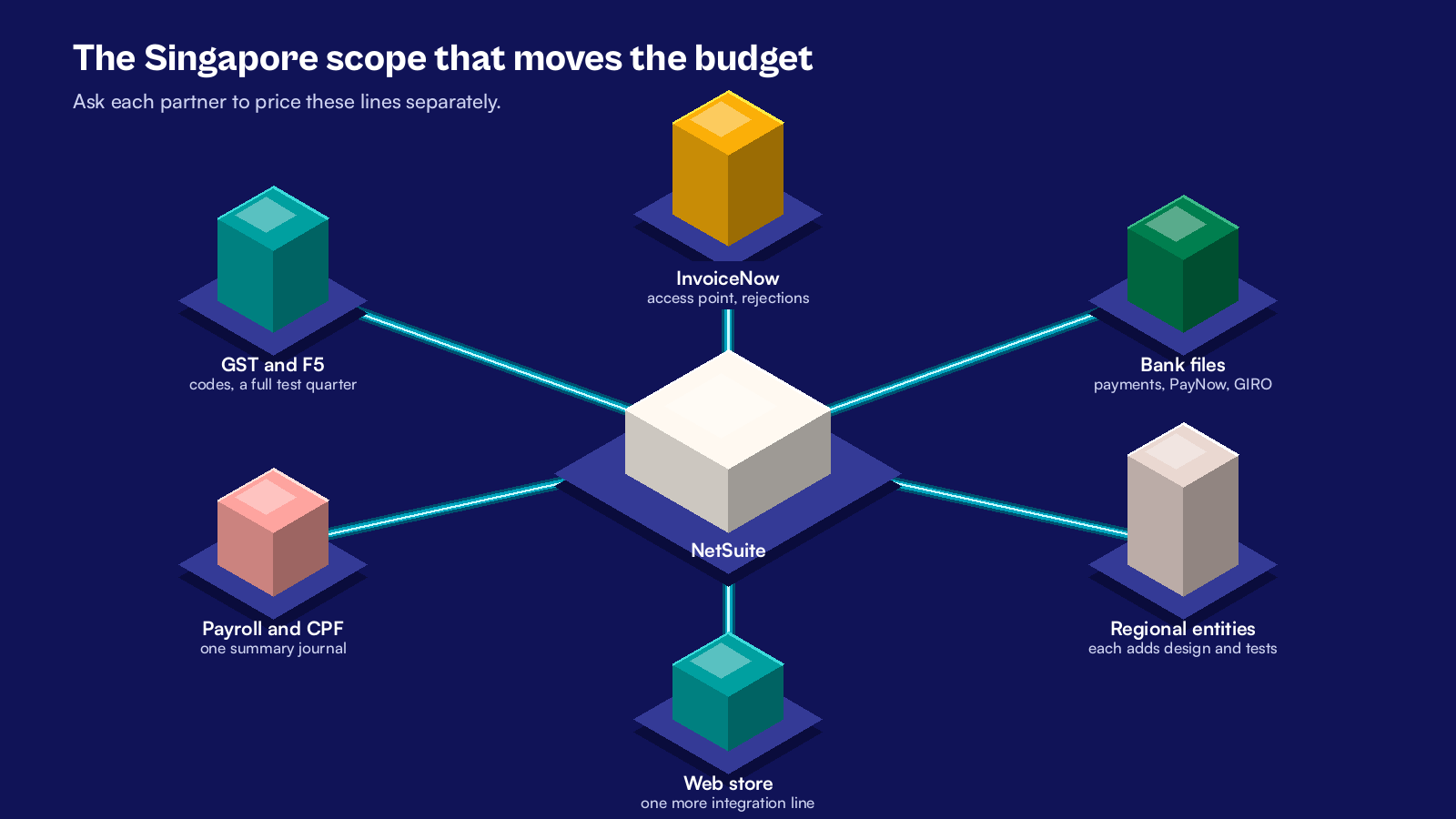
Most of the difference between two Singapore quotes comes from a short list of local scope. Ask each partner to price these lines separately.
GST setup and the F5 return
NetSuite handles Singapore GST through tax codes on items and transactions and reports that feed the GST F5 return. The cost sits in design and testing: mapping each supply type to a code and testing a full quarter before go live. Imports, exports and mixed supplies add test cases.
InvoiceNow
IRAS requires every new voluntary GST registrant to send invoice data through an InvoiceNow ready solution, from 1 April 2026. IRAS has announced that the requirement will extend to all GST registered businesses in phases by April 2031. NetSuite is on IMDA's list of Peppol ready solutions, so the work is connecting it to an access point, mapping the invoice data and testing rejections.
Bank payments and receipts
Paying suppliers by bank file usually uses the Electronic Bank Payments SuiteApp, set up for your bank's format. Matching PayNow, FAST and GIRO receipts needs bank statement import and matching rules. Most of the cost is testing with the bank, which can take longer than the NetSuite work.
Payroll and CPF
Singapore payroll usually runs in a payroll provider that calculates CPF and sends NetSuite a summary journal. Budget for the account mapping, the journal format and one parallel pay run.
Regional entities
Each extra subsidiary in NetSuite OneWorld adds design, build and testing time for its currency, tax setup, intercompany flows and consolidation. If you plan to add a Malaysian or Australian entity later, say so in discovery so the design leaves room for it.
Web store and other systems
Every extra system adds an integration line. A web store is a common one. Our guide to NetSuite ecommerce integration in Australia shows the records, GST rules and payout checks that drive that line, and most of them apply in Singapore too.
How do you size your own budget?
Work through these steps with your finance lead before you ask for quotes.
- List the processes you need on day one and the ones that can wait.
- Count your entities, currencies, integrations and data sources.
- Name an owner on your side for each stage and check they have the time.
- Ask each partner for a quote split by the same stages as the table above.
- Add contingency of about 10 percent and agree what it covers.
- Add GST on the fee and confirm the input tax treatment.
Then use this table to see which pattern you are closest to.
| Your situation | What changes against the example |
|---|---|
| One entity, standard processes, one or two integrations | Shorter build and fewer integration tests |
| One entity with InvoiceNow, bank files and payroll | Close to the example above |
| Two to four regional subsidiaries | Add design, build and testing time for each entity |
| Web store, marketplaces or a third party warehouse | Add an integration line for each system |
| Custom workflows or scripts | Add a build and testing line for each one, with its own acceptance test |
At CuriousRubik, we price each stage against an agreed outcome, so you can see what you are paying for before the next stage starts. Our NetSuite implementation team can turn your scope into a stage by stage budget and plan. You can also read how we work with NetSuite customers in Singapore or see our pricing approach.
Related reading
NetSuite Implementation Timeline in Singapore by Stage
Typical week ranges for each stage and the local steps before go live.
How NetSuite Consultant Rates in Singapore Compare With Outcome Fees
How day rates compare with outcome fees and how to price overrun risk.
NetSuite Data Migration in Singapore, Step by Step
What data to move, when to cut over and how to reconcile in SGD.