For Singapore finance and operations leads planning a NetSuite rollout: realistic ranges by stage and the local gates that set go live.
Last reviewed: 22 October 2026. Product details reflect this review date. Availability and behavior can vary by account, role and release.
As a planning guide, a typical NetSuite implementation timeline in Singapore is three to six months for one company with standard processes. Plan six to nine months or more when you add subsidiaries, many integrations or complex data. Local gates often decide the go live date: the GST F5 quarter, InvoiceNow readiness, CPF payroll journals and bank payment files.
Key takeaways
- Plan by stage, not by a single end date. Each stage has its own exit test.
- Pick the go live date first, at the start of a GST quarter, and plan backward from it.
- Test the CPF payroll journal and every bank file format during user acceptance testing, not after go live.
- Treat the ranges here as planning ranges from our project work, not promises. Your scope sets the real number.
How long does a NetSuite implementation take in Singapore?
A NetSuite implementation timeline is the planned sequence of stages, from discovery to hypercare, with a go live date the whole team works back from. The length depends mostly on scope: how many entities, integrations and custom processes you bring into phase one.
Oracle states that its QuickStart offer for Singapore wholesale distributors with up to 10 users, at a fixed fee and scope, typically goes live within three months. Oracle also offers SuiteSuccess, NetSuite's industry based approach with ready made roles, dashboards and workflows. Both are good anchors for a small, standard rollout.
Larger projects take longer. These are typical planning ranges we use for Singapore companies.
| Company profile | Typical range | What drives the time |
|---|---|---|
| One entity, under 20 users, standard processes | 3 to 4 months | Data cleanup and training |
| One entity, 20 to 60 users, a few integrations | 4 to 6 months | Integrations, payroll journal, bank files |
| Regional group with subsidiaries in other currencies | 6 to 9 months | Intercompany design, consolidation, local tax |
| Heavy customization or legacy data | 9 months or more | Scripts, testing cycles, data history |
If you are comparing markets, our NetSuite implementation timeline for Australia uses the same stages with Australian gates.
What happens at each stage of a NetSuite implementation timeline in Singapore?
Every NetSuite project in Singapore moves through the same seven stages. The weeks below are our planning judgment for a single entity with 20 to 60 users, not fixed rules.
- Discovery, 2 to 3 weeks. Confirm scope, owners and the go live date.
- Design, 3 to 5 weeks. Agree the chart of accounts, tax codes, approvals and integrations.
- Build, 5 to 8 weeks. Configure NetSuite, write any scripts and build integrations.
- Data migration, 2 to 4 weeks. Load customers, suppliers, items, opening balances and open transactions, then reconcile them.
- User acceptance testing (UAT), 2 to 4 weeks. Your team runs real scenarios end to end and signs off. UAT means the people who will use the system prove it works for their daily tasks.
- Cutover, 1 week. Final data load, balance checks and the switch.
- Hypercare, 2 to 4 weeks. Close support after go live while users settle in.
Each stage needs a written exit test. Design ends when the owners sign the design, not when the calendar says so.
In our experience, scope added late is the most common reason a stage runs long. If CRM joins phase one, add design time for the customer record and sales stages. Our same day piece on NetSuite CRM for Singapore companies explains what that design covers.
Which Singapore gates set the go live date?
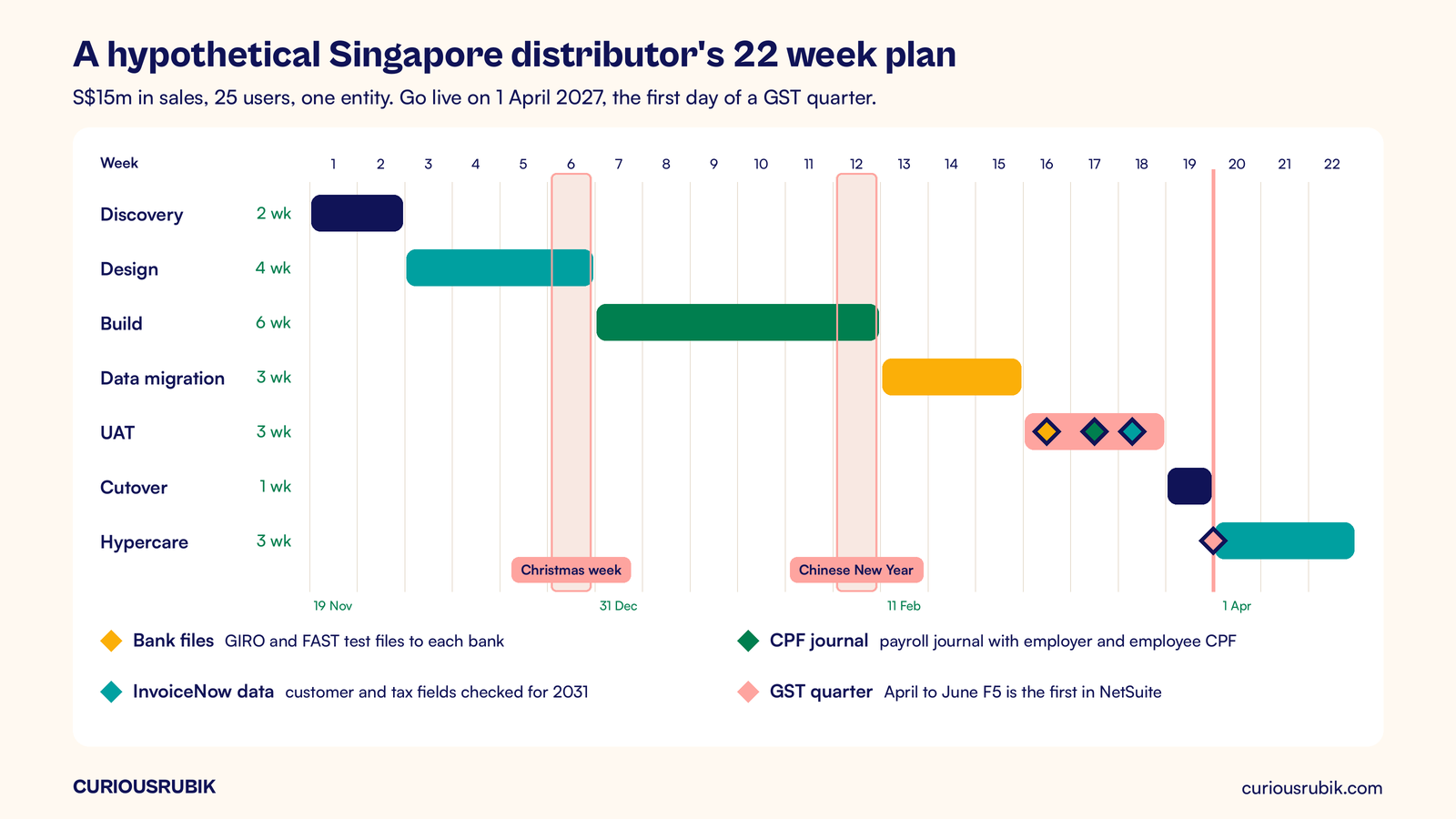
Some dates are set by IRAS, CPF and your banks, not by the project. Check each one before you lock the plan.
GST F5 quarter
Most GST registered businesses file an F5 return each quarter, due one month after the quarter ends. Going live on the first day of a GST quarter keeps each return in one system. Our guide to the NetSuite GST F5 return shows how to prepare and review it.
InvoiceNow readiness
IRAS is phasing in InvoiceNow, Singapore's network for sending invoice data directly between systems. New voluntary GST registrants have had to comply since 1 April 2026. Existing registrants follow in phases by size of annual supplies. The dates run from 1 April 2028 for the smallest to 1 April 2031 for those above S$4 million, as set out in the IRAS announcement. Even if your date is years away, set up customer and tax data now so the switch later is simple.
CPF payroll journal
Payroll often runs in a separate payroll system and posts a journal into NetSuite. Test that the journal carries employer and employee CPF amounts to the right accounts. CPF contributions are due on the last day of each month, and the CPF Board acts against employers who have not paid by the 14th of the next month. That makes the first payroll after go live a hard date.
Bank payment files
NetSuite creates supplier and payroll payment files through the Electronic Bank Payments SuiteApp. The Southeast Asia Localization SuiteApp adds Singapore bank formats, such as GIRO and FAST files. Test the format for each bank you use. Banks can take a week or more to approve a test file, so start early.
Holidays and year end
Christmas, the year end close and Chinese New Year all reduce the hours your team can give. Do not plan UAT or cutover over them.
A hypothetical Singapore distributor's 22 week plan
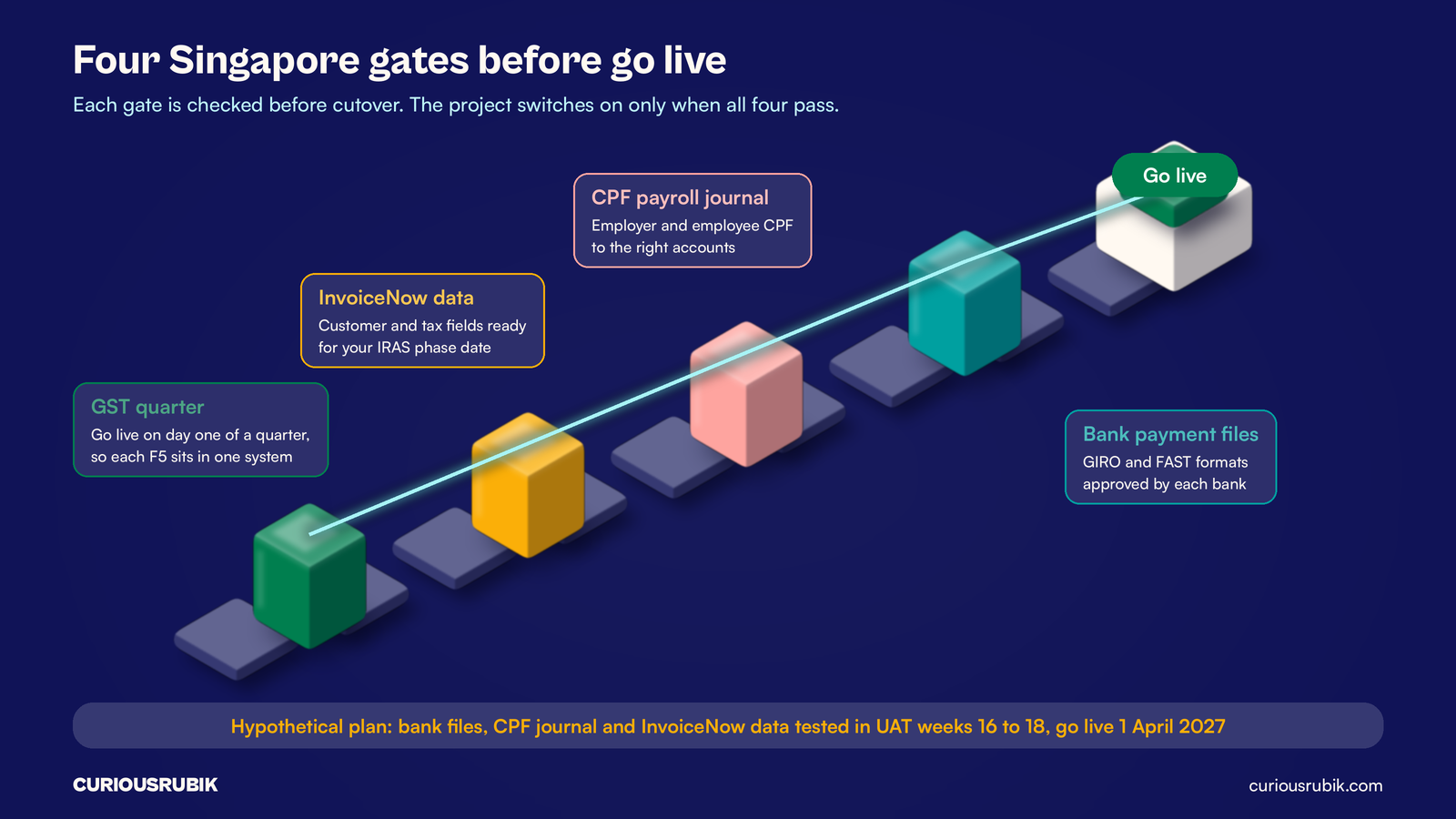
A hypothetical Singapore distributor has S$15 million in annual sales, 25 users and one entity, with a Malaysia subsidiary planned for a later phase. Its GST quarters run January to March, April to June and so on. The team picks 1 April 2027 as the go live date, the first day of a GST quarter, and plans backward.
| Stage | Weeks | Calendar |
|---|---|---|
| Discovery | 2 | Weeks 1 to 2 |
| Design | 4 | Weeks 3 to 6, includes the Christmas week |
| Build | 6 | Weeks 7 to 12, ends around Chinese New Year |
| Data migration | 3 | Weeks 13 to 15 |
| UAT | 3 | Weeks 16 to 18, bank files and CPF journal tested |
| Cutover | 1 | Week 19, with no cutover task on Good Friday, 26 March |
| Hypercare | 3 | Weeks 20 to 22, after go live on 1 April 2027 |
| Total | 22 | Week 1 starts on 19 November 2026 |
The stages add to 22 weeks: 2 plus 4 plus 6 plus 3 plus 3 plus 1 plus 3. Go live falls at the start of week 20, so the first quarter in NetSuite is April to June 2027, and the March quarter's F5 stays in the old system. The March payroll runs in the old setup. The April payroll journal is the first real test in NetSuite, with April CPF due by 30 April and CPF Board action if it is not paid by 14 May.
With annual supplies above S$4 million, this distributor's InvoiceNow date is 1 April 2031. It still captures the customer data that InvoiceNow needs from day one.
What makes a Singapore rollout run late?
Most delays come from decisions, not software. These are the patterns we see most often.
- Data decisions left late. Nobody owns item codes or customer cleanup until migration starts.
- Testers not freed up. Finance staff run UAT while still closing the month.
- Scope added mid project. A new report, entity or integration arrives after design sign off.
- Bank and payroll tests started late. A file rejected in week 18 can move the date.
Hold a weekly steering check on the next gate and name one person who can say yes or no. When a go live decision is close, a clear checklist helps. Our NetSuite go live checklist sets out stop and go criteria.
At CuriousRubik, we agree the first outcome, the evidence that proves it and the go live gates before the build starts. CuriousRubik's NetSuite implementation team can turn your scope into a stage plan with dates you can check. You can also read our implementation guide and see our NetSuite work in Singapore.
Frequently asked questions
Can NetSuite be implemented in 30 days in Singapore?
For most companies, no. A very small business with standard processes and clean data may move fast, but even Oracle's QuickStart offer for small distributors says typically within three months. Thirty days rarely leaves time for data checks, testing and training. A short plan that slips costs more than a realistic plan that holds.
What is the best month to go live with NetSuite in Singapore?
The first month of a GST quarter is usually best, because each F5 return then sits in one system. Avoid weeks near Chinese New Year and the year end close, when staff are away or busy. Many companies also avoid the last weeks of their financial year for the same reason.
How long does UAT take for a NetSuite project?
Plan two to four weeks for a single entity. That gives your team time to run real scenarios, log issues, retest fixes and sign off. Groups with several subsidiaries or many integrations need longer. Free up testers from daily work, or UAT drags on while the month end close competes for their time.
Does InvoiceNow affect our NetSuite timeline?
It depends on your GST status and supplies. New voluntary registrants must already comply, while most existing registrants have dates between 2028 and 2031. If your date falls inside the project window, add design and testing time for InvoiceNow. If it is later, capture the right customer data now so the change is small.
How long should hypercare last after go live?
Two to four weeks suits most single entity projects. Hypercare should cover the first month end close, the first payroll journal and the first GST quarter entries. End it when open issues are low and users work without daily help. Agree those exit criteria before go live so the handover to support is clear.
Related reading
NetSuite Implementation Timeline in Australia
The same stages applied to Australian projects, with the BAS, STP and end of financial year dates that shape the plan.
A NetSuite Go Live Checklist with Clear Stop and Go Criteria
How to decide, with evidence, whether your NetSuite project is ready to switch on.