When Australian companies compare Business Central vs NetSuite, the deciding factors are usually how many entities you run and how they consolidate, how much you depend on Microsoft 365 and the Microsoft partner ecosystem, how payroll and STP will be handled, and the cost of the partner who will implement and support it. Business Central often suits single-entity or simple multi-company businesses already deep in Microsoft. NetSuite often suits growing groups with several entities, more complex order-to-cash, or plans to expand overseas.
Both products have Australian customers and Australian partners. The work is in testing your own processes against each.
Map your entities and consolidation first
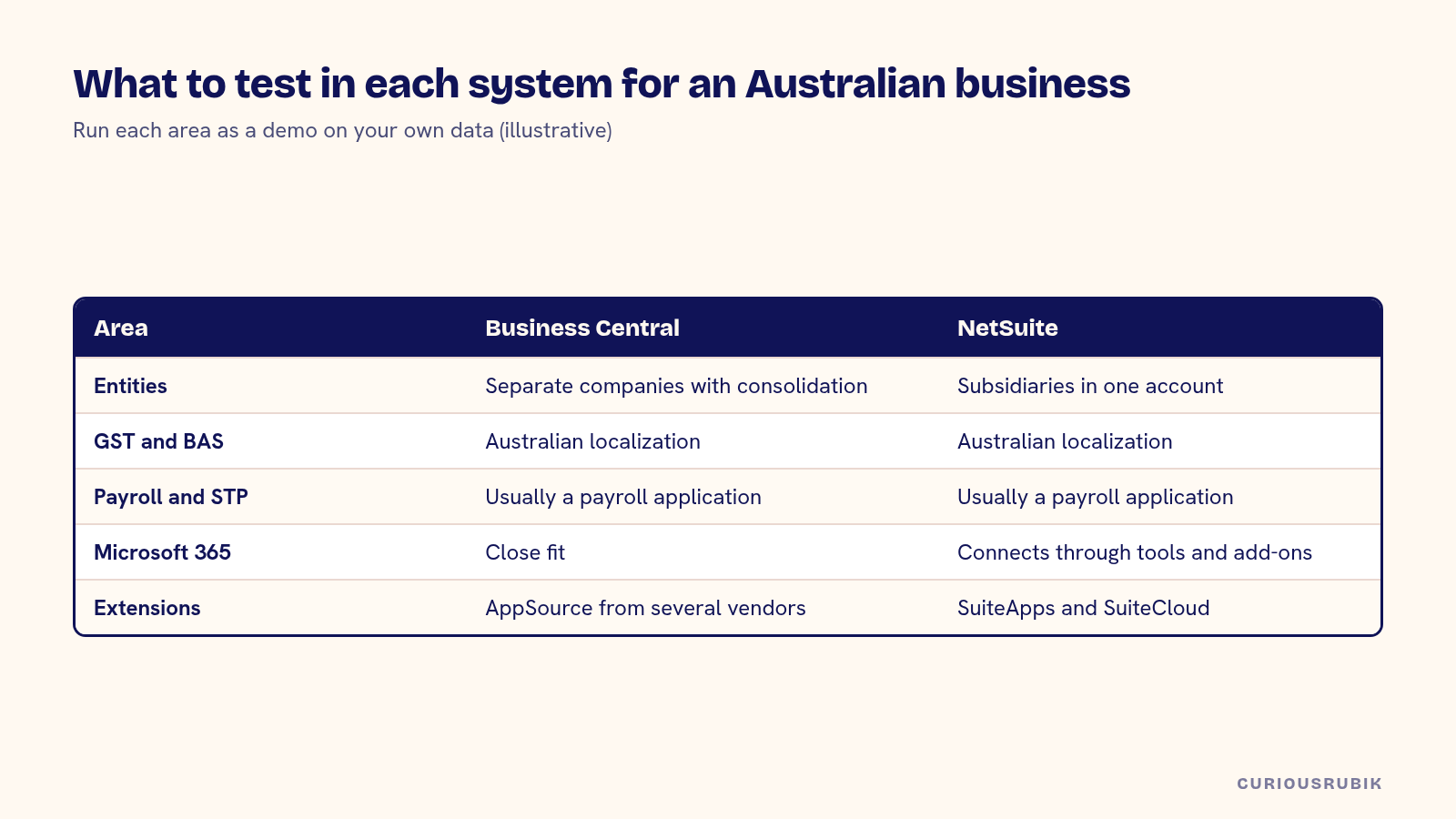
Business Central handles several legal entities as separate companies, with intercompany postings and consolidation functions linking them. NetSuite OneWorld runs subsidiaries inside one account, with shared customers, vendors and items and consolidated reporting across them.
Neither approach is wrong. Write down how many entities you run today and expect in three years, which share customers or stock, and how often you consolidate. Then ask each partner to demonstrate a month-end close across your actual entity structure, including intercompany eliminations. The demo will tell you more than a feature list.
If you trade in New Zealand or plan to, include that entity in the demo. Ask how NZ GST returns are produced, how NZD transactions are revalued and how the consolidated report shows both currencies. Expansion plans belong in the requirements now, even if the entity won't exist for another year.
Test GST and BAS on your transactions
Both products support Australian GST and BAS reporting through their Australian localizations. The differences show up in specific cases: imports with deferred GST, mixed supplies, adjustments for bad debts and corrections from prior periods.
Give each partner a sample of last quarter's transactions and ask them to produce the BAS figures and trace them back. Our guide to tracing Australian GST from NetSuite transactions to the BAS describes the evidence a finance team should expect.
Decide how payroll and STP will work
Neither product includes Australian payroll as a standard module in the way many local payroll systems do. Most companies use a dedicated payroll application that reports through Single Touch Payroll and posts journals to the ERP, or a partner-built payroll extension.
Decide which application calculates pay, which reports to the ATO and how the journals and super liabilities reconcile in the ERP. Our post on NetSuite Single Touch Payroll covers the reconciliation that keeps those systems in step.
Compare the Microsoft fit honestly
Business Central's strongest advantage for many businesses is how closely it works with Microsoft 365: Outlook, Excel, Teams and Power BI. If your staff live in those tools and your IT team manages Microsoft licensing, that integration matters.
NetSuite connects to Microsoft tools as well, through standard exports, add-ons and integration platforms. Ask each partner to show the daily tasks your team does in Excel or Outlook, then judge how much it matters in practice.
Weigh the partner and extension model
Business Central is sold and implemented through Microsoft partners, and many functions come from AppSource extensions built by other vendors. That gives choice, and it adds suppliers to manage. NetSuite is licensed through Oracle NetSuite or its partners, with SuiteApps and SuiteCloud customization filling gaps.
For each option, list which extensions you would need, who supports each one and how they handle the twice-yearly product updates both platforms receive. A system that depends on five extensions from five vendors needs a clear owner for regression testing.
Check inventory and order-to-cash depth
For wholesalers, distributors and retailers, the stock and order processes usually decide the comparison. Test the scenarios that cost you money today: back orders with partial shipments, customer-specific price lists, landed cost on imported goods, returns with credit notes and stock held at a third-party warehouse.
Ask each partner to run these on your own items and customers, with your units of measure and your freight terms. Watch how many steps a user takes and how many depend on an extension. Then ask how stock and margin reports reconcile to the general ledger at month-end. If a warehouse integration is in scope, ask who monitors it and what happens when a dispatch confirmation fails to arrive.
A hypothetical Melbourne wholesaler comparison
A hypothetical Melbourne wholesaler runs two Australian entities and a small New Zealand entity, with around 40 users, a B2B portal and a third-party warehouse. All figures are illustrative.
| Factor | Business Central | NetSuite |
|---|---|---|
| Entity model | Three companies with consolidation | Three subsidiaries in one account |
| Payroll | Third-party payroll with STP, journals to ERP | Third-party or partner payroll with STP, journals to ERP |
| B2B portal and warehouse | AppSource extensions plus integration | SuiteApp or integration platform |
| Estimated implementation | 4 to 6 months | 5 to 7 months |
| Three-year cost estimate | A$420,000 to A$520,000 | A$480,000 to A$600,000 |
Business Central comes in cheaper on these figures. The wholesaler expects to open a Singapore entity within two years and wants shared stock visibility across all entities. It runs the month-end demo on both, finds the NetSuite close simpler for its group structure and decides the extra cost is justified. A business without the expansion plan could reasonably choose the other way.
Build the AUD cost on the same scope
Compare licenses, implementation, extensions, payroll, integrations, support and internal staff over three years. Use the same user numbers and scope for both. Ask whether each figure includes GST and how annual price increases are handled.
Include the people cost. Business Central teams often rely on a power user who is comfortable in Excel and the Microsoft 365 admin center. NetSuite teams usually need an administrator who understands roles, saved searches and workflows. Either can be a part-time role at first, so price it honestly and decide who will do it.
Phase lengths have a cost too. Our guide to the NetSuite implementation timeline in Australia shows what realistic phases look like. If you are also considering MYOB, read NetSuite vs MYOB Acumatica for Australian businesses.
Use the Business Central vs NetSuite checklist
Before you shortlist, answer each of these:
- How many entities will you run in three years, and how do they consolidate?
- Has each partner run a month-end close demo on your entity structure?
- Did each partner produce your BAS figures from your own transactions?
- Which system calculates pay, reports STP and reconciles super?
- How much of your daily work depends on Microsoft 365?
- Which extensions are needed, and who supports each one?
- Who runs regression testing for each product update?
- Is three-year AUD cost modeled on the same users and scope?
Our NetSuite business consulting team runs side-by-side evaluations, and our page for Australian NetSuite projects shows how we work with local finance teams. For a broader method, read NetSuite ERP Evaluation in Australia Through Local Workflows and Cost.
Related reading: NetSuite or Business Central for Your Implementation Requirements
Frequently asked questions
Is Business Central cheaper than NetSuite in Australia?
Often on licenses and implementation for simpler businesses. Compare three-year cost on the same scope, including extensions and support.
Does either product include Australian payroll?
Neither includes it as a standard module. Most companies use a payroll application with STP and post journals to the ERP.
Which is better for multiple entities?
NetSuite's single-account subsidiary model often suits groups with shared customers and stock. Business Central uses separate companies with consolidation.
Do both support BAS reporting?
Both have Australian localizations for GST and BAS. Test your specific transactions before relying on either.
How often are the products updated?
Both receive two major updates a year. Plan regression testing for each one.