For Australian finance leads with a growing NetSuite account: what a health check reviews, how long it takes and what you get.
Last reviewed: 23 October 2026. Product details reflect this review date. Availability and behavior can vary by account, role and release.
A NetSuite health check in Australia is a short, structured review of a live account. A consultant checks your setup, roles, scripts, workflows, saved searches, integrations and Australian tax and payroll settings. You receive a ranked list of findings and a fix plan. Most reviews take two to four weeks and change nothing in your account while they run.
Key takeaways
- A health check is a one off review with a written result. It does not replace ongoing support.
- Ask for Australian checks by name: GST codes and BAS mapping, STP payroll journals, Payday Super timing and your EOFY routine.
- Good findings are ranked by business impact and by effort, so you know what to fix first.
- Plan two to four weeks, a few hours from each process owner and read only access for the reviewer.
What is a NetSuite health check?
A NetSuite health check is a review of how your account is set up and used today, measured against how your business works now. It looks for settings that no longer fit, workarounds that cost time and risks that could cause a wrong number or a failed process.
NetSuite gives growing businesses one cloud system for finance, inventory, orders, CRM and reporting. Oracle also upgrades every account twice a year.
Over a few years your business changes too. New entities arrive, staff move on and quick fixes pile up. A health check brings the setup back in line with the business, so you get full value from the platform you already pay for.
A health check is different from ongoing help. Managed services look after your account month after month. Our guide to NetSuite managed services in Australia explains that model. A health check is a point in time review that often comes first, so the ongoing team starts from a clean list.
When should an Australian business book a health check?
Most companies book one when they notice the same pain more than once. These are the triggers we see most often.
- You inherited the account. A new finance lead or IT manager has taken over and nobody can explain why some scripts or fields exist.
- Spreadsheets are creeping back. Teams export data to fix it outside NetSuite, then key it back in.
- Month end is getting longer. The close took five days a year ago and now takes eight.
- Tax and payroll checks feel manual. BAS figures need adjusting before lodgment, or STP pay events do not match the payroll journal.
- A big change is coming. A new entity, an acquisition, a new warehouse or a new ecommerce channel.
- It has been more than 12 months since anyone reviewed the account.
Timing matters in Australia. Avoid July and August, when EOFY work and the TPAR are due. A review between September and May leaves time to fix findings before the next 30 June.
What does a NetSuite health check in Australia cover?
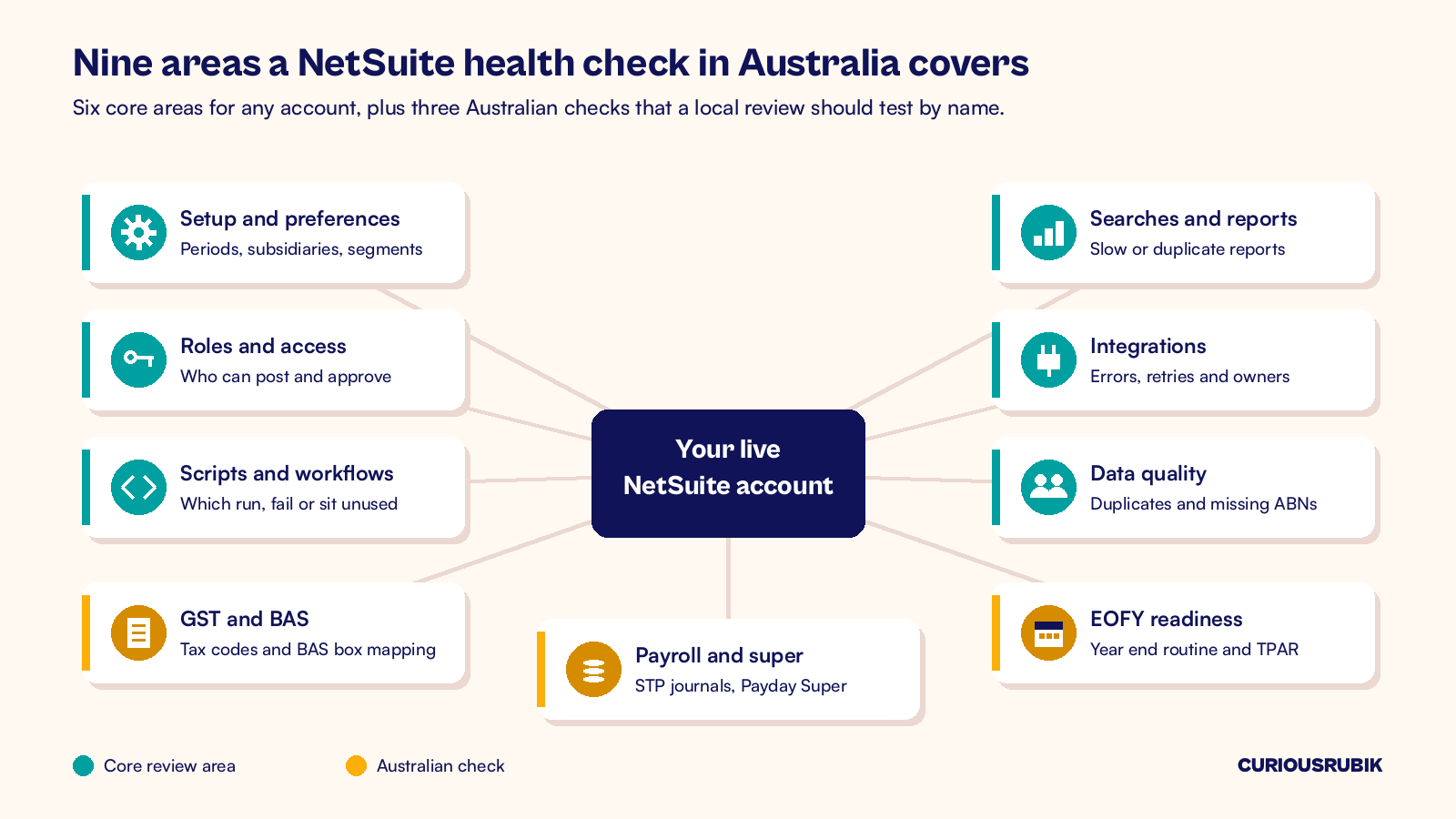
A full review covers the core of the account plus the Australian settings that only a local review will test. Ask the reviewer to confirm each area below in the proposal.
| Area | What the reviewer checks | Why it matters |
|---|---|---|
| Setup and preferences | Accounting periods, subsidiaries, currencies, segments and company preferences | Wrong settings flow into every report |
| Roles and access | Who can approve, post and edit, and whether duties are split | Protects your controls and audit trail |
| Scripts and workflows | Which ones run, which fail, which nobody uses | Old automation slows saves and breaks after upgrades |
| Saved searches and reports | Slow searches, duplicate reports, dashboards nobody opens | Trust in the numbers |
| Integrations | Error logs, retries, owners and reconciliation for each feed | Orders, payments and payroll must arrive once |
| Data quality | Duplicate customers, vendors and items, missing ABNs | Clean master data keeps BAS and TPAR right |
| GST and BAS | Tax codes, BAS box mapping and imported goods | Figures you can lodge without manual edits |
| Payroll and super | STP journal mapping, PAYG and super liabilities, Payday Super timing | Liabilities that agree with what was paid |
| EOFY readiness | Year end close routine, TPAR flags, fixed assets | A calm June instead of a rushed one |
The last four rows are where an Australian review earns its fee. If your payroll runs through a connector, also ask for a check of the payroll journal against STP. Our post on NetSuite Single Touch Payroll integration shows what a clean match looks like.
How long does a health check take, and what do you get?
A focused technical review can take about a week. A full review with process interviews usually takes two to four weeks. The time depends on the number of subsidiaries, scripts and integrations, and on how quickly your process owners can meet.
A typical review runs in five steps.
- Kick off. Agree the scope, the business problems to test and who the reviewer will interview.
- Collect. The reviewer gets a read only role and pulls lists of scripts, workflows, searches, roles and integration logs.
- Interview. Short sessions with each process owner: finance, payroll, sales, purchasing and warehouse.
- Analyze. Each finding is written down with the evidence, the business impact and the effort to fix it.
- Present. A walkthrough of the report and a ranked fix plan, with quick wins first.
The written report is the main thing you receive. Each finding should say what was found, where it was found, what it costs you and what the fix is. A finding with no evidence is only an opinion. Ask to see a sample report before you sign.
A hypothetical Melbourne wholesaler's health check
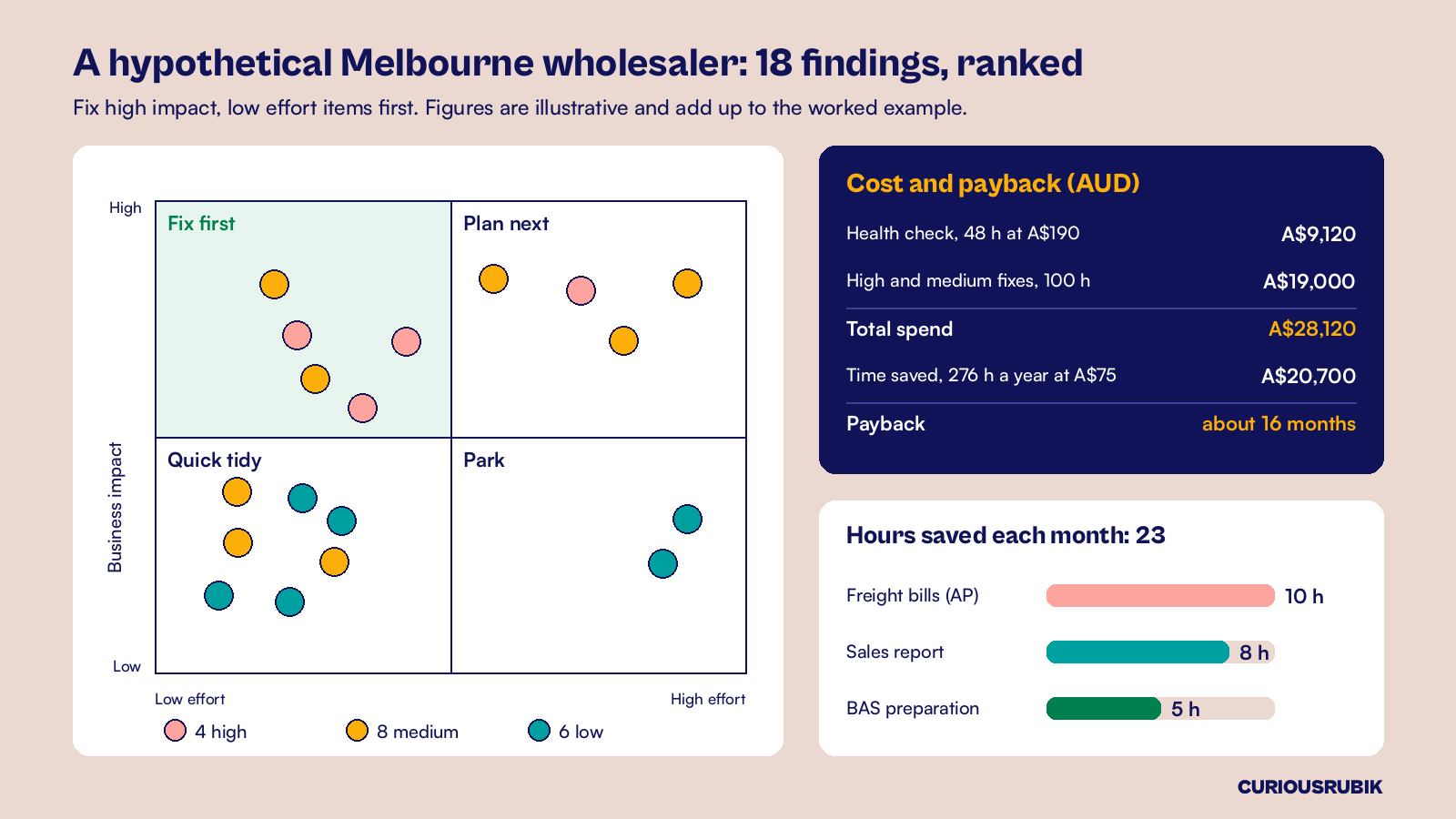
A hypothetical Melbourne wholesaler has run NetSuite for three years with 60 users and one subsidiary. Close takes eight days and the BAS needs manual edits each month. The finance lead books a three week health check.
The review uses 48 consultant hours at an illustrative rate of A$190 an hour, so it costs A$9,120. It finds 18 issues: 4 high, 8 medium and 6 low.
- High: a GST code for imported goods maps to the wrong BAS box, and the payroll journal posts super to the wrong liability account. Two freight bill imports keep failing, and one role can both create and approve vendor bills.
- Medium: duplicate vendors with no ABN, slow dashboard searches and a manual sales report built in a spreadsheet.
- Low: unused fields and old workflows that nobody triggers.
The team fixes the high and medium items first. That takes 100 hours, or A$19,000 at the same rate. The total spend is A$28,120.
After the fixes, the AP team saves 10 hours a month on freight bills. BAS preparation drops from 8 hours to 3 hours. The sales report now runs inside NetSuite and saves 8 hours.
That is 23 hours a month, or 276 hours a year. At an internal cost of A$75 an hour, the saving is A$20,700 a year. The work pays back in about 16 months, and the BAS and super fixes remove two real compliance risks.
Get the most from your review
A few simple steps before and after the review make the result far more useful.
- Write down three problems. Give the reviewer the issues that hurt most, in your own words. The findings should answer them.
- Name an owner for each process. Reviews stall when nobody can explain how a process should work.
- Share last quarter's evidence. A BAS working paper, an STP report and a month end checklist help the reviewer test real figures.
- Agree how fixes will happen. Your own administrator, the reviewer or a support team. Decide before the report lands.
- Book a follow up. Check the fixed items after one month end and one BAS cycle.
At CuriousRubik, we start with the problem you care about most and show the evidence behind each finding. CuriousRubik's NetSuite optimization service can run your health check and then fix the ranked list with you.
You can also read what a useful NetSuite health check should examine for a general checklist. If you also want a tighter close, our same week post on NetSuite flux analysis explains how to keep variance answers in the ledger. Our NetSuite Australia page covers how we work with Australian businesses.
Frequently asked questions
How much does a NetSuite health check cost in Australia?
It depends on scope. A focused technical review costs less than a full review with interviews across finance, payroll and operations. Ask for a fixed fee or a capped number of hours, a written list of areas covered and a sample report. Price the fixes separately once you see the ranked findings.
Does a health check change anything in our NetSuite account?
It should not. The reviewer works with a read only role or a sandbox, so daily work carries on as normal. Any fixes come later as separate, approved changes. Test them in a sandbox first and record each one in your change log, with an owner and a date.
How often should we run a NetSuite health check?
Once a year suits most growing Australian businesses, ideally between September and May so findings are fixed before EOFY. Run an extra review before a big change, such as a new entity, an acquisition or a new sales channel. A short review after each major change keeps the account in good shape.
Is a health check the same as NetSuite support?
No. Support answers issues as they come up and keeps the account running. A health check steps back, reviews the whole account at one point in time and gives you a ranked fix plan. Many companies run a health check first, then hand the plan to their support or managed services team.
What should we prepare before the review starts?
Prepare a short list of the problems that hurt most, a named owner for each process and a read only role for the reviewer. Add recent evidence, such as last quarter's BAS working paper and an STP report. These let the reviewer test real figures instead of guessing how the account is used.
Related reading
What a Useful NetSuite Health Check Should Examine
A general checklist of the areas every NetSuite review should cover, in any market.
NetSuite Managed Services in Australia: What to Expect
What ongoing managed services cover after a review, how monthly hours are sized and how onboarding works.
NetSuite EOFY Checklist for Australian Finance Teams
The year end tasks to plan in NetSuite before 30 June, from the close to the TPAR.