A NetSuite wholesale distribution setup for an Australian business has to get five things right: landed cost on imported stock, including GST and duty treatment; stock across warehouses in different states; customer-specific pricing and rebates; EDI and portal orders from trade customers; and margin reporting that finance and sales both trust. Configure those around your real transactions and the rest of the system tends to follow.
Australian distributors share some common pressures. Most stock is imported, freight across the country is expensive and slow, large retail customers set the terms for orders and invoices, and margins are thin enough that a small cost error shows up quickly.
Capture landed cost on every import
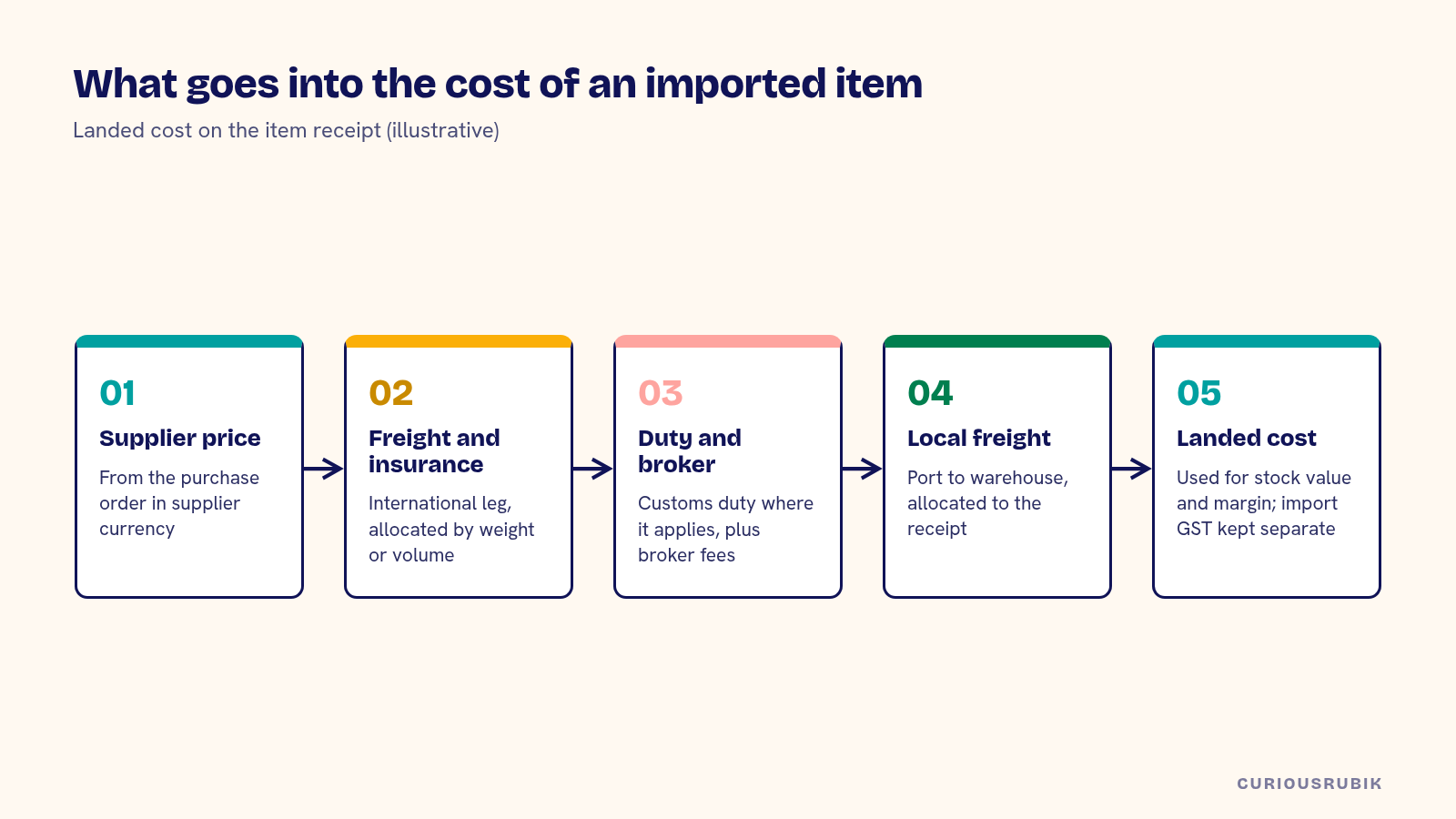
The cost of an imported item includes the supplier price, international freight, insurance, customs duty where it applies, broker fees and local freight to the warehouse. If NetSuite values stock at the supplier price only, your margins look better than they are until the freight invoices arrive and are expensed.
Use landed cost allocation on item receipts, with cost categories for each component. Decide how each is allocated: by value, weight, quantity or volume. Then decide what happens when the freight invoice arrives after the stock has been sold. Agree the treatment with your accountant and test it with a real container.
Import GST is a separate matter. It is not part of the inventory cost for a registered business that can claim it, so keep it on its own account and code. If you use the deferred GST scheme, the import GST appears on your BAS instead of being paid at the border. Our guide to tracing Australian GST from NetSuite transactions to the BAS shows how to check it.
Run stock across states with transfer orders
Distributors with warehouses in several states, or a mix of their own sites and a 3PL, need stock movements to be visible. Use NetSuite locations for each warehouse, and transfer orders for movements between them, so stock in transit is tracked and costed.
Decide how transfer freight is treated, whether it is added to the item cost at the receiving location or expensed. Set reorder points per location, because demand in Perth and demand in Brisbane rarely match. If a 3PL holds stock, reconcile their stock report to NetSuite weekly.
Set customer pricing your sales team can maintain
Wholesale pricing is rarely one list. You might have price levels by customer group, contract prices for key accounts, quantity breaks and promotional prices for a period. NetSuite supports these, but the order in which they apply needs to be clear.
Write the pricing hierarchy down and test it with real orders. Then decide who maintains each layer. A contract price that expired six months ago and is still applied is a common margin leak.
Track rebates and allowances properly
Rebates from suppliers and to customers often decide whether a product line is profitable. Supplier volume rebates, retailer promotional allowances and marketing contributions all need to be accrued as you trade. If you wait for the credit note to arrive, months of margin are misstated.
Decide how each rebate is calculated, how often it is accrued and how it is settled. Then build a reconciliation between accrued and settled amounts. Our post on NetSuite wholesale rebates and chargeback requirements covers the design in more detail.
Connect EDI and portal orders
Large Australian retailers commonly require EDI for purchase orders, dispatch advices and invoices. Smaller trade customers may prefer a B2B portal. Both need to create sales orders in NetSuite with the right price, delivery address and customer reference, and both need exception handling for orders that don't match.
Agree which EDI documents you need with each trading partner and who provides the EDI connection. Test the whole cycle, from order through dispatch to invoice and payment, with each major customer before go-live.
Decide where lot, expiry and serial tracking apply
Some ranges need more than a quantity. Food, chemicals, health products and some building materials need lot or batch numbers with expiry dates, and recalls depend on them. Electrical and higher-value items may need serial numbers for warranty claims.
Turn tracking on only where you need it, because every tracked item adds work at receipt, picking and stocktake. For the items that need it, decide how the 3PL or warehouse captures lot and serial data, and how it reaches NetSuite. Then test a recall: pick one lot, and check that you can list every customer who received it within minutes. Set picking rules too, such as first expiry first out, and confirm that the warehouse system follows them.
A hypothetical Sydney distributor's margin review
A hypothetical Sydney hardware distributor imports from China and Vietnam, holds stock in Sydney and Melbourne and sells to two national retailers and 300 trade customers. All figures are illustrative.
| Item | Before review | Finding | After review |
|---|---|---|---|
| Average gross margin on imported range | 34% | Freight and duty expensed, not landed | 29% |
| Melbourne stock value | A$1.2m in NetSuite | Transfers in transit not recorded | A$1.35m incl. in transit |
| Retailer promotional allowance | Expensed on credit note | Not accrued as sales were made | Accrued monthly |
| Contract prices | 46 active | 11 past end date | Expired and reviewed |
The true margin on the imported range is lower than reported, and two product lines turn out to be close to break-even. The distributor renegotiates freight on one and reprices the other. Your numbers will differ. The checks are common to most distributors.
Report margin that sales and finance agree
Margin reports should use landed cost, include accrued rebates and allowances and match the general ledger. If sales and finance use different numbers, nobody trusts either. Our guide to testing NetSuite wholesale distribution from customer price to margin has a test sequence for this.
If you are moving from MYOB, read our MYOB to NetSuite migration guide for stock and cost cutover. If you are still choosing a platform, our comparison of Business Central vs NetSuite in Australia covers distribution fit, and the NetSuite implementation timeline in Australia shows how to plan around stocktake and EOFY.
Use the NetSuite wholesale distribution checklist
Before go-live, check each of these:
- Are landed cost categories and allocation methods set for each import component?
- Is import GST kept out of inventory cost and traced to the BAS?
- Does each warehouse have its own location, with transfers tracked in transit?
- Is the pricing hierarchy written down and tested with real orders?
- Do expired contract prices stop applying automatically?
- Are supplier and customer rebates accrued as you trade?
- Is the EDI cycle tested with each major trading partner?
- Does the margin report use landed cost and reconcile to the ledger?
Our NetSuite implementation team sets up distributors across Australia, and our page for Australian NetSuite projects describes how we work with local teams. For the broader design, see NetSuite Implementation for Wholesale Distribution.
Related reading: NetSuite Wholesale Rebates and Chargeback Requirements
Frequently asked questions
Does NetSuite support landed cost?
Yes. Landed cost can be allocated to item receipts by cost category and allocation method.
Is import GST part of inventory cost?
For a GST-registered business that can claim it, import GST is generally kept separate from inventory cost. Confirm with your accountant.
How should we handle stock at a 3PL?
Set it up as its own location and reconcile the 3PL's stock report to NetSuite weekly.
Can NetSuite handle EDI with Australian retailers?
Usually through an EDI provider integrated with NetSuite. Agree the documents with each trading partner and test the full cycle.
Why is our margin report different from finance's?
Common causes are freight and duty not landed, rebates not accrued and price data that is out of date.