NetSuite vs Xero in Australia comes down to how many hours your finance team spends outside the ledger each month to lodge BAS, reconcile Single Touch Payroll, consolidate entities and value stock. One ABN, one payroll and simple stock sit comfortably in Xero. Several ABNs, a New Zealand company, imported stock and approvals that auditors test usually do not.
The trap is comparing the two on invoice screens and subscription price. Xero is good accounting software, and many Australian businesses run it well past A$20 million in revenue. The cost of staying shows up at the edges: BAS working papers, rekeyed payroll journals, intercompany schedules in Excel and a landed cost sheet only one person follows. For the general case, read when moving from Xero to NetSuite makes business sense. This post is the Australian version, built around ATO obligations.
Judge NetSuite vs Xero in Australia by the month-end close
List every task finance did last month after the final transaction was entered: BAS reconciliation, payroll clearing, intercompany matching, stock adjustments, accruals and the board pack. Next to each task, write the system where the work actually happened. Anything marked "Excel" or "email" is a cost Xero is not carrying for you.
That list replaces the feature comparison. Both products raise invoices and record bills. What differs is whether the work around them stays inside one controlled record. Build it with the person who does the work, not the person who signs the BAS and only sees the clean summary.
Count how many BAS lodgements the group really prepares
Each Xero organization holds one set of books, so each ABN usually means its own file, its own subscription and its own BAS. Unless the companies form a GST group, every registered entity lodges separately, and the trading company may lodge monthly while the others lodge quarterly. Nothing checks intercompany GST treatment across separate files.
Write the lodgement calendar down: entity, ABN, GST cycle, preparer and reviewer. If it runs past two lines and someone reconciles the entities by hand each period, GST is a trigger. NetSuite OneWorld keeps each subsidiary's tax reporting separate inside one account, so the BAS still belongs to its entity while the transactions behind it share one chart of accounts. Our walkthrough on how to trace Australian GST from NetSuite transactions to the BAS shows the evidence trail to expect before you accept a design.
Keep your STP Phase 2 payroll provider and fix the journal
Xero Payroll handles STP Phase 2 reporting for many small employers, which is a fair reason to stay. NetSuite is rarely the payroll engine in Australia. Groups that move usually keep an STP-enabled payroll provider and post a summarized journal into NetSuite for each pay run and entity. The switch changes how payroll reaches the ledger, not who reports pay events to the ATO.
Test three things. Does the payroll journal split by entity, department and cost center without rework? Do PAYG withholding, super and payroll tax land in clearing accounts that someone reconciles monthly? Does the STP finalization at year end agree to the ledger? Since 1 July 2026, Payday Super requires contributions to reach funds within 7 business days of each payday, so a clearing account reviewed only at quarter end is a risk in either system. Our posts on NetSuite Single Touch Payroll integration and reconciliation and superannuation reconciliation in NetSuite cover the mapping.
Bring the New Zealand company into the same close
Many Australian groups open a New Zealand sales company early. In Xero that is another organization in NZD with its own GST return to Inland Revenue, and group reporting becomes an export plus a consolidation workbook.
If the NZ company trades stock or recharges staff time with the Australian parent every month, consolidation is a trigger. NetSuite OneWorld runs AUD and NZD subsidiaries in one account with intercompany transactions and consolidated reporting, though elimination rules still need design and testing. Our breakdown of NetSuite implementation cost in Australia for multi-entity groups shows what each extra entity adds to scope, so the decision is priced rather than guessed.
Price landed cost before stock valuation drifts
For importers, freight, duty, broker fees and import GST arrive on separate bills, often weeks after the goods, and import GST may be paid to the broker or deferred to the BAS. Xero's tracked inventory handles simple quantities and average cost. Locations, landed cost allocation, serials and batches usually depend on an inventory app connected to Xero. The question is whether balance sheet stock agrees with the app every month without a manual true-up.
Pick one container from last quarter and follow it: purchase order in USD, supplier bill, freight bill, the broker invoice with duty and GST, receipt into a warehouse and the first sale. If allocating that cost needed a spreadsheet and a month-end journal, stock valuation is a trigger. Our guide to NetSuite wholesale distribution in Australia covers how locations and landed cost are usually designed.

A hypothetical Brisbane importer measuring hours outside the ledger
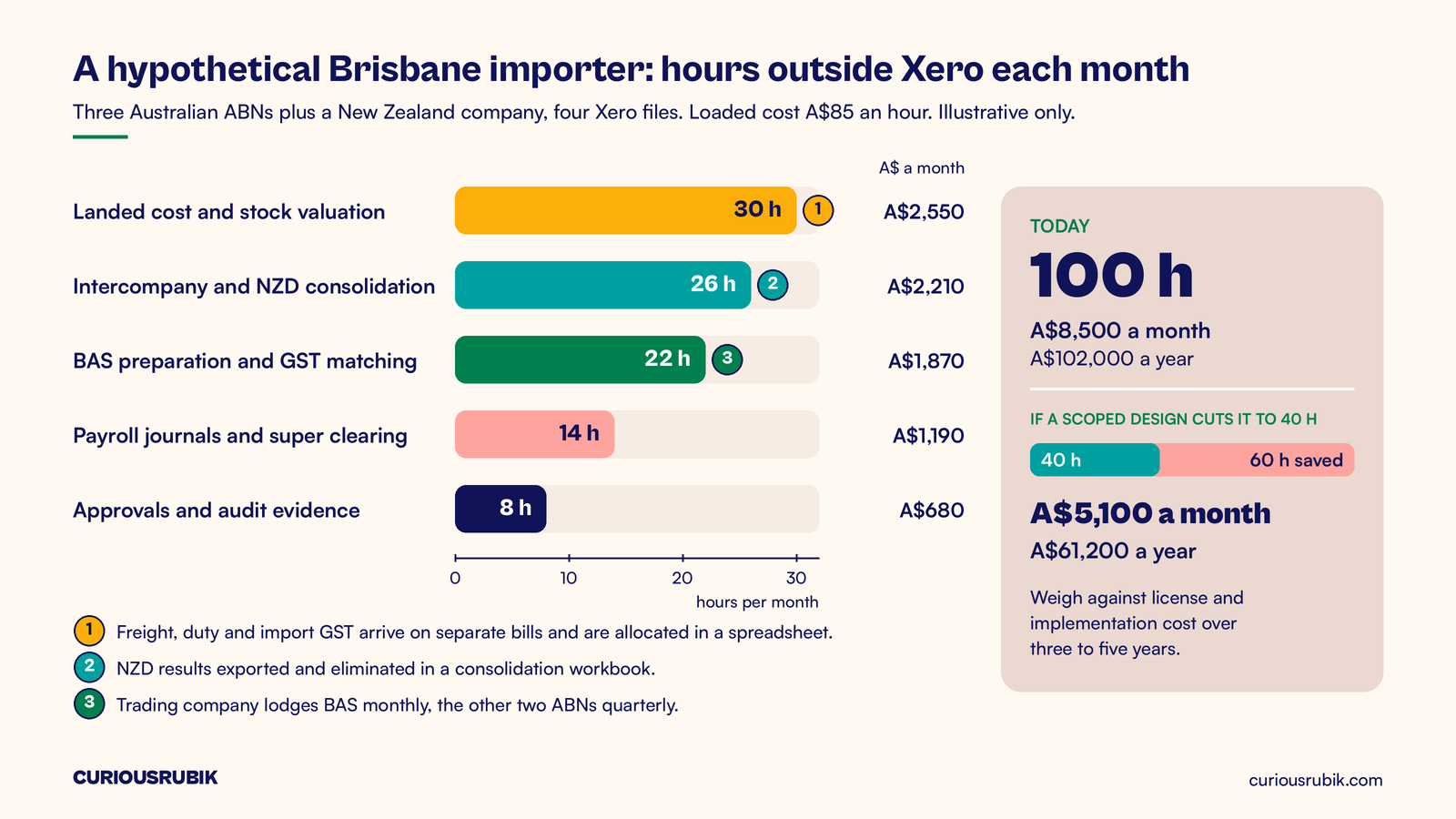
This example is hypothetical and simplified. A Brisbane importer of outdoor equipment has A$32 million in revenue, three Australian companies (trading, property and a services company that employs the staff) and a New Zealand sales company. It runs four Xero organizations, an inventory app, an STP-enabled payroll provider and a consolidation workbook. The trading company lodges BAS monthly, the other two quarterly.
Finance logged its time outside Xero for a quarter and averaged it per month: 22 hours on BAS preparation and GST matching, 14 hours reconciling payroll journals and super clearing, 26 hours on intercompany and NZD consolidation, 30 hours on landed cost and stock valuation and 8 hours chasing approvals and evidence. That is 100 hours a month. At a loaded internal cost of A$85 an hour, it comes to A$8,500 a month, or A$102,000 a year.
Suppose a scoped NetSuite design could credibly cut those 100 hours to 40. The saving is 60 hours a month, worth A$5,100, or A$61,200 a year. Weigh that against license and implementation cost over three to five years, not against the Xero subscription alone. Change the facts and the answer flips: with one ABN, no NZ company and 200 SKUs in one warehouse, the log would likely show under 30 hours, and Xero with tighter close discipline wins.
Move approvals and TPAR flags into the transaction
Xero approvals suit small teams. Growing groups need more, such as purchase limits by department, a second approver above A$25,000 and proof that the approver did not also create the supplier. When that matrix lives in email, audit sampling becomes an inbox search.
If the group pays contractors for building and construction, cleaning, courier or road freight, IT, security, investigation or surveillance services, those payments belong in the Taxable payments annual report, due 28 August. Flag the supplier and service type when the bill is entered, and check the ABN at supplier setup, because a supplier that quotes no ABN can trigger withholding at the top rate. Our guide to NetSuite TPAR reporting covers vendor flags, and the NetSuite EOFY checklist for Australia shows where TPAR sits in the year-end calendar.
Set the switching rule before you talk to partners
Agree the rule before any demo. One workable version: shortlist NetSuite when hours outside the ledger pass an agreed threshold, such as 60 a month, and at least two of these hold: more than two ABNs or an NZ company in the close, imported stock with landed cost, approval rules that auditors test or payroll journals rekeyed by entity. If not, invest in Xero setup and close discipline, then measure again in six months.
When it is met, give partners the evidence (lodgement calendar, payroll journal sample, container walk-through and hours log) and ask each to show which hours their design removes. CuriousRubik's NetSuite implementation services can help Australian teams turn that evidence into an accepted scope, alongside our NetSuite work in Australia.
Frequently asked questions
Does NetSuite replace our payroll system in Australia?
Usually not. Australian groups on NetSuite typically keep an STP Phase 2 enabled payroll provider and post a journal into NetSuite after each pay run. Plan the journal mapping, clearing accounts and year-end finalization check in the project.
Can a GST group stay on separate Xero files?
It can, but the representative member reports GST for every member on its BAS, so someone combines the files each period. Count those combining hours before you decide.
Is Xero cheaper than NetSuite?
On subscription, yes, often by a wide margin. A fair comparison adds add-on apps, the consolidation tool and internal hours outside the ledger. Compare that total with NetSuite license and implementation cost over the same period.
Should we switch on 1 July?
Not automatically. A financial year boundary makes opening balances, STP finalization and TPAR cleaner, but it is also the busiest time for finance. Many groups pick a quarter start so the first NetSuite BAS covers a full period. Avoid a mid-period switch unless you have rehearsed the first lodgement.
Is the Australian decision the same as in Singapore?
The logic is similar; the triggers differ. Singapore companies weigh InvoiceNow and GST F5 evidence, while Australian groups weigh BAS per ABN, STP and TPAR. If you run both, read NetSuite vs Xero in Singapore: When to Switch as well.
Related reading
NetSuite vs MYOB Acumatica: When to Move Up
The Australian comparison for businesses on MYOB: which operating limits justify a move to NetSuite and which can be solved with better setup.